
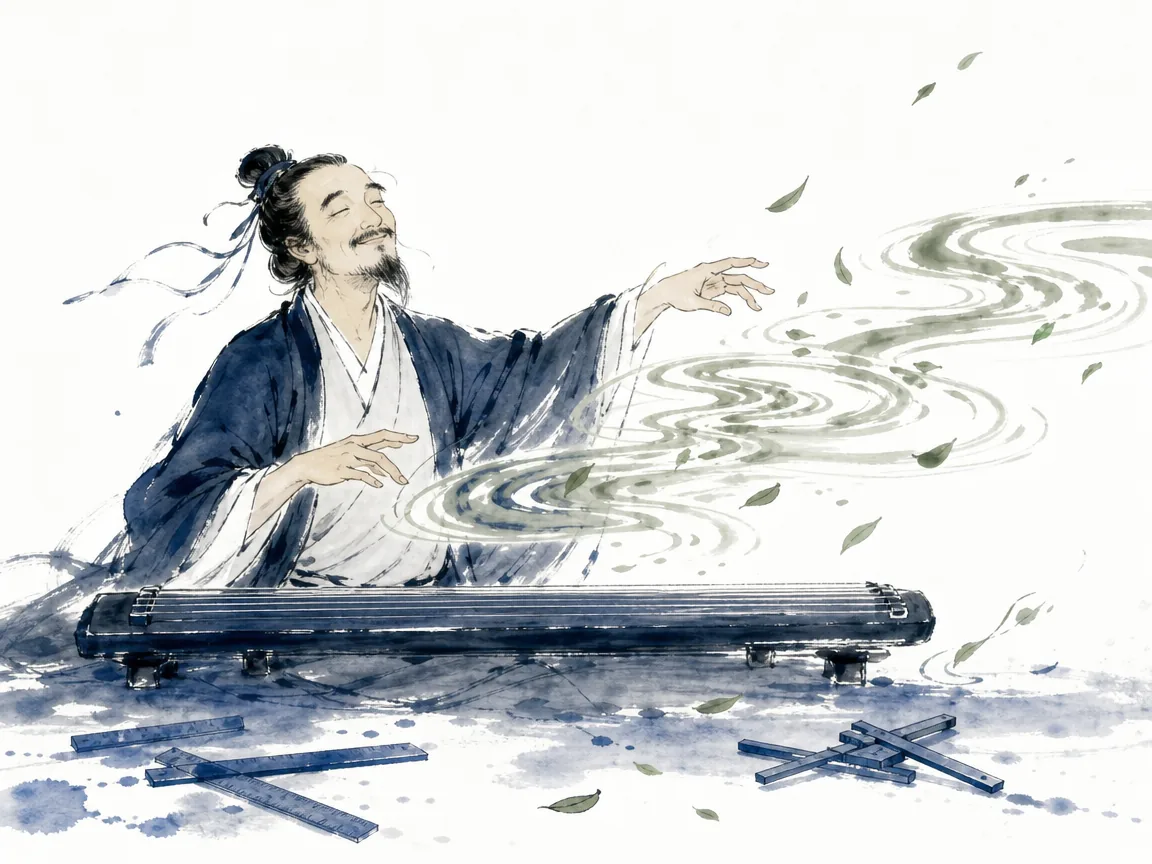
There is a moment every skilled person knows — you are doing something you have practiced for years, and suddenly you forget you are doing it. Time disappears. The inner voice that narrates your every move goes quiet. There is no gap between what you intend and what your hands do. When you finally look up, the work is finished, and it is better than anything you could have produced through conscious effort alone.
Chinese tradition gave this state a name: huajing (化境). It is often translated loosely as "the realm of transformation" or "the stage of effortless mastery." It is not perfection, nor is it mysticism. It describes a condition where the boundaries between self, skill, and action dissolve, and what remains is something that looks ordinary — almost invisible—a foundational perspective explored in Effortless Mastery in Chinese Philosophy.
This article explores what huajing means, why it matters for people who live in an age of constant optimization, and how the wisdom of Daoism might offer a different relationship with effort than the one our culture usually sells us.
Effortless Mastery in Chinese Philosophy: What Huajing Means
The word huajing does not come from a single classical text as a fixed technical term. It appears across Chinese aesthetic and philosophical discourse to describe a level of attainment where technique becomes so thoroughly internalized that it leaves no trace of strain. The highest praise for a craftsman, painter, or musician in this tradition is often not that they are impressive, but that they are unnoticeable — their work simply is, without the friction of conscious effort.
Two natural images help clarify what this looks like. One is salt dissolving in water. Put a pinch of salt into a glass, stir, and the crystals vanish. You cannot point to where the salt is, yet every drop carries its taste. The salt has not disappeared — it has become the medium itself. The other image is wind moving across still water. Wind has no fixed shape or sound. But when it passes over a lake, the ripples that spread outward are the wind's visible breath. You do not need to see the wind to know it is there.
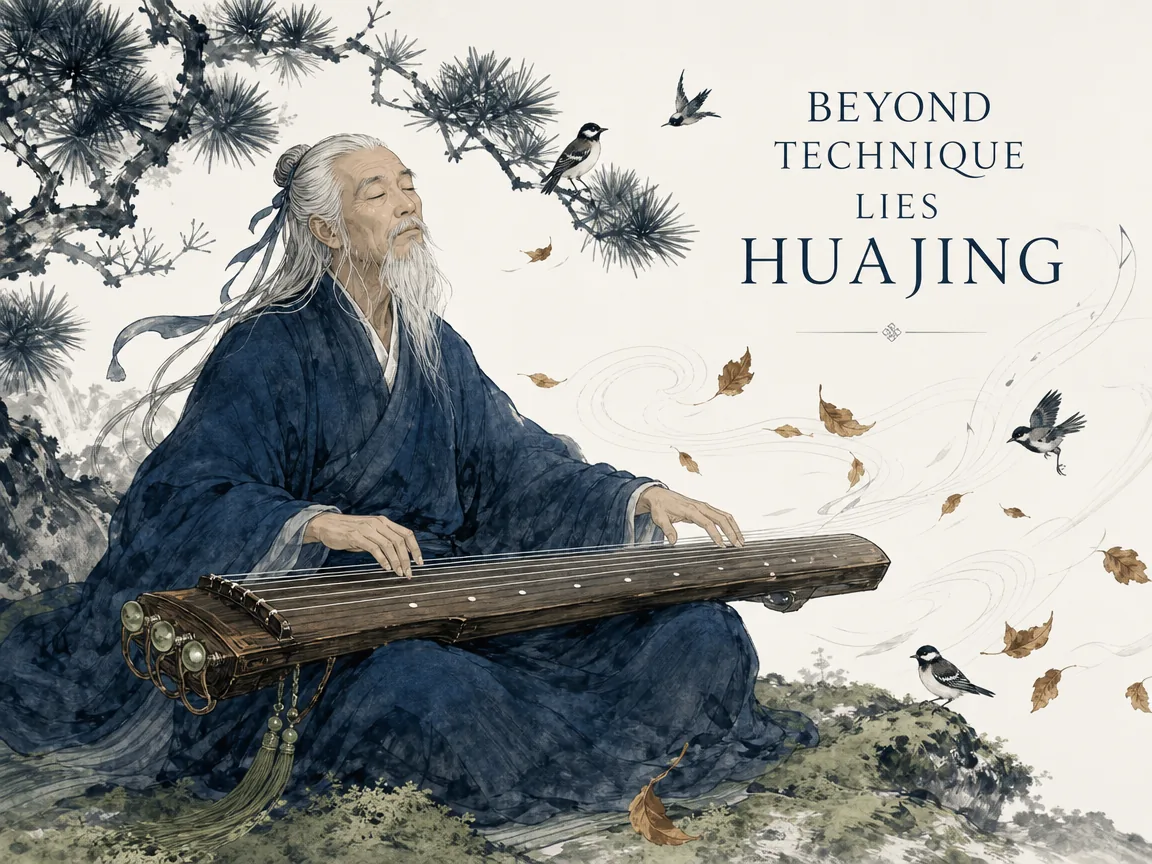
These images point to the same insight: mastery at its deepest level is not about adding more force, more technique, or more visible effort. It is about becoming permeable — letting your skill integrate so thoroughly with the task that the distinction between "you doing it" and "it happening through you" begins to blur. This is not a supernatural ability. It is a well-documented phenomenological condition described across Eastern traditions and studied in contemporary psychology under names like "flow."
The Cook Who Never Dulled His Blade
One of the most enduring stories about huajing comes from the Zhuangzi (庄子), a foundational Daoist text. In the chapter "On the Care of Life" (养生主), the text describes a butcher named Ding carving an ox for Lord Wen Hui [2]. His movements are described as dance — his hand, shoulder, foot, and knee all moving in rhythm, the sound of his blade entering the body resonating like music.
When the lord asks how he achieved this, Ding explains that he began by seeing a whole ox. After three years, the whole animal disappeared from his perception. What remained was a landscape of gaps — the natural spaces between bones, sinews, and joints. His blade, thinner than paper, moves through those spaces without ever meeting resistance. He has been using the same knife for nineteen years, slaughtering thousands of oxen, and the blade remains as sharp as if freshly honed [2].
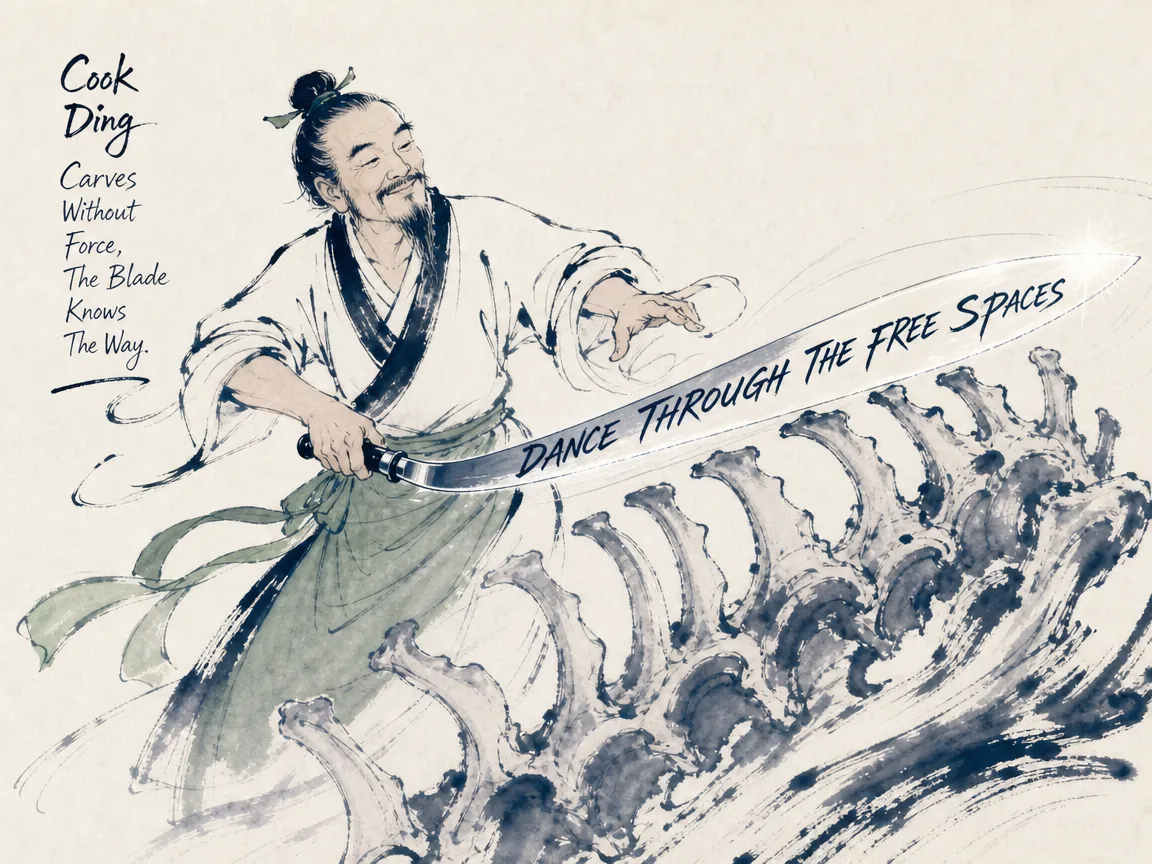
"I work with the Way, not just technique," he says. "The joints have intervals, and the blade has no thickness. By entering the intervals with nothingness, my blade moves freely with ample room to spare."
Scholars of Zhuangzi's thought frequently cite this passage as a paradigm of cultivated, seemingly effortless action — a state that emerges not from innate talent but from years of focused practice that eventually dissolve the boundary between practitioner and practiced [1]. Cook Ding does not overpower the ox. He does not fight it. He learns its structure so completely that what looks like mastery is actually a kind of attentive surrender to the way things are.
The story is not about violence or even about cooking. It is about a way of being in the world — one in which the intelligent response is not to push harder against resistance, but to find the space that was already there.
Four Dimensions of Attainment
Contemporary interpreters of Chinese aesthetics and philosophy often organize the experience of huajing into four progressive dimensions. This framework is a modern synthesis rather than a structure found in any single classical text, but it helps make sense of what the tradition describes To explore these themes from another angle, read our related reflection on Why Wars Begin When No One Can Say “Enough”.
Heart-Hand Unity
At the most basic level, huajing means the disappearance of the gap between intention and action. A beginner playing the piano thinks about each key. An experienced player's fingers find the notes before conscious thought catches up. The skill has moved from the mind into the body — what the Chinese phrase xin shou he yi (心手合一) captures literally as "heart and hand becoming one." This is what Cook Ding describes when he says his knife moves according to natural patterns rather than conscious calculation.
Self-World Unity
When technique becomes embodied, the relationship between the person and the task changes fundamentally. The world is no longer an obstacle to overcome but a field of possibilities to navigate. In Zhuangzi's account, the ox transforms from a solid resistance into a network of openings. The blade does not conquer the ox — it travels through it. This is the dimension of wu wo he yi (物我合一), where opposition dissolves and the practitioner moves with the grain of reality rather than against it.
Heaven-Human Unity
The third dimension is the most difficult to describe because it involves the temporary disappearance of the ego itself. A famous example comes from the story of Wang Xizhi (王羲之) and his Lantingji Xu (兰亭集序), the "Preface to the Poems Collected from the Orchid Pavilion." Written in the spring of 353 CE during a gathering of literati, the piece was composed in a half-intoxicated state (bànzuì, 半醉) — half-drunk, half-aware. According to the Tang-era account by He Yanzhi (何延之), when Wang Xizhi woke and tried to rewrite it dozens of times, none matched the original [3]. Not because his technique had declined, but because that specific convergence of mood, weather, company, and spontaneity could not be reproduced.
This is what the Chinese call tian ren he yi (天人合一) — heaven and human becoming one. The self steps aside. Something larger acts through the person. The result looks accidental, but it is earned by a lifetime of preparation.
Return to Simplicity
The final dimension is fan pu gui zhen (返璞归真) — the return to simplicity. In Chinese painting, this is sometimes illustrated by the late works of artists like Bada Shanren (八大山人), whose Sparrow and Bamboo shows a sparrow perched on a bare branch, rendered in minimal ink strokes that seem almost crude at first glance [4]. But beneath the apparent simplicity lies a lifetime of technical mastery, layered ink techniques creating subtle tonal variation and visual depth, and a distilled essence that only deep practice can produce [4]. The work looks easy because everything unnecessary has been removed.
Why This Matters Now
We live in an age that worships effort. Every productivity system, every leadership course, every self-help book tells the same story: more discipline, more optimization, more grinding. The pressure to perform constantly has turned work into a form of self-violence for many professionals. Burnout is not a personal failure — it is the logical outcome of a culture that equates worth with visible struggle.
Huajing offers a different model. It does not say effort is worthless. Cook Ding spent years learning before his knife stopped dulling. Wang Xizhi had trained in calligraphy since childhood before the Orchid Pavilion moment. Deliberate practice is essential. But huajing also says that effort has a limit — and beyond that limit, more effort produces diminishing returns, then negative returns. The path forward is not to try harder. It is to remove the obstacles that make effort necessary in the first place.
Modern psychology has documented a parallel phenomenon in what Mihaly Csikszentmihalyi called "flow" — a state of deep absorption where challenge and skill are perfectly balanced and self-consciousness fades [1]. Whether or not we accept the philosophical frameworks behind huajing, the experiential description is recognizable: the best work often comes not from forcing it but from creating the conditions where it can emerge.
The practical implication is simple and radical: mastery is not about adding more effort. It is about subtracting what gets in the way.
How to Approach Huajing Without Mystification
If huajing sounds inaccessible, it is partly because the language around it can drift toward the mystical. But the concept is grounded in ordinary human experience. Here are a few ways to think about it practically:
Long practice precedes short moments. Huajing does not replace deliberate practice — it follows it. The goal is not to skip the work but to reach a point where the work no longer feels like work. This applies to writing, coding, teaching, caregiving, or any skill developed over years.
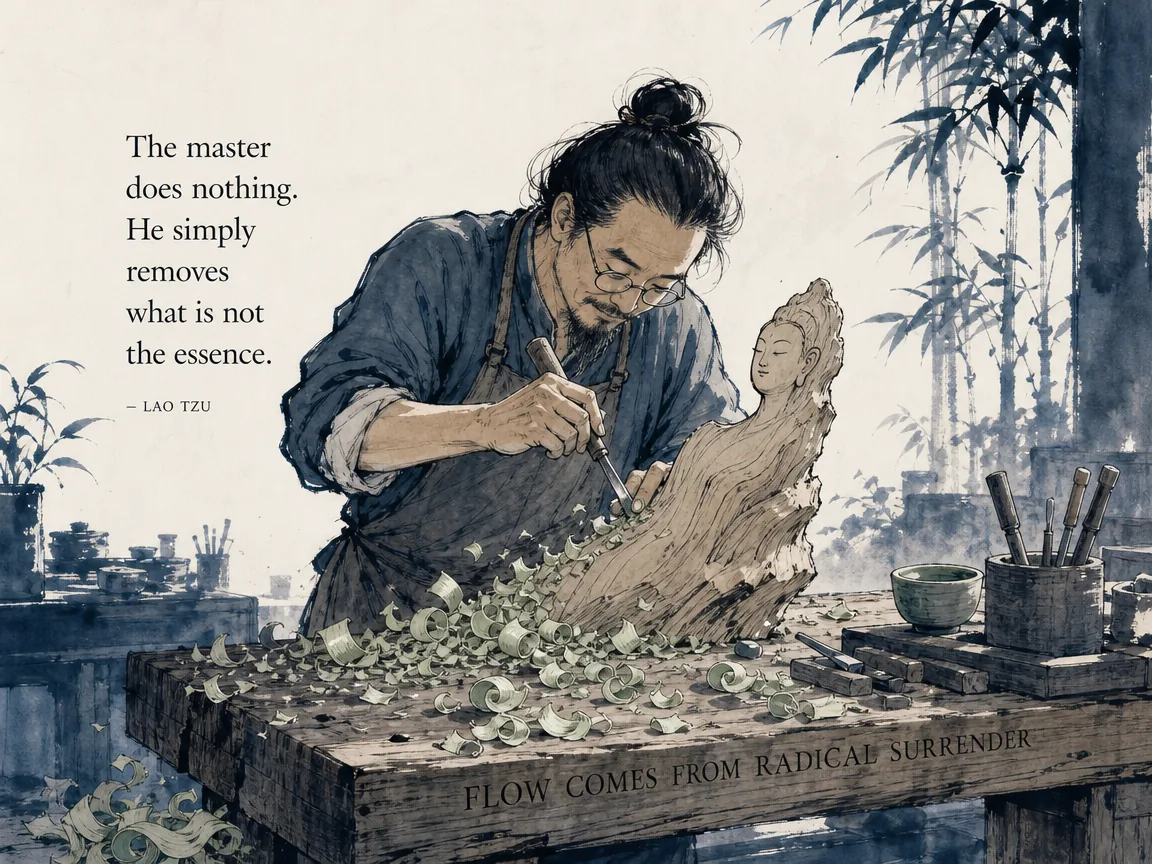
Create conditions, not outcomes. You cannot force a flow state. You can, however, reduce interference: adequate rest, focused attention, familiar tools, and a environment where self-judgment is minimized. The space between practice and performance matters more than most people allow.
Notice the ordinary moments. Huajing rarely arrives as a dramatic event. It appears in small, frequent instances — a conversation that flows without preparation, a routine task completed with unexpected ease, a creative decision that feels both spontaneous and inevitable. These moments are not exceptions to mastery. They are its evidence.
Release the need to be seen mastering. One of the strangest paradoxes of huajing is that the most accomplished people often look the least accomplished. They do not announce their expertise. They do not perform competence. Their skill is visible only in the quality of what they produce, not in the display of effort. For professionals who feel pressure to signal productivity through busyness, this is a counter-cultural lesson.
Common Questions
Is huajing the same as "flow"? They describe similar experiences from different traditions. "Flow" comes from positive psychology and focuses on the psychological conditions that produce optimal experience. Huajing comes from Chinese philosophy and carries additional metaphysical implications about the relationship between self and world. The overlap is real, but the frameworks are not identical.
Does this mean I should stop trying so hard? No. Huajing describes what happens after sustained practice, not instead of it. The Chinese tradition is clear that the effortless state is earned through effort — it is just a different relationship to effort, one that eventually lets go of conscious control. The danger is not effort itself but the belief that more effort is always better.
Can huajing be taught, or is it purely personal? It can be approached through guidance, but it cannot be forced. A teacher can help remove obstacles — bad habits, unnecessary tension, unrealistic expectations — but the actual transition from conscious effort to spontaneous action is something the individual must experience. This is why the tradition emphasizes both study and practice.
How is this relevant to someone who works in an office, not a studio? Every skilled professional experiences moments of huajing — the presentation that runs smoothly without notes, the negotiation that resolves itself, the code that writes almost automatically. These are not anomalies. They are evidence that the principle applies beyond art or craftsmanship. The question is whether we create conditions for them or constantly obstruct them with anxiety and over-control.
What Comes Next
The pursuit of huajing is not a retreat from the world but a different way of moving through it. It asks us to consider whether the constant pressure to perform, to optimize, to visibly struggle is the only way to do good work — or whether there is another path, one that values clarity over intensity, ease over exertion, and simplicity over display.
Ancient Chinese philosophy does not promise that this path is easier. It promises that it is more sustainable. The knife that moves through the joint does not dull. The mind that stops fighting itself does not burn out. And the professional who learns to trust the work they have already done may find, to their surprise, that the best results come not from pushing harder but from letting go of the push altogether, reflecting the enduring wisdom of Effortless Mastery in Chinese Philosophy.
Examine this artistic principle further through the classical aesthetic philosophy of The Patina of Time: What Chinese Wisdom Teaches Us About Growing Rich, Not New.
Deepen your understanding of these principles in our reflection on What a Soulmate of True Understanding (*Zhījǐ*, 知己) Reveals About What We Need From Each Other.
Sources & Further Reading
[1] Zhuangzi (Stanford Encyclopedia of Philosophy) — Academic overview of Zhuangzi's thought, including analysis of Crafty Man chapters and exemplars of cultivated, effortless action.
[2] Zhuangzi / Nourishing the Lord of Life (莊子/養生主) – Wikisource — Original text of the "Cook Ding" passage (庖丁解牛), including the lines "nineteen years now" and effortless movement.
[3] Record of the Orchid Pavilion Beginning and End (蘭亭始末記) – Wikisource — Tang-era account documenting the composition of the Lantingji Xu in 353 CE.
[4] Album of flowers, birds, insects, and fish – Smithsonian's National Museum of Asian Art — Curatorial description of Bada Shanren's (八大山人) distilled ink painting technique.
Further Reading
- Csikszentmihalyi, Mihaly. Flow: The Psychology of Optimal Experience.
- Robinet, Isabelle. Daoism: The World of the Realizer.
- Watson, Burton (trans.). Chuang Tzu: Basic Writings.







[…] Connect these enduring values to the broader cultural heritage explored in The Art of Effortless Mastery: What Ancient Chinese Philosophy Teaches Us About Letting Go. […]