
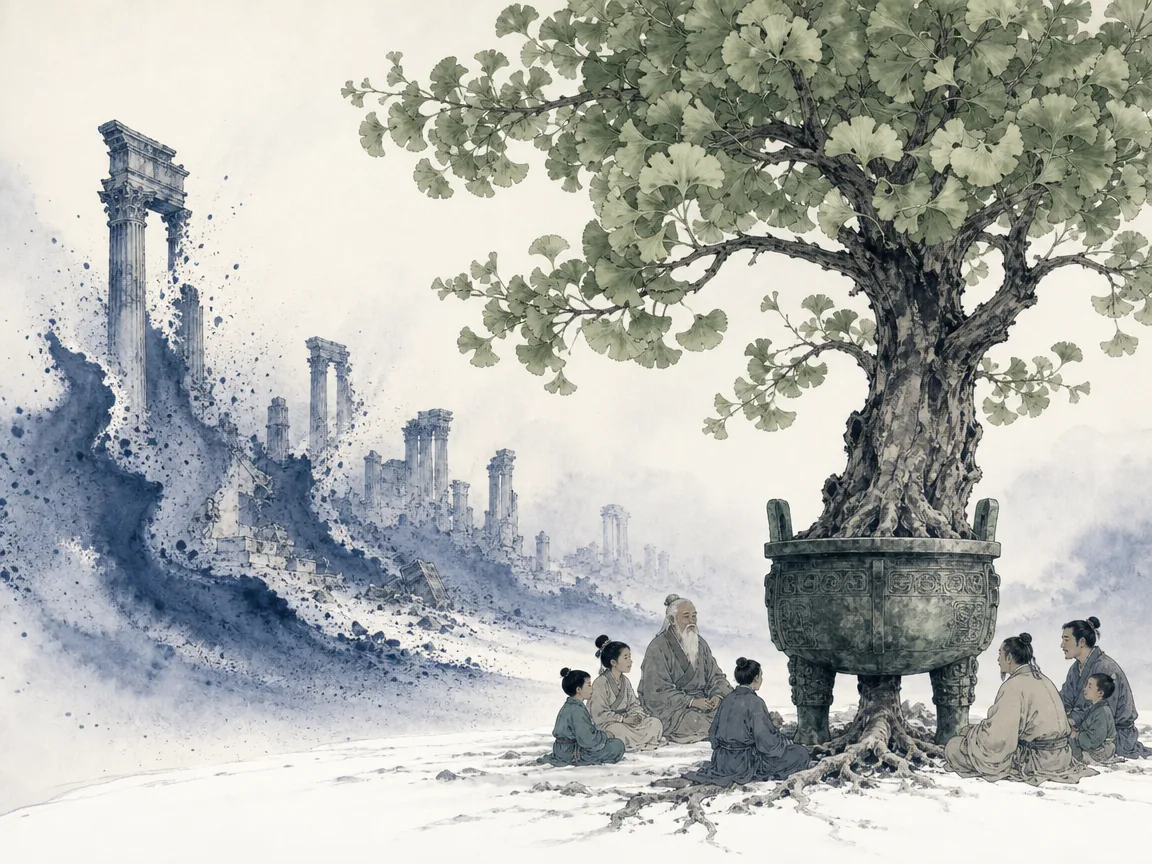
Western scholars have long puzzled over a question that seems almost impossible to solve: why does China persist? For millennia, vast empires across the world have risen to greatness and then fractured into irretrievable pieces. Rome fell and never reunited. Persia was absorbed into new orders. The Ottoman Empire dissolved into separate nations. But when China's dynasties collapsed, they were always followed not by permanent fragmentation but by renewed unity. Even rulers from non-Han ethnic backgrounds — Mongols, Manchus — accepted this logic after taking power. As one common observation goes, whoever wins becomes the inheritor of the same civilizational project [1].
This pattern is striking precisely because it contradicts what we see everywhere else in world history. When European empires broke apart, no one attempted to rebuild them. The Roman Empire did not return. The British Empire did not reunite its former colonies into a single political body. Yet Chinese history is full of cycles in which order, after long periods of division, always re-emerges. Understanding why requires looking not at military might or geographic advantage alone, but at something deeper — a distinctive way of thinking about identity, legitimacy, and continuity that is rooted in classical Chinese philosophy—a foundational perspective explored in Why Chinese Civilization Endures.
The answer begins with a single word: Zhongguo (中国). While it is usually translated as "China," the term carries a meaning that extends far beyond a fixed territory or ethnic group. For over three thousand years, it has functioned as a cultural idea — a vision of a legitimate center, a civilizational core that could be inherited across generations and dynasties, regardless of who sat on the throne. This mindset, shaped by Confucian and Daoist thought, offers us a remarkably useful lens for understanding how any community — including our own — might navigate an age defined by polarization and fragmentation.
Why Chinese Civilization Endures: The Puzzle That Defies Easy Explanation
It is easy to take China's continuity for granted if you grow up within its cultural orbit. But for outsiders, the phenomenon often seems extraordinary, even bewildering. The historian Timothy Brook captured this sentiment when he noted that many Westerners find it difficult to reconcile the idea of China as a continuous civilization with their own experience of nation-states that appear and disappear [2].
Across Eurasia, empires have followed a familiar arc. They expand, consolidate, and eventually fracture under the weight of internal strain or external pressure. Once broken, the pieces rarely come back together. Europe illustrates this pattern repeatedly — from the Roman Empire through the Holy Roman Empire to the colonial empires of the early modern period. Each collapse produced a lasting transformation, not a restoration.
China's trajectory looks different. Dynastic cycles are well documented: the Qin, Han, Tang, Song, Yuan, Ming, and Qing each rose and fell. Yet each new regime, upon taking power, positioned itself not as something entirely new but as the rightful heir to what came before. Even a rebel founder like Zhu Yuanzhang — who led a peasant uprising against Mongol rule — acknowledged the legitimacy of the Yuan dynasty in his accession edict, stating that the Mongols had been appointed by Heaven to rule and that their mandate had simply transferred [3].
This is not to suggest that every dynasty uniformly or smoothly recognized its predecessor. History is messier than that. But the dominant pattern — that new rulers sought to inherit rather than replace — is one of the most consistent features in Chinese political culture [4]. And it points to something fundamental about how Chinese civilization understands itself.
Zhongguo: More Than a Name for a Country
The term Zhongguo literally means "the Central State" or "the Realm in the Middle." Its earliest known appearance in inscribed Chinese is found on the He Zun, a bronze vessel from the early Western Zhou period, roughly three thousand years ago. The inscription records the king's decision to establish a capital at a new site, referring to it as the Zhongguo — not as a fixed border or ethnic homeland, but as the legitimate center of civilizational authority [5].
This early usage reveals a crucial insight: Zhongguo was never primarily about geography or bloodline. It was a concept of cultural and political legitimacy. Whoever governed with virtue and order inhabited the center; whoever lost the Mandate of Heaven (Tianming, 天命) became peripheral. The idea is closely linked to a core Confucian conviction that political authority derives from moral governance rather than sheer force — a principle expressed throughout the classical tradition.
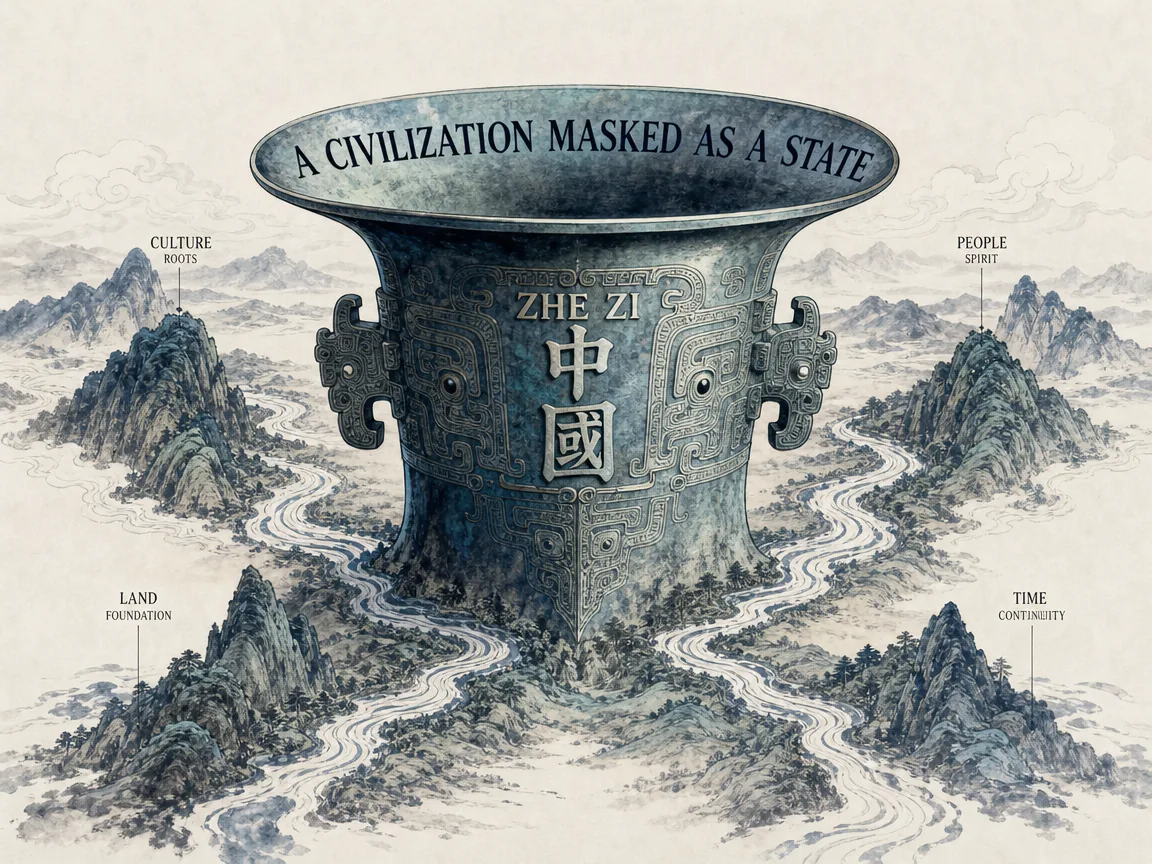
In the Analects, Confucius is recorded as saying that a ruler who governs by virtue is like the North Star, remaining in its place while all other stars revolve around it [6]. Authority, in this framework, is not imposed from without; it is earned and sustained through ethical conduct. This distinction matters deeply for understanding Chinese continuity. Because legitimacy is conceived as something that can be lost and regained, dynastic change does not necessarily mean civilizational collapse — it can mean civilizational renewal.
The concept of Zhongguo also allows for inclusion across ethnic and cultural lines. A ruler did not need to be ethnically Han to claim the mantle of Chinese sovereignty. What mattered was whether they upheld the civilizational order — the rituals, the scripts, the administrative frameworks, the moral language of governance. This openness, paradoxically, strengthened the system's durability by allowing it to absorb transformative influences without breaking apart.
Dynastic Inheritance as Civilizational Strategy
One of the most revealing moments in Chinese history comes from the transition between the Yuan and Ming dynasties. When Zhu Yuanzhang declared himself emperor in 1368, he issued an edict that has become famous among historians for its careful framing of legitimacy [3]. Rather than dismissing the Mongol rulers outright, he acknowledged that they had been appointed by Heaven to govern the realm. Their mandate had lasted for over a century, and now it had passed. Zhu Yuanzhang positioned himself not as a subversive overthrower (diānfùzhě, 颠覆者) who destroyed a foreign regime, but as a restorer of order under a new heavenly mandate.
Similar patterns appear throughout Chinese history. The Tang dynasty (618–907), founded by a lineage with mixed northern ethnic origins, claimed descent from Laozi (Li Er) to anchor its rule in the deepest currents of Chinese philosophical tradition [5]. The Yuan dynasty itself, established by Mongol conquerors, adopted Chinese administrative practices and presented itself as a legitimate Chinese dynasty. The Qing dynasty (1644–1912), founded by the Manchus, similarly embraced Confucian governance and the mandate framework. To explore these themes from another angle, read our related reflection on How Sun Tzu’s ‘Empty and Full’ Teaches You to Make Opponents Waste Their Strength.
None of these regimes declared themselves to be foreign intruders or brand-new civilizations. Each sought to weave itself into the existing tapestry. The practical effect was profound: even during periods of profound political rupture, the civilizational fabric held. The symbols, the language, the philosophical vocabulary — all of it survived because each new generation treated it as inherited property rather than alien import.
Classical Chinese thinkers had already provided the philosophical vocabulary for this approach. The I Ching (Book of Changes) teaches that transformation is the constant — that change itself is the only unchanging principle. The Dao De Jing emphasizes flexibility, adaptability, and the strength of what yields rather than what resists. Together, these traditions offered a worldview in which continuity and change were not opposites but partners: a river that changes its shape but remains the same river.
Qin Shi Huang's Invisible Framework
Any discussion of Chinese continuity must address the first emperor, Qin Shi Huang, whose brief reign (221–210 BCE) left an enduring imprint. His achievements were ruthless and often brutal, but his structural legacy proved remarkably durable. He standardized the written script, unified weights and measures, and connected the realm through a vast network of roads and canals [7].
What made these reforms so significant was not that they were invented by him — many of these practices existed in various forms before his time — but that he codified them at a civilizational scale. After the Qin collapsed, subsequent dynasties did not discard these frameworks. They inherited them. The written script, in particular, became one of the most powerful unifying forces in Chinese history. Even as spoken dialects diverged enormously across regions, a shared written language allowed scholars, officials, and rulers across the vast territory to communicate through a common cultural medium.
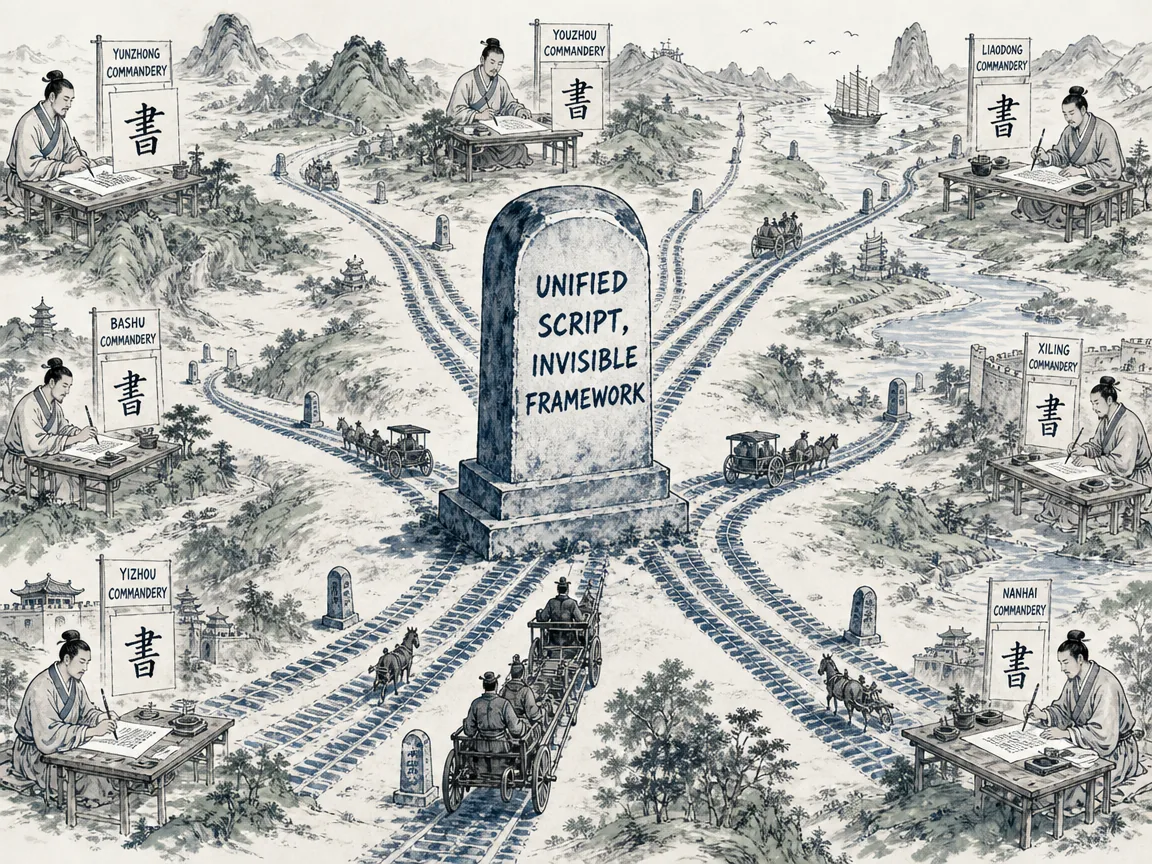
This phenomenon aligns with a recurring insight in Daoist thought: the most enduring structures are often invisible. Water shapes stone not through brute force but through persistence. The Dao De Jing praises the soft over the hard, the yielding over the rigid, precisely because these qualities prove more resilient over time [8]. Qin's institutional framework operated in a similar register. It was not a wall that demanded constant defense; it was a skeleton that could bear new flesh across centuries.
Later dynasties refined and expanded upon these foundations rather than tearing them down. The Han institutionalized Confucian scholarship. The Tang perfected the examination system. The Song developed a sophisticated bureaucratic state. Each layer added depth to the civilizational structure without erasing what came before.
What This Continuity Teaches Us Today
We live in an age of fragmentation. Political polarization, cultural nationalism, and accelerating technological change make it feel as though the ground beneath us is shifting faster than our institutions can adapt. Identity itself has become a contested terrain — many people feel torn between tradition and innovation, between roots and reinvention.
Chinese civilization offers a different model of endurance, one that may speak directly to our moment. Its central lesson is that continuity does not require rigidity. You can transform and still remain yourself. A dynasty can fall, a government can change, a leader can come from an entirely different background — and the civilizational project can continue, not because it refused to change, but because it understood itself as a living inheritance rather than a fixed artifact.
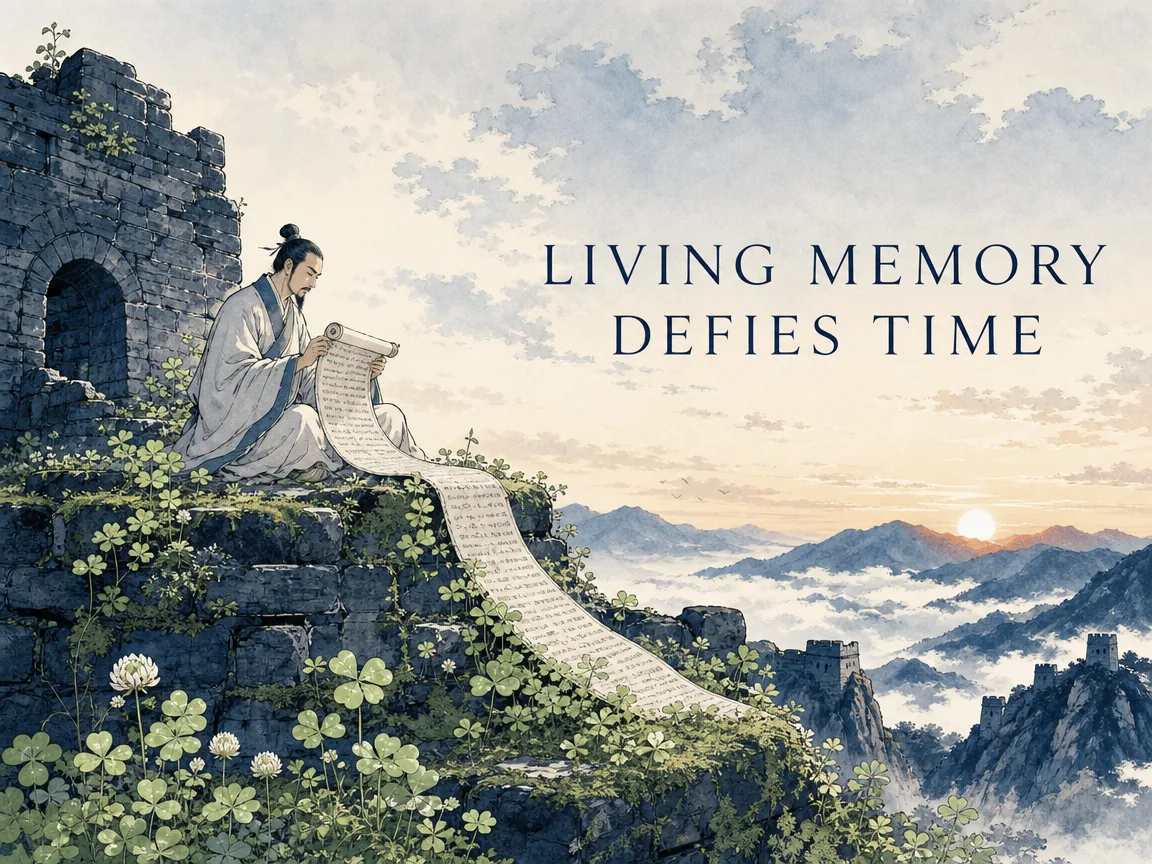
This perspective is grounded in classical wisdom. The Confucian emphasis on xiao (filial piety) extends beyond the family to encompass reverence for what one's predecessors built. The Daoist appreciation for natural flow and adaptation provides the philosophical justification for change without loss of identity. Together, they suggest a way of being in the world that is neither nostalgic stagnation nor reckless rupture.
For the modern reader, the practical question is not whether we can build a civilization that lasts three millennia — that is far beyond any individual's reach — but how we might cultivate personal and communal resilience in our own contexts. How do we honor what we have inherited while remaining open to necessary change? How do we hold fast to our values without becoming brittle? These are not ancient problems. They are urgent, everyday concerns.
One useful reflection is to ask where we locate the boundaries of our own identities. If we define ourselves narrowly — by territory, by bloodline, by a single moment of origin — then any disruption threatens to unravel everything. But if we understand ourselves as participants in an ongoing story, something larger than our immediate circumstances, then change becomes part of the narrative rather than its destruction. This is precisely the mindset encoded in the concept of Zhongguo: the center is not a place on a map but a commitment to a continuing project.
A Note on Comparisons and Complexity
It is worth pausing to acknowledge the limitations of any broad comparison between Chinese and European civilizational patterns. The analogy between Europe's fragmented empires and China's recurring unity is tempting, but it risks oversimplifying two enormously complex histories [4]. Europe has its own narratives of renewal, restoration, and cultural continuity. China has experienced devastating losses, prolonged divisions, and moments of profound cultural rupture. Neither trajectory is smooth or inevitable.
Scholars continue to debate the relative importance of geography, economics, institutions, and ideology in explaining China's persistence [2]. No single factor — not the written script, not Confucianism, not the mandate system — fully accounts for it. The most honest answer is that Chinese civilization endured through a combination of adaptive cultural frameworks, institutional innovations, and a philosophical tradition that valued continuity alongside transformation.
What matters for our purposes is not to declare one model superior to another, but to recognize that different civilizations develop different strategies for survival. The Chinese strategy, forged over millennia, offers a repertoire of ideas that may prove useful in our own search for meaning and resilience.
FAQ
Is Chinese civilization truly unbroken, or has it experienced genuine ruptures? Chinese history includes periods of foreign rule, internal rebellion, and prolonged division. The Qin-Han transition, the fall of the Tang, and the Mongol and Manchu conquests were all moments of profound disruption. The distinctive feature is not the absence of rupture but the pattern of renewal that followed — the tendency for successive regimes to reinvest in a shared civilizational framework rather than abandon it entirely.
Does the concept of Zhongguo imply Chinese cultural superiority? Not necessarily. In its classical usage, Zhongguo denoted a center of civilizational order rather than an assertion of racial or ethnic supremacy. The concept was inclusive in principle — a ruler could theoretically be culturally "Chinese" without being ethnically Han, provided they upheld the rituals and governance traditions. Critics rightly note that the boundary between cultural inclusivity and cultural imperialism has sometimes been contested in practice.
Can this model of civilizational continuity be applied outside of China? The underlying logic — that continuity can coexist with transformation — is a philosophical insight available to anyone. Different cultures and communities can draw on their own traditions to develop analogous frameworks. The specific Chinese concepts discussed here arose within a particular historical context, but the broader question they address — how to remain faithful to the past while adapting to the future — is universal.
In Summary
Chinese civilization's endurance is not a mystery that defies explanation — it is a phenomenon that invites reflection. Across three thousand years, a distinctive cultural logic took shape: dynasties rose and fell, but the civilizational project endured because each new generation saw itself as inheritor rather than revolutionist. Classical Chinese thought — Confucian ethics, Daoist adaptability, the Mandate of Heaven — provided the philosophical scaffolding for this resilience.
For readers navigating an era of rapid change and deep uncertainty, the lesson is quietly radical: you do not have to erase the past to survive the future. Continuity is not the enemy of transformation. It can be its condition. By understanding how a civilization maintained itself across millennia without losing its identity, we may find new ways to think about our own place in time — and our responsibility to what comes next, reflecting the enduring wisdom of Why Chinese Civilization Endures.
To explore these themes from another angle, read our related reflection on Moving First: How Ancient Strategy Teaches Us to Shape the Board, Not Just the Battle.
Deepen your understanding of these principles in our reflection on How Could a Civilization Win by Absorbing Its Conquerors? The Surprising Power of Chinese Cultural Gravity.
Sources & Further Reading
[1] "How Peculiar is Chinese Civilization in Other Nations' Eyes?" (中华文明——在其他国家眼中有多奇怪?) — Discussion of the concept that successive regimes positioned themselves as inheritors of Chinese civilization rather than founders of something entirely new — see (Bilibili transcript).
[2] "How Peculiar is Chinese Civilization in Other Nations' Eyes?" (中华文明——在其他国家眼中有多奇怪?) — Western scholarly perspectives on the distinctive nature of Chinese civilization and the challenges of explaining its continuity — see
[3] Accession Edict of Ming Taizu Zhu Yuanzhang (即位诏) – Wikisource — Original text of Zhu Yuanzhang's accession edict (即位诏), acknowledging the Yuan dynasty's heavenly mandate and its eventual termination — see
[4] Accession Edict of Ming Taizu Zhu Yuanzhang (即位诏) – Wikisource — Analysis of the pattern of dynastic succession and legitimacy in Chinese history, including caveats about generalizations — see
[5] Bulletin of the Institute of History and Philology, Academia Sinica (史語所集刊) — Scholarly discussion of Tang dynasty reverence for Laozi and northern Asian cultural factors — see
[6] Bulletin of the Institute of History and Philology, Academia Sinica (史語所集刊) — The concept of virtue-based governance and the Mandate of Heaven in classical Chinese political philosophy, as discussed in the context of Zhongguo — see and "How Peculiar is Chinese Civilization in Other Nations' Eyes?" (中华文明——在其他国家眼中有多奇怪?).
[7] "How Peculiar is Chinese Civilization in Other Nations' Eyes?" (中华文明——在其他国家眼中有多奇怪?) — Discussion of Qin Shi Huang's institutional reforms — standardization of script, weights, measures, and infrastructure — as described in the source material — see
[8] "How Peculiar is Chinese Civilization in Other Nations' Eyes?" (中华文明——在其他国家眼中有多奇怪?) — Daoist philosophical principles of adaptability and the strength of yielding, referenced throughout the discussion of Chinese continuity — see
Further Reading
- The Analects of Confucius — foundational text on virtue-based governance and ethical leadership.
- Dao De Jing (Laozi) — classical Daoist text exploring adaptability, humility, and the nature of lasting strength.
- I Ching (Book of Changes) — ancient Chinese divination and philosophical text on transformation and cyclical change.
- [Records of the Grand Historian: Basic Annals of the First Emperor of Qin (史记·秦始皇本纪)] — primary historical account of the first emperor's reign and reforms.






