
Zhuangzi Chapter 7 Meaning: The Violence of Well-Meaning Control
Modern life runs on the assumption that improvement is always good. We optimise ourselves, curate our relationships, standardise our organisations, and pursue versions of people and systems that look correct. Beneath that assumption sits a quiet but powerful question that Chinese philosopher Zhuangzi asked over two thousand years ago: who decides what counts as improvement—and at what cost to what was originally whole?
The answer matters more than we often realise. Because the impulse to remake the world in our image, even when we believe we are helping, is one of the most common and most damaging forms of control in human life. It appears in parenting, in love, in leadership, and in the way we carry ourselves. We do not wake up intending violence. We wake up intending to fix.
Zhuangzi addresses this impulse most directly in the Ying Di Wang (应帝王), the final chapter of the Inner Chapters of the Zhuangzi []. In that chapter, he does not offer a manual for better management or a strategy for more effective influence. He offers something far more unsettling: a warning about the moment when care becomes a project of renovation rather than presence, and when the desire to help turns into the destruction of what was alive.
The Death of Chaos
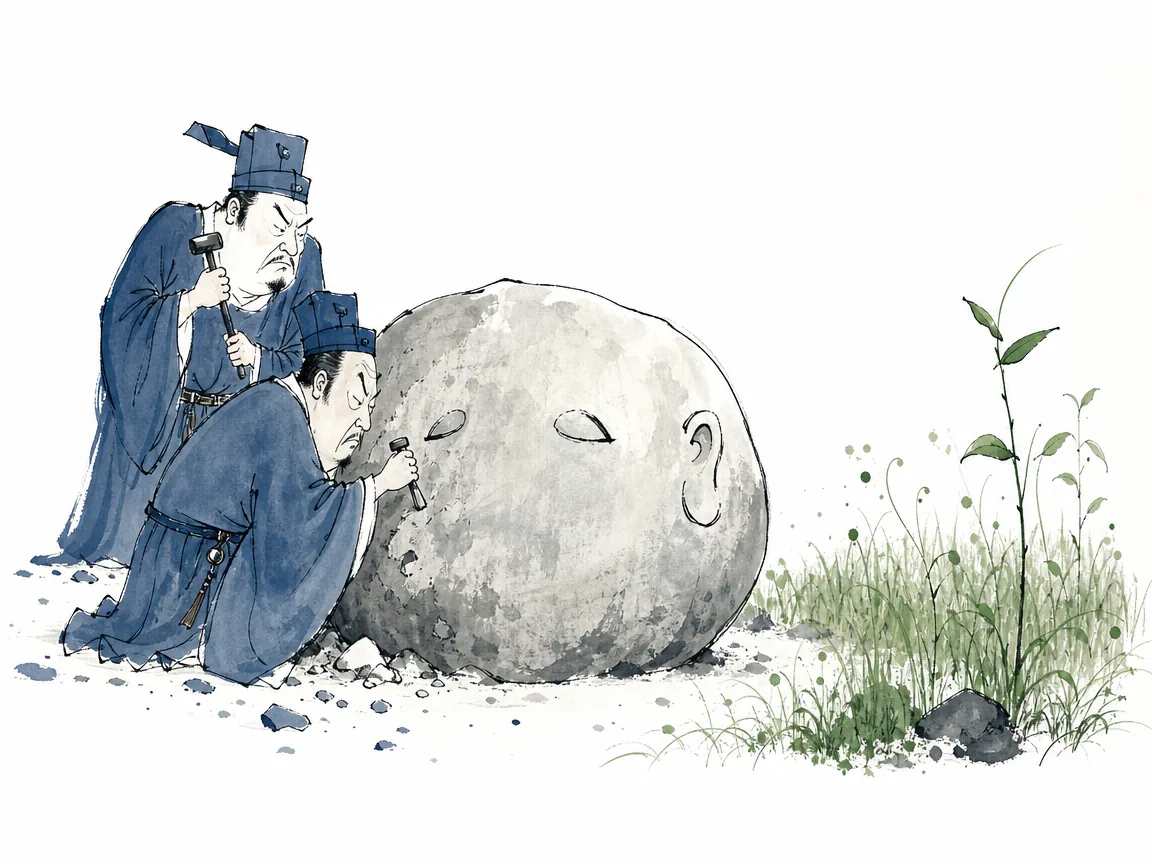
Zhuangzi opens the chapter with a short and unforgettable story. The emperor of the Southern Sea is called Shu (儵). The emperor of the Northern Sea is called Hu (忽). The emperor of the central region is Hundun (渾沌), often translated as Chaos []. Shu and Hu meet frequently in Hundun's territory, and Hundun treats them with extraordinary kindness. Out of gratitude, they decide to repay him.
They observe that every other person has seven openings—eyes, ears, nostrils, and a mouth—used for seeing, hearing, eating, and breathing. Hundun alone has none. So they agree to give him what all other people have. One hole each day for seven days. On the seventh day, Hundun dies [].
The story is strange, almost absurd. But its strangeness is deliberate. Hundun is not a metaphor for ignorance. He is wholeness before categorisation. He is a living being whose completeness does not depend on matching the shape of anyone else's design. Shu and Hu are not villains. They act from gratitude and what they sincerely believe is help. Yet their very goodness kills him.
This is the parable's central insight: the deepest harm in human life is rarely malicious. It is love or duty or responsibility pressed into the mould of someone else's standard. It is the conviction that if something does not match my picture of how it should be, then it is broken and I must repair it. Zhuangzi places this story at the beginning of the Ying Di Wang precisely because everything that follows—the political philosophy, the ethical tension, the question of how to live with others—flows from this one devastating event.
Where "Helping" Becomes Harming
Zhuangzi's warning in this chapter is not limited to rulers or philosophers. Every domain of human life reproduces the same pattern.
Parenting and Education
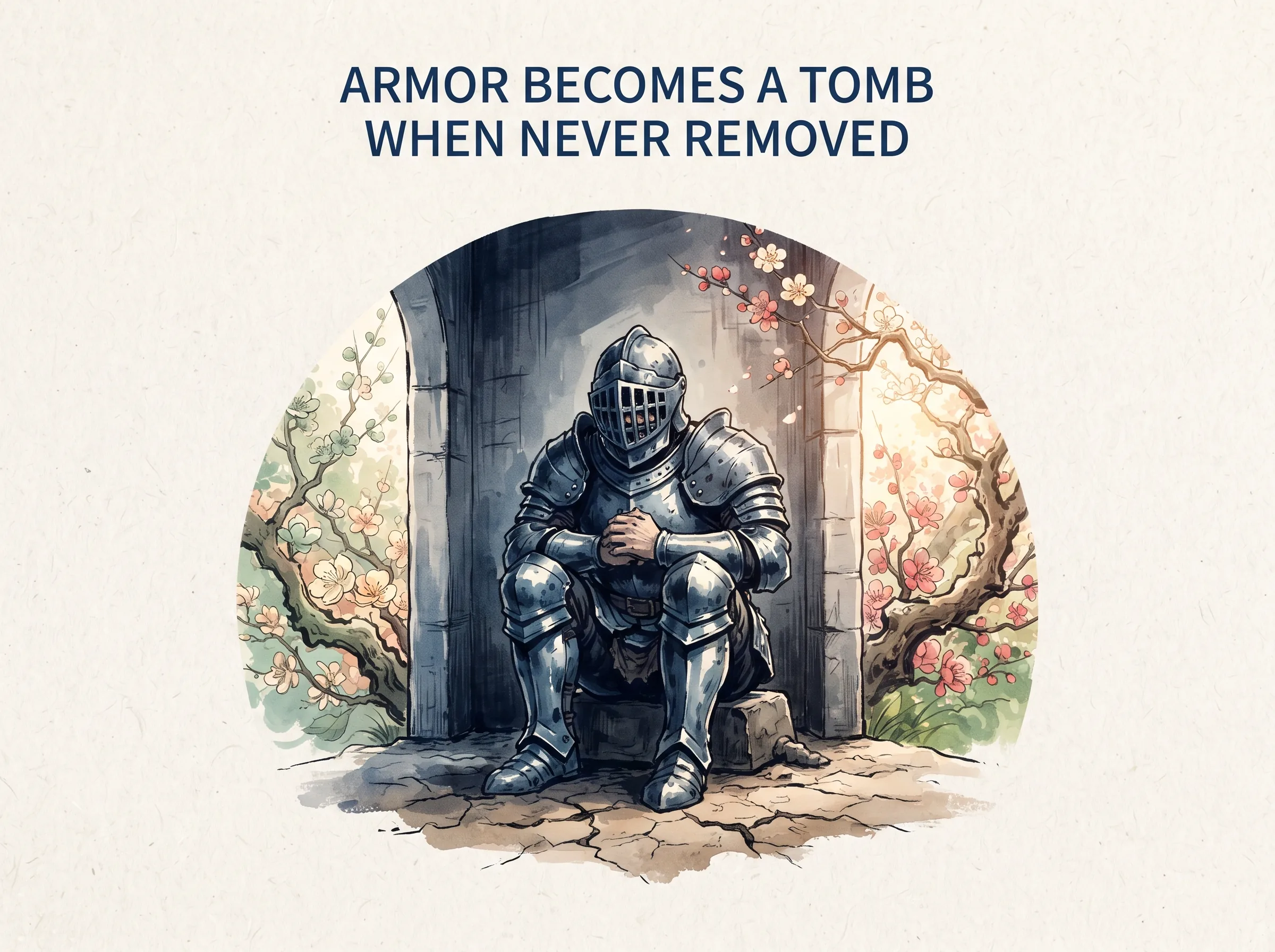
Parents and teachers often carry the most visible form of this impulse. The child who is shaped through schedules, expectations, and narrow definitions of success may become "normal" by outside standards. But normality is not the same as aliveness. Zhuangzi's image of Hundun suggests that the untamed capacity to be oneself—the part of a person that does not fit neatly into categories—is not a defect to be corrected. It is the very thing that keeps a life open.
This does not mean education should abandon guidance. It means we should ask whether we are helping a child grow or merely making them legible to a system that values predictability over vitality.
Relationships and Love
In intimate relationships, the same pattern appears quietly. Someone says, "I love the real you." But their behaviour operates from a different place: "I love you enough to change you." The partner who is constantly asked to be more ambitious, more mature (chéngshú, 成熟), more expressive, or more like an idealised version begins to feel exactly what the parable describes. The holes are being drilled. What was once spontaneous becomes strategic. Presence is replaced by performance.
The difference between supporting someone and remaking them is not always visible in the moment. It becomes visible only after, when the relationship has lost the very quality that made it worth having.
Leadership and Systems
Organisational life is perhaps the most obvious arena for controlled chaos. A system that is innovative, adaptive, and creative often depends on a certain amount of disorder. When leaders impose strict standards of efficiency, standardise behaviour, and replace spontaneity with process, the result may look better on paper. The organisation becomes easier to manage. But the energy that created it in the first place—the creativity, the initiative, the sense that people are genuinely invested—can quietly die. To study the primary classical text and commentary, explore the original Chinese text and deep philosophical translation in Fit for Emperors and Kings: The Mirror-Like Heart and the Fate of Chaos.
Zhuangzi's point is not that systems should have no structure. It is that structure imposed from above, without respect for the system's own rhythm, tends to suffocate the very vitality it claims to protect. The question is not whether there is order. The question is what kind of order it is, and who benefits from it.
What Wu Wei Actually Means
A frequent misunderstanding of Zhuangzi is that his concept of wu wei (无为) means doing nothing. The Ying Di Wang chapter argues the opposite. Wu wei is not passivity. It is a disciplined form of action that responds rather than projects.
Scholars describe wu wei in several overlapping ways: as non-assertive action, as non-coercive action, as effortless action, and as adaptiveness to circumstances rather than control over them [][]. It is contrasted with action driven by self-serving desire, anxiety, or the need to prove oneself right []. The concept is not simply "inaction." It is action that comes from alignment with how things actually are, rather than from the actor's ego or fear.
In the context of the Ying Di Wang, wu wei takes on a particularly sharp meaning. It is not that a good leader never acts. It is that a good leader does not act from the impulse to remake the world in their own image. The action is measured not by how much is done, but by whether the action respects the inner logic of the person or system it encounters.
This is harder than control. Control is easy when you believe you already know the answer. Wu wei requires genuine stillness—the ability to see what is there before you impose what you want. It requires trusting that not every problem needs solving and not every difference needs correcting.
The Shaman Who Could Not Read the Unreadable
The chapter contains a second major story that deepens the first warning. A divine shaman from the state of Zheng named Ji Xian (季咸) claims to read a person's life and death, fortune and misfortune, with extraordinary accuracy []. Liezi (列子), the shaman's admirer, brings him to meet his own teacher, Huizi (壶子).
Ji Xian examines Huizi four times. The first time, he predicts imminent death. The second time, he says Huizi has recovered and shows signs of life. The third time, he cannot give a clear reading because Huizi's energy appears unsettled. The fourth time, Huizi reveals a mode of presence that Ji Xian cannot categorise at all—and the shaman flees before he can recover his composure [].
The point of the story is not that Huizi possessed magical powers. It is about the difference between being fixed and being unfixed. A person whose life is shaped by rigid identities, fixed fears, and predictable desires presents a readable surface. Anyone with enough skill can map that surface and forecast the trajectory. But a person who is genuinely open—who does not cling to a single identity or a single mode of being—cannot be captured by any external system of prediction.
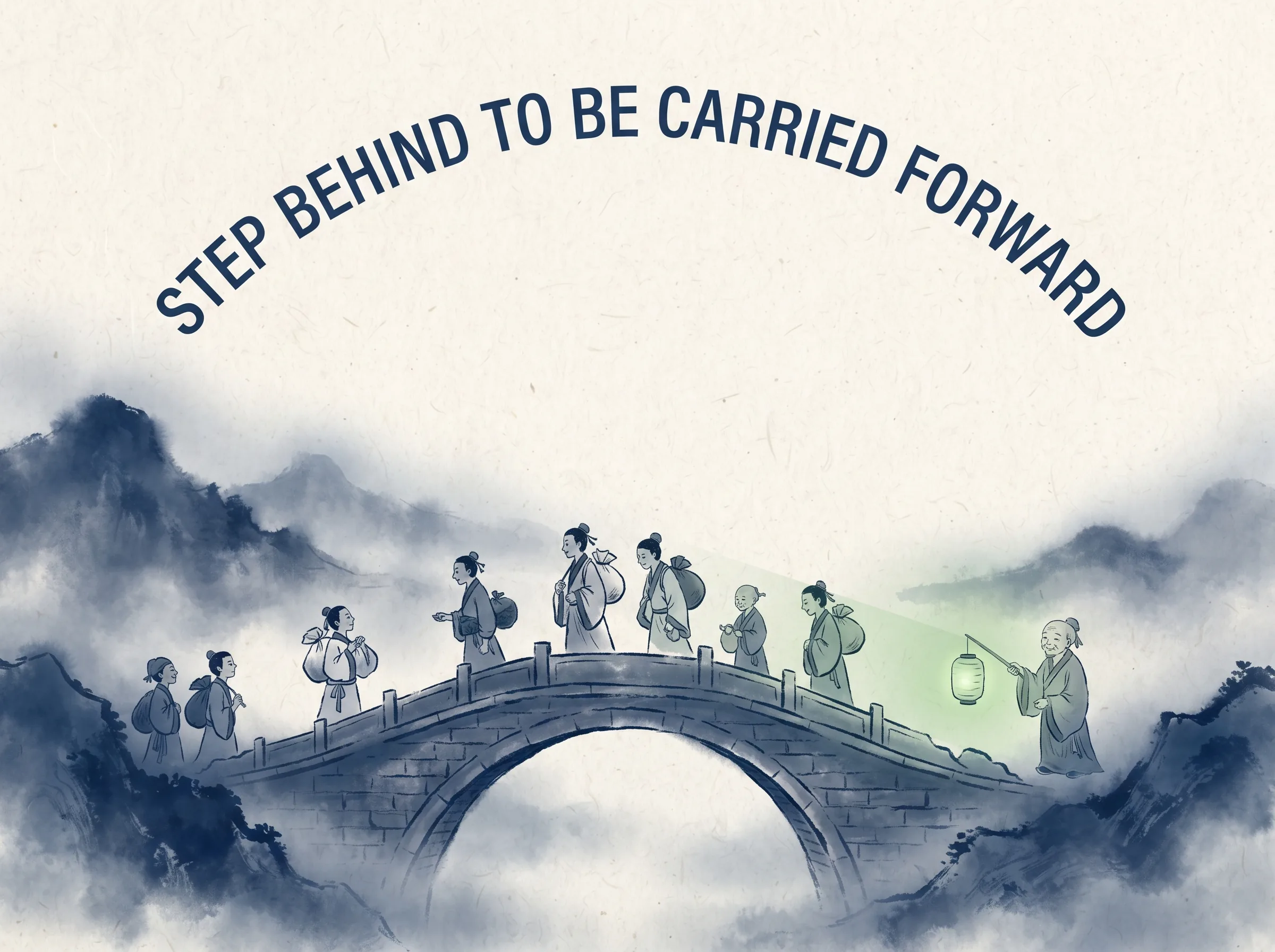
Zhuangzi links this story to the parable of Hundun because both warn against the violence of fixed categories. When you force someone into a category—defective, incomplete, behind schedule, disorganised—you begin to act as though their difference is a problem to be solved. When they resist that categorisation, as Huizi does, they expose the limits of your ability to control or predict them. And that exposure is terrifying to anyone who believes that knowledge equals power.
The deeper lesson applies beyond leadership or philosophy. It applies to anyone who has ever tried to understand another person well enough to change them. Understanding is one thing. Using understanding as leverage is another. Zhuangzi suggests that true freedom lies not in being impressive or even successful, but in being genuinely open—not in being legible to others, but in refusing to be reduced to a set of measurable traits.
The Final Question
The Ying Di Wang is the last chapter of the Inner Chapters, and Zhuangzi uses that position deliberately. After the preceding chapters explore freedom from the small self (Xiao Yao You), seeing through rigid distinctions (Qi Wu Lun), following the grain of life (Yang Sheng Zhu), and navigating the complexities of the human world (Ren Jian Shi), the final question is almost unavoidable: now that you understand the Dao, will you use that understanding to control others?
Wisdom without humility becomes a new form of tyranny. Knowledge can easily transform into arrogance when it is carried by someone who has not learned to restrain their impulse to intervene. The title of the chapter itself—"Ying Di Wang"—contains the answer. The character yìng (应) means to respond. The chapter describes a sovereign who governs not by commanding but by responding, not by imposing a standard but by meeting the world as it is.
This is the ultimate test of spiritual maturity. It is not what you achieve. It is what you resist doing.
Practical Takeaways
The parable of Hundun and the lessons of the Ying Di Wang are not abstract philosophy. They point toward a practical question we face every day: when do we act, and when do we hold back?
Before trying to change someone, ask a simple question
Am I seeing their lack, or am I seeing only their difference from me? This question cuts through the easiest self-deception in human relationships. What feels like concern often turns out to be a demand for conformity.
In leadership, measure success by what thrives on its own
If everything in your organisation depends on your constant intervention, the system may not be healthier than it was before you arrived. It may simply be more dependent. A sign of genuine health is that parts of the system continue to grow and adapt even in your absence.
In relationships, distinguish support from satisfaction
Are you supporting someone's actual needs, or are you satisfying your need for a certain kind of partner, child, or friend? The difference is subtle but decisive. One leads toward freedom. The other leads toward control.
In self-development, examine your motivation
Is your growth expanding your aliveness, or is it merely making you more socially legible? There is a difference between becoming more capable and becoming more acceptable. Zhuangzi would urge us to notice which one we are actually pursuing.
When Your Best Intention Is the Problem
We live in a culture that celebrates intervention. We are taught that problems exist to be solved, that differences exist to be smoothed out, that people and systems exist to be optimised. The Ying Di Wang challenges that instinct at its root.
Zhuangzi is not arguing that nothing should ever be done. He is arguing that the impulse to act from a place of anxiety, ego, or the desire to prove ourselves right is one of the most destructive forces in human life. The story of Hundun survives because it captures something we all recognise but rarely admit: the most dangerous violence is often love that refuses to accept someone as they are.
The alternative is not indifference. It is a deeper form of attention—one that sees the person or system in front of you without immediately measuring it against an internal template. It is the discipline of restraint, not as a limitation but as a practice of respect. It is the willingness to let something be whole without insisting on improving it.
That is a radical idea in a world that never stops asking us to do more, fix more, and become better. But it may also be the idea that saves what is most alive in us.
FAQ
Is the story of Hundun's death meant to be taken literally?
No. Like many stories in the Zhuangzi, the parable of Hundun operates on a symbolic level. It is not a historical account but a philosophical image. The point is that well-meaning intervention can destroy the very thing it claims to help. The deaths of Chaos is a metaphor for the loss of wholeness when someone imposes their own standard of completeness onto a living being.
Does Zhuangzi oppose all forms of leadership and governance?
No. The Ying Di Wang chapter distinguishes between control and response. Zhuangzi critiques leadership that imposes its own image onto others. He does not reject governance itself. Instead, he describes a form of leadership rooted in wu wei—action that responds to the real conditions of a situation rather than projecting a predetermined plan onto it.
What is the relationship between the Hundun parable and the story of Ji Xian?
Both stories illustrate the danger of fixed categories. In the Hundun parable, Shu and Hu impose their standard of what a complete human should look like onto a being whose completeness lies elsewhere. In the Ji Xian story, the shaman tries to predict and classify Huizi's life using fixed methods, but Huizi refuses to be pinned down. Together, the stories warn that whenever we reduce a person or situation to a set of measurable traits, we lose access to what is genuinely alive.
Can Zhuangzi's ideas about non-interference be applied to modern parenting and management?
Yes, though the application requires care. Zhuangzi's warning is not that parents and managers should never guide or structure. It is that they should examine their motives. When guidance comes from love and respect for the other person's nature, it is likely to support growth. When it comes from anxiety, the desire for control, or the need to see the other person match a preconceived ideal, it risks repeating the fate of Hundun—replacing genuine aliveness with a more conforming but less vital version, reflecting the enduring wisdom of Zhuangzi Chapter 7 Meaning.
To explore these themes from another angle, read our related reflection on Why the More We Control, the More We Break: Zhuangzi’s Answer to Modern Exhaustion.
Deepen your understanding of these principles in our reflection on True Cultivation Is Not Adding—It’s Recovering: Zhuangzi’s Lost Art of Restoring Inborn Nature (*Shàn Xìng*, 缮性).
Sources & Further Reading
[1] Zhuangzi / Responses for Emperors and Kings (应帝王) – Zhuangzi Online — Primary source text of the Ying Di Wang chapter, including the Hundun parable and the Ji Xian narrative.
[2] Zhuangzi (Stanford Encyclopedia of Philosophy) — Scholarly overview of the Zhuangzi text, the Guo Xiang edition, and the structure of the Inner, Outer, and Miscellaneous chapters.
[3] Laozi (Stanford Encyclopedia of Philosophy) — Discussion of wu wei as non-coercive, non-assertive action rather than total inaction, supported by multiple scholarly interpretations.
[4] 3.3 Classical Chinese Philosophy – Introduction to Philosophy | OpenStax — Overview of wu wei in Daoist thought as adaptiveness and resistance to forceful control.
Further Reading
- Burton Watson, translator. Chuang Tzu: Basic Writings. Columbia University Press. A widely used English translation of the Zhuangzi, including the Ying Di Wang chapter.
- Victor Mair, translator. The Complete Works of Chuang Tzu. Columbia University Press. Another authoritative English translation with detailed commentary.
- Robinet, Isabelle. The Book of Master Nan-Guo: Studies in the Interpretation of the Zhuangzi. This volume offers close readings of key chapters in the Inner Chapters, including Ying Di Wang.






