
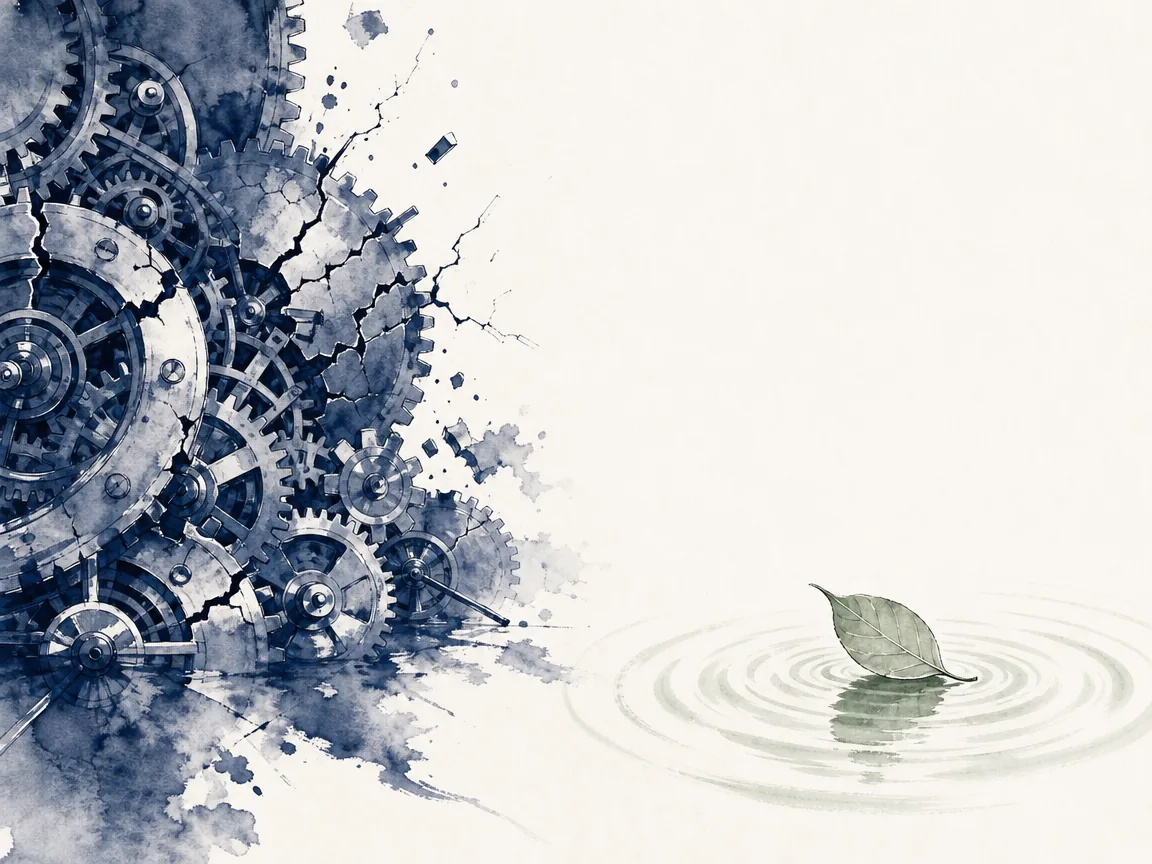
There is a familiar modern experience: the more we plan, schedule, measure, and optimize our lives, the thinner we feel — and the more anxious we become. We fill our calendars. We track our habits. We treat ourselves like machines that need constant adjustment. And yet the result is often the opposite of what we intended: a quiet but relentless fatigue, a low-grade panic that the world is slipping through our fingers, a sense that no matter how much we tighten our grip, everything feels more fragile.
Psychology researchers have noted that struggles to augment or diminish control are believed to be at the core of anxiety and mood disorders 1. The pursuit of control is not inherently pathological — the perception of control is broadly considered adaptive across diverse spheres of psychosocial functioning 1. But when the urge to manage becomes compulsive, when every hour must be justified and every outcome pre-empted, control stops serving life and starts consuming it. The paradox is real: the tighter we hold on, the less room there is for anything to breathe—a foundational perspective explored in Zhuangzi Chapter 12 Meaning.
Over two thousand years ago, a thinker named Zhuangzi asked a different question. In a chapter of his book variously translated as Heaven and Earth (Tiandi), he pointed to the sky above and the ground below and asked: if the Dao does not issue commands, why do all things still grow, change, and find their place? His answer was not that we should stop trying altogether, but that the highest order is not imposed from the outside — it is allowed to unfold from within. The Tiandi chapter is part of the so-called Outer Chapters of the received Zhuangzi, a section that modern scholarship assigns to various sources beyond the core Inner Chapters and reflects contributions from a School of Zhuangzi 2. Whether or not Zhuangzi himself wrote it, the chapter articulates a vision of order that turns our modern logic of control on its head. This is what it might have to say about why we are exhausted — and what it could mean to try a different way.
Zhuangzi Chapter 12 Meaning: The Logic of Control and Its Hidden Cost
Modern life runs on a simple assumption: problems exist because things are not being managed well enough. If a process is chaotic, add rules. If a team is unproductive, add oversight. If your life feels scattered, add structure. The underlying faith is that the world improves when more intelligence is applied to it — when someone stands outside the system and engineers a better outcome.
But this logic contains a blind spot. When order is forced from the outside rather than nurtured from within, it tends to produce rigidity, not resilience. A schedule that leaves no room for deviation breeds anxiety whenever something goes wrong. A management style built on constant intervention teaches people to wait for permission rather than to act. A self-image built on self-optimization makes any moment of rest feel like failure.
This is not to say that control is always harmful. Psychological research notes that the value of exercising control through choice may depend on certain personal and cultural values that may be learned, as well as situational factors, including the complexity of the choice 1. When choices are simple, when stakes are low, and when we have the cognitive resources to decide, taking action is reasonable. The problem arises when we generalize this instinct to every domain of life — when we treat uncertainty as an enemy to be defeated rather than a condition to be navigated.

Zhuangzi's point in the Tiandi chapter is precisely this overextension. He does not argue that nothing should ever be done. He argues that most of what we call action is actually restless interference — effort applied not because it is needed, but because stillness feels unsafe.
What Does True Order Look Like?
The Tiandi chapter opens with a question that sounds almost playful but cuts to the root of everything: if the Dao does not speak, how does the world keep running? Heaven and Earth do not hold meetings. They do not issue decrees. They do not send reminders. And yet seasons turn, rivers flow, trees grow, and animals find their way. Something is holding everything together — but it is not a manager.
This is the chapter's central metaphor. Heaven and Earth represent a self-generating, self-regulating order — not a machine to be managed but a living system to be trusted. Human-made order relies on rules, standards, metrics, and enforcement. Heavenly order works differently: things find their own way because they are part of a whole that already knows how to sustain itself. The difference is not trivial. It is the difference between a garden that is tended and a forest that grows.
When we forget this distinction, we tend to treat the world as if it were a machine. Machines require operators. They break when left alone. They perform only when instructions are followed. But living systems are not machines. A child does not learn to walk because she has been optimized; she walks because walking is already in her nature. A forest does not need a forest manager; it needs soil, rain, and time. A human life does not become meaningful because it has been scheduled efficiently; it becomes meaningful when it is aligned with something larger than itself.
Zhuangzi's insight is that we have confused the two. We have applied machine logic to living systems — including our own lives — and then wondered why everything feels brittle.
Continue with the deeper interpretation and practical application.
ChiDestiny members get access to the full analysis, modern applications, and the growing Chinese Wisdom Library.
FAQs
Is the Tiandi chapter actually by Zhuangzi? Scholars generally agree that the received Zhuangzi contains material from multiple authors and traditions. The Outer Chapters, which include the Tiandi chapter, are typically viewed as reflecting the thought of a later "School of Zhuangzi" rather than the historical figure himself 2. This does not diminish the philosophical value of the chapter. Many influential ideas in Chinese philosophy emerged from schools rather than single individuals, and the Tiandi chapter remains one of the most developed statements of Zhuangzi's broader vision.
Does Zhuangzi's view mean we should stop trying to improve our lives? No. Zhuangzi is not arguing for passivity. He is distinguishing between action that arises from clarity and alignment and action that arises from fear and restlessness. The Tiandi chapter invites us to ask not whether we should act, but how — and whether our efforts serve life or merely our anxiety about life. Improvement and ease are not opposites.
What exactly is tian de (天德)? Tian de is a concept that appears in several early Chinese texts. In the context of the Tiandi chapter, it is commonly understood as the mode of giving and nurturing that characterizes Heaven and Earth — productive without claiming, sustaining without controlling. It is not a moral prescription but an observation of how the natural world operates, offered as a model for human conduct.
Can these ideas help with burnout and anxiety? These are philosophical reflections, not clinical treatments. However, the psychological literature does note that struggles with perceived control are associated with anxiety and mood disorders 1. The Zhuangzian perspective can complement professional care by offering a framework for examining our relationship with control — not as a replacement for therapy or medical advice, but as a way of thinking that some find helpful alongside other approaches.
Closing: Returning to the Larger Order
The modern impulse to control is not irrational. It comes from a genuine desire for safety, meaning, and well-being. But when that impulse becomes the only way we relate to the world, it narrows our lives until nothing can breathe. Zhuangzi's Tiandi chapter does not ridicule this impulse. It expands it — by reminding us that the world has always been held together by something far older and stranger than human management.
True order is not imposed. It is allowed. True strength is not force. It is alignment. The challenge of modern life is not to do more, but to discern what needs our hands and what needs only our presence.
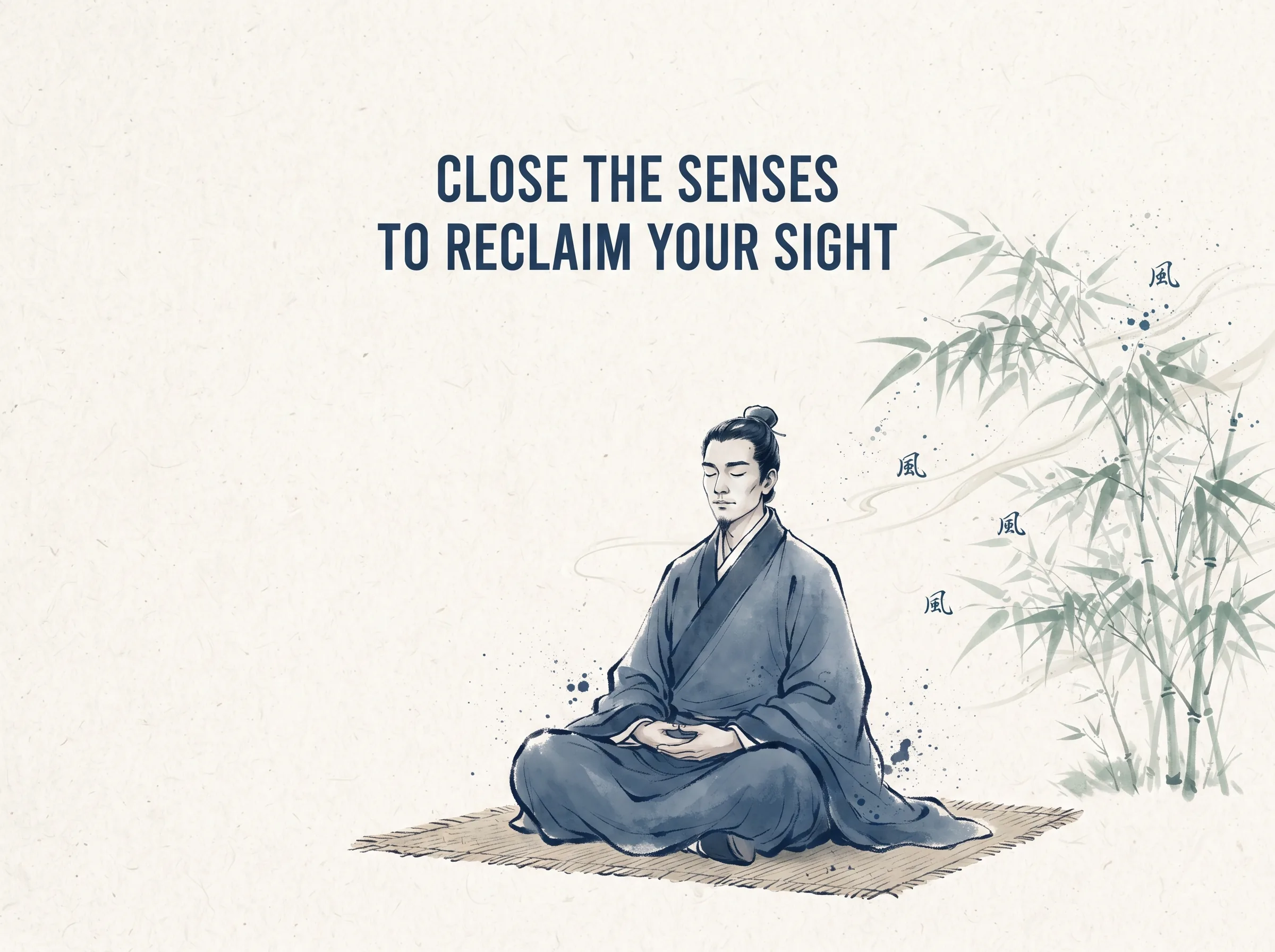
If you want to explore this further, consider reading the Tiandi chapter in translation, reflecting on one area of your life where control might be masking fear, and experimenting — even briefly — with stepping back and observing what happens when you stop trying to manage everything. The world may surprise you, reflecting the enduring wisdom of Zhuangzi Chapter 12 Meaning.
To explore these themes from another angle, read our related reflection on Why People Hear Truth But Still Resist It — A Zhuangzi Guide to Speaking That Actually Lands.
Deepen your understanding of these principles in our reflection on Can Virtue Become Violence? What Zhuangzi Knew 2,400 Years Ago.
Sources & Further Reading
[1] Further Reading (not cited in this article):
[2] Zhuangzi: Basic Writings, translated by Burton Watson — a widely used English translation of key chapters
[3] The Complete Works of Zhuangzi, translated by Victor Mair — another respected translation with extensive commentary
[4] Dao De Jing: A New Translation of the Tao Te Ching, translated by Robert G. Henricks — for understanding the related concept of wuwei in earlier Daoist thought






