
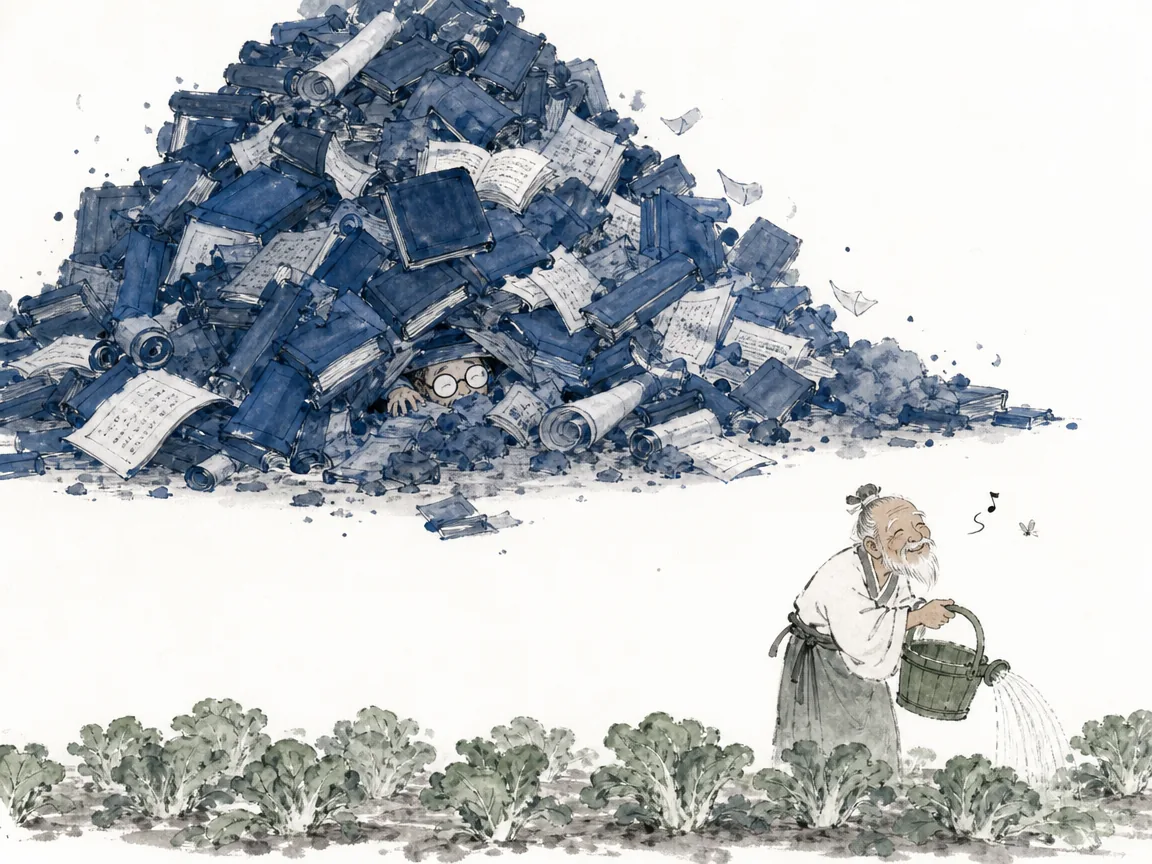
We live in an era when the sum total of human knowledge is available at a moment's notice. We carry libraries in our pockets, attend courses by the dozen, and collect bookmarks like talismans against uncertainty. And yet, many people report feeling more anxious, more confused, and more disconnected than at any point in recent history. Learning more has not automatically led to living better. This gap between knowing and wisdom is not a new problem, but it is one that Zhuangzi, the great Daoist philosopher of the fourth century BCE, diagnosed with remarkable precision more than two thousand years ago.
In the Tian Dao (天道) chapter of the Zhuangzi, Zhuangzi offers a radical diagnosis: human suffering often comes not from ignorance, but from mistaking knowledge, language, and cleverness for the Way itself. The text describes how the ancients left their words in texts but not what they accomplished and how—meaning the know-how that died with them [2]. In other words, the map is not the territory, the menu is not the meal, and the book is not the life. True wisdom is not accumulated—it is lived—a foundational perspective explored in Zhuangzi Chapter 13 Meaning.
This insight feels urgent today. A Pew Research Center survey found that 20% of American adults feel overloaded by information, even as 77% say they like having so much information at their fingertips [4]. The tension is structural: we want more, and yet more does not bring clarity. What ancient philosopher can tell us about this paradox? Zhuangzi's answer is both simple and unsettling. He suggests that the real problem is not too little knowledge but the wrong relationship to knowledge—the confusion between signs and reality, between technique and wisdom, between cleverness and the Way.
Zhuangzi Chapter 13 Meaning: Maps Are Not the Territory
Tian Dao (天道), meaning "the Way of Heaven," is the thirteenth chapter of the received Zhuangzi and belongs to the outer chapters [1]. It is not a description of a deity or a cosmic command. Rather, it points to the underlying order that allows all things to unfold naturally—the reason the sun rises without announcement, the seasons turn without negotiation, and plants grow without ambition. This order does not speak, yet it is present everywhere. It does not give commands, yet it moves all things.
Zhuangzi places human language, books, systems, and techniques before this standard and finds them wanting—not worthless, but subordinate. They are shadows of the Way, not the Way itself. A recipe is not nutrition. A manual is not skill. A philosophy is not a life. The Tian Dao chapter warns repeatedly against the habit of treating descriptions as if they were the reality they describe.
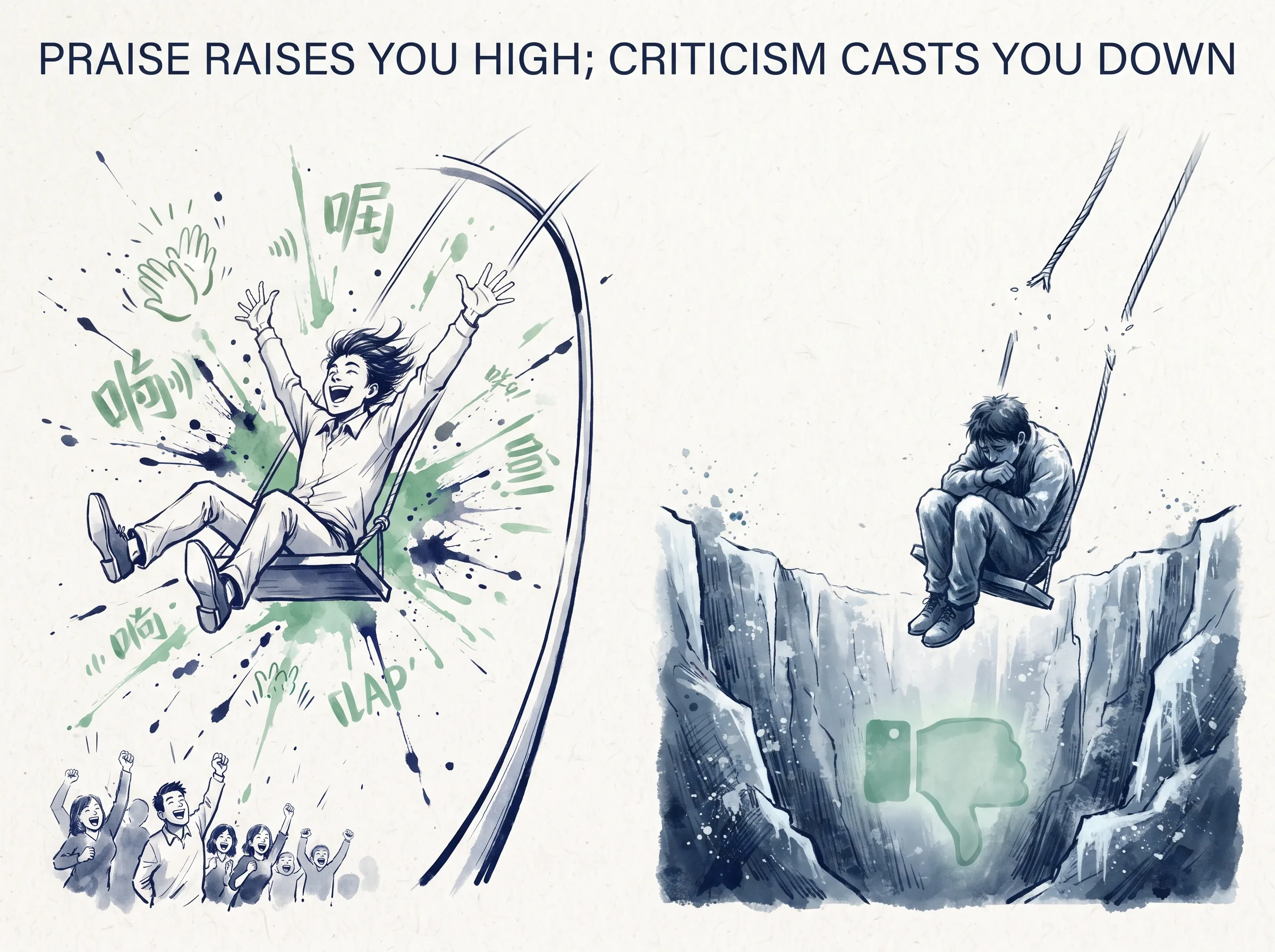
This is the same insight later captured in Western philosophy as "the map is not the territory," but Zhuangzi articulated it in a context where ritual, learning, and textual authority were already elevated to near-sacred status. His point was never anti-intellectual. He opposed the arrogance that mistakes accumulation for transformation. Knowledge is useful. Language is necessary. But when these become substitutes for experience, they turn into cages.
Continue with the deeper interpretation and practical application.
ChiDestiny members get access to the full analysis, modern applications, and the growing Chinese Wisdom Library.
Sources & Further Reading
[1] Mind (Heart-Mind) in Chinese Philosophy (Stanford Encyclopedia of Philosophy) — Discussion of the wheelwright passage in Tian Dao and its implications for the limits of verbally transmitted knowledge (yánchuán, 言传).
[2] Information Overload | Pew Research Center — Survey data on American adults' relationship with information volume, noting that 20% feel overloaded while 77% value having information accessible.
[3] Zhuangzi / Nourishing the Lord of Life (養生主) – Chinese Text Project — Original text of the Cook Ding parable from Yang Sheng Zhu, confirming its location outside Tian Dao.
[4] Zhuangzi / The Way of Heaven (天道) – Chinese Text Project — Source text for the Tian Dao chapter, where the wheelwright Bian dialogue and the chapter's reflections on language and the Way are found.
Further Reading
- Zhuangzi, The Complete Works, trans. Burton Watson. Columbia University Press.
- Chen Guying (陳鼓應), Zhuangzi Jiazhu Pingyi (莊子譯註). Zhonghua Shuju.
- Harro von Senger, "The Concept of 'Nature' in Zhuangzi." In The Cambridge Companion to Confucianism.
- Roger T. Ames and David L. Hall, Dao De King: Making This Life Significant. Ballantine Books.
FAQ
Is Zhuangzi saying we should stop learning entirely? No. Zhuangzi does not reject knowledge, language, or study. He warns against treating them as substitutes for lived experience. Learning is valuable when it transforms your understanding and your way of being, not when it merely increases the volume of what you can say without having genuinely internalized.
What exactly is Tian Dao (天道)? Tian Dao literally means "the Way of Heaven" and appears as the thirteenth chapter of the received Zhuangzi [1]. It refers not to a deity or a set of cosmic commands but to the underlying natural order that allows all things to unfold spontaneously—the order by which seasons change, plants grow, and rivers flow without intention or force. The Tian Dao chapter examines how human systems, language, and cleverness relate to this deeper order.
Is the Cook Ding story from Tian Dao? No. The famous parable of Cook Ding (庖丁解牛) appears in the Yang Sheng Zhu (养生主), the third inner chapter of the Zhuangzi, not in Tian Dao [1]. The two parables are often discussed together because they share the same theme—wise action follows natural structure rather than forcing against it—but they come from different chapters.
How does this apply to someone who feels overwhelmed by information? The Tian Dao chapter offers a simple but demanding practice: pause and ask whether the information you are consuming is helping you live more clearly or merely adding to the noise. If it is the latter, the issue is not too little knowledge but the wrong relationship to it. Zhuangzi would suggest reducing consumption, increasing attention to direct experience, and measuring learning by changes in your life rather than by the number of concepts you can name.






