
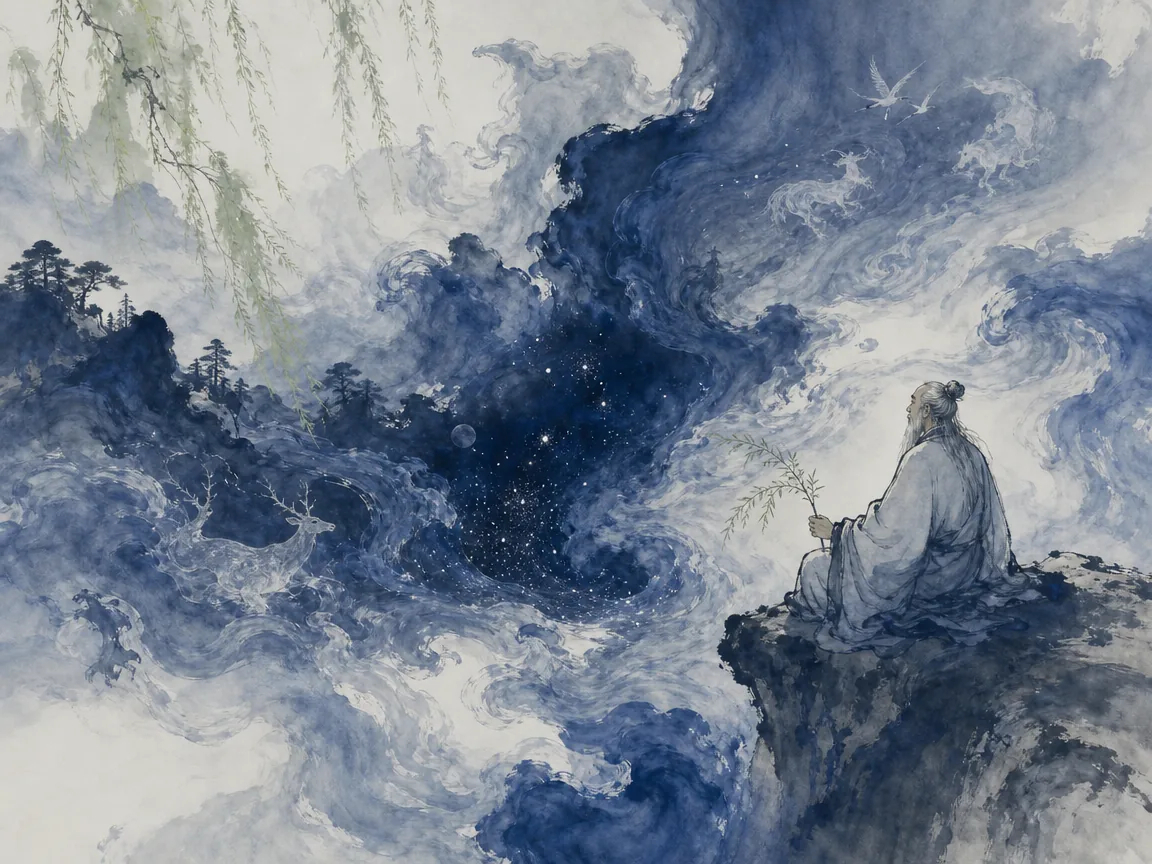
The first time you truly feel the weight of mortality — perhaps standing at a hospital bedside, staring at an empty chair at the dinner table, or lying awake at 3 a.m. with the quiet certainty that one day you will not wake — it hits with a physical force. The mind rebels. Not because death is unknown, but because life is known too well. You have built a world around someone, or something, or someone's absence now creates a hole that logic cannot fill. This is the moment when most self-help advice falls flat. "Stay positive." "Focus on the present." "Everything happens for a reason." These phrases may come from love, but they often land like indifference, because they ask you to manage an emotion that was never meant to be managed — it was meant to be understood.
Two thousand years ago, a philosopher named Zhuangzi wrote about this exact ache. Not with clinical detachment, but with a clarity so precise that it feels almost unbearable — in the best sense. In a chapter called Da Zong Shi (大宗师, "The Great and Venerable Teacher"), he does not tell you to stop grieving. He asks a more radical question: What if the suffering comes not from loss itself, but from the belief that you are a separate, fixed self fighting against a universe that simply moves? What if your fear of death is, at its root, a fear of losing control — and what if letting go of that control is not surrender, but the deepest form of freedom? This principle is central to Zhuangzi Chapter 6.
This essay is not a prescription for how to stop hurting. Grief is not a problem to solve. But it may be a doorway to see more clearly — and Zhuangzi's teaching offers a lens that can help you walk through it without breaking.
Zhuangzi Chapter 6: Living in Reaction, Not in Alignment
Modern culture conditions us through anxiety, competition, desire, and fear — not through understanding. We are taught what to want, what to avoid, how to measure success, and who to blame when things change. A career ends? You lacked resilience. A relationship fades? You didn't try hard enough. Someone dies? There must have been something you could have done differently. This framework turns life into a series of personal failures to avoid, rather than a natural flow to participate in.
Zhuangzi opens Da Zong Shi by posing a direct challenge: Are these external voices — societal expectations, personal ambitions, cultural definitions of a life well-lived — truly your teachers? Or is there something deeper you can learn from? The chapter suggests that much of our suffering does not come from events themselves, but from the layer of interpretation we pile on top of them. When you confuse the two — when you treat the uncontrollable as if it were yours to command — suffering becomes automatic [2].
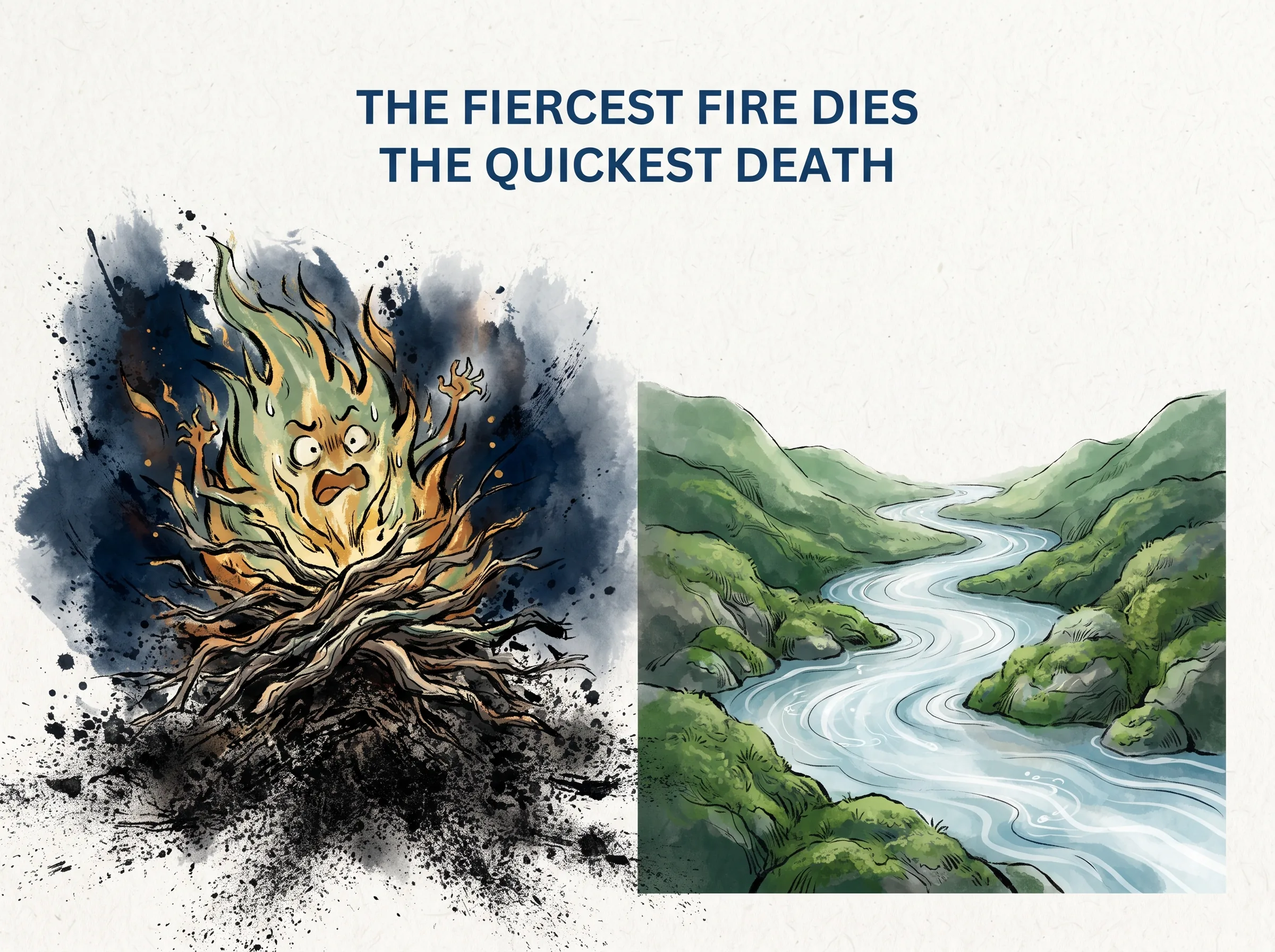
Consider the ordinary loop: you love someone deeply, which is beautiful and true. Then fear enters — not because love is wrong, but because love makes you vulnerable to loss. The fear leads to attempts at control: over schedules, over health choices, over how much time remains. When control fails (as it always does), guilt and anxiety deepen the wound. Zhuangzi does not say this makes you weak. He says it makes you human — and that the path forward is not to become colder, but to become clearer about what belongs to you and what belongs to the larger current you are part of.
The Core Distinction: What Belongs to Heaven vs. What Belongs to You
The pivotal line in Da Zong Shi is this: "To know what belongs to Heaven and what belongs to Human — that reaches the summit" [2]. Zhuangzi does not define these categories with a checklist, but the passage that follows gives the direction clearly. Birth, aging, death, the limits of the body, events shaped by forces beyond personal will — these are described as belonging to Heaven (天, Tiān). How you respond, how you settle yourself within limits, how you move with change rather than against it — these are the domain of human action (人, Rén).
Most of our distress, Zhuangzi suggests, comes from treating the first category as if it were the second. You cannot control aging. You cannot prevent death. You cannot guarantee that someone you love will stay. But you can respond with clarity. You can grieve without believing the grief means something is fundamentally wrong. You can act fully in the time you have, without demanding permanence as a condition for meaning.
This is not passive resignation. It is a reorientation of attention. When you stop trying to manage what cannot be managed, energy becomes available for what can be met — presence, care, honesty, gratitude. The distinction is not meant to erase emotion, but to stop emotion from spiraling into despair by being fed by false assumptions about control.
The True Person: Stability Without Coldness
Zhuangzi paints a portrait of what he calls the true person (真人, Zhēn Rén): "They do not rejoice in life, nor dread death; they do not cling to arrival, nor shun departure" [2]. At first reading, this sounds like emotional numbness — or worse, indifference. But Zhuangzi immediately clarifies that this is not the absence of feeling. It is the absence of being hijacked by it.
The ordinary person loves life, yes — but often with a hidden condition: life must not end. Love becomes entangled with possession. The fear of loss infects the joy of presence. The true person, by contrast, loves fully precisely because they are no longer terrified of love's impermanence. Their stability comes not from having more control, but from having less investment in a specific outcome.
Zhuangzi describes this state in simple, almost physiological terms: "Their sleep is without dreams, their waking without worry, their breathing deep and rooted" [2]. This is not a promise of supernatural peace, but an observation about what happens when the nervous system is no longer trapped in a constant state of reaction — when you are not bracing for the next blow, not replaying the last one, not performing for approval you will never quite earn. It is a calm that can be recognized in everyday terms: deep breath, untroubled sleep, a willingness to be exactly where you are without needing it to be different.
Sitting and Forgetting: Loosening the Bonds
One of the most striking passages in Da Zong Shi is a conversation between the disciple Yan Hui and the philosopher Confucius about a practice called zuo wang (坐忘, "sitting and forgetting"). Yan Hui says: "I have abandoned my limbs, ejected my hearing and sight, cast off form, and put away knowledge — this is called sitting and forgetting" [2]. To study the primary classical text and commentary, explore the original Chinese text and deep philosophical translation in The Great and Most Honoured Master: The True Person of Old and Forgetting All.
This is not literal self-harm or intellectual emptiness. It is a metaphor for unbinding. Zhuangzi identifies three layers that commonly trap awareness:
First, body sensations that hijack attention — hunger, tension, fatigue, pleasure — pulling you constantly toward relief or pursuit. Second, emotional reactivity to every external stimulus, where a word, a look, or an event triggers an automatic spiral. Third, cognitive labeling — the constant mental filing system of good and bad, success and failure, gain and loss — that obscures the living flow beneath the categories.
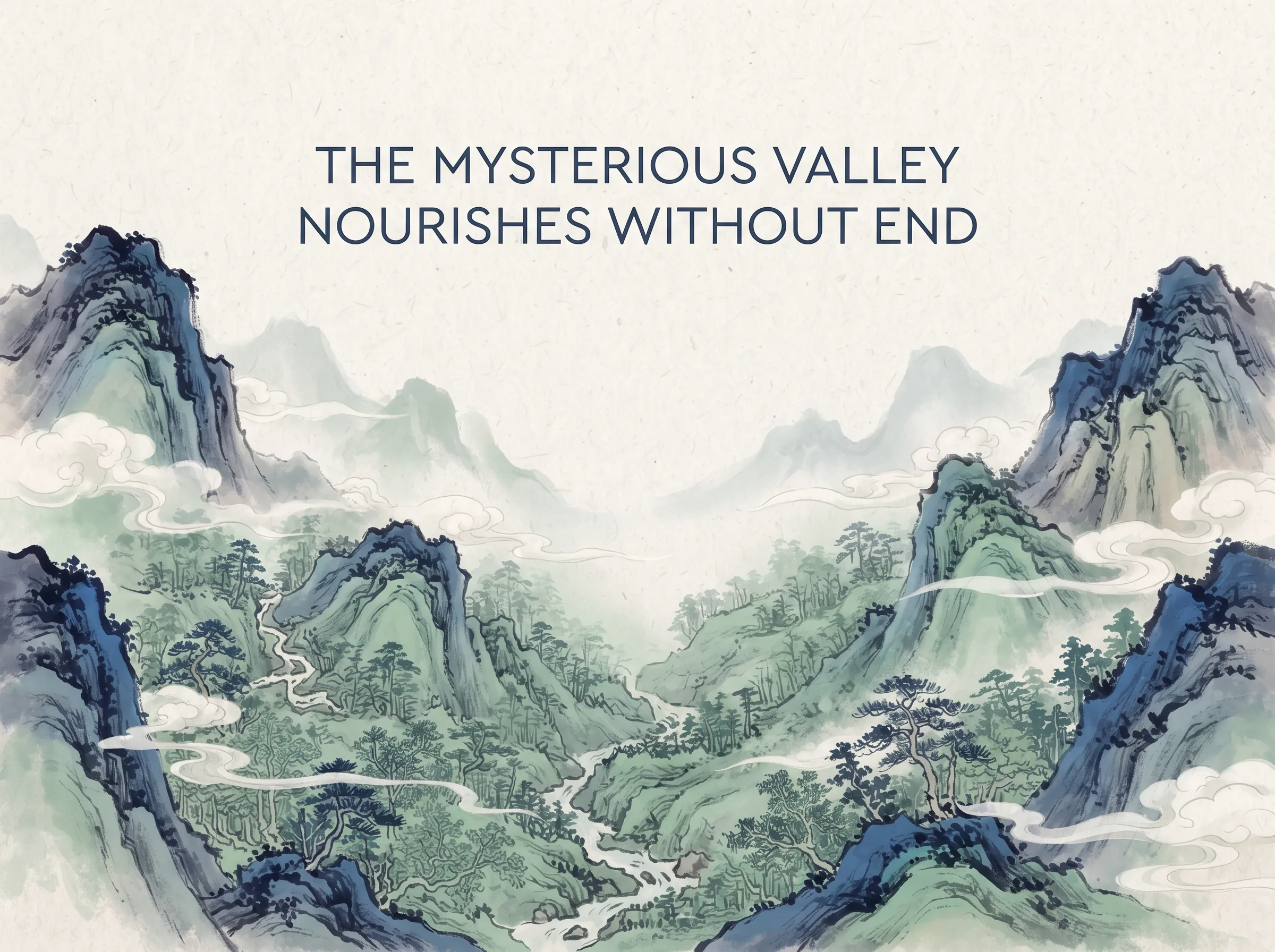
"Forgetting" in this context means releasing the grip, not erasing identity. It is the difference between having a role and being consumed by it. You still have a name, a history, relationships — but those things no longer dominate your sense of who you are or dictate your emotional state. The self that needs proving, defending, and securing begins to loosen.
Death as Transformation, Not Destruction
Perhaps the most powerful moment in Da Zong Shi comes near the end, when a figure named Zi Lai lies dying. His family weeps around him. Instead of resentment or fear, Zi Lai speaks these words: "Heaven and Earth form the great furnace; creation and transformation are the skilled smith. Where could I go that would not be right?" [2]
He is not denying his mortality. He is reframing it. The body is not a possession to be hoarded — it is a temporary form within an ongoing process. Earlier in the same chapter, Zhuangzi writes: "The great earth bears me in form, labors me in life, rests me in age, and gives me peace in death. Therefore to goodify my life is to goodify my death" [2]. Death is not the opposite of life; it is life's natural return to the whole from which it came.
Zhuangzi does not say grief is wrong. In the very passage where Zi Lai speaks of transformation, his family is weeping — and Zhuangzi records it without judgment. Tears are natural. Being imprisoned by them is the choice. The teaching is not to suppress sorrow, but to prevent sorrow from becoming a story of injustice against the universe. When grief is held within a wider understanding, it can remain honest without turning into despair.
A Modern Reader's Challenge
If you truly understood that you are a phase of cosmic transformation — not a fixed, isolated entity — how would that change the way you live? What would you stop fighting? What would you start doing differently? These are not abstract questions. They touch the practical center of every relationship, every career decision, every moment of fear about the future.
Below are a few ways to bring Zhuangzi's insights into daily life. They are not exercises in spiritual bypassing. They are grounded in the texture of ordinary experience.
Practical Guidance for Working With Change and Loss
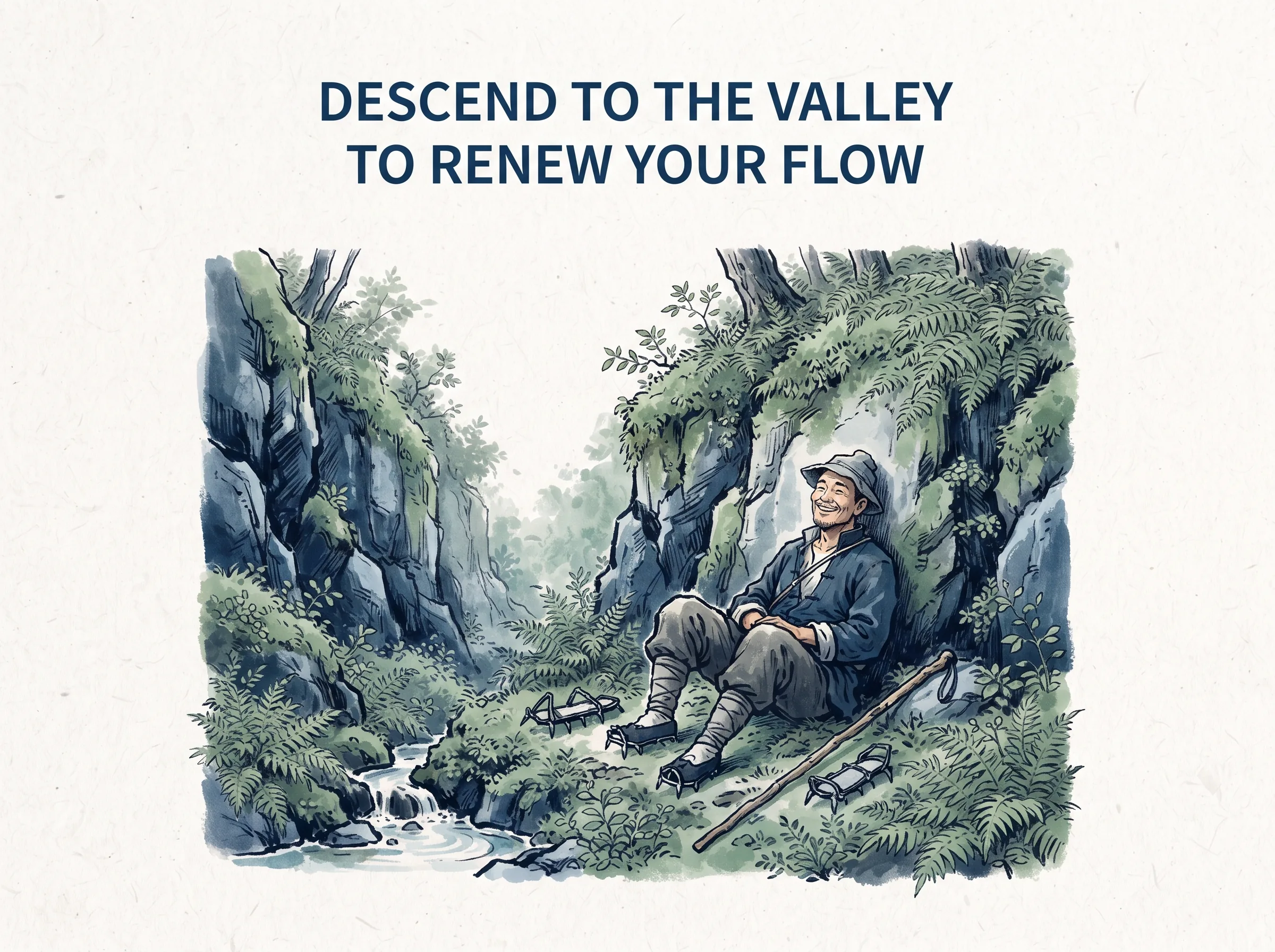
1. Name the distinction — Heaven vs. Human. When anxiety rises about something you cannot change (a diagnosis, a departure, the aging of a parent, your own mortality), pause and ask: Is this mine to influence, or mine to accept? Write it down if it helps. The act of naming the boundary between what you can and cannot control is itself a form of relief.
2. Practice one layer of zuo wang per day. You do not need to sit in meditation for hours. Choose one layer to loosen:
- Body: When tension rises, notice it without immediately trying to fix it. Breathe into it.
- Emotion: When a strong feeling arises, let it move through without narrating it as a permanent truth.
- Cognition: Notice when you are labeling an experience as "good" or "bad" and ask: Is this actually true, or is this just my habit of judgment?
3. Reframe one moment of loss as transformation. When something ends — a relationship, a job, a stage of life — instead of asking Why did this happen to me?, try asking What is this returning to? What was never really mine to keep? This is not cold rationalization. It is an expansion of perspective that can soften the edges of grief.
4. Sit with the question Zi Lai faces. When fear of death or loss visits, consider: If this moment, too, is part of a larger flow — not a punishment, not a mistake, but a phase within a process I am part of — what would that change about how I meet it right now? You do not need to believe this fully. You only need to let the question sit with you.
Frequently Asked Questions
Q: Does Zhuangzi's teaching mean I should not feel sad when someone dies?
No. Zhuangzi does not say grief is wrong. In Da Zong Shi, even as Zi Lai contemplates death as transformation, his family weeps beside him and the text records their tears without condemnation. The teaching is not to suppress sorrow, but to prevent sorrow from hardening into the belief that something has gone fundamentally wrong with the universe. Grief is natural. Being trapped by it is where the opportunity for clarity begins.
Q: Isn't this just a way to avoid dealing with real pain?
It can be used that way — no philosophy is immune to misuse. But Zhuangzi's teaching is not about avoidance. It is about seeing more clearly. Avoidance says, I will not think about death. Zhuangzi says, Look directly at death and see that it is part of the same process as life. The difference is between closing your eyes and opening them wider. Both approaches deal with reality; one tries to escape it, the other meets it.
Q: Can I practice this without being interested in Daoism or ancient philosophy?
Yes. The practical elements — distinguishing what you can control from what you cannot, noticing the layers of conditioning that drive your reactions, reframing loss within a broader context — do not require belief in any particular tradition. They are tools for seeing more clearly, regardless of your background. Zhuangzi's language is ancient, but the problems he addresses are immediate.
Q: What if I am in the middle of acute grief and this feels impossible to apply?
That is completely understandable. These reflections are not meant for the raw, fresh wound — they are for the moments when the pain has settled enough to allow a wider view. You do not need to force anything. Sometimes the most honest response to loss is simply to let yourself feel it. When you are ready, you can return to these questions gently, without pressure.
Closing Thoughts
Zhuangzi's Da Zong Shi does not offer comfort in the way we usually expect. It does not tell you that everything will be okay, or that the pain will pass quickly, or that there is a plan you can trust. Instead, it offers something arguably more valuable: a shift in perspective that changes how pain is carried.
The fear of death and the ache of loss are not problems to solve. They are invitations to see more clearly — to notice where you are clinging, where you are confusing what is yours with what belongs to a larger flow, where your sense of self has become narrow enough to make every change feel like a threat. When you broaden that sense, life does not become easier. It becomes deeper.
You do not need to abandon your attachments to find peace. You only need to stop believing they are permanent. You do not need to stop loving. You only need to love without demanding that love defeat time. And you do not need to become a true person overnight. You only need to notice, in small moments, where you are fighting what cannot be fought — and breathe, and let go, just a little.
Next step: If this resonance stayed with you, try the practical guidance above for one week. Pick one tool — the Heaven/Human distinction, a single layer of zuo wang, or the Zi Lai reflection — and return to it gently each day. You do not need to master it. You only need to practice noticing, reflecting the enduring wisdom of Zhuangzi Chapter 6.
To explore these themes from another angle, read our related reflection on When Tools Become Masters: What Zhuangzi’s Chapter 26 Teaches Us About Losing Our Inner Sovereignty.
Deepen your understanding of these principles in our reflection on Why the Most Exhausted People Often Have Everything.
Sources & Further Reading
[1] Primary source
[2] Zhuangzi / Da Zong Shi (大宗师) — Chinese text of Chapter 6 of the Zhuangzi, containing the passages on the true person, sitting and forgetting, Zi Lai's final words, and the fish in the dried puddle.
[3] Secondary reference
[4] Chinese Ethics — Stanford Encyclopedia of Philosophy — Academic overview of ethical thought in classical Chinese philosophy, including contextual discussion of the Zhuangzi.
[5] Contemporary research on related themes
[6] Practitioner perspectives on the use of acceptance and commitment therapy for bereavement support — PMC — Qualitative study examining how psychological flexibility, acceptance, and value-directed action relate to grief support; findings suggest potential but note limited evidence.
[7] Coping Flexibility and Complicated Grief: A Comparison of American and Chinese Samples — PMC — Comparative study linking lower coping flexibility to complicated grief, relevant to discussions of rigidity versus adaptability in responding to loss.
[8] Further reading (not cited in this essay)
[9] Watson, Burton (trans.). The Complete Works of Zhuangzi. Columbia University Press.
[10] Bruette, Brian. Zhuangzi: Philosophical Texts. Oxford University Press.
[11] Chinese Ethics — Stanford Encyclopedia of Philosophy — For broader philosophical context beyond this essay's scope.






