
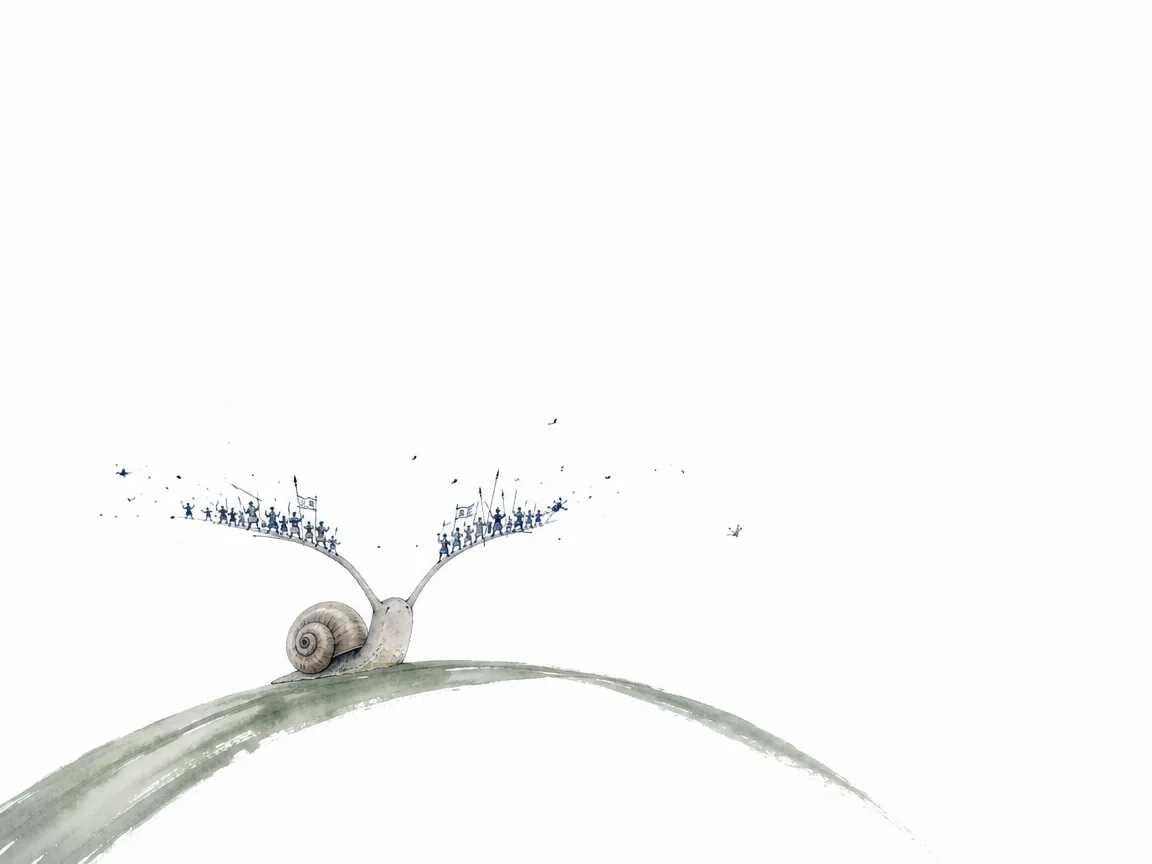
There is a story in the Zhuangzi that sounds like nonsense until it stops sounding like nonsense. A man named Dai Jinren visits the king of Wei and tells him about two states, one on the left horn of a snail and one on the right. They fight over territory. Tens of thousands die. The victorious army chases the defeated for fifteen days before turning back [2]. The king, confronted with this image, is supposed to realize how absurd his own plans for war and assassination look when measured against the infinite [2].
You may not be waging war over a snail's horn. But you are likely fighting something that, from a wider angle, looks remarkably like a snail-horn war. The office rivalry that drains your week. The social media thread that pulls you into circles you swore you'd leave. The family grievance you keep rehearsing like a case you haven't closed. The identity you've built around being the person who saw through something others missed. None of these are zero. But each one has a habit of inflating itself inside your nervous system until it occupies the entire sky—a foundational perspective explored in Zhuangzi Chapter 25 Meaning.
Zhuangzi is not offering an excuse to opt out. He is offering a method of scale. The problem, on his reading, is rarely the size of the event itself. It is the size of the frame you are using to view it.
Zhuangzi Chapter 25 Meaning: Two States on a Snail's Horn
The passage appears in the Ze Yang chapter, the twenty-fifth chapter of what scholars classify as the Miscellaneous Chapters of the received Zhuangzi [1] [2]. In it, Dai Jinren uses a deliberately jarring image to disturb the king's certainty [2]. The text does not spell out the moral in a neat sentence; the point emerges from the contrast between the scale of the conflict and the scale of the ground it is fought over [1] [2].
The two states are called Chushi and Manshi, located on opposite horns of a single snail [2]. They wage war. Bodies fill the ground. The pursuit lasts fifteen days [2]. From inside the horn, the war is catastrophic. From outside, it is almost comic. Both perspectives are real. Neither is total.
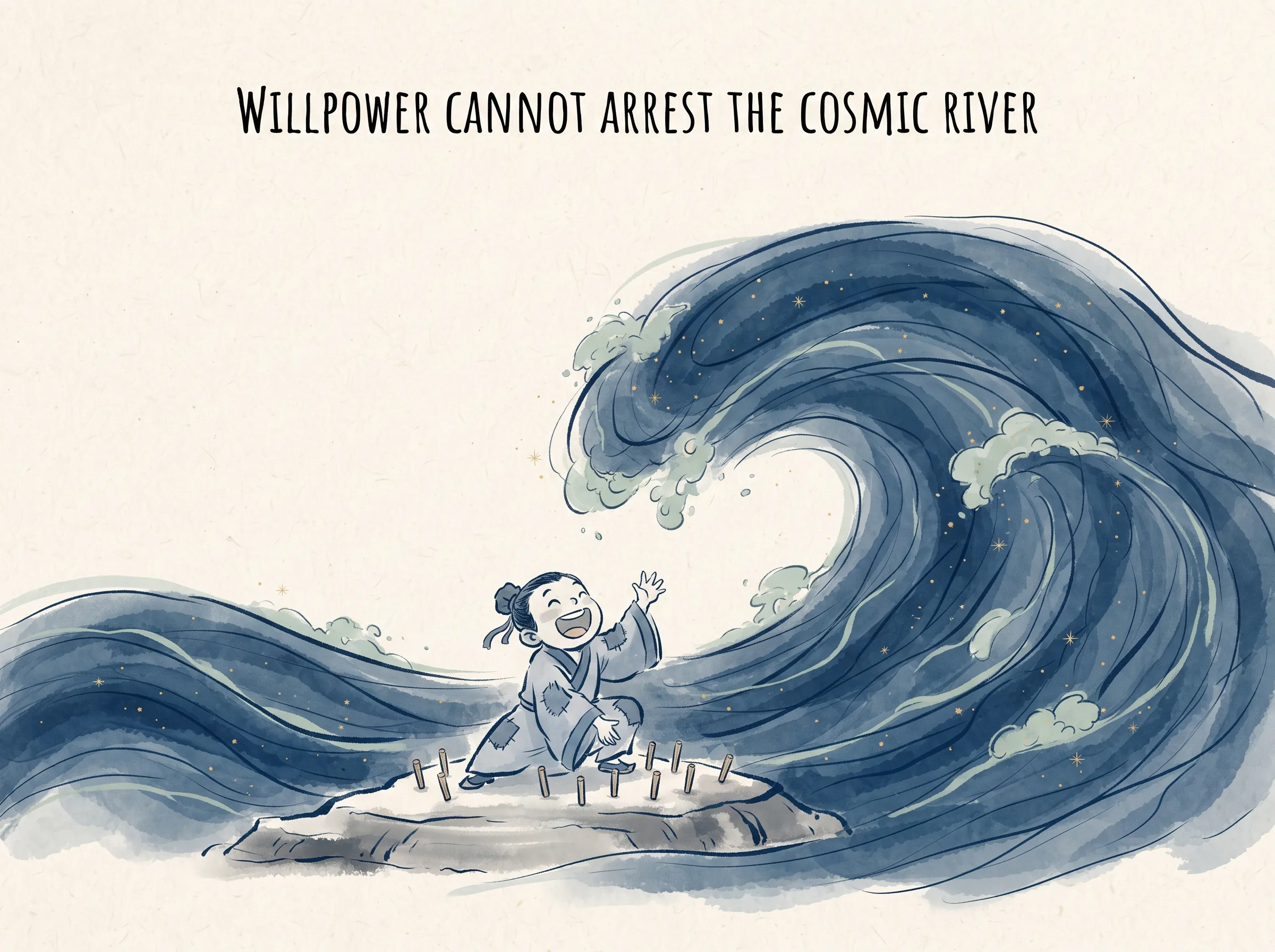
This is the opening move of Zhuangzi's method. He does not begin by telling you your feelings are wrong. He begins by asking you to check the size of the container in which those feelings live. A conflict that fills your Tuesday does not have to fill your life. A moment that feels defining does not have to be. The text invites the king, and the reader, to practice exactly this shift in perspective.
Continue with the deeper interpretation and practical application.
ChiDestiny members get access to the full analysis, modern applications, and the growing Chinese Wisdom Library.
FAQ
Is the snail-horn story actually from the Zhuangzi? Yes. The passage appears in the Ze Yang chapter, which belongs to the Miscellaneous Chapters of the received Zhuangzi [1] [2]. It features two states on a snail's horn and is attributed in the text to a man named Dai Jinren speaking to the king of Wei [2].
Does Zhuangzi want me to stop caring about my problems? No. The text distinguishes between proper care and misplaced scale [2]. Problems are real. The danger is inflating them beyond their actual size until they dominate your attention and your identity.
Is "knowing fate" the same as giving up? No. Classical passages in the Zhuangzi frame acceptance of the uncontrollable as clarity, not passivity [3] [4]. You still act. You just stop punishing yourself for outcomes outside your control.
What is the practical takeaway for someone feeling stuck in daily conflicts? Check the scale. Ask whether the frame you are using is appropriate for the event. Separate effort from outcome. Protect your attention from small containers that have grown too large in your mind.
Closing Thoughts
The snail-horn war is not a joke about your problems. It is a mirror for your scale. Zhuangzi does not ask you to abandon your battles. He asks you to verify whether the ground you are fighting over is as large as your nervous system assumes. Most wars worth fighting are larger than a single corner of your life. Most wars you are currently fighting are smaller than your anxiety makes them appear.
The next step is not to escape the world. It is to widen the frame. Read a little outside your usual circle. Talk to someone whose priorities differ from yours. Spend time with nature or art that does not reward productivity. Let your mind practice carrying a larger container. Then return to your work, your relationships, and your projects with a simpler question: is this war actually on a snail's horn?
If the answer is yes, you do not have to stop fighting. You just have to stop letting the fight consume you, reflecting the enduring wisdom of Zhuangzi Chapter 25 Meaning.
To explore these themes from another angle, read our related reflection on What Does It Mean to Truly ‘Have’ Something?.
For a deeper comparative examination of these ideas, explore our related study on Why Your Strength Isn’t Real Strength — Zhuangzi on What Happens When the Ground Drops Out.
Sources & Further Reading
[1] Zhuangzi (Stanford Encyclopedia of Philosophy/Fall 2025 Edition) — Discussion of Zhuangzi's relativist talk of dependence on location, trajectory, and momentum, and the open-textured conclusions of the parables
[2] Zhuangzi / Zeyang (莊子/則陽) – Wikisource — Original Chinese text of the Ze Yang chapter, including the snail-horn parable with Chushi and Manshi
[3] Zhuangzi / In the World of Men (莊子/人間世) – Wikisource — Passage on accepting what cannot be changed and aligning with fate
[4] Zhuangzi / Mastering Life (莊子/達生) – Wikisource — Passage on recognizing the limits of what can be controlled ### For Further Reading
[5] Zhuangzi / Zeyang (莊子/則陽) – Wikisource — Full chapter for contextual study of the snail-horn passage and its surrounding dialogues
[6] Zhuangzi (Stanford Encyclopedia of Philosophy/Fall 2025 Edition) — Scholarly overview of Zhuangzi's philosophical themes, including skepticism toward fixed viewpoints and the role of parables in conveying insight






