
Most of us carry a quiet, unexamined assumption: that if we look stable, we are stable. A successful career, a calm demeanor in conversation, the ability to handle multiple demands — these feel like evidence of an inner core that can't be shaken. And so when pressure finally hits, something unexpected happens. The person who has always seemed composed, capable, even serene, suddenly fractures. Words they cannot take back. Decisions made from panic. A self-image that crumbles faster than they thought possible.
The unsettling truth is that most of us cannot tell the difference between appearance and rootedness until the moment of rupture. We confuse the conditions that allow us to perform well with genuine inner freedom. We mistake a well-maintained persona for a cultivated self. This gap — between what we project and what we actually hold — is one of the deepest problems classical Chinese philosophy identified long before the modern age—a foundational perspective explored in Zhuangzi Chapter 33 Meaning.
Zhuangzi, who flourished through the latter half of the fourth century BC [1], explored this question with unusual sharpness. Across several chapters of the text that bears his name, he returns again and again to a single concern: what happens to the self when the external scaffolding that supports it is removed? The answer is not comforting, but it is honest.
Zhuangzi Chapter 33 Meaning: Two Levels of Mastery
One of the most revealing passages in the Zhuangzi involves the archer Lie Yukou. He has gathered a small audience, most notably the figure Bo Yin Wu Ren, to demonstrate his skill. He draws the bow to full extension, balances a cup of water on his wrist, and releases arrow after arrow without spilling a drop. The account describes it with spare precision: arrows land one after another, the next already being nocked before the previous has struck — a display of control so complete it borders on the supernatural.
To most observers, this would be conclusive proof of mastery. But Bo Yin Wu Ren responds differently. He says something that cuts to the heart of the matter: "This is the archery of shooting, not the archery of not-shooting."
The distinction is subtle but enormous. The archery of shooting is technique held together by tension, attention, and the constant management of outcome. It works — brilliantly — as long as nothing disrupts the conditions that produced it. The archer's skill depends on everything being exactly right: the stance, the breath, the environment, the awareness of being watched. It is real skill, but it is conditional skill. The self remains hostage to the result.
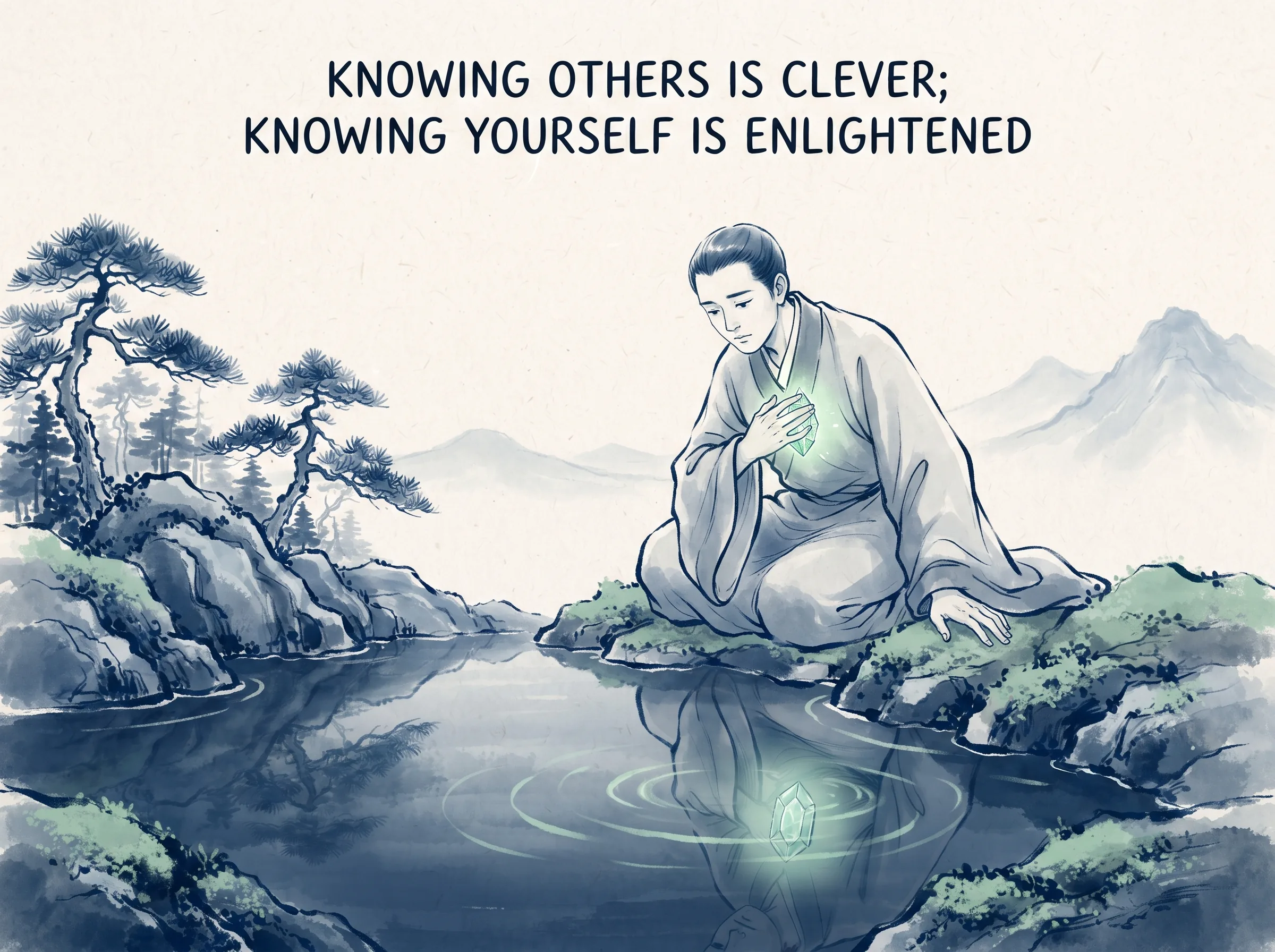
The archery of not-shooting is different. It is not the absence of skill but its deepening. The bow is still drawn, the arrow still flies, but the relationship between the archer and the act has changed. There is no longer a thin membrane of ego standing between intention and execution, waiting to be pierced by failure or fed by success. The archer is not less skilled; the skill has simply stopped being a performance of the self. It has become an expression of something larger.
Bo Yin Wu Ren sees this distinction immediately, and he knows that Lie Yukou has not yet crossed it. So he does something that tests the boundary between them.
What the Cliff Edge Reveals
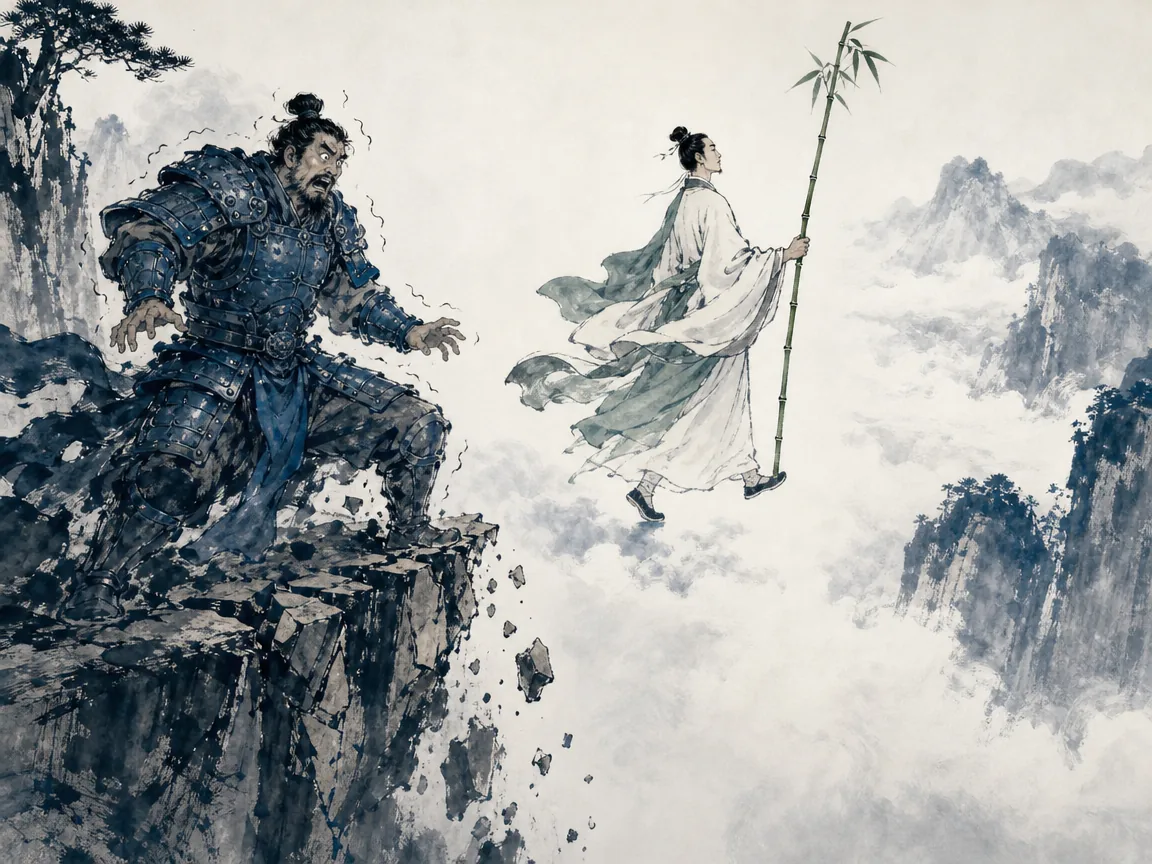
Bo Yin Wu Ren leads Lie Yukou to a mountain, stands him on unstable stone, and moves until half his foot hangs over a precipice a hundred ren deep. Then he invites him forward.
Lie Yukou collapses. He presses himself to the ground and sweats until the perspiration reaches his heels.
The transformation is total and humiliating. The man who had balanced water on his wrist without spilling a drop is now unable to stand on solid ground when a real threat is placed before him. His composure was not a quality of his character — it was a product of safe conditions. Remove the safety, and the architecture of his self-possession disappears.
This is the test that matters. Safety does not prove stability; pressure reveals what safety conceals. The cliff edge is not a punishment but an honest mirror.
Modern life offers countless equivalents. Consider the professional who handles routine work with effortless poise but unravels the moment a project faces real jeopardy. Consider the person who speaks with clarity and insight online but becomes defensive, reactive, or hollow when challenged directly. Consider the friend who seems completely at peace with their life until their partner, their employer, or their health status is actually threatened — and then the composure cracks in ways that shock everyone, including themselves.
The self-image trap is especially dangerous because it is almost invisible from the inside. We read our own competence and assume it is character. We mistake the absence of crisis for the presence of strength. We take our ability to manage predictable situations as proof that we could manage unpredictable ones.
Zhuangzi's point is that only the precipice can tell you which you have — and by then, it may be too late to rebuild what you thought was solid. To study the primary classical text and commentary, explore the original Chinese text and deep philosophical translation in Under Heaven: The Grand Survey of Chinese Philosophy and the Solitary Spirit of Zhuangzi.
Continue with the deeper interpretation and practical application.
ChiDestiny members get access to the full analysis, modern applications, and the growing Chinese Wisdom Library.
FAQ
Is the archery story about Lie Yukou really from the Zhuangzi? Yes. The encounter between the archer Lie Yukou and the figure Bo Yin Wu Ren appears in a chapter of the Zhuangzi traditionally associated with the name Tian Zifang (sometimes numbered Zhuangzi Chapter 33 Meaning). The passage describes Lie Yukou's precise archery display and Bo Yin Wu Ren's response that it represents the "archery of shooting" rather than the deeper "archery of not-shooting," followed by the cliff-edge test in which Lie Yukou becomes visibly overcome with fear.
Does Zhuangzi reject skill, success, and achievement entirely? No. Zhuangzi does not argue against competence or effort. His concern is specifically with the attachment that turns skill into a measure of self-worth, success into an identity, and achievement into a cage. A person can be highly skilled and still be free; the difference lies in whether the self is hostage to the outcome.
How should I think about Zhuangzi's views on death — is it pessimistic or hopeful? Zhuangzi's treatment of death resists simple categorization. He neither treats it as tragedy nor as something to be enthusiastically welcomed. Rather, he frames it as a return to the natural processes of the world — a transformation rather than an annihilation. From a practical standpoint, this perspective can reduce the anxiety that comes from treating every loss of status or role as an existential threat.
Can these ideas be applied without adopting any religious or spiritual practice? Yes. The Zhuangzi is fundamentally philosophical and literary rather than devotional. Its insights about conditional strength, the traps of reputation, and the value of groundedness do not require belief in any particular doctrine. They can be examined as observations about human psychology and social dynamics, regardless of one's religious orientation.
Discover the historical and philosophical roots in the classical foundation in Lie Yu-kou: Riding the Wind and Retaining the Jewel Under the Dragon’s Chin.
For a deeper comparative examination of these ideas, explore our related study on Why the Dao Is Already Here: Letting Go of the Quest for Something Far Away.
Sources & Further Reading
[1] Zhuangzi — Stanford Encyclopedia of Philosophy entry covering Zhuangzi's historical period (flourished through the latter half of the fourth century BC), the division of the text into Inner, Outer, and Miscellaneous chapters, and the scholarly consensus regarding authorship.
[2] Zhuangzi / Tian Zifang (田子方) – Zhuangzi Online — Digital edition of the Tian Zifang chapter containing the Lie Yukou archery passage and the cliff-edge test.
Further Reading
- Burton Watson translations of the Zhuangzi — widely available and frequently cited for accessibility to English readers.
- Victor H. Mair translations — another commonly referenced English-language rendering of the Zhuangzi text.






