
We live in an age that has never had so much information—and has never felt so deeply divided. Scroll through any feed, and you will find people speaking past each other with remarkable confidence, each armed with a fragment of explanation for everything from personal failure to global crisis. The sense that something essential is missing is not a personal failing. It is the signature texture of our moment: more inputs, less clarity; more certainty, more anxiety.
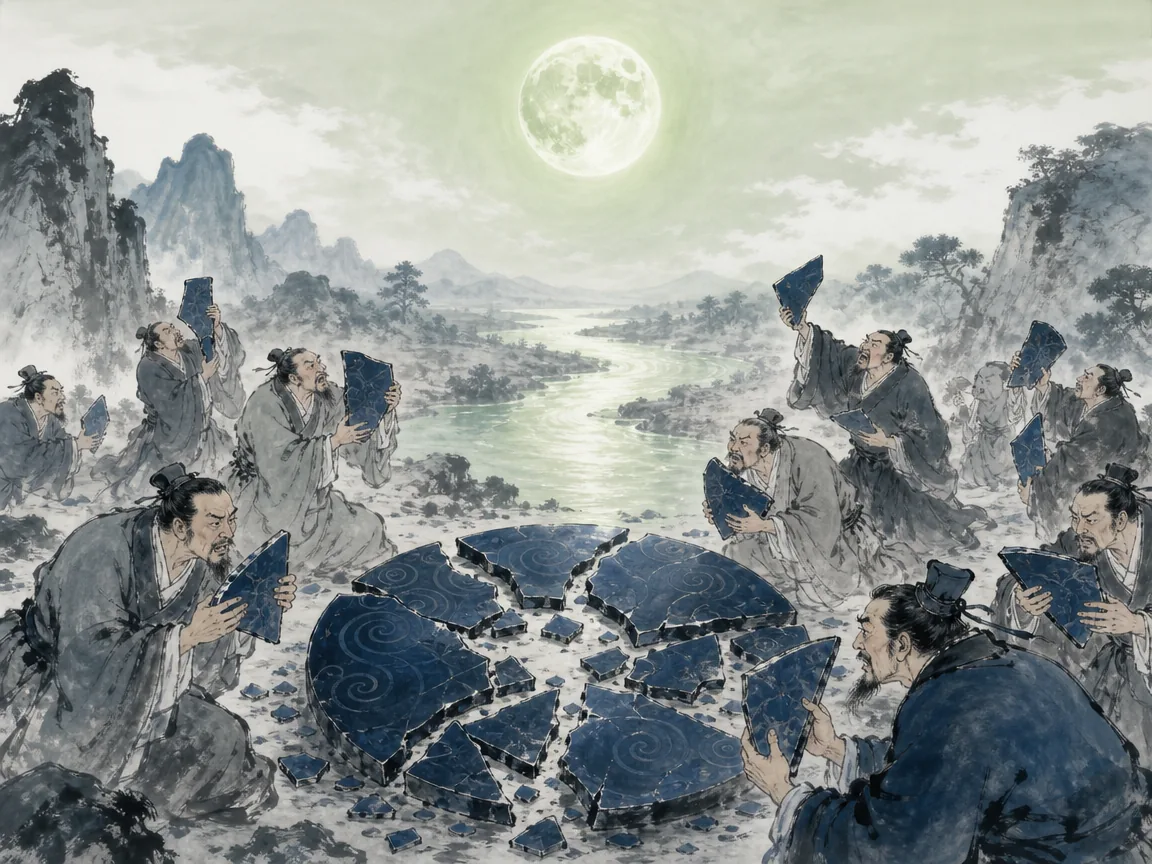
Two thousand years ago, a thinker named Zhuangzi described precisely this condition. In the final chapter of his book—known as Tianxia, or "Under Heaven"—he observed that as the world grew unstable and interests multiplied, the once-integral understanding of the Way splintered into competing schools, each seizing upon one facet of reality and mistaking it for the whole [1]. His diagnosis was radical: the danger is not ignorance, but half-knowledge dressed as total truth. People do not suffer simply because they lack answers. They suffer because they have adopted a single answer and used it to replace a living world—a foundational perspective explored in Zhuangzi Chapter 34 Meaning.
The question this essay explores is not how to find a better theory, but how to live honestly with partial understanding. Zhuangzi did not offer a new system to replace the old ones. Rather, he invited readers to recognize the limits of every system—including his own—and to recover a capacity for wholeness that no single discipline can provide. For anyone tired of choosing sides, exhausted by the demand to pick a framework and commit, this ancient reflection may offer a different kind of freedom: the freedom to think deeply without being captured by any single thought.
Zhuangzi Chapter 34 Meaning: The Paradox of Our Information Age
It is tempting to blame the internet for modern fragmentation, but the pattern Zhuangzi identified predates algorithms by millennia. What he called "the splitting of the Way under heaven" is not primarily a technological problem. It is a human one. Whenever societies grow complex and competition intensifies, knowledge tends to specialize. Different groups seize upon different aspects of reality and begin to treat their partial view as the complete picture [1].
This tendency is not new. The Hundred Schools of Thought in ancient China—Confucians, Mohists, Daoists, Legalists, Logicians, and others—each captured something genuine about how the world works. But each also narrowed its vision by elevating one principle above all others. A scholar focused on ritual saw the world through moral obligation. A strategist focused on power saw the world through control and consequence. A natural philosopher saw the world through spontaneity and flow. None were entirely wrong. All were incomplete.
Today, the same pattern repeats in new forms. A person who has read a few books on psychology may begin to explain every relationship through the lens of attachment and trauma. Someone steeped in economics may reduce every human decision to cost and incentive. A manager trained in data may see people primarily as productivity units. Each perspective illuminates something real. Each becomes a trap when it stops being a tool and starts being a worldview.
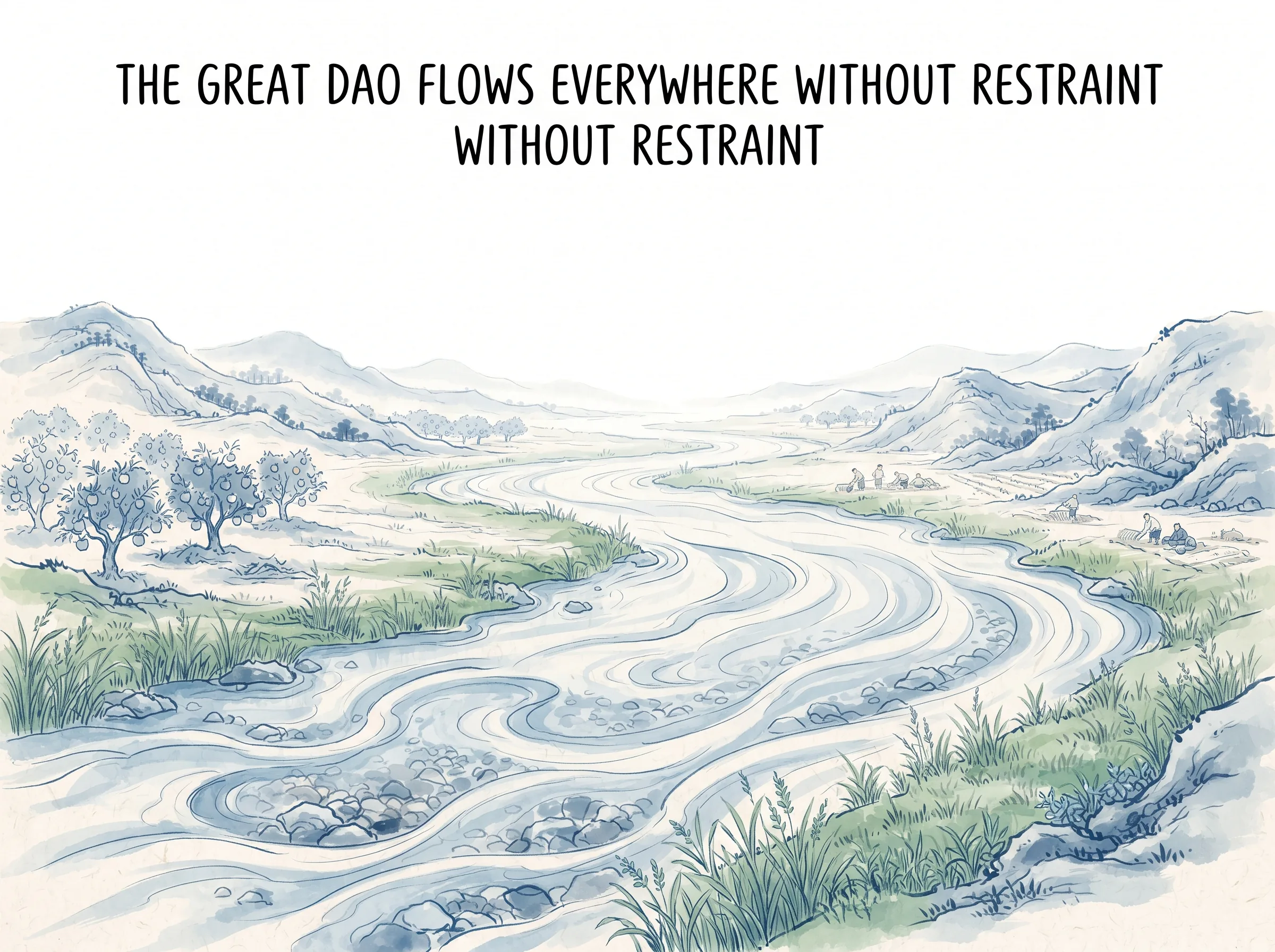
The psychological cost is significant. Certainty feels safe, but certainty built on fragments breeds anxiety rather than peace. When we believe we hold the complete answer, any experience that contradicts that answer feels threatening rather than informative. The mind, seeking comfort in chaos, clings to simple explanations—even flawed ones—because a wrong map still feels better than no map at all.
Continue with the deeper interpretation and practical application.
ChiDestiny members get access to the full analysis, modern applications, and the growing Chinese Wisdom Library.
Frequently Asked Questions
Is the Tianxia chapter definitely written by Zhuangzi himself? Most scholars agree that the Zhuangzi as we have it is a layered text compiled over centuries, and the final chapter is generally understood as part of that later accumulation rather than a direct composition of Zhuangzi's own hand [1]. This does not diminish its philosophical value, but it is worth noting that attributing every chapter to a single author misrepresents the text's history.
Does Zhuangzi think all knowledge is bad? No. Zhuangzi was deeply learned and intellectually sophisticated. His critique is not of knowledge itself but of the arrogance that arises when partial knowledge is mistaken for total truth. He warns against the use of knowledge as a weapon or an identity, not against the pursuit of understanding.
Can this ancient philosophy help with modern political polarization? Zhuangzi's analysis offers a psychological and cultural lens, not a political program. Research on social media algorithms suggests that while platform design can influence what content users encounter, the relationship between algorithmic curation and political attitudes is complex and not straightforwardly causal [3]. What Zhuangzi provides is a reminder that polarization is not merely a technological problem but a human one—rooted in the tendency to confuse partial perspectives with complete truth.
What should I do if I feel lost without a firm belief system? Zhuangzi does not offer comfort in the form of a new doctrine. His invitation is to find steadiness not in holding firmly to one answer but in developing the capacity to remain open amid uncertainty. This is not easy, and it does not eliminate anxiety entirely. But it shifts the goal from finding the perfect framework to cultivating a flexible, attentive relationship with whatever framework is useful in any given moment.
Conclusion
Zhuangzi's Tianxia does not solve the problem of fragmentation. It names it—and in naming it, it loosens its grip. The chapter reminds us that every system of thought is a perspective, and every perspective is limited. The goal is not to abandon thinking but to think with humility, to use ideas without being used by them, and to remain open to realities that exceed any single framework.
If you want to go deeper, the Tianxia chapter is best read alongside the earlier chapters of the Zhuangzi, particularly the Qiwulun and Zhibiyao ("The Greatest Happiness"), where Zhuangzi develops his reflections on perspective, language, and freedom. The Stanford Encyclopedia of Philosophy entry on Zhuangzi offers a reliable scholarly overview of the text's composition and key themes [1]. For those interested in the historical context of the schools Zhuangzi critiques, the entry on the School of Names provides useful background on the Logicians and figures like Hui Shi [2], reflecting the enduring wisdom of Zhuangzi Chapter 34 Meaning.
To explore these themes from another angle, read our related reflection on From the Northern Ocean to the Nine-Thousand-Li Sky: Zhuangzi’s Blueprint for Unconditional Freedom.
For a deeper comparative examination of these ideas, explore our related study on Why the Most Exhausted People Often Have Everything.
Sources & Further Reading
[1] Zhuangzi — Stanford Encyclopedia of Philosophy. Overview of Zhuangzi's life, texts, and philosophical themes, including the layered composition of the extant thirty-three-chapter text and the attribution of only the inner chapters to Zhuangzi's lifetime.
[2] School of Names — Stanford Encyclopedia of Philosophy. Discusses the Logicians (Mingjia), including Hui Shi as a traditional representative and frequent interlocutor of Zhuangzi.
[3] Influence of Facebook Algorithms on Political Polarization Tested — Nature. Reports on experimental findings regarding social media algorithm changes and their effects on political attitude polarization.
Further Reading
- Zhuangzi: Basic Writings, trans. Burton Watson (Columbia University Press) — accessible translation with introduction and notes.
- The Complete Works of Zhuangzi, trans. Burton Watson (Columbia University Press) — comprehensive edition covering all thirty-three chapters.
- Zhuangzi: The Inner Chapters, trans. Roger Ames and David Hall (Hackett Publishing) — philosophical interpretation focused on the core chapters.
- Stanford Encyclopedia of Philosophy entries on Daoism and Chinese philosophy for broader contextual grounding.






