
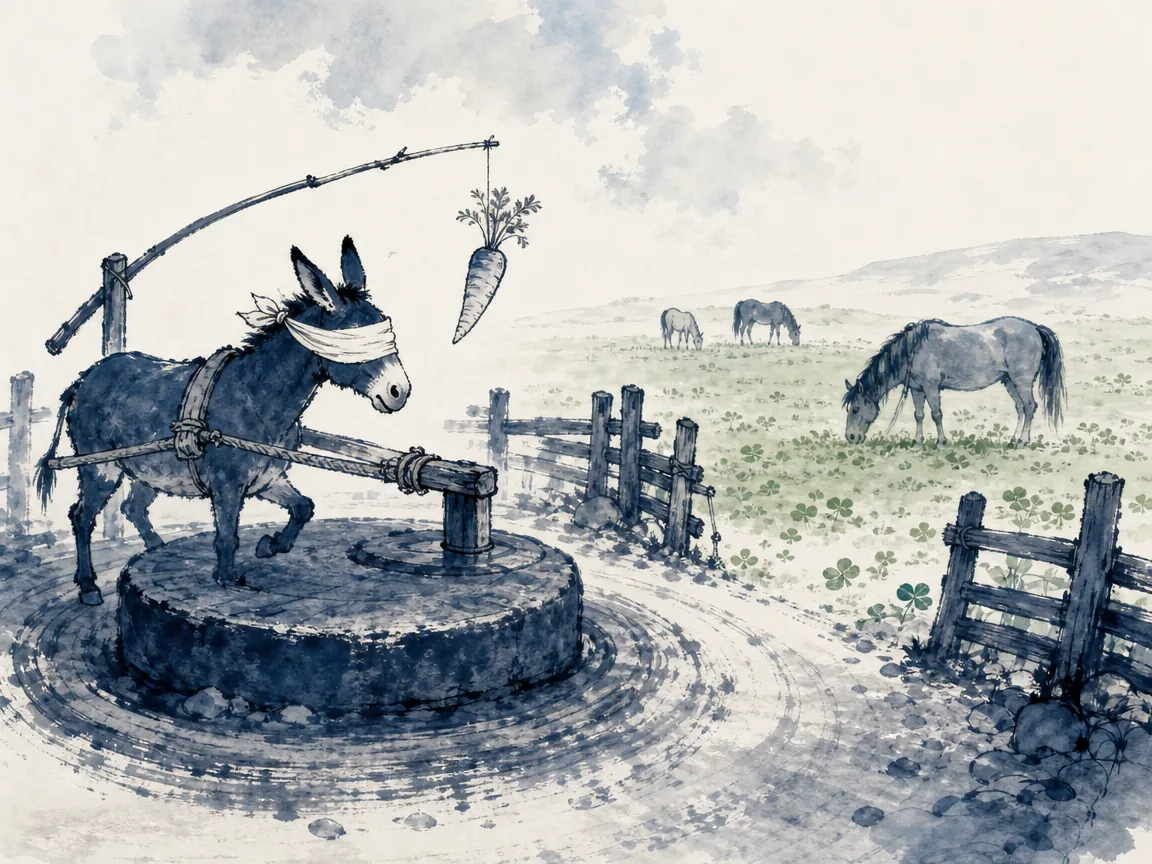
You know the type — or perhaps you recognize yourself in it. The person who checked every box, landed the promotion, built the portfolio, accumulated the credentials, and yet feels a quiet hollowness that no external marker seems able to fill. Meanwhile, another kind of exhaustion circulates freely through our screens: the scroll that never ends, the metric that always dips, the comparison that never resolves. We chase. We reach. And still, something inside us refuses to settle.
There is a well-known pattern in this kind of restlessness, one that ancient Chinese philosophy called to attention over two thousand years ago. Zhuangzi, a fourth-century BCE thinker whose work survives through a collection of philosophical texts [1], proposed a radical claim: the trap is not primarily the world itself. The trap is the scale by which you measure yourself. The cage is invisible because you have been taught to carry it inside you — in the language you use, the comparisons you make, the labels you wear, and the habits of seeing the world through a single narrow lane—a foundational perspective explored in Zhuangzi Chapter 35 Meaning.
What follows is not a call to abandon ambition, reject your career, or walk away from the world. It is an invitation to look more carefully at the ruler you are using. The framework below organizes nine interlocking layers of insight drawn from the Zhuangzi corpus. These layers are not a schematic laid out systematically by Zhuangzi himself — the text is rich with parables, dialogues, and images rather than numbered arguments — but they offer a coherent lens for understanding how the mind becomes enclosed and how that enclosure can be loosened [2].
Continue with the deeper interpretation and practical application.
ChiDestiny members get access to the full analysis, modern applications, and the growing Chinese Wisdom Library.
FAQ
Q: Is Zhuangzi recommending that I do nothing and give up on my goals? No. Zhuangzi is not advocating passivity. He is questioning whether your current goals are shaped by your own values or by borrowed scales of judgment. The aim is not to stop acting but to act in ways that do not fragment your inner life.
Q: Did Zhuangzi actually organize his philosophy into nine layers? No. The nine-layer framework presented here is a modern organizational lens drawn from various passages across the Zhuangzi corpus. Zhuangzi's text is structured around parables, dialogues, and images rather than systematic classifications.
Q: Can these ideas help with anxiety or burnout? Some readers find that reflecting on Zhuangzi's perspectives offers a different frame for understanding pressure and exhaustion. These are philosophical reflections rather than clinical recommendations, and they should not replace professional support when that is needed.
Q: Does "free wandering" mean traveling or changing my job? Not necessarily. In Zhuangzi's usage, free wandering refers more to an inner stance — the capacity to move through life without being imprisoned by external approval, fixed identities, or rigid metrics of success, reflecting the enduring wisdom of Zhuangzi Chapter 35 Meaning.
To explore these themes from another angle, read our related reflection on Why the Deepest Tragedy Is Spending Your Whole Life Proving You Are Useful.
For a deeper comparative examination of these ideas, explore our related study on Beyond Escape: How Zhuangzi Can Help You Live Authentically in a World That Won’t Stop Defining You.
Sources & Further Reading
[1] Zhuangzi (Stanford Encyclopedia of Philosophy)
[2] Zhuangzi / Adjustment of Controversies (莊子/齊物論) – Wikisource
[3] Zhuangzi / Free and Easy Wandering (莊子/逍遙遊) – Chinese Classics
[4] Zhuangzi / Nourishing the Lord of Life (莊子/養生主) – Wikisource
[5] Zhuangzi / In the World of Men (莊子/人間世) – Wikisource
[6] Zhuangzi (莊子) – Wikisource
[7] Zhuangzi: "Adjustment of Controversies" (齐物论) – Guwen Island






