
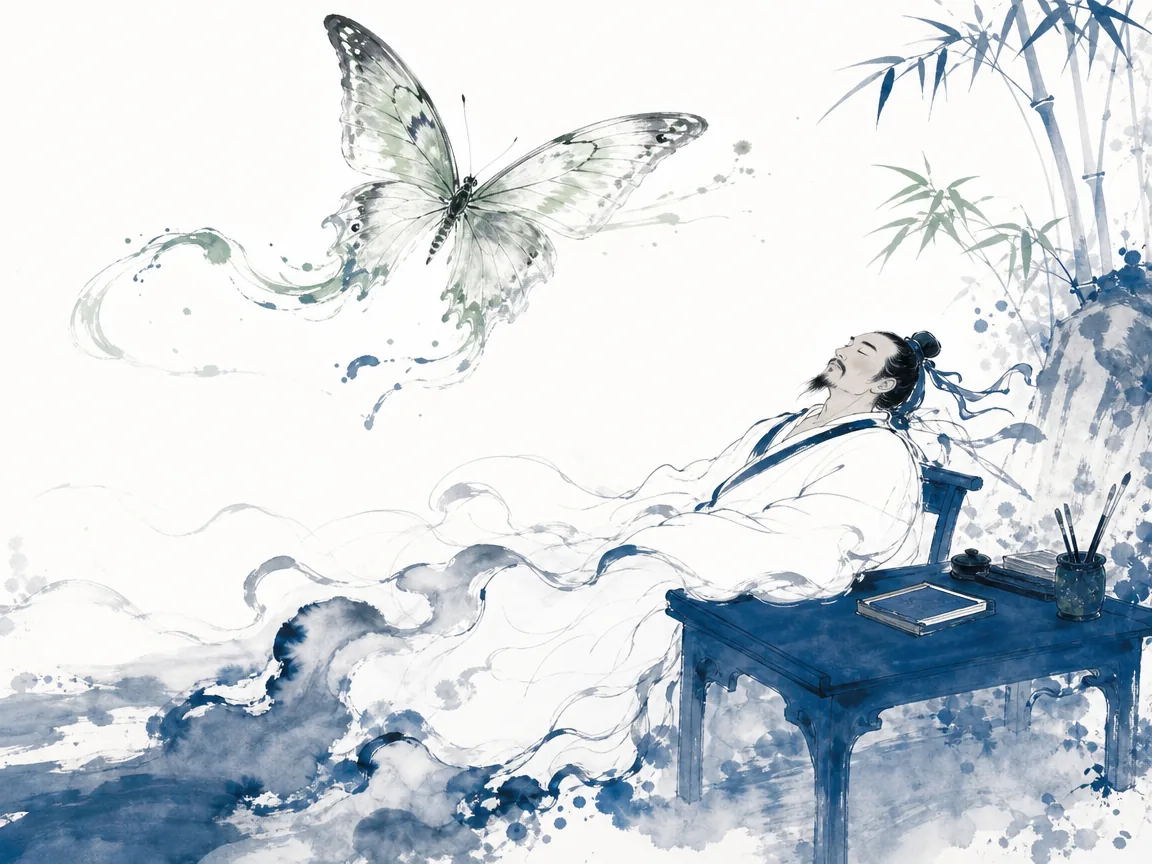
You are not your job title. You are not your follower count. You are not the story other people have written about you.
Yet most of us navigate daily life as if those definitions were facts. We measure ourselves against career ladders, social metrics, and the invisible benchmarks of family and culture. Our self-worth rises and falls with performance reviews, algorithmic feedback, and the occasional compliment or criticism from strangers. Somewhere along the way, we internalize a simple equation: being useful means being valuable; being seen means existing—a foundational perspective explored in Zhuangzi Chapter 36 Meaning.
What if the problem isn't that we lack more success, but that we've built our sense of self on definitions that were never ours to begin with?
Over two thousand years ago, the Chinese thinker Zhuangzi (庄子) turned his attention to exactly this trap. His writings diagnose the deepest form of bondage not as physical confinement but as mistaking what the world calls us for who we truly are [1]. Yet Zhuangzi is also one of the most misread philosophers in history. People routinely assume he teaches withdrawal — that his vision of freedom means escaping society, retreating to mountains, or opting out of responsibility. But a closer reading reveals something far more demanding: Zhuangzi's entire system is about staying present in the world without being absorbed by it. True freedom, in his view, is learning to participate fully while preserving an inner space that external circumstances cannot colonize.
This distinction matters enormously for anyone who feels trapped between societal pressure and the desire to live authentically. Zhuangzi does not ask you to leave your job, your relationships, or your responsibilities. He asks you to stop letting those things define the core of who you are.
Zhuangzi Chapter 36 Meaning: The Bird, The Fish, and The Scale of Your Life
The Zhuangzi opens with perhaps its most famous image: a creature called Kun, a enormous fish in the northern sea, transforms into Peng, a bird whose wings stretch across the sky like clouds hanging from heaven. Peng flies thousands of miles to the southern ocean, while smaller birds flutter around nearby trees, unable to imagine anything beyond their local branches. They mock Peng for its ambition. Zhuangzi uses this contrast not to elevate the great bird above the small ones, but to expose the limits of any single perspective.
The passage has been read as a metaphor for expanding your frame of reference — recognizing that people operate from different scales of experience and value, and that no single vantage point captures the whole picture [1]. A person who spends their life measuring success in narrow terms — salary, status, visibility — will naturally judge anyone who refuses that metric. The person who wants to learn deeply is called unrealistic. The one who seeks solitude is labeled unstable. The ones doing the judging are simply flying at a different altitude, and they cannot see beyond their own airspace.
Freedom, Zhuangzi suggests, is not doing whatever you want. It is no longer measuring your life by someone else's small ruler. When you internalize the dominant definitions of your culture — that productivity equals worth, that visibility equals value — you shrink your own possibilities to fit a template that was never designed for your actual nature. The antidote is not rebellion but expansion: developing a vantage point wide enough to hold your own path without needing constant external confirmation.
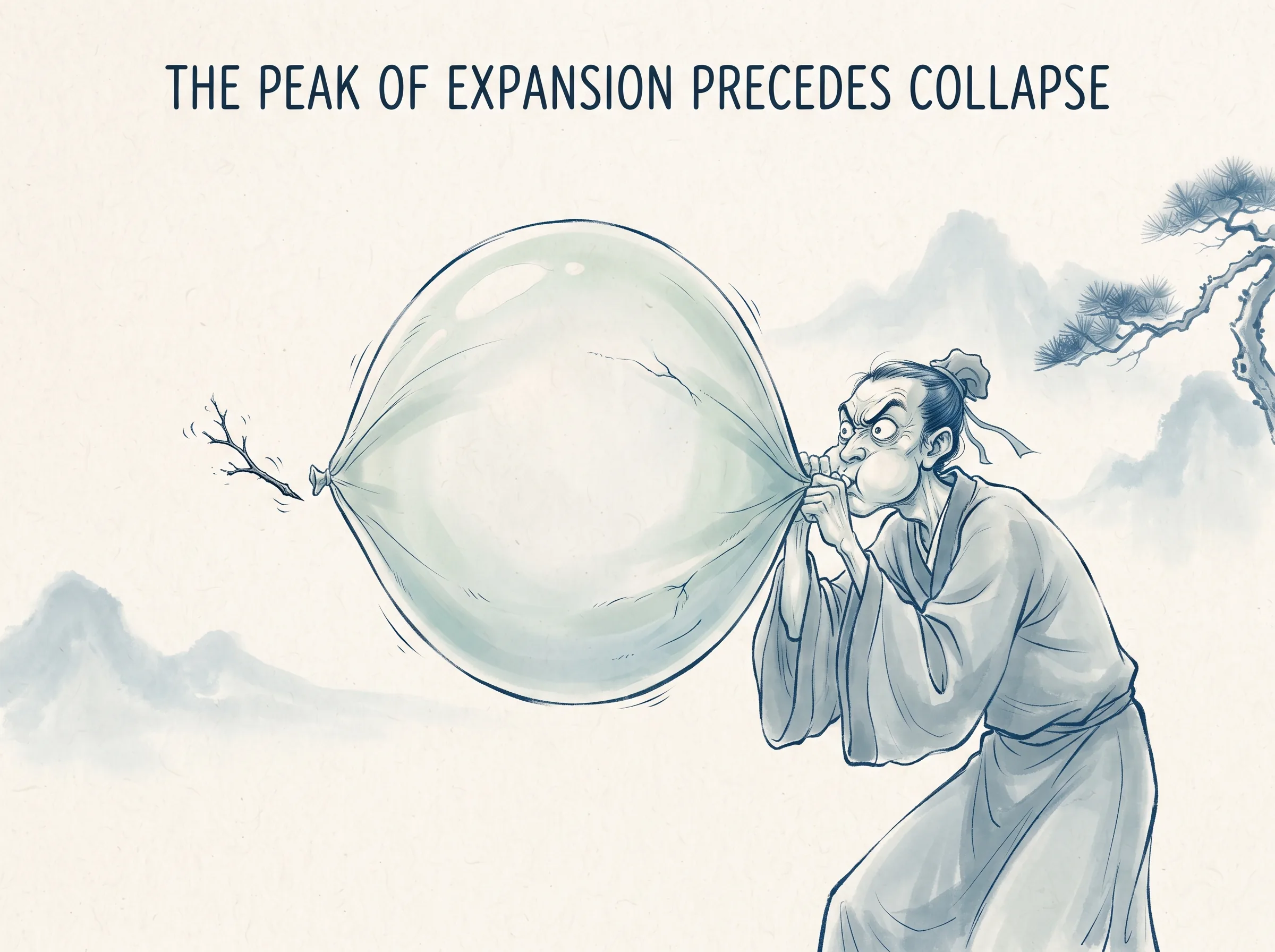
In practice: Pay attention to the standards by which you automatically evaluate yourself. When you feel inadequate, ask: Whose ruler am I using? Often the answer reveals that the measurement belongs to a system — corporate, cultural, algorithmic — rather than to your own life. Recognizing this distinction is itself a form of liberation.
Seeing Behind Every Argument: Why Most Conflicts Are About Position, Not Truth
One of the most psychologically acute chapters in the Zhuangzi examines the nature of disagreement itself. Zhuangzi observes that almost every argument people have is rooted not in objective truth but in competing life positions — different experiences, values, fears, and psychological structures that produce entirely different ways of seeing the same situation.
When two people dispute whether something is "good" or "bad," "right" or "wrong," they are often speaking from irreconcilable frameworks. The person who has experienced scarcity will prioritize security. The person who has been controlled will prioritize autonomy. The person raised in chaos will crave order. None of these orientations is universally correct; they are adaptive responses to different conditions of life. Zhuangzi's point is not that all views are equally valid in a moral sense, but that every view emerges from a specific position — and recognizing that origin transforms how we engage with disagreement.
This insight is remarkably relevant to modern life. Online arguments, workplace conflicts, family disagreements — most are not clashes between truth and error but collisions between competing life structures. The person who argues passionately about career ambition may be speaking from a position shaped by economic precarity. The person who advocates for slow living may be responding to burnout. Both are reasonable from where they stand. Neither has accessed a neutral, objective standpoint.
The awakened response, Zhuangzi suggests, is not to abandon judgment but to recognize where judgment comes from. When you understand that a harsh criticism reflects the critic's position rather than your essence, you gain the capacity to hear what is useful and release what is not — without internalizing the attack as identity.
In practice: The next time someone's words cut deep, pause before absorbing them as truth. Ask yourself: What position is this person speaking from? What does their reaction reveal about their concerns, not mine? This simple shift — from "they are attacking me" to "they are expressing their framework" — creates psychological distance that protects your sense of self.
Continue with the deeper interpretation and practical application.
ChiDestiny members get access to the full analysis, modern applications, and the growing Chinese Wisdom Library.
Frequently Asked Questions
Does Zhuangzi's philosophy encourage irresponsibility or laziness? No. Zhuangzi's concept of wuwei (无为) is often translated as "non-action," but it does not mean doing nothing. It means acting in alignment with natural patterns rather than against them. The Cook Ding story illustrates this: the cook is highly skilled and actively engaged, but his technique follows the structure of the ox rather than imposing force upon it. In modern terms, wuwei is the difference between swimming with the current and flailing against it — both involve effort, but one is sustainable and the other is self-defeating.
Is Zhuangzi compatible with a religious or spiritual practice? Zhuangzi's writings have been incorporated into Daoist religious traditions, but the philosophical text itself is not a scripture in the conventional sense. It does not prescribe rituals, deities, or doctrines. Some readers approach it as a philosophical guide to living; others find in it spiritual resonance that complements their existing practice. The text itself remains deliberately open-ended, favoring paradox and story over dogma.
How is Zhuangzi's thought different from Western individualism? Western individualism typically emphasizes personal rights, autonomy, and self-expression as ends in themselves. Zhuangzi's vision of authenticity is similar in its concern for inner freedom but differs in its metaphysical grounding. Zhuangzi situates the individual within a continuous flow of natural processes — birth, death, change — and suggests that true freedom comes from aligning with that flow rather than asserting independence against it. The goal is not self-assertion but self-transcendence: dissolving the rigid boundaries of ego to participate more fully in the larger movement of life.
Should I read Zhuangzi alongside other philosophical traditions? Many readers find that engaging Zhuangzi in dialogue with other traditions — Stoicism, Buddhism, existentialism, modern psychology — deepens their understanding of both. The Stanford Encyclopedia of Philosophy notes that Zhuangzi's thought shares affinities with other ancient Chinese traditions, including parts of the Analects and the work of Song Xing, while also offering distinctive critiques of rigid moral and intellectual systems [1]. Reading widely can help you avoid the very trap Zhuangzi warns against: mistaking one framework for the whole truth.
Conclusion: Living Authentically Without Leaving the World
The question that opened this article — can you live authentically without escaping reality? — is one Zhuangzi spent his entire career answering. His reply, distilled across 33 chapters, is a confident yes. But the path he outlines is neither simple nor comfortable. It requires continual vigilance against the easy definitions the world offers, the courage to question the standards you have internalized, and the patience to develop an inner center that external circumstances cannot easily disturb.
Authenticity, in Zhuangzi's vision, is not a destination you reach but a practice you maintain. It means showing up fully in your life — your work, your relationships, your community — while refusing to let those roles consume your sense of self. It means participating in systems without worshipping them, using tools without being used by them, pursuing goals without confusing achievement with meaning.
The next step is not to read more or plan more. It is to notice — here, now — where you are already trading your inner clarity for external validation, and to ask a single question: What would it feel like to live differently?
Zhuangzi's answer is simple: expand your scale. See behind every judgment. Follow the grain. Cultivate internal wholeness. Release the need to control. Honor the limits of language. And remember — you can be fully in the world without letting the world define you, reflecting the enduring wisdom of Zhuangzi Chapter 36 Meaning.
To explore these themes from another angle, read our related reflection on Why Chasing Happiness Makes You Less Happy — and What Zhuangzi’s Ancient Idea of “Highest Joy” Can Teach You.
For a deeper comparative examination of these ideas, explore our related study on Why the Deepest Tragedy Is Spending Your Whole Life Proving You Are Useful.
Sources & Further Reading
[1] Zhuangzi. — Stanford Encyclopedia of Philosophy, Stanford University. — Comprehensive scholarly overview of Zhuangzi's life, texts, and philosophical positions, including discussion of the 33-chapter structure compiled by Guo Xiang and the authorship debates surrounding the inner, outer, and miscellaneous chapters.
Further Reading
- Watson, Burton (translator). The Complete Works of Zhuangzi. Columbia University Press, 1968. — A widely used English translation of the full 33-chapter text with extensive commentary.
- Cleary, Thomas (translator). The Classics of Zhuangzi. Shambhala Publications, 1989. — Accessible translation with contextual notes for general readers.
- Major, Sarah et al. (translators). The Complete Zhuangzi. Hackett Publishing, 2001. — Scholarly translation emphasizing philosophical accuracy and readability.
- Roelofs, Lucas. Zhuangzi and the Unexpected. Harvard University Press, 2024. — Contemporary scholarly analysis of Zhuangzi's literary and philosophical strategies.






