
You've felt it: the weekend that doesn't refresh you, the productivity system that leaves you more drained than before, the sense that no matter how many hours you put in, you're running on empty. We live in a culture that equates effort with value — work harder, optimize more, learn faster, push through. Yet exhaustion keeps winning.
There is an ancient Chinese text, nearly 2,400 years old, that diagnosed this problem with remarkable precision. In the third chapter of the Zhuangzi, known as Yangsheng Zhu (《养生主》), the philosopher opens with a line that reads almost like a diagnosis of modern life: "My life has limits, but knowledge has none. To pursue the limitless with the limited — that is danger." The text warns that when a finite human being throws themselves against an infinite world of demands, information, comparisons, and expectations, something breaks. Not the world — the person—a foundational perspective explored in Zhuangzi Chapter 3 Meaning.
This chapter, traditionally attributed to Zhuangzi (庄子), is one of the seven inner chapters that form the core of the received text [1]. It is not, as its title might suggest, a manual for physical health or longevity hacks. It is something far more radical: a meditation on how to move through an overwhelming world without being torn apart by it.
Zhuangzi Chapter 3 Meaning: Not the Body
The Chinese term yangsheng (养生) is commonly translated as "nurturing life" or "preserving nature," and zhu (主) means the master, the center, the governing axis. Together, the chapter title points not toward diet and exercise but toward something deeper — the inner pivot around which a life turns.
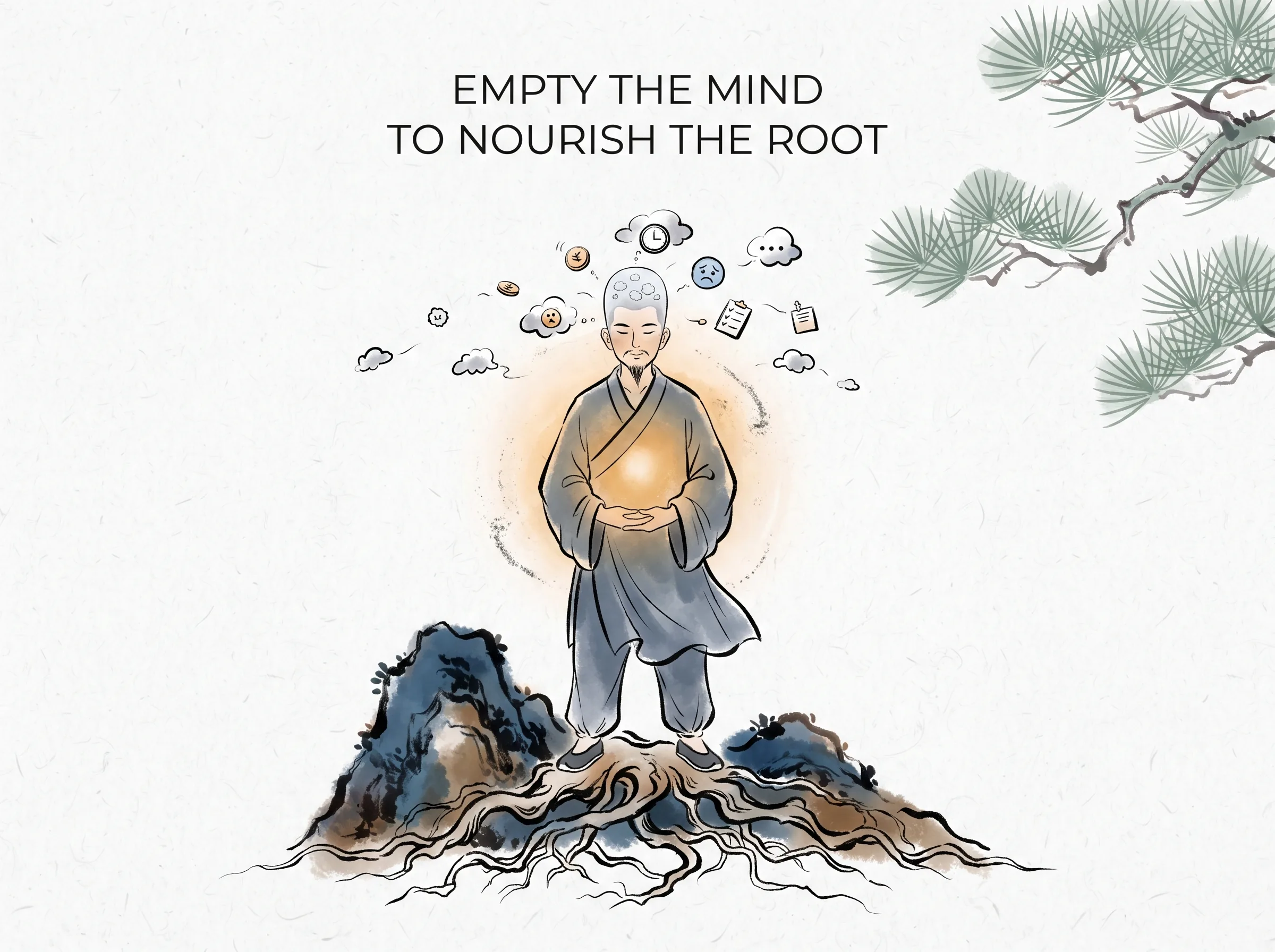
What does it mean to lose that center? Consider the modern condition: your attention is captured by algorithmic feeds, your self-worth is measured against curated images of success, your pace is set by deadlines that never slow down. A person without a center is one whose attention, emotions, and sense of direction are all determined by external systems — trends, comparisons, evaluations, fears. They appear to be living actively, but internally they are being pulled in every direction, like a leaf caught in a current.
The Zhuangzi itself frames this concern in its opening lines, which remain one of the most stark observations in classical Chinese philosophy about the relationship between finite human capacity and the infinite demands placed upon it [1]. The text argues that true yangsheng — true nurturing of life — is not about accumulating more skills, more knowledge, more achievements. It is about protecting the internal governor that keeps you from being scattered by an overstimulating world.
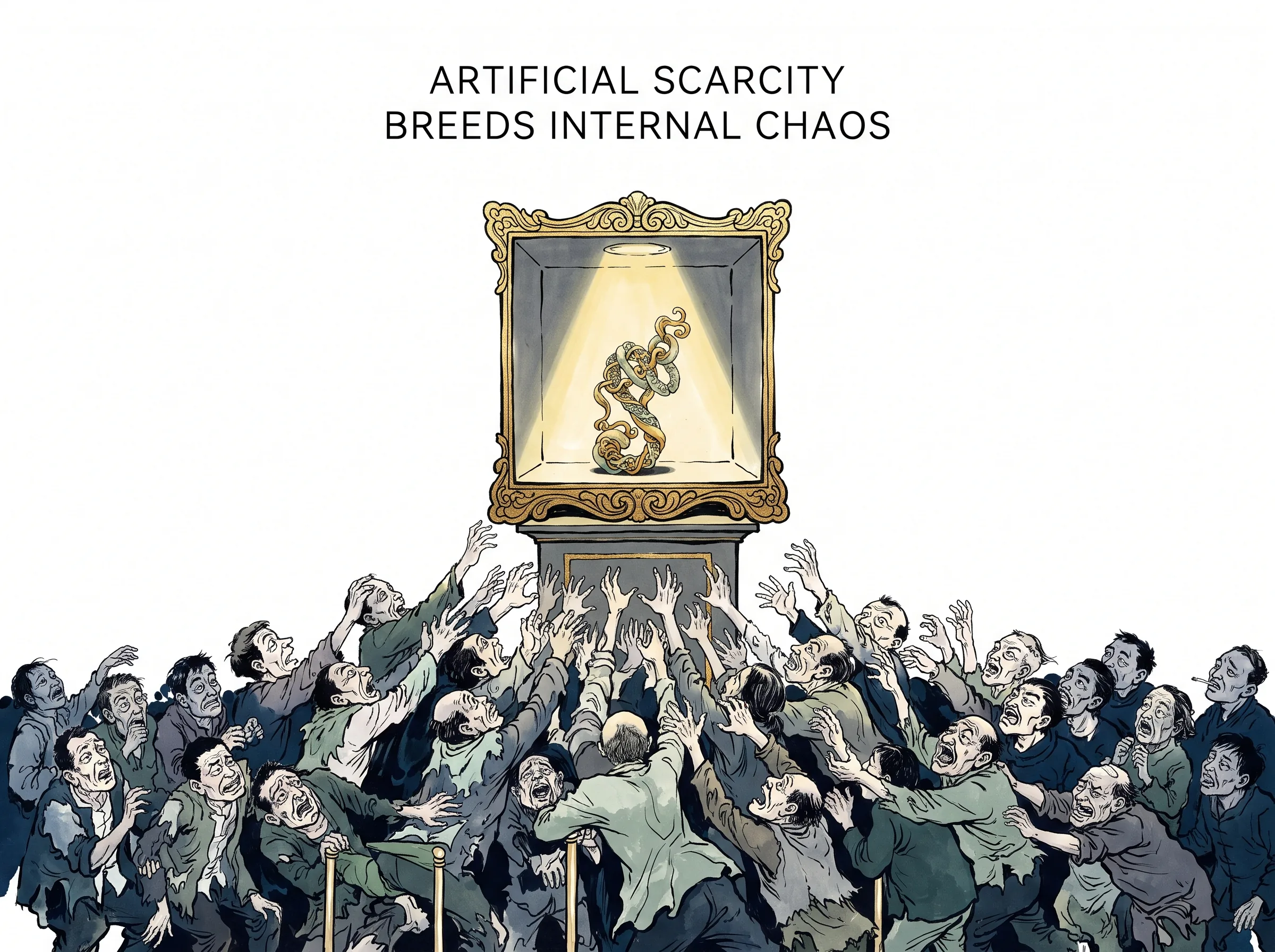
Zhuangzi deepens this point with a seemingly simple statement: "Do good without attaching to fame; avoid evil without clinging to punishment." On the surface, this reads like moral advice. But its radical implication is that even virtue can become a trap when performed for external reward — recognition, status, the approval of others [1]. A person chasing good deeds for reputation is just as captive as a person avoiding wrongdoing out of fear. In both cases, the center of action has been outsourced. The question for anyone feeling exhausted is worth asking honestly: Am I acting from my own axis, or am I living someone else's script?
The Cook Ding Parable: Finding the Gap Instead of Hacking the Bone
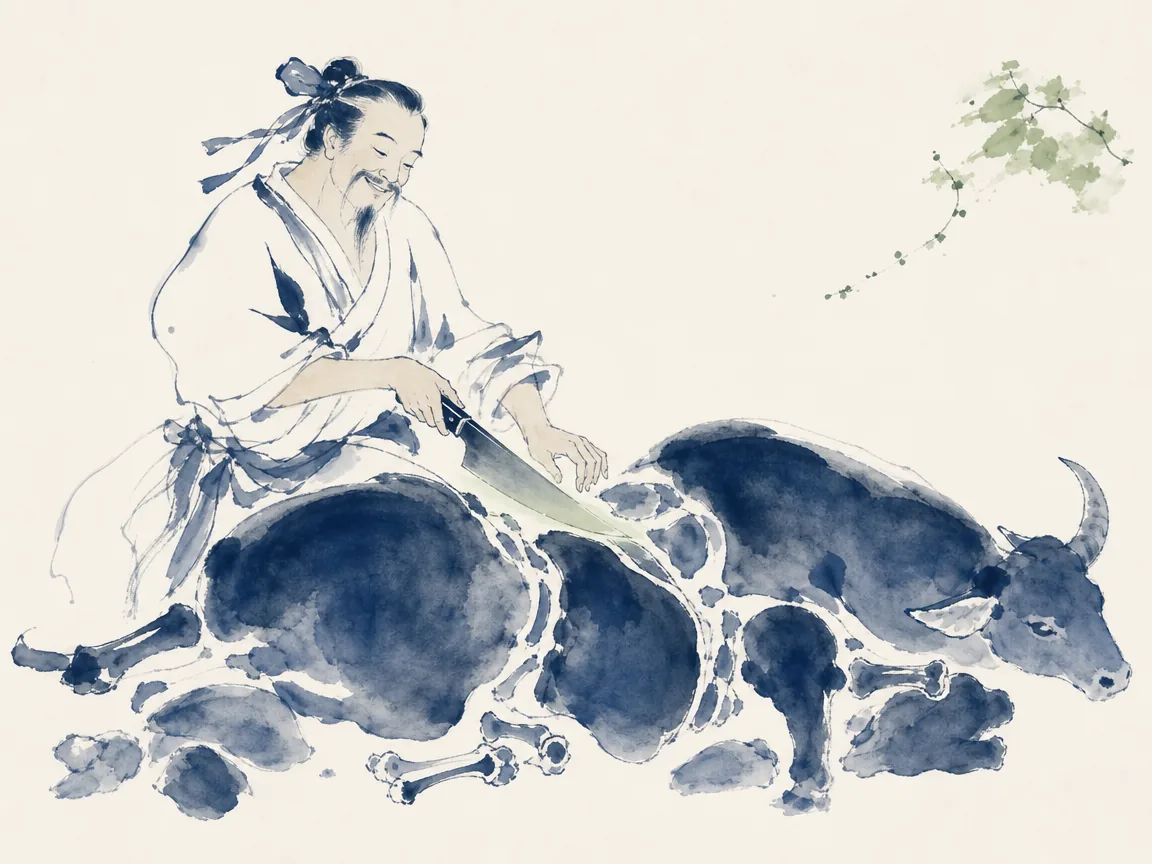
Perhaps the most famous passage in the Yangsheng Zhu is the story of Cook Ding, a butcher who explains to a ruler why his blade has remained sharp for nineteen years after slicing through thousands of oxen [1].
The key is not force but perception. Cook Ding does not hack at the ox. He follows its natural structure — the spaces between joints, the grain of the flesh, the paths that already exist. As he describes it: "Heavenly principles provide the structure; I follow along the great gaps and guide the blade through the large cavities, following the natural constitution of the animal." Where there is space, the blade moves freely. Where there is bone, it does not touch [1].
Most people approach life the way an inexperienced cook approaches an ox: they swing hard, they force their will against resistance, they try to cut through what should be navigated. They treat relationships, careers, creative projects, and personal goals as problems to be conquered rather than structures to be understood. And just as a blade forced against bone quickly dulls, a person who constantly pushes against the grain of reality exhausts themselves. To study the primary classical text and commentary, explore the original Chinese text and deep philosophical translation in The Master of Nourishing Life: Cook Ding’s Blade and Finding Free Space.
There is a crucial detail that is often overlooked. Cook Ding does not become careless as his skill grows. When he encounters a complex junction — where sinews and bones interweave — he becomes more careful, not less: "Alert, I stand guarded; my eyes are focused, my movements slowed. I handle the knife with barely a touch." The mastery he describes includes vigilance at precisely the moments when it is most needed [1]. Confidence without caution destroys the blade.
The Three Stages of Perception
Cook Ding's description of his own development maps onto a pattern that appears again and again in both Eastern and Western traditions of mastery:
Stage 1 — Seeing the whole. At first, Cook Ding "saw nothing but the entire ox." This is the beginner's experience of any complex domain: the workload looks like an immovable wall, the conflict looks insurmountable, the future looks like a single block of resistance. The problem is overwhelming because it is not yet differentiated.
Stage 2 — Seeing the structure. After three years, "he no longer saw the whole ox." He had learned to perceive internal relationships, pressure points, tensions, and gaps. This is the stage of discernment — the ability to see what is actually there rather than what appears on the surface. The ox is no longer a single obstacle; it is a landscape of possibilities for where the blade can enter.
Stage 3 — Meeting with spirit, not sight. Eventually, Cook Ding reached a point where he "met it with spirit and did not look with his eyes." Sensory cognition gave way to something more integrated — a kind of embodied knowing where action and perception are no longer separate. This is not mysticism but the natural endpoint of deep practice: the structure has been internalized, and response becomes immediate and accurate [1].
Every skill, every relationship, every phase of life moves through a version of this pattern. The novice feels overwhelmed by the whole. The practitioner learns to read the structure. The master acts from integrated understanding. The exhaustion that accompanies most modern efforts often comes from trying to perform at Stage 3 while still stuck in Stage 1 — attempting to act with ease in a situation you have not yet learned to see clearly.
Practical Implications for Modern Life
The Yangsheng Zhu was not written for monks or recluses. Its advice applies to anyone navigating a demanding world. Here are several ways its insights translate into practical orientation:
Identify your center. Before adding another habit, tool, or goal to your routine, ask: what is actually mine? What am I pursuing because it aligns with my own axis, and what am I pursuing because an external system — social media, workplace culture, family expectation — has assigned it to me? Distinguishing the two is the first act of yangsheng.
Look for the gap before applying force. When a situation feels impossibly difficult, pause and ask: what is the natural structure here? Where is the tension point? Where is the space that already exists? In a work project, the gap might be a process that, once streamlined, removes most of the friction. In a relationship, it might be an unspoken assumption causing repeated conflict. In your own schedule, it might be a commitment that was never truly yours.
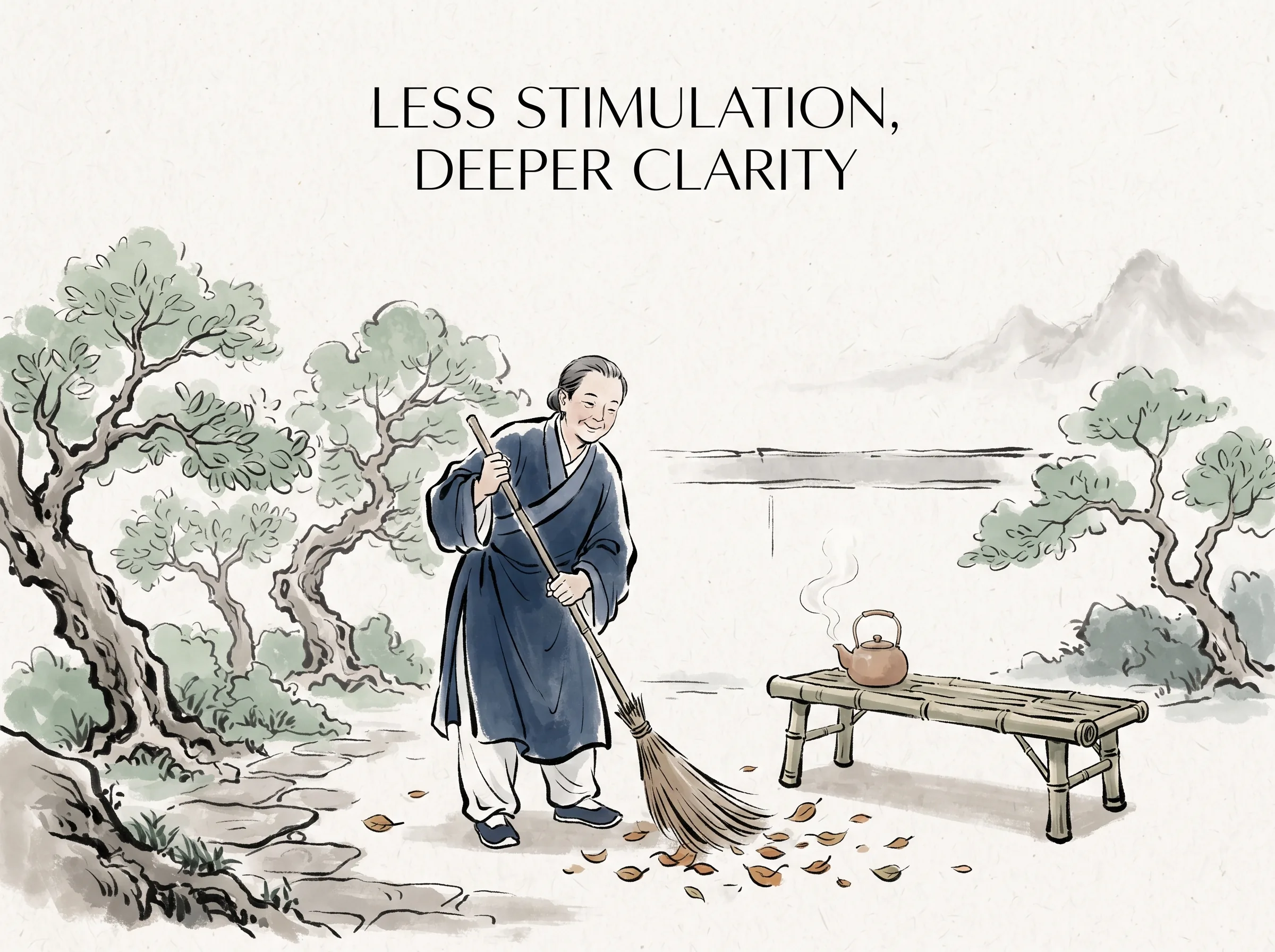
Cultivate discernment. Zhuangzi's warning about "doing good without attaching to fame" applies broadly: not every piece of knowledge, relationship, or opportunity belongs in your life. The infinite world will keep offering more. The practice is learning what to let in and what to let pass.
Protect your blade. Rest is not laziness; it is maintenance of the instrument you live through. The Cook Ding story shows that the blade survives not through occasional heroics but through consistent, careful practice over time. A tired mind forced against a problem is like a dull blade forced against bone — it damages both.
Release the fear of ending. The Yangsheng Zhu closes with one of the most quietly powerful images in classical Chinese literature: "The fuel is exhausted, but the fire is passed on — and its end cannot be known." The individual form — like firewood — eventually burns out. But what moves through a life — the way one meets the world, the contributions made, the understanding shared — can continue in ways that outlast the personal self. This does not eliminate grief or loss. It reframes them [1].
FAQ
Is Zhuangzi saying we should do less and achieve nothing? Not at all. The Cook Ding story is about action — precise, skilled, effective action. Zhuangzi's point is that the quality of action matters more than the quantity. The goal is not inaction but action that does not destroy the actor.
What exactly does "following the gap" mean in practice? It means studying a situation before reacting to it. In a work crisis, instead of immediately responding to every demand, you might map out what is actually within your control, where the real bottlenecks are, and which pressures are structural versus self-imposed. In a personal conflict, it might mean identifying the underlying need rather than arguing over the surface complaint. The "gap" is the space where effort meets ease.
Does this apply to creative work and career decisions, not just daily tasks? Yes. Creative projects often fail not from lack of effort but from forcing a shape that the material does not support. Career decisions made out of comparison or anxiety rather than genuine alignment are another form of hacking at bone. The principle — perceive structure before acting — scales across domains.
Is "yangsheng" the same as self-care or mindfulness? These are related but not identical. Self-care often focuses on restoring the body; mindfulness focuses on present-moment awareness. Yangsheng, as Zhuangzi presents it, is broader: it is about preserving the central axis of a life so that everything else — work, relationships, creativity, aging — can unfold without self-destruction.
The exhaustion that modern life produces is rarely a sign of personal failure. More often, it is a signal that a finite being is trying to meet an infinite demand without a center. Zhuangzi's Yangsheng Zhu offers a different path: not the accumulation of more effort, but the cultivation of perception; not the conquest of reality, but the navigation of its natural grain.
The next step is not to do more. It is to look more carefully. Where in your life are you hacking at bone? What structure, if you could see it clearly, would make your effort feel easier — not because the task shrank, but because you finally found the place where the blade could enter? This is the lasting lesson of Zhuangzi Chapter 3 Meaning.
To explore these themes from another angle, read our related reflection on Letting Go of the Fight: What the Zhuangzi’s Sword Teaching Says About True Strength.
For a deeper comparative examination of these ideas, explore our related study on Why Knowledge Won’t Save You: What Zhuangzi Teaches About True Transformation.
Sources & Further Reading
[1] Zhuangzi / Yangsheng Zhu — Wikisource, the free library. The complete Chinese text of the third chapter of the Zhuangzi, traditionally attributed to Zhuangzi, containing the opening diagnosis, the Cook Ding parable, and the final fire metaphor.
[2] Mind (Heart-Mind) in Chinese Philosophy — Stanford Encyclopedia of Philosophy. Discussion of the Chinese concept of xin (heart-mind) as the integrating center of perception, emotion, and judgment, relevant to understanding Zhuangzi's notion of the "master" or center of life.
[3] Chinese Ethics — Stanford Encyclopedia of Philosophy. Overview of ethical frameworks in Chinese philosophy, including discussions of virtue, self-cultivation, and the relationship between individual action and cosmic order in texts such as the Zhuangzi.
Further Reading
- Graham, A.C. Chuang-tzu: The Inner Chapters. Routledge, 2001. A widely respected translation and commentary on the inner chapters of the Zhuangzi.
- Ziporyn, Brook. Zhuangzi: The Complete Writings. Hackett Publishing, 2020. A modern translation with extensive notes and interpretive guidance.
- Watson, Burton. The Complete Works of Zhuangzi. Columbia University Press, 1968. A classic English translation with clear commentary.
- Roberts, Jonathan. A New Account of Evil in Zhuangzi. Journal of Chinese Philosophy, 2017. Scholarly discussion of Zhuangzi's views on moral action and external attachment.






