
There is a particular kind of exhaustion that no amount of sleep resolves. It comes from saying yes when you are already full, from entering rooms where your presence is expected but your inner life is not protected, from becoming so useful to everyone else that there is simply nothing left for yourself. This is not a modern invention. More than two thousand years ago, a collection of texts now known as the Zhuangzi — specifically its fourth chapter, Ren Jian Shi (人间世), commonly translated as "The World of Men" — diagnosed the same condition with striking clarity. The chapter does not teach escape. It teaches how to enter the human world intact.
Ren Jian Shi belongs to what scholars call the "Inner Chapters" of the received Zhuangzi [1], a section traditionally associated with the figure of Zhuangzi though its precise authorship remains debated among scholars [2]. Rather than offering rules for withdrawal, the chapter presents a series of stories and dialogues about people who find themselves drawn into complex relationships, demanding workplaces, and structures of power they did not create. Their danger is not failure but slow consumption — being used up by roles, expectations, and their own sense of indispensability. The question the text repeatedly returns to is not whether the world is worth entering, but how to enter it without becoming its object—a foundational perspective explored in Zhuangzi Chapter 4.
Zhuangzi Chapter 4: When Good Intentions Become Self-Destruction
The chapter opens with Yan Hui, described as one of Confucius' most devoted disciples, requesting permission to travel to the state of Wei to advise its ruler. The ruler is characterized as young, arbitrary, and reckless with the lives of his people. Yan Hui believes he can reform him. What follows is a dialogue in which Confucius — speaking here as a literary voice within the text — warns that Yan Hui's moral certainty will not protect him. Rightness, in this world, does not guarantee safety or impact.
The warning is practical, not cynical. Confucius notes that a person who enters a chaotic system armed only with the conviction that he is correct may find himself punished, humiliated, or worse. The lesson extends far beyond ancient politics. Anyone who has entered a difficult conversation expecting that truth alone would prevail, or who has tried to fix a relationship or workplace dynamic through sheer good intention, recognizes the pattern. The world does not operate on the logic of correctness. It operates on power, timing, emotional undercurrents, and the limited capacity of others to receive what you bring.
This is where the first practice begins.
Xin Zhai: Fasting the Mind Before Entering the World
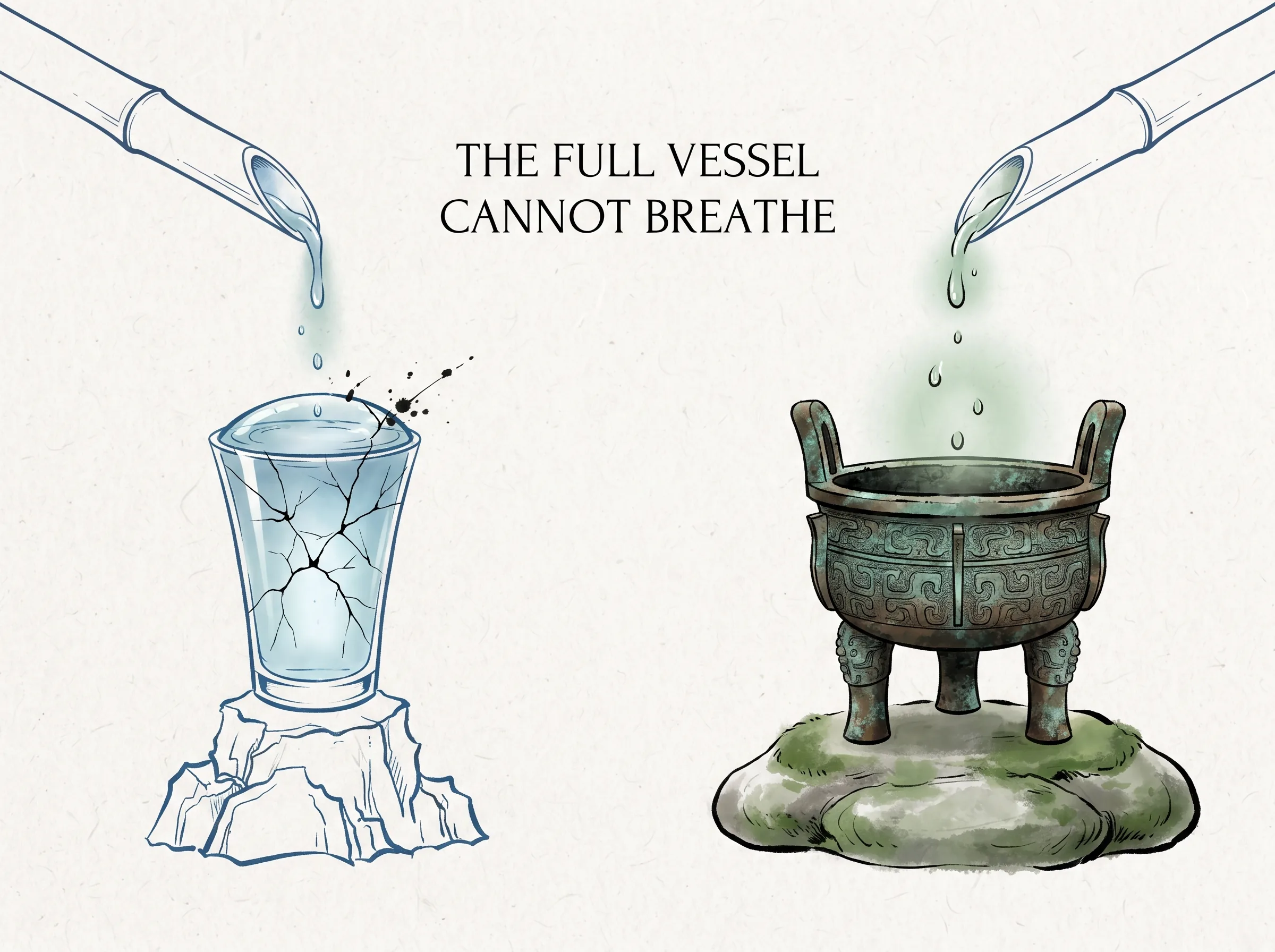
Before suggesting how Yan Hui should approach the ruler, Confucius introduces a concept called xin zhai (心斋), often translated as "fasting of the mind" or "fasting of the heart-mind." The passage is direct and somewhat startling: "Do not listen with your ears. Listen with your mind. Do not listen with your mind. Listen with your spirit." The passage continues, "Spirit is emptiness, waiting for things. Only the Dao gathers in what is empty. Emptiness is the fasting of the mind" [1].
The heart-mind (xin) in classical Chinese thought encompasses both cognition and feeling [2]. The xin zhai asks you to move beyond the level where the heart-mind is occupied by preset judgments, the urgency to prove yourself, the need to fix others, and the insistence on being right. When the mind is full of these things, it cannot truly receive the world. It only reflects its own preparations back onto whatever it encounters.
In practical terms, this translates into a simple but disciplined pause before entering difficult situations. Before a heated conversation, a high-stakes negotiation, or any moment where ego tends to override clarity, ask yourself: Am I bringing my actual presence to this, or am I bringing a script I have been rehearsing? Am I hearing the other person, or am I listening for an opening to deliver what I already know? The xin zhai is not about suppressing emotion or becoming indifferent — it is about clearing the internal noise so that what actually arises in the situation can meet your attention.
Modern life fills the heart-mind constantly. Notifications, opinions, performance metrics, social comparison, and the accumulated voice of external expectation leave little room for the kind of receptivity the text describes. The practice, then, is not additional self-improvement but a deliberate unclogging. Before you enter the human world, you fast from the internal noise that makes you predictable, reactive, and ultimately vulnerable to being used.
Practical application:
- Before an important conversation, sit for two minutes in silence. Let your internal list of points, grievances, and desired outcomes settle. Notice when you are ready to listen rather than perform.
- When you feel the impulse to correct someone immediately, pause and ask: is my response serving understanding, or is it serving my need to be right?
- At the end of each day, identify one moment where you felt "full" — where your reaction came from preparation rather than presence. Note what was occupying your heart-mind.
Riding Circumstances, Preserving Your Center
Not every situation can be avoided. Some obligations are real — a job you need, a relationship you cannot simply leave, a responsibility that falls to you not because you chose it but because you are there. The Ren Jian Shi chapter addresses this directly through a different dialogue, in which a minister named Ye Gongzi Gao expresses anxiety about an embassy he is about to undertake to the state of Qi. The task is unavoidable. He fears he will fail or be harmed.
The guidance offered is encapsulated in a single line: "Ride things to roam the heart-mind; rely on the unavoidable to nourish your center" [1]. This is one of the most compact statements of practical philosophy in the entire chapter. It acknowledges reality without surrendering to it. You do not deny the situation. You do not waste energy resisting what you cannot change. But you also refuse to let the situation consume your inner life.
The distinction matters. Many people who find themselves in demanding circumstances swing between two unhelpful extremes: outward compliance coupled with inner rebellion, or genuine engagement poisoned by resentment. Both consume the heart-mind. The alternative described in the text is neither denial nor resistance but a chosen, calm engagement — doing what must be done while preserving the center that makes the doing yours and not merely a reaction to external pressure. To study the primary classical text and commentary, explore the original Chinese text and deep philosophical translation in In the World of Men: The Fasting of the Mind and the Useless Sacred Tree.
In a modern context, this might mean staying present in a difficult job without internalizing its chaos as your own emergency. It might mean engaging in a challenging relationship without allowing it to become the sole source of your identity or emotional regulation. It means recognizing that some things are unavoidable and treating that unavoidability not as a sentence to suffering but as the raw material for cultivating inner stability. You are not being forced. You are being given an opportunity to practice something difficult and real.
Practical application:
- Map your "unavoidables" honestly. List the obligations you cannot currently escape — work tasks, family responsibilities, financial commitments. For each, ask: what is the minimum I need to do, and what is the maximum I am allowing this to cost me internally?
- Practice the distinction between action and identification. You can complete a task without making it the story you tell yourself about who you are.
- When frustration arises in an unavoidable situation, name it silently: "This is pressure. I am choosing to carry it." Naming creates a small gap between the experience and your identification with it.
The Usefulness of Uselessness
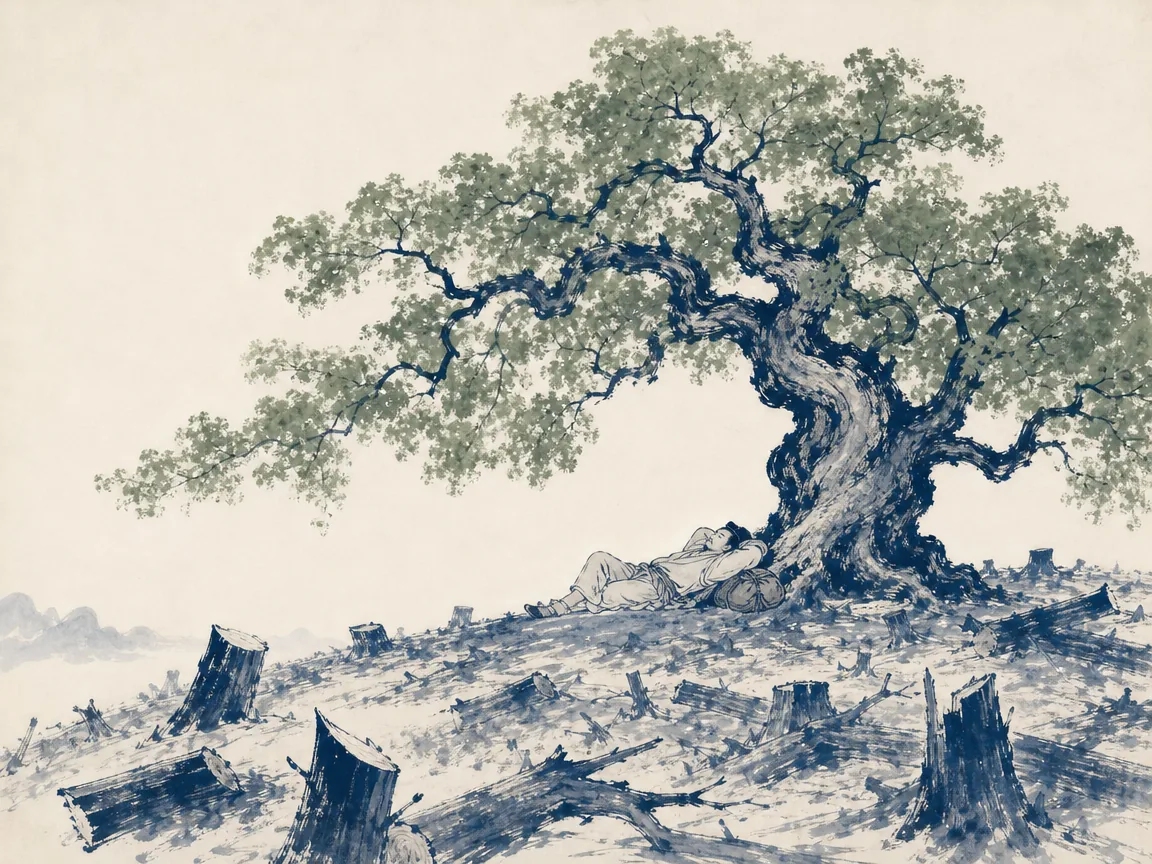
Perhaps the most widely discussed idea in Ren Jian Shi is the paradox of wu yong zhi yong (无用之用) — "the usefulness of uselessness." The chapter tells the story of a crooked, gnarled tree that a carpenter passes without a second glance. When the tree speaks to him in a dream, it explains that its very inability to serve any practical purpose is what allowed it to grow old and large. Had it been useful — suitable for boats, coffins, furniture, doors, or pillars — it would have been cut down long ago [1].
The tree then offers its own interpretation: "I have sought to be of no use for a long time. I nearly died more than once. Now I have achieved it, and this is my great use" [1].
This is not an argument for laziness or intentional incompetence. The point is subtler and more urgent. When you become purely functional — when your value in the eyes of others is reduced to what you can produce, solve, or deliver — you become vulnerable to extraction. The overachiever who is always needed becomes a resource rather than a person. The emotionally available friend becomes a repository for everyone else's projections. The competent worker becomes synonymous with the work itself, with no boundary left for a private self.
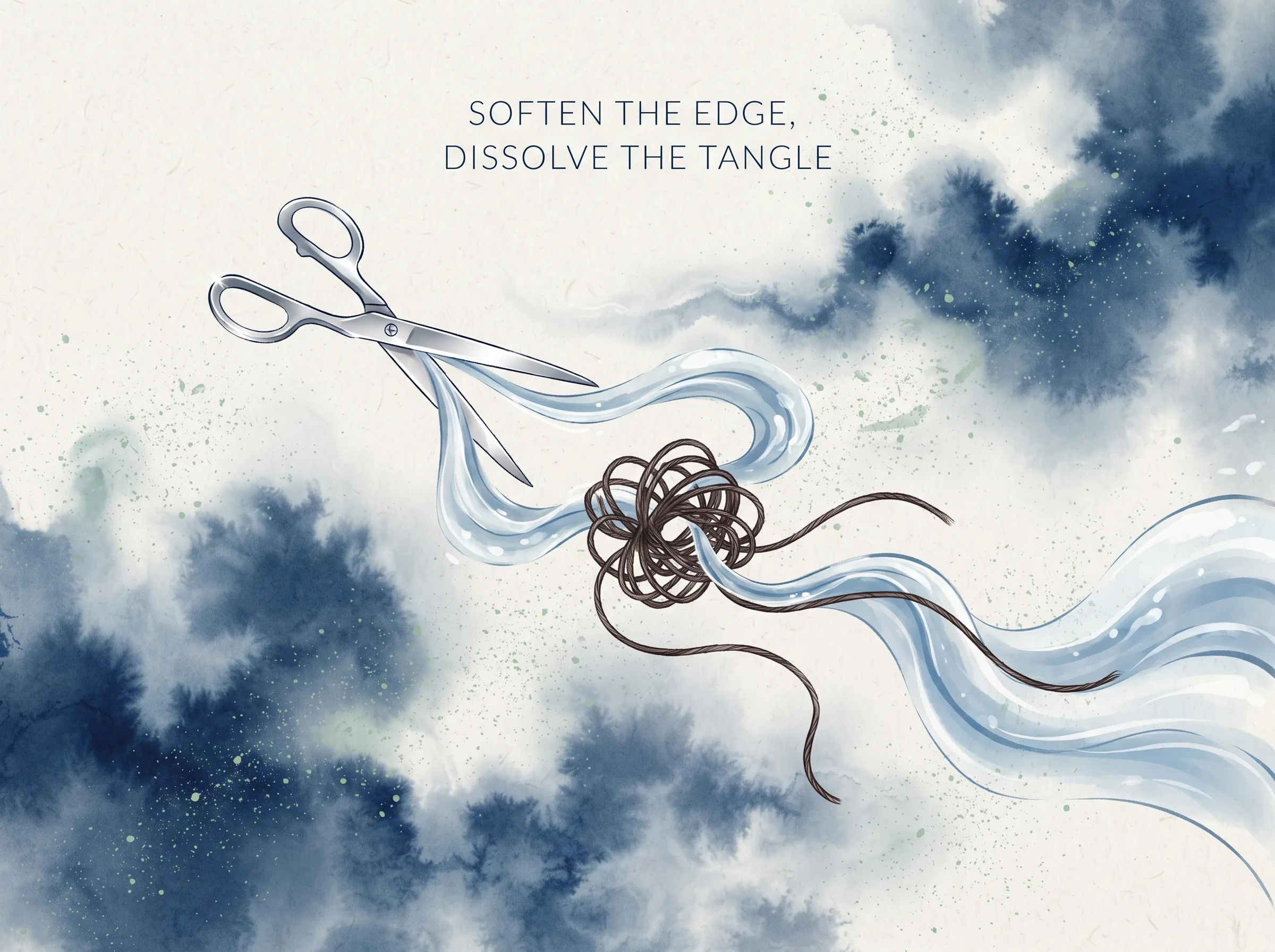
In contemporary terms, the dynamic is amplified by systems designed to make you maximally usable. Digital platforms profit from your attention. Workplaces reward your availability. Social networks circulate your vulnerabilities as content. The more legible you are to these systems, the more efficiently they can consume you. The insight offered here is that preserving a part of yourself that serves no external metric is not laziness — it is self-preservation. It is the deliberate maintenance of an interior space that no productivity dashboard, performance review, or social media algorithm can map.
A related story reinforces this point. The chapter describes a man named Zhi Li Shu (支离疏), whose body is so deformed that he escapes conscription, mandatory labor, and the social expectations that demand conformity. Instead, he receives public relief and lives out his natural years [1]. The text is not praising disability. It is using extreme metaphor to make a structural observation: the standards by which society selects and values people are also the standards by which it consumes them. To be fully legible to the machine around you is to be fully available for its use. Some incompleteness, some refusal to fit, some deliberate opacity can be protective.
The chapter concludes with this observation: "People know the usefulness of usefulness, but they do not know the usefulness of non-usefulness" [1]. The statement is not anti-achievement. It is an invitation to ask a question most modern systems discourage you from asking: what part of me am I willing to keep out of circulation?
Practical application:
- Identify one area of your life where you have become purely functional — where people relate to you only for what you produce or provide. What would it look like to introduce a dimension of yourself that asks nothing in return?
- Schedule time each week for an activity that has zero measurable output: walking without a fitness goal, reading without taking notes, sitting without a podcast. These are spaces where you are not "useful," and therefore not consumable.
- Practice being slightly illegible to the systems around you. Not every thought needs to be shared. Not every capacity needs to be deployed. Selective opacity is a form of self-preservation.
The Mantis and the Wagon: Courage Without Clear Sight
There is a moment in Ren Jian Shi where a man named Yan He is about to become tutor to the crown prince of Wei, a boy described as fierce and unpredictable. Worried about how to handle the situation, Yan He consults Qu Boyu. The advice given includes a striking image: "Do you not know the mantis? It raises its arms to block the wheels of a carriage, not understanding that it is no match for what it faces. This is because it praises its own strength" [1].
The mantis is not condemned for being brave. The warning is about misreading the structure of power. Speaking truth without reading the room, confronting injustice without accounting for the forces arrayed against you, insisting on being heard when the conditions for being heard do not yet exist — these are not always signs of courage. Sometimes they are signs of a self that has not yet learned to see clearly.
The modern parallel is familiar. The employee who delivers an uncompromising critique in a meeting where the decision is already made. The friend who delivers an ultimatum to someone who lacks the capacity to receive it. The activist who mistakes visibility for impact. None of these are inherently wrong. But Ren Jian Shi insists that clarity about the terrain comes before courage in action. The chapter does not teach cynicism or withdrawal. It teaches the discipline of seeing before acting, of distinguishing between what is right and what is viable, of understanding that a principle deployed without strategy often destroys more than it transforms.
Practical application:
- Before any confrontation or bold statement, spend five minutes mapping the terrain: who holds power, what are their interests, what is the timing, and what outcome is actually possible?
- Ask yourself: am I acting from clarity or from the need to be seen as brave? The mantis is brave. The mantis is also destroyed. Courage without clear sight is not wisdom.
- Practice strategic silence. There are moments when not speaking is the more powerful choice — not because you are afraid, but because you see the structure clearly enough to know that speech right now would serve performance rather than transformation.
Walking Through the World Without Becoming Its Object
Ren Jian Shi is not a manual for escaping the human world. It is a manual for entering it consciously — armed with inner emptiness, realistic assessment, and the discipline of choosing when to engage and when to hold back. The practices it describes — emptying the mind, riding what cannot be avoided, preserving a space of uselessness, seeing the structure of power before stepping into it — are not techniques for winning. They are techniques for staying alive to yourself.
The chapter's deepest insight may be this: the greatest danger is not failure but slow consumption. You do not need to lose everything in a single dramatic collapse. You can lose yourself gradually, through a thousand small agreements to be more useful, more available, more legible, more compliant than your inner life can sustain. The text offers an alternative. Enter the world. Do your work. Engage with responsibility. But keep a part of yourself that no role, no relationship, and no system can claim. That part is not selfish. It is the condition for everything else.
What you can do next: Begin by noticing where your sense of indispensability is costing you. Where are you saying yes because you are afraid that saying no will make you irrelevant? Where have you made yourself so useful that your own interior life has become secondary? These are not failures of character. They are patterns that Ren Jian Shi recognizes as the ordinary risk of being human in a world that rewards extraction.
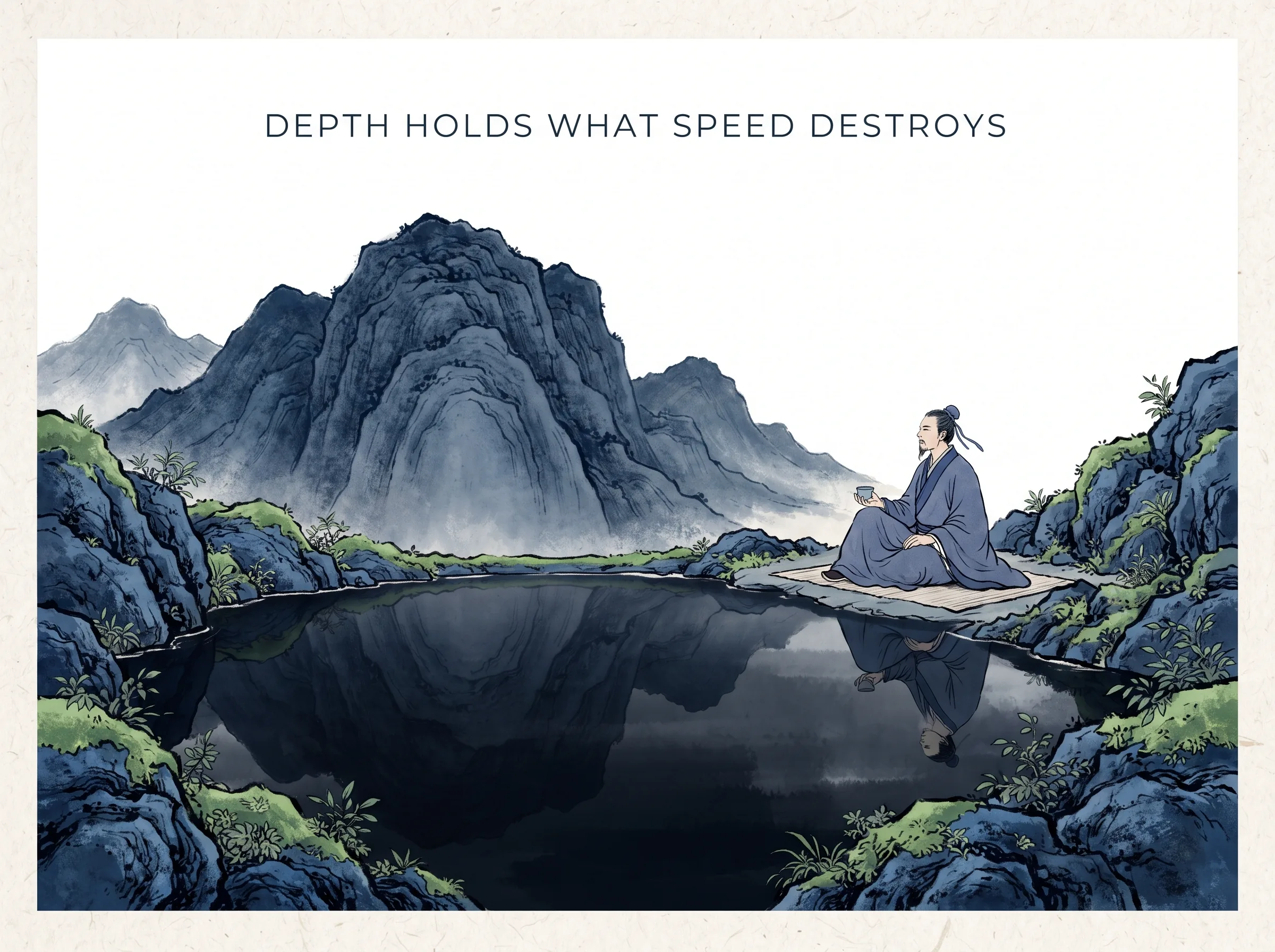
Choose one situation this week — a conversation, a commitment, a response you habitually give — and practice the xin zhai before entering it. Pause. Empty the script. Ask yourself what is actually present in front of you, separate from what you have been preparing to say or do. Then act from that place rather than from the fullness you brought in.
You may find, as the chapter suggests, that the world does not collapse when you stop being entirely available to it. It may even change in ways you did not expect — because the version of you that shows up when you are not consumed is the version that can actually see clearly.
FAQ
What is the "fasting of the mind" (xin zhai) in practical terms? It is a practice of emptying the heart-mind of preset judgments, the urge to prove yourself, and the need to fix or change others before entering a difficult situation. It is not emotional suppression or indifference, but a deliberate pause that restores your capacity to receive what is actually happening rather than reacting from a prepared position.
Does Zhuangzi's "usefulness of uselessness" mean I should avoid being productive? No. The point is not to become incompetent or lazy. It is to preserve a part of yourself that serves no external metric — a space of inner life that is not measured by output, approval, or utility. In a culture that treats people as resources, maintaining this inner space is an act of self-preservation, not avoidance.
Is Ren Jian Shi about withdrawing from society? Not at all. The chapter is about entering the human world consciously, not escaping it. The danger it identifies is not engagement but being consumed by engagement. The practices it describes — emptiness, riding unavoidable circumstances, preserving uselessness, seeing before acting — are tools for staying intact while fully participating in complex social and professional life.
How reliable is the Zhuangzi as a historical source for Zhuangzi's own thoughts? The received Zhuangzi is a compiled text, and the precise authorship of its chapters remains a subject of scholarly debate. The "Inner Chapters," including Ren Jian Shi, are traditionally associated with Zhuangzi but may also reflect the work of later followers who adapted his themes and style. Scholars generally treat the text as a philosophical document from the late Warring States to early Han period rather than as a literal record of one person's teachings [2], reflecting the enduring wisdom of Zhuangzi Chapter 4.
To explore these themes from another angle, read our related reflection on Why Do You Keep Chasing Goals That Don’t Make You Feel Free?.
For a deeper comparative examination of these ideas, explore our related study on Letting Be and Exercising Forbearance: The Danger of Meddling with Minds.
Sources & Further Reading
[1] Zhuangzi / In the World of Men (莊子/人間世) – Wikisource — Classical Chinese text of the Zhuangzi, Chapter 4 (Ren Jian Shi), hosted on Wikisource.
[2] Zhuangzi — Stanford Encyclopedia of Philosophy — Scholarly overview of the text's composition, authorship debates, and philosophical themes.
Further Reading
- Mind (Heart-Mind) in Chinese Philosophy — Stanford Encyclopedia of Philosophy — For deeper understanding of the concept of xin (心) as both cognitive and affective faculty in classical Chinese thought.






