
養生主第三
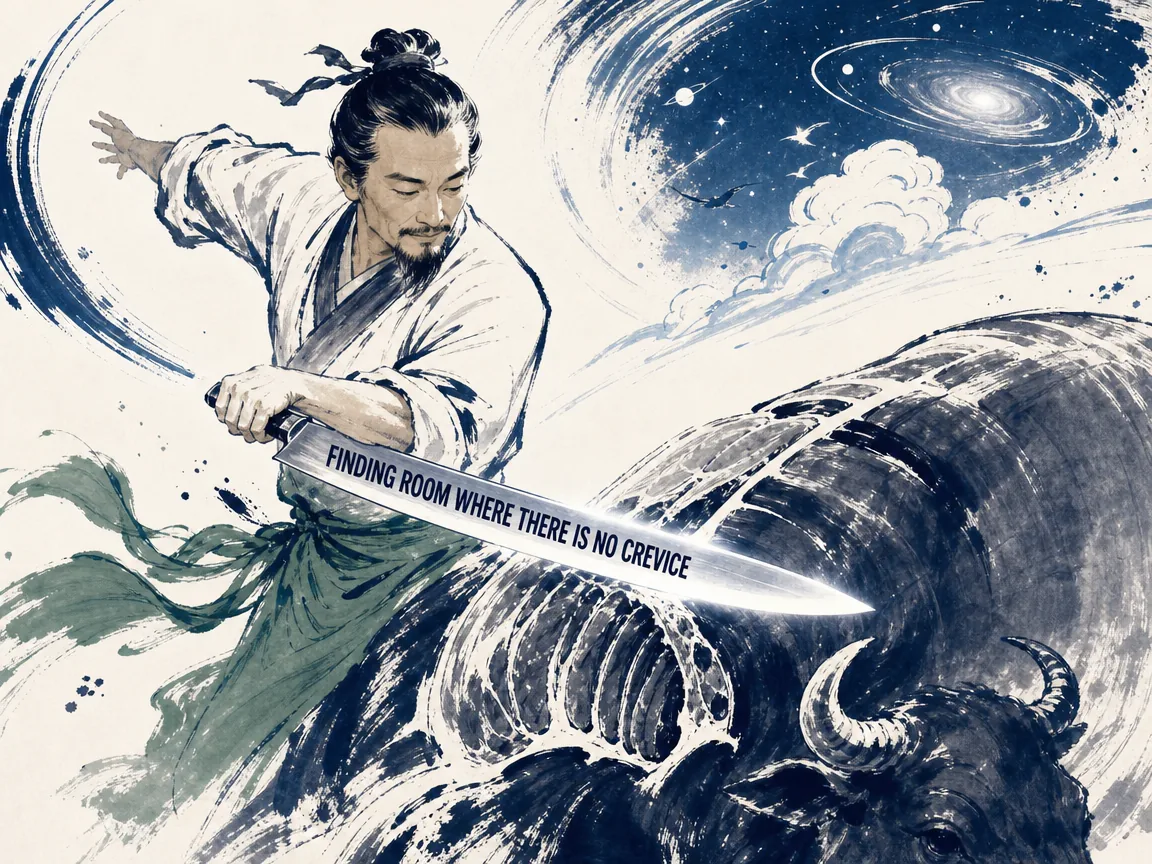
Core Insight: "There are spaces between the joints, and the blade of the knife has really no thickness. If you insert that which has no thickness into where there are spaces, there is plenty of room for it to move about." — Zhuangzi, 養生主第三
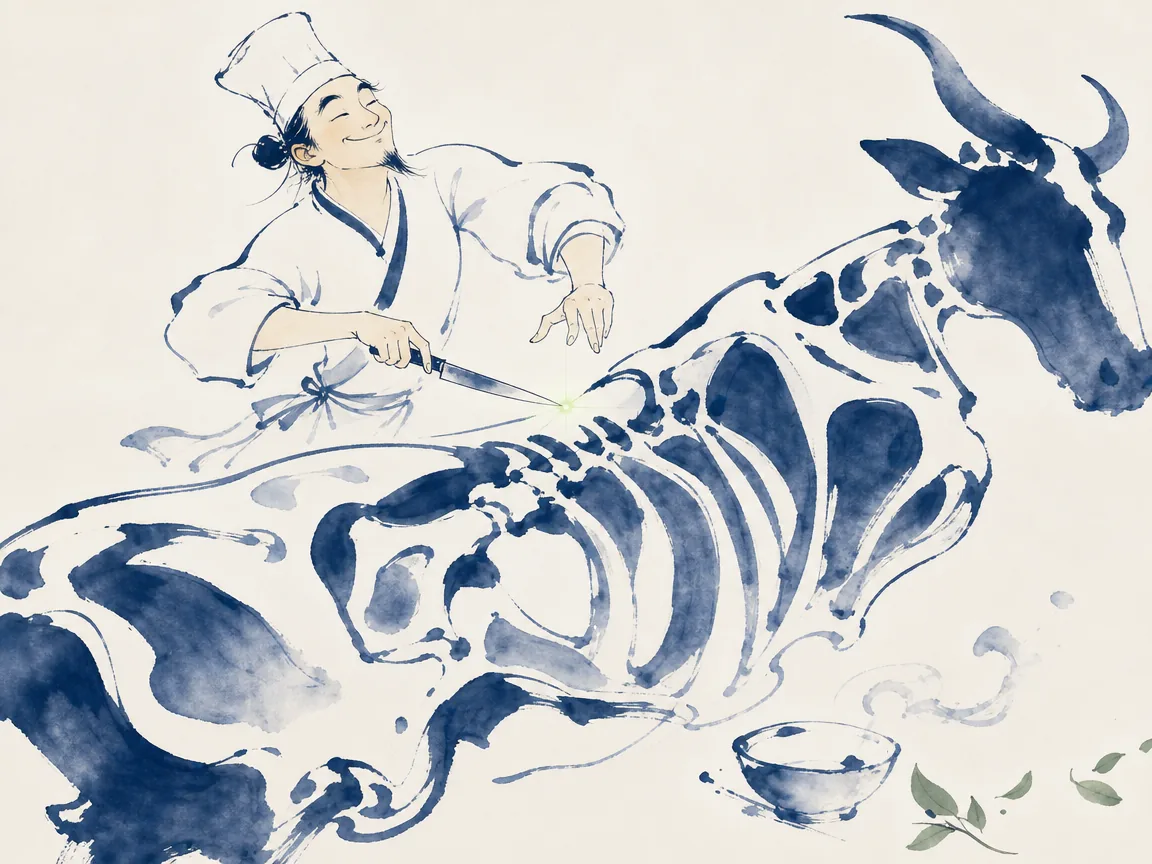
Our life has a limit, but the quest for knowledge has none. To pursue the limitless with the limited is perilous. Cook Ding carves an ox not with brute force, but by following the natural grain of Heaven. Because he inserts that which has no thickness into the open spaces between the joints, his blade remains as sharp after nineteen years as if newly honed—a foundational perspective explored in Zhuangzi Chapter 3 Translation. To see how Cook Ding’s dexterity translates into surviving modern workplace exhaustion, read our reflection on Why You’re Exhausted No Matter How Hard You Try (According to Zhuangzi).
Zhuangzi Chapter 3 Translation: Moving Where There Is Room for the Blade
Zhuangzi Chapter 3 Translation (養生主第三) invites us to step back from our everyday conditioned assumptions. For modern readers living in an achievement-driven world, Zhuangzi does not offer more techniques for self-improvement; instead, he asks what would happen if we stopped measuring our worth entirely by external usefulness and societal approval.
Complete Chapter Translation: Modern Western Reading
There is a limit to our life, but to knowledge there is no limit. With what is limited to pursue after what is unlimited is a perilous thing; and when, knowing this, we still seek the increase of our knowledge, the peril cannot be averted. There should not be the practice of what is good with any thought of the fame (which it will bring), nor of what is evil with any approximation to the punishment (which it will incur): an accordance with the Central Element (of our nature) is the regular way to preserve the body, to maintain the life, to nourish our parents, and to complete our term of years.
His cook was cutting up an ox for the ruler Wen Hui. Whenever he applied his hand, leaned forward with his shoulder, planted his foot, and employed the pressure of his knee, in the audible ripping off of the skin, and slicing operation of the knife, the sounds were all in regular cadence. Movements and sounds proceeded as in the dance of 'the Mulberry Forest' and the blended notes of the King Shou.'
The ruler said, 'Ah! Admirable! That your art should have become so perfect!' (Having finished his operation), the cook laid down his knife, and replied to the remark, 'What your servant loves is the method of the Dao, something in advance of any art. When I first began to cut up an ox, I saw nothing but the (entire) carcase. After three years I ceased to see it as a whole. Now I deal with it in a spirit-like manner, and do not look at it with my eyes. The use of my senses is discarded, and my spirit acts as it wills. Observing the natural lines, (my knife) slips through the great crevices and slides through the great cavities, taking advantage of the facilities thus presented. My art avoids the membranous ligatures, and much more the great bones. A good cook changes his knife every year; (it may have been injured) in cutting – an ordinary cook changes his every month – (it may have been) broken. Now my knife has been in use for nineteen years; it has cut up several thousand oxen, and yet its edge is as sharp as if it had newly come from the whetstone. There are the interstices of the joints, and the edge of the knife has no (appreciable) thickness; when that which is so thin enters where the interstice is, how easily it moves along! The blade has more than room enough. Nevertheless, whenever I come to a complicated joint, and see that there will be some difficulty, I proceed anxiously and with caution, not allowing my eyes to wander from the place, and moving my hand slowly. Then by a very slight movement of the knife, the part is quickly separated, and drops like (a clod of) earth to the ground. Then standing up with the knife in my hand, I look all round, and in a leisurely manner, with an air of satisfaction, wipe it clean, and put it in its sheath.'
The ruler Wen Hui said, 'Excellent! I have heard the words of my cook, and learned from them the nourishment of (our) life.'
When Gong-wen Xian saw the Master of the Left, he was startled, and said, 'What sort of man is this? How is it he has but one foot? Is it from Heaven? or from Man?' Then he added, 'It must be from Heaven, and not from Man. Heaven's making of this man caused him to have but one foot. In the person of man, each foot has its marrow. By this I know that his peculiarity is from Heaven, and not from Man.
A pheasant of the marshes has to take ten steps to pick up a mouthful of food, and thirty steps to get a drink, but it does not seek to be nourished in a coop. Though its spirit would (there) enjoy a royal abundance, it does not think (such confinement) good.'
When Lao Dan died, Qin Shi went to condole (with his son), but after crying out three times, he came out. The disciples said to him, 'Were you not a friend of the Master?' 'I was,' he replied, and they said, 'Is it proper then to offer your condolences merely as you have done?'
He said, 'It is. At first I thought he was the man of men, and now I do not think so. When I entered a little ago and expressed my condolences, there were the old men wailing as if they had lost a son, and the young men wailing as if they had lost their mother. In his attracting and uniting them to himself in such a way there must have been that which made them involuntarily express their words (of condolence), and involuntarily wail, as they were doing. And this was a hiding from himself of his Heaven (-nature), and an excessive indulgence of his (human) feelings; a forgetting of what he had received (in being born); what the ancients called the punishment due to neglecting the Heaven (-nature). When the Master came, it was at the proper time; when he went away, it was the simple sequence (of his coming). Quiet acquiescence in what happens at its proper time, and quietly submitting (to its ceasing) afford no occasion for grief or for joy. The ancients described (death) as the loosening of the cord on which God suspended (the life).
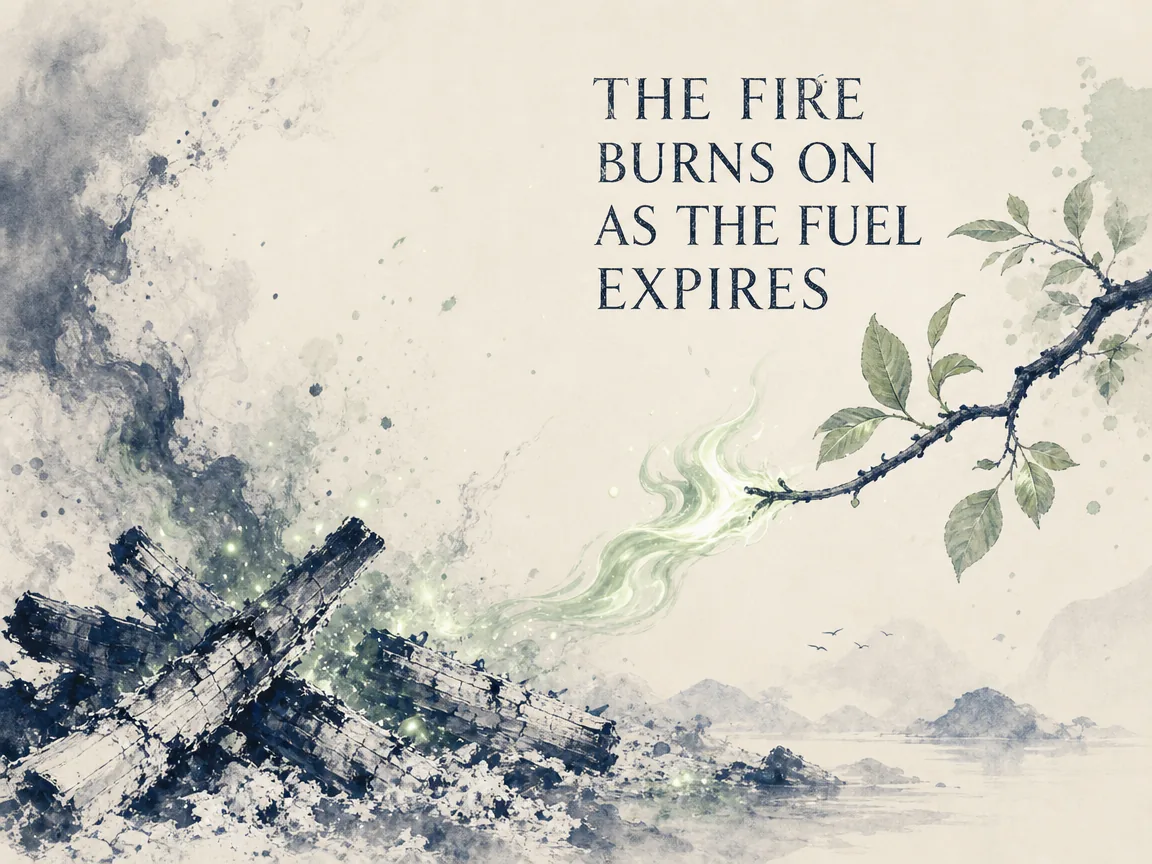
What we can point to are the faggots that have been consumed; but the fire is transmitted (elsewhere), and we know not that it is over and ended.
Zhuangzi’s quiet acceptance of death in this chapter — where the fuel is consumed but the fire transmits onwards — is deepened in our study of the transcendent sage in The Great and Most Honoured Master: The True Person of Old and Forgetting All.
Continue to Zhuangzi’s next chapter on survival amidst political danger and societal friction: In the World of Men: The Fasting of the Mind and the Useless Sacred Tree.






