
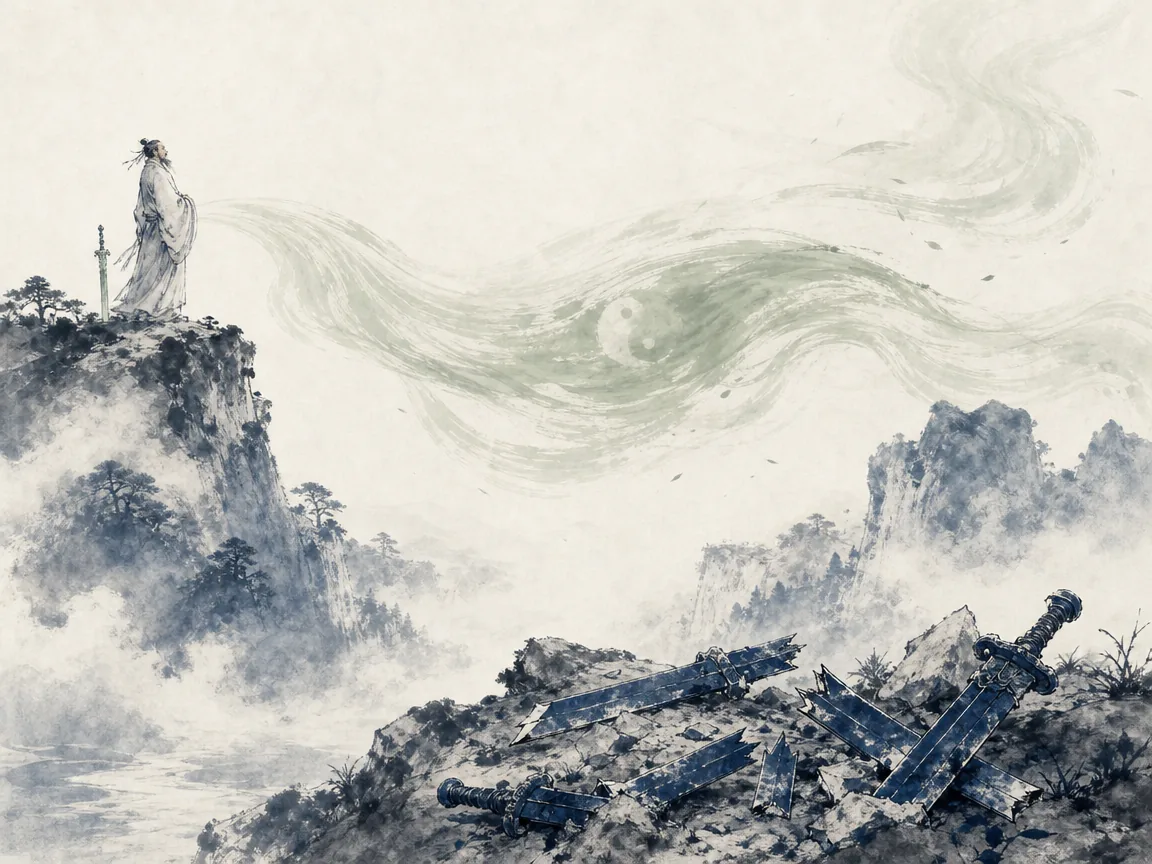
Zhuangzi Chapter 31 Meaning: Introduction
You know the moment. A notification arrives. A comment catches your eye. Before you've even finished reading it, your fingers are already moving, shaping a reply that will land somewhere between sharp and surgical. The urge to defend yourself, to win the exchange, to make the other person feel the weight of being wrong — it arrives almost automatically, like a muscle memory honed by years of living in a culture that treats every disagreement as a battle requiring a victor.
We move through our days in a near-permanent state of readiness to fight. Not the kind of fight with physical violence, but the smaller, quieter battles that occupy most of our attention: the professional slight, the social media debate, the relationship friction that we catalog and store like evidence for a trial that never adjourns. The cost of this posture is easy to dismiss because it accumulates slowly. It shows up as exhaustion, as the sense that life has become a series of skirmishes rather than a sustained practice of building something meaningful. We tell ourselves we are standing up for what is right. Sometimes we are. Often, we are simply defending a version of ourselves that cannot tolerate being questioned.
There is an older conversation about this problem, one that comes from a text traditionally associated with the Chinese philosopher Zhuangzi, known in English as the Zhuangzi [Zhuangzi (Stanford Encyclopedia of Philosophy)]. In a chapter called "Speech on Swords," the text presents a story in which a ruler is so consumed by the spectacle of sword fighting that the state itself begins to suffer. A philosopher is summoned to advise him — not by telling him his obsession is wrong, but by reframing what he thinks he understands about strength itself. The teaching that emerges challenges a deeply familiar assumption: that the highest form of power is the ability to defeat others. The Zhuangzi suggests something more unsettling. The most skilled person you will ever meet may never seem to fight at all — and that may be precisely why they are strong.
The Three Swords
The story opens with a king who surrounds himself with swordsmen. They compete daily, some die, and the kingdom weakens. When Zhuangzi arrives, he does not begin with criticism. Instead, he introduces the idea that there are different kinds of swords — not merely weapons, but ways of exercising power.
The first is what the text calls the sword of the common person. This is the sword of head-on collision: two opponents lock eyes, exchange sharp words or blows, and one falls. The drama is immediate. The stakes feel existential. But the energy expended is enormous, and the aftermath is typically emptiness — victory won at the cost of further conflict, since defeating one opponent simply makes the next one necessary. Modern life is full of these encounters. The online argument that begins as a point of disagreement and escalates into a contest of character assassination. The workplace disagreement where winning the point matters more than solving the problem. The relationship fracture where being right becomes more important than being connected. In each case, the participant experiences a surge of false power — the adrenaline of engagement, the satisfaction of seeing the other person backed into a corner. But the satisfaction is brief, and it leaves the system weaker than it was before.
The second is the sword of the feudal lord. This is not a blade held in the hand but a structure held in the mind: territory, institutions, people, strategy. Power here is organizational rather than personal. The feudal lord does not need to fight every battle because the system itself creates advantage. Translated into contemporary life, this looks like someone who stops asking "how do I win this argument?" and starts asking "what conditions would make this argument unnecessary?" It might mean building habits and routines that prevent conflict from arising in the first place. It might mean investing in relationships and professional networks that create mutual leverage rather than zero-sum competition. It might mean designing your environment so that willpower is not the primary resource you rely on. The shift is subtle but profound: from reacting within a conflict to architecting the conditions that shape whether conflict arises at all.
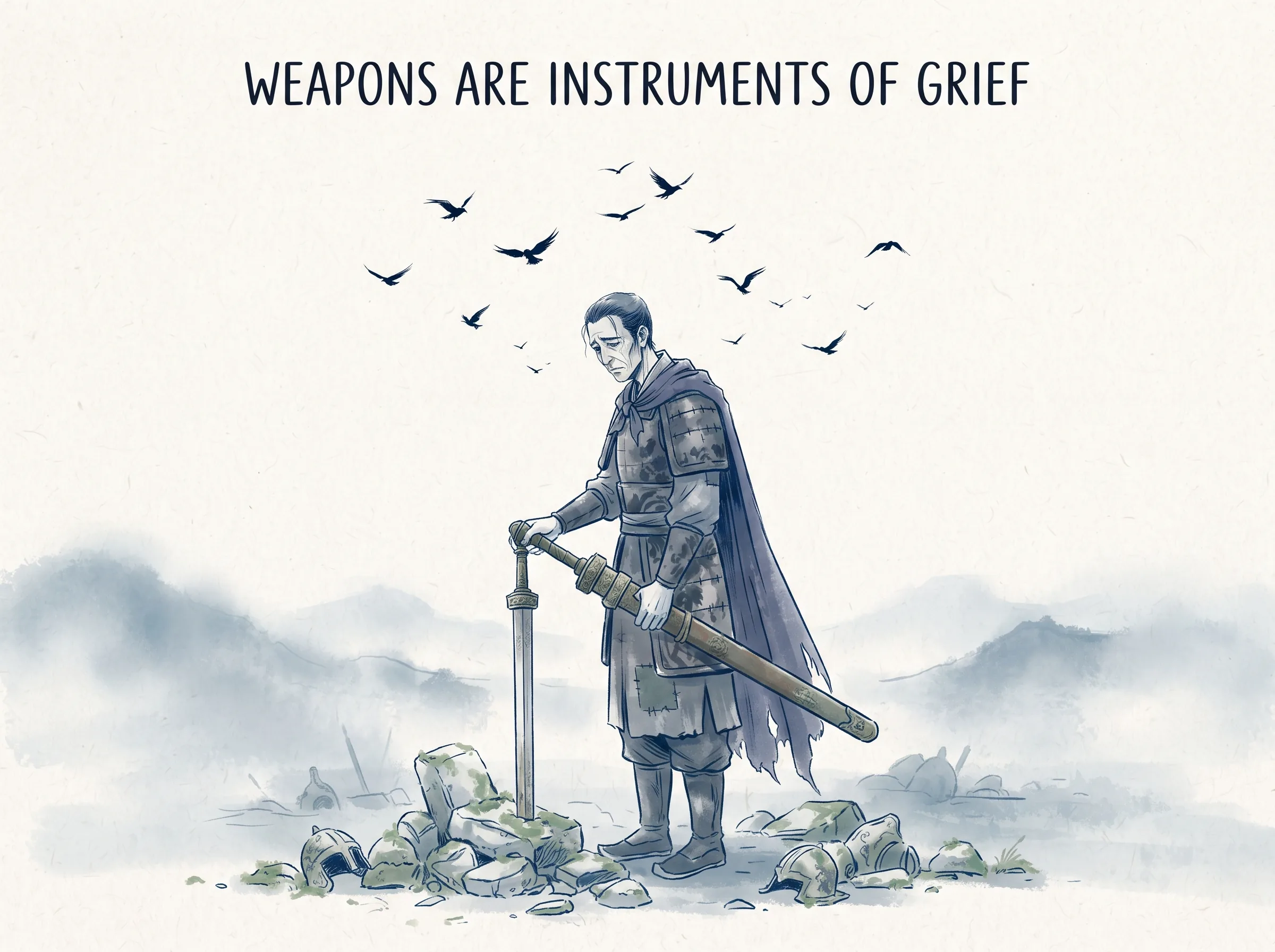
The third is the sword of the sovereign of heaven. Here the metaphor expands beyond any single state or individual into something closer to cosmic order. The text describes this sword in grand terms — encompassing geography, seasons, the interaction of opposing forces, the balance of action and restraint. The effect attributed to it is not destruction but alignment: a world in which each part finds its proper place and conflict loses its necessity. In the story, this is what finally captures the king's attention, because it reframes everything he thought he understood about strength.
It is worth noting that the Zhuangzi is a composite text shaped over centuries, and modern scholars generally do not attribute the later chapters without reservation to the historical figure Zhuangzi himself [Zhuangzi (Stanford Encyclopedia of Philosophy)]. The "Speech on Swords" belongs to these later sections. What matters for our purposes is not biographical certainty but the enduring question the text raises: if power exists on a spectrum from brute force to structural harmony to something approaching cosmic alignment, which level are we actually operating at when we pick up our swords?
Continue with the deeper interpretation and practical application.
ChiDestiny members get access to the full analysis, modern applications, and the growing Chinese Wisdom Library.
FAQ
Is the "Speech on Swords" actually written by Zhuangzi? The chapter belongs to the later sections of the Zhuangzi, and modern scholars generally do not attribute it without reservation to the historical Zhuangzi. The text as we have it is a composite compiled and edited over centuries, with contributions from multiple authors and traditions [Zhuangzi (Stanford Encyclopedia of Philosophy)]. Whether or not Zhuangzi himself wrote these lines, the teaching has been part of the Chinese philosophical tradition for over a thousand years and continues to be studied and practiced.
Does this mean I should never stand up for myself? No. The teaching distinguishes between defending values and defending ego, between protecting boundaries and seeking dominance. A clear, calm statement of what is acceptable is very different from a reactive attack. The "Speech on Swords" critiques the reflexive fight response, not the principled choice to act with integrity.
How is this different from being passive or indifferent? Passivity is the absence of action. The sword of the sovereign of heaven is not absence — it is a different kind of action, one that operates at a higher level of organization. The person described in the teaching still engages with the world. They still make decisions. They still act. But they do not act from a place of panic or the need to prove themselves. Their strength comes from inner order rather than from defeating others.
Can I really apply a two-thousand-year-old text to modern problems like social media? The "Speech on Swords" is fundamentally about the psychology of conflict — how we respond to perceived threats, how we confuse aggression with strength, how we waste energy on battles that do not serve us. These dynamics are not bound to any particular era. The mediums change — swords become arguments, arguments become posts, posts become threads — but the underlying patterns remain recognizable. That is one reason the text continues to be read and referenced, reflecting the enduring wisdom of Zhuangzi Chapter 31 Meaning.
To explore these themes from another angle, read our related reflection on The Deepest Incompleteness Is Not Physical: What Zhuangzi’s *De Chong Fu* Teaches About Inner Wholeness.
For a deeper comparative examination of these ideas, explore our related study on Why You’re Exhausted No Matter How Hard You Try (According to Zhuangzi).
Sources & Further Reading
[1] Zhuangzi (Stanford Encyclopedia of Philosophy) — Academic overview of the Zhuangzi text, its compilation history, and scholarly debates about authorship and structure.
[2] Records of the Grand Historian, Volume 43 (史記/卷043) – Wikisource — The Records of the Grand Historian's account of the Zhao royal lineage, which records King Huiwen of Zhao but does not mention the encounter with Zhuangzi described in the "Speech on Swords."
Further Reading
-
Burton Watson, translator. Chuang Tzu: Basic Writings. Columbia University Press. A widely used English translation of key Zhuangzi chapters.
-
Victor Mair, translator. Zhuangzi: The Classic of Inner Happiness. Hackett Publishing. Another respected English translation with extensive notes.
-
"Wu-wei" entries in philosophical dictionaries and the Stanford Encyclopedia of Philosophy for discussion of the Daoist concept of non-forcing action.






