
Many people have everything by external standards and still feel hollow inside. They have the career, the relationships, the appearance of control—yet underneath, there is a quiet exhaustion that no achievement seems to fill. This is not a personal failing. It is a condition of our time: a kind of spiritual fragmentation where attention, identity, and self-worth are pulled apart by constant external demands.
The roots of this fragmentation are everywhere. Social comparison is no longer occasional but continuous, fed by algorithms designed to keep us scrolling, evaluating, and wanting. Self-worth becomes something measured in likes, followers, and milestones rather than something cultivated from within. Desire is manufactured rather than discovered. Identity is performed rather than lived. The result is someone who looks whole on the outside but has no stable center on the inside—a foundational perspective explored in Zhuangzi Chapter 5.
Two thousand years ago, the Chinese philosopher Zhuangzi addressed this very condition in a chapter called De Chong Fu—often translated as "The Sign of Virtue Complete" or "The Seal of Inner Fullness" [1]. His diagnosis was radical: true completeness does not live in the body, status, or appearance. It lives inward. And when inner virtue is genuinely full, it shows outwardly without effort.
Zhuangzi Chapter 5: What Does Inner Coherence (Dé Chōng, 德充) Actually Mean?
To understand Zhuangzi's vision, we need to clarify the three characters that form the chapter's title. In common understanding, dé (德) is often translated as "virtue" in the moral sense—a quality of being good, upright, or ethical. But in Zhuangzi's usage, it means something deeper: the inner fullness, the internal coherence, the stability of one's inner life. It is not about moral performance or social approval.
Chōng (充) means filled, complete, overflowing from within. When Zhuangzi speaks of dé chōng (德充, virtue filled / inner wholeness), he is describing a person whose inner life is so coherent and settled that it does not depend on external validation, physical perfection, or social achievement to feel real
Fú (符, sign / token) is more difficult to translate. Some scholars render it as "sign" [1], while others use "seal" or similar terms. Whatever the precise word, the idea is consistent: when inner virtue is full, it naturally manifests outwardly. It does not need to announce itself. It simply radiates.

This is why De Chong Fu is so unsettling to conventional thinking. Zhuangzi is not offering comfort to people who feel incomplete because of their circumstances. He is offering a completely different definition of what it means to be complete.
Zhuangzi's Radical Portrait: Who Really Looks "Complete"?
De Chong Fu opens not with beautiful, successful, or powerful people—but with those whom society would dismiss. Zhuangzi places three figures at the center of his narrative, and all three challenge every assumption about where wholeness resides
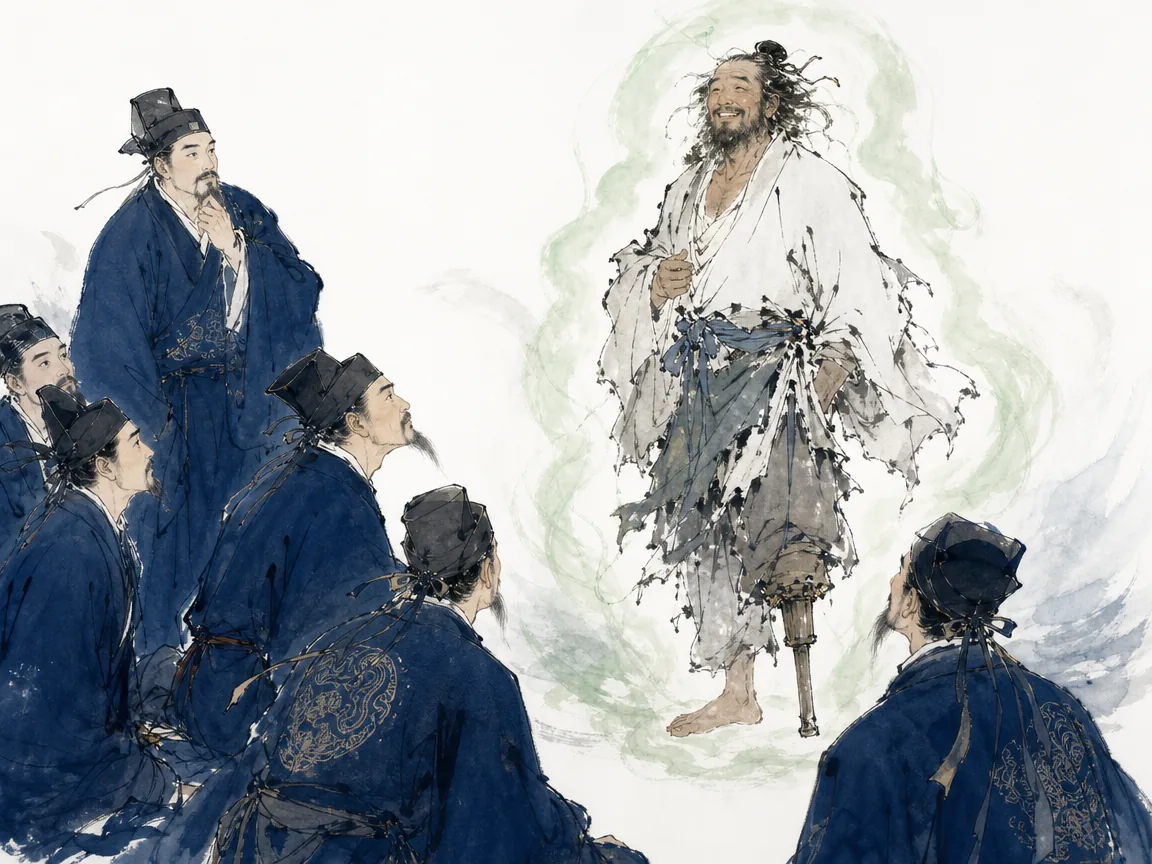
Wang Dai (王骀) is described as a man who suffered a foot amputation—the punishment known as foot amputation (yuè xíng, 刖刑). By any conventional standard, he is physically incomplete (cánquē, 残缺). Yet Zhuangzi writes that the number of people who follow Wang Dai is equal to that of Confucius's disciples When asked how this is possible, Confucius explains that Wang Dai stands without teaching and sits without debating, yet people leave him feeling fuller than when they arrived: "empty going, full returning"
Shen Tu Jia (申屠嘉) is another man marked by physical disability. He studies alongside Zi Chan, the distinguished minister of Zheng—a man of power, status, and refinement. But when Zi Chan's prejudice against Shen Tu Jia's body is revealed, it becomes clear that the physically complete man is spiritually divided, while the physically marked man is inwardly whole
Ai-tai Tuo (哀骀它) is described in the text as a man of extremely unattractive appearance—"so ugly he startles the world" Yet men who spend time with him find themselves unable to leave, and more than ten women ask their parents to let them become his concubines rather than marry ordinary men Confucius, reflecting on this phenomenon, calls Ai-tai Tuo one who possesses "complete ability and virtue that does not appear" To study the primary classical text and commentary, explore the original Chinese text and deep philosophical translation in The Sign of Virtue Complete: The Whole Person Behind the Mutilated Form.
Zhuangzi is not offering consolation to people with disabilities. He is delivering a judgment on the standards by which society measures worth. The chapter asks a devastating question: who is truly complete—the one who looks perfect but lives in anxiety and comparison, or the one who bears scars but carries an unshaken center?
The Modern Parallel: Fragmented Bodies, Shattered Spirits
The condition Zhuangzi diagnosed is not limited to ancient China. It describes a very specific form of modern suffering.
Research on social networking sites confirms what many already experience: negative social comparison is linked to higher levels of depression and anxiety, while feelings of envy and inferiority intensify when people encounter curated images of others' lives [4]****[5]. The mechanism is precise. When your self-worth is outsourced to external metrics—likes, followers, career progress, aesthetic approval—you become permanently responsive to whatever the world tells you to want. You fragment.
Your attention is scattered by design. Your sense of value is tied to performance. Your identity becomes something you construct rather than something you discover. You adapt to "what works" in each context—professional, social, romantic—until there is little sense of who you are when no one is watching.
This is exactly the condition Zhuangzi identified. He called it the scattering of spirit (神散). The body may be intact, but the self is pulled in a dozen directions, each one demanding a different version of you. You look whole. You feel hollow.
What Does It Mean to Have Inner Coherence (Dé Chōng, 德充) Today?
Having inner coherence (dé chōng, 德充) does not mean becoming numb, detached, or indifferent to life. Zhuangzi's metaphor of still water (zhǐ shuǐ, 止水) offers a helpful image: a flowing river cannot reflect the sky clearly—only still water can. Stillness in Zhuangzi is not passivity. It is the capacity to remain centered while everything around you changes.
What might this look like in practice?
Reclaim your attention. Notice when you are scrolling to avoid thinking, comparing yourself to measure worth, or performing a version of yourself to gain approval. Each of these habits fractures your inner coherence. You do not need to eliminate them entirely—you need to become aware of them.
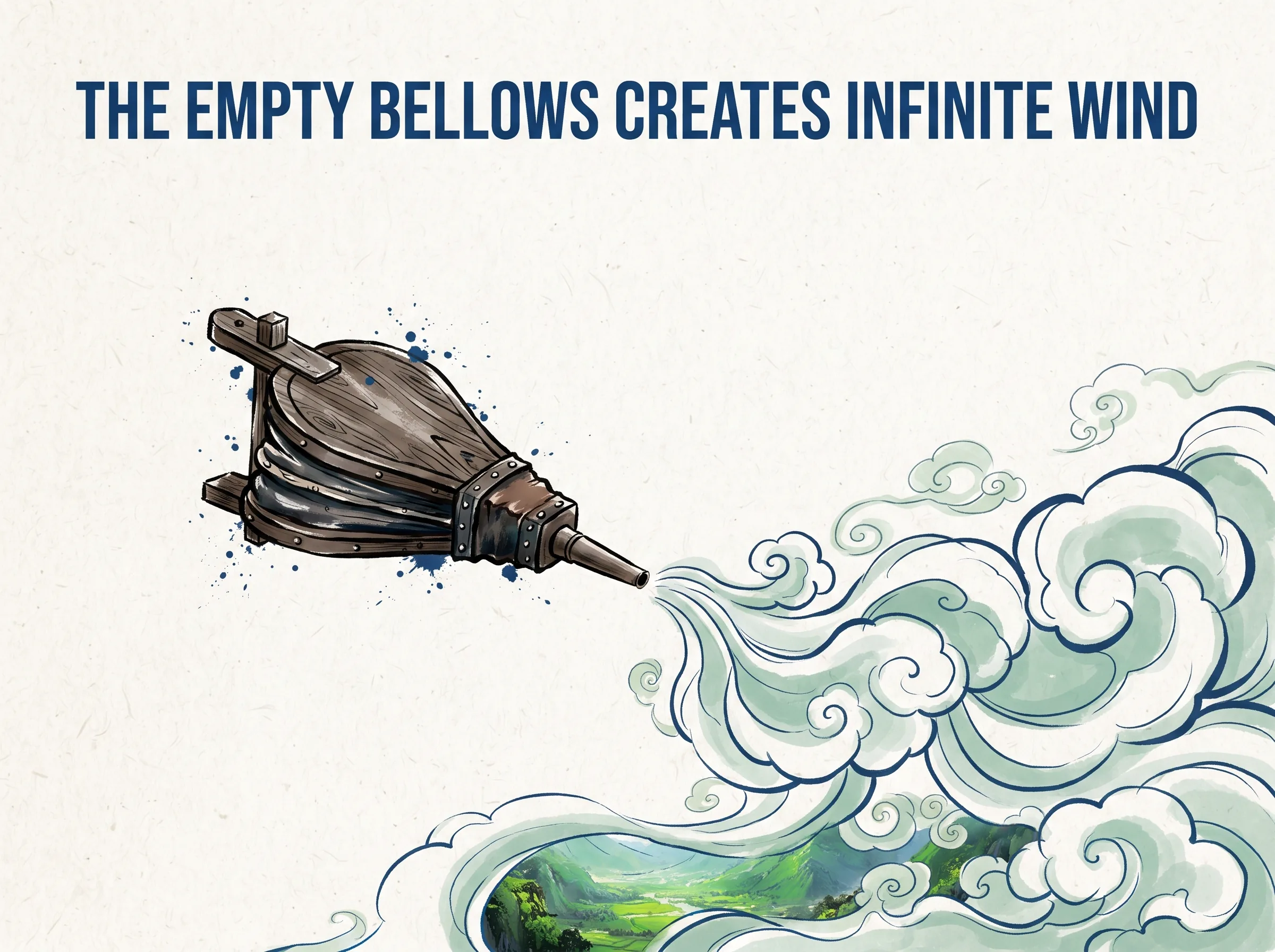
Stop outsourcing your sense of self. When your value depends on what others think, you will never feel sufficient, because external validation is inherently unstable. Zhuangzi suggests that a person of inner wholeness (dé chōng, 德充) does not beg for recognition—they are complete within. This does not mean rejecting all feedback, but it does mean not letting every opinion determine your sense of worth.
Practice inward stillness. You do not need to retreat to a mountain. The practice is simpler: when you feel pulled in multiple directions, pause. Ask yourself not "what should I do?" but "who am I when no one is watching?" This question is uncomfortable at first. It is also the beginning of integrity.
People who carry this kind of inner coherence are recognizable—not by what they say, but by how they make others feel. Near them, you do not feel the need to perform. Their presence is stabilizing without being demanding. There is a difference between this kind of presence and what we usually call charisma. Charisma often demands attention. Inner coherence simply rests.
The Path Back to Wholeness
Zhuangzi does not ask you to ignore reality. He asks you to root your life in a different place.
Body changes. Appearance fades. Status shifts. Wealth arrives and departs. Social approval comes and goes. If your sense of completeness depends on any of these, you will always be vulnerable to loss. But an inner center—once established—cannot be taken by external circumstance.
The shift Zhuangzi proposes is a shift of lens: from outward form (xíng, 形) to inner virtue (dé, 德). You stop asking "do I look complete?" and start asking "am I internally coherent?" You stop measuring yourself by how others receive you and start measuring yourself by whether you are living from a centered place.
This does not guarantee success by conventional standards. It does not promise that everyone will like you, that you will never fail, or that your body will remain young. What it does offer is something more durable: the ability to face life's imperfections without being destroyed by them.
You will never be fully accepted, fully beautiful, fully successful. But you can stop letting those impossibilities fracture you. Wholeness is not external perfection. It is internal coherence.
A New Measure
De Chong Fu is not a chapter about disability. It is a chapter about where we place the source of our worth. Zhuangzi puts society's outcasts at the spiritual center and those with power and status in the shadow—not to mock the powerful, but to reveal that external completeness and internal completeness are not the same thing.
The invitation is simple and radical: stop chasing external completeness. Build internal integrity. When inner virtue (dé, 德) is full, outer resonance (fú, 符) follows on its own. You do not need to announce who you are. You do not need to perform wholeness. A person who is internally coherent simply stabilizes everyone around them—without saying a word.
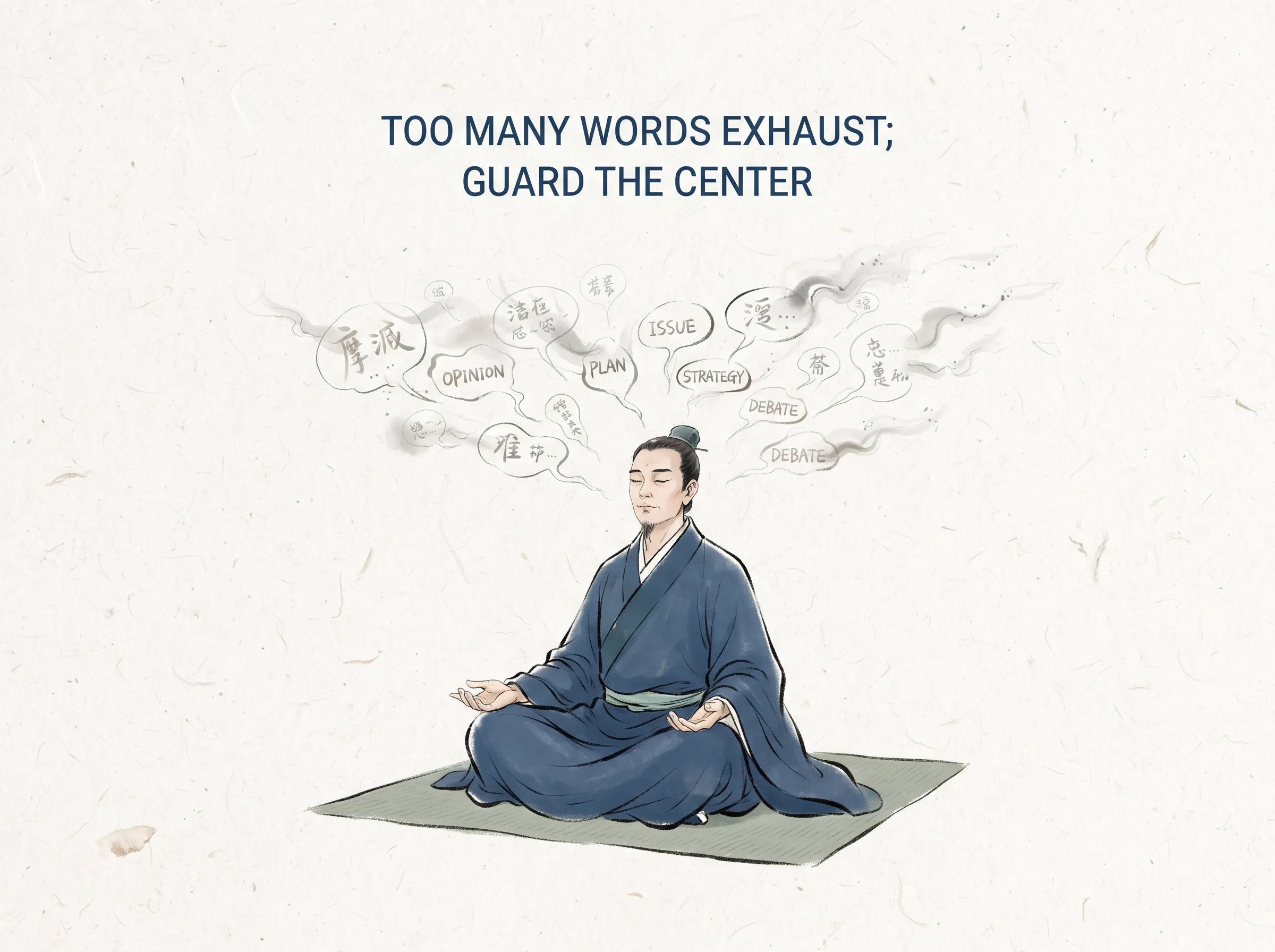
If this resonates, consider starting small. Choose one area of your life where you have been outsourcing your sense of worth—perhaps social media, professional validation, or relationships—and experiment with observing it without immediately reacting. Notice what happens when you pause instead of perform. Over time, these small pauses accumulate into something Zhuangzi would recognize: a life no longer fragmented by the demand to appear whole, but genuinely whole from the inside out.
FAQ
Q: Is "De Chong Fu" really about disabled people? Not primarily. The chapter uses physically marked individuals as literary devices to challenge conventional assumptions about where completeness resides. Zhuangzi's point is that inner coherence matters more than external form.
Q: How is Zhuangzi's concept of inner virtue (dé, 德) different from the common understanding of virtue? In everyday Chinese, dé (德) often refers to moral character or good behavior. In Zhuangzi's philosophy, it refers to inner fullness and coherence—the stability of one's internal life rather than conformity to external moral standards
Q: Does Zhuangzi's teaching mean I should ignore my appearance or achievements? No. Zhuangzi does not deny physical differences or social realities He challenges the idea that these should be the primary source of your sense of worth. The body and accomplishments are not the problem; making them the foundation of your identity is.
Q: Can this ancient philosophy help with modern anxiety and stress? Research on social comparison and digital media suggests that reducing comparison-based thinking can lower anxiety and depression symptoms [4]****[5]. While Zhuangzi's framework is philosophical rather than clinical, its emphasis on inner stability over external validation aligns with what contemporary psychology recognizes as protective factors for mental well-being, reflecting the enduring wisdom of Zhuangzi Chapter 5.
Discover the historical and philosophical roots in the classical foundation in Cutting Open Satchels: Why Clever Protections Only Arm the Great Thief.
For a deeper comparative examination of these ideas, explore our related study on Tian Zi-fang: The True Scholar in Casual Clothes and the Arrow of Mind.
Sources & Further Reading
[1] The Complete Works of Zhuangzi | Columbia University Press — Burton Watson's translation of De Chong Fu (《德充符》) as "The Sign of Virtue Complete" (Chapter 5 of the Inner Chapters)
[2] Zhuangzi / Signs of Virtue Complete (德充符) — Original classical Chinese text of De Chong Fu (德充符) with annotated translations confirming the figures of Wang Dai, Shen Tu Jia, and Ai-tai Tuo
[3] Zhuangzi (Stanford Encyclopedia of Philosophy) — Academic overview confirming the structure of the Inner Chapters (1–7) and scholarly interpretations of inner virtue (dé, 德)
[4] Social Networking Sites, Depression, and Anxiety: A Systematic Review – PMC — Research linking negative social comparison on SNS to higher depression and anxiety
[5] Envy, Social Comparison, and Depression on Social Networking Sites: A Systematic Review – PMC — Research on envy and inferiority in relation to curated social media images
Further Reading
- Zhuangzi, Inner Chapters — The complete text of chapters 1–7, including De Chong Fu (德充符), in multiple English translations (Burton Watson, Gary Snyder, Victor Mair)
- The Stanford Encyclopedia of Philosophy entry on Zhuangzi for scholarly context on Daoist concepts of virtue (dé, 德) and the Way (dào, 道)






