
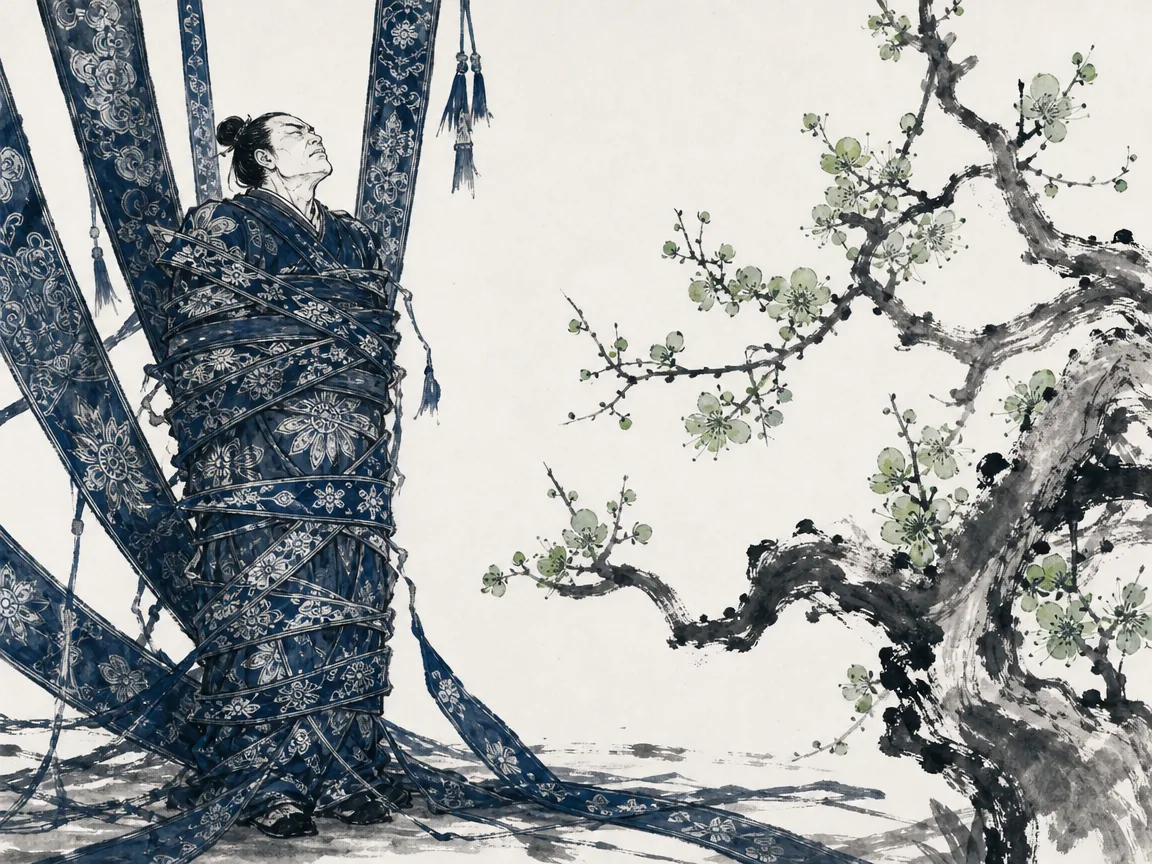
Society is full of beautiful words. Filial piety. Discipline. Success. Ease and unforced grace (sōngchí gǎn, 松弛感). Positive energy. Boundaries. Self-optimization. We collect these terms the way children collect stickers, trusting that each one marks something good and true. And most of the time they do point toward genuine values. But somewhere along the way, a quiet question goes unasked: who benefits when this word becomes the final authority over how I live?
Zhuangzi asked this question not gently, but with the blunt force of a cracked bell. In one of the most uncomfortable chapters of the Zhuangzi, he placed a notorious bandit on stage to deliver a devastating critique of Confucius. The chapter is called Dao Zhi—"Robber Zhi"—and it is the only place in the received text where someone described as a violent, greedy robber openly judges the Sage himself. This is not a simple act of rebellion. It is a deliberate thought experiment. Zhuangzi lets the least respectable voice in the room speak loudest, so that we might hear something the respectable voices have grown too comfortable to notice—a foundational perspective explored in Zhuangzi Chapter 30 Meaning.
The question he pushes us toward is sharper than any morality lecture: when a good idea becomes a weapon, how do we tell the difference? And more personally—when our morals feel like they are feeding us, how do we know they haven't quietly become a cage?
Zhuangzi Chapter 30 Meaning: The Bandit Who Scolded the Sage
The Dao Zhi chapter opens with an extraordinary setup. It tells us that Confucius, considered the greatest teacher in the Chinese tradition, hears about a bandit named Zhi—described as the younger brother of a respected official—and decides to visit him in person, hoping to reform him through teachings on ren yi, humaneness and righteousness [1]. Confucius returns home afterward, and the text records that he did not speak for several days, as if the encounter had left him speechless [1].
Then Zhi delivers one of the most sustained critiques of moral authority in ancient literature. He accuses Confucius of using eloquent words and artificial rituals to confuse and burden the world, trading genuine understanding for hollow reputation [1]. His words are rough, sometimes cruel, and intentionally provocative. Zhuangzi does not ask us to admire Zhi. In fact, the text itself describes him as someone who robs cities, seizes livestock and women, neglects his family, ignores ancestral sacrifices, and causes suffering for ordinary people [1]. He is not offered as a model of virtue. He is offered as a mirror.
The deeper purpose of this chapter is structural, not biographical. Some scholars have noted that the familial relationship described at the opening—Zhi as the brother of Liu Xia Hui, and Liu Xia Hui as Confucius's friend—is historically implausible, since Liu Xia Hui is thought to have lived roughly a century before Confucius [3]. Whether this discrepancy is an error, a later addition, or something else entirely remains debated What matters philosophically is not the biography but the gesture: Zhuangzi puts an extreme outsider at the center of a conversation about moral language, precisely to show that truth does not always speak from the highest platform. The most dangerous illusions are often defended by the most trusted voices.
What the Bandit Was Really Attacking
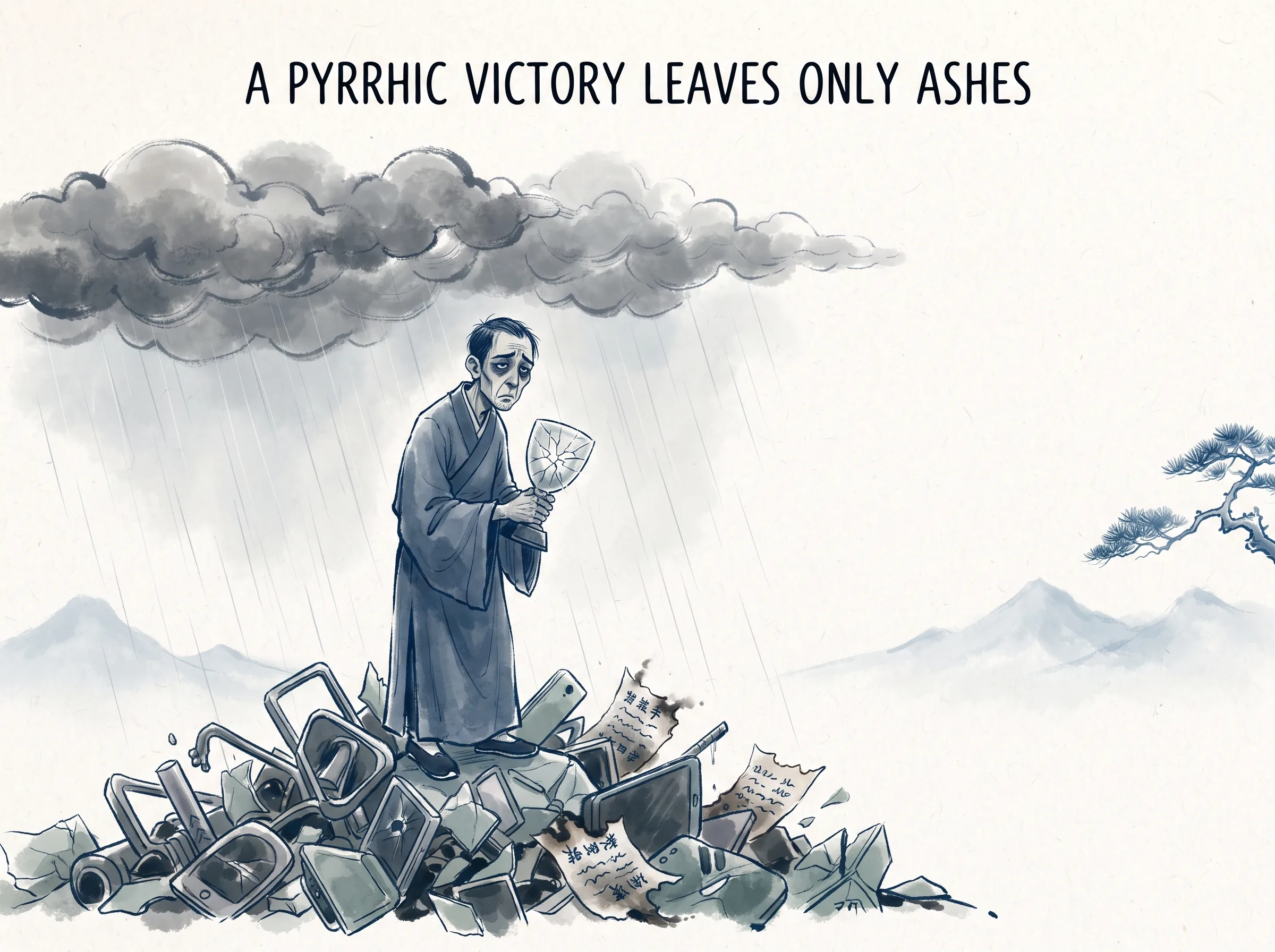
Zhi does not argue that morality is meaningless. He argues that morality, when severed from living human beings, becomes a machinery of destruction. His most striking passage lists a series of historical and legendary figures who died pursuing virtuous reputations: Bi Gan, whose heart was torn out; Wu Zixu, cast into a river; Boyi and Shuqi, who starved rather than compromise their principles; Jie Zitui, burned alive while embracing a tree; and Wei Sheng, who drowned holding onto a bridge pillar because he refused to break a romantic appointment [1]. The text explicitly calls Bi Gan and Wu Zixu "the so-called loyal ministers of the world," and then asks, almost in disbelief: these two men were regarded as loyal ministers by the world, yet in the end they became the laughter of all under heaven [1].
Zhi's point is uncompromising. When a virtue demands the sacrifice of the very life it is supposed to protect, we should ask whose glory is being served. If the result of virtue is death, and the cost of righteousness is your actual living existence, then the virtue has stopped serving you. It has started consuming you.
The chapter also includes Bao Jiao, who died embracing a tree after criticizing the world, and Shentou Di, who drowned himself after his remonstrations went unheard [1]. Together these six figures are described as "no different from scattered dogs, flowing pigs, or begging gourds"—all who separated themselves from life for the sake of a name, not attending to their natural condition and lifespan [1]. Zhuangzi's accusation is not that these people were wicked. It is that civilization has a habit of packaging self-destruction as the highest form of goodness, and then expecting everyone to volunteer for it.
Continue with the deeper interpretation and practical application.
ChiDestiny members get access to the full analysis, modern applications, and the growing Chinese Wisdom Library.
FAQ
Is the Robber Zhi chapter actually by Zhuangzi? Scholars generally agree that the Dao Zhi chapter is part of the miscellaneous sections of the received Zhuangzi, compiled by Guo Xiang into the thirty-three chapters we have today, and that Zhuangzi himself is not likely the sole author of these later sections [2]. The chapter's authorship is therefore attributed to followers or later writers influenced by Zhuangzi's thought.
Did Confucius and Robber Zhi actually meet? No. The encounter is a literary and philosophical device, not a historical record. The familial details at the beginning of the chapter are also considered historically implausible by modern scholars Zhuangzi uses the scenario to stage a confrontation between two ways of understanding the world.
Does Zhuangzi think morality is pointless? No. Zhuangzi criticizes morality that has been separated from living human beings and turned into a system of judgment and control. He is not arguing for amorality; he is arguing for a morality that serves life rather than sacrificing it to a label.
What is the difference between "preserving authenticity" and "preserving life"? The Dao Zhi chapter uses the phrase "quan zhen" (preserving true nature or authenticity) when criticizing artificial moral performance [1]. A related concept, "quan sheng" (preserving life), appears in the Yangshengzhu ("The Way of Nourishing Life") chapter Both point toward protecting the genuine human being from being consumed by external standards, though they appear in different sections of the text, reflecting the enduring wisdom of Zhuangzi Chapter 30 Meaning.
To explore these themes from another angle, read our related reflection on Beyond Escape: How Zhuangzi Can Help You Live Authentically in a World That Won’t Stop Defining You.
For a deeper comparative examination of these ideas, explore our related study on Why the More We Control, the More We Break: Zhuangzi’s Answer to Modern Exhaustion.
Sources & Further Reading
[1] Zhuangzi (Stanford Encyclopedia of Philosophy) — Overview of the Zhuangzi's composition, authorship debates, and philosophical themes including language and naming.
[2] Chapter 29: Robber Zhi — Zhuangzi — Zhuangzi | Forage — English translation of the Dao Zhi chapter with notes on historical context.
[3] Zhuangzi / Robber Zhi (莊子/盜跖) – Wikisource — Original Chinese text of the Dao Zhi chapter.
Further Reading
- Zhuangzi (Stanford Encyclopedia of Philosophy) — Recommended for deeper exploration of Zhuangzi's philosophy of language, skepticism toward fixed norms, and the tension between convention and natural spontaneity.






