
Modern life runs on a quiet but relentless demand: be useful. From the moment we begin forming habits of self-improvement, the message is embedded in everything around us. Good grades lead to good careers. Skills translate into income. Even rest is increasingly framed as "productive downtime" — recovery with a purpose. Relationships are evaluated by what they provide. Content is measured by engagement. Identity itself is often assembled from achievements, competencies, and external validation. When nothing produces, something quietly panics.
This is a condition that Zhuangzi, the ancient Chinese thinker, recognized long before modern productivity culture gave it a name. In a world where people are trained to see themselves as instruments of value — useful to employers, families, markets, algorithms — he offered a radical inversion. What if the deepest tragedy is not being useless, but spending your entire life proving you are useful? What if the very thing you chase to feel worthwhile is the thing that consumes you? This principle is central to Zhuangzi Chapter 20.
Zhuangzi's concern was not abstract. It was deeply human. He saw that when a person's sense of worth depends entirely on external utility, they stop being a living, breathing subject and become an object — a tool designed for someone else's purpose. The tree in his most famous parable was cut down not because it was bad, but because it was good for something. The danger, Zhuangzi understood, is not worthlessness. The danger is being so useful that you cease to belong to yourself.
Zhuangzi Chapter 20: The Mountain Tree That Survived By Being Useless
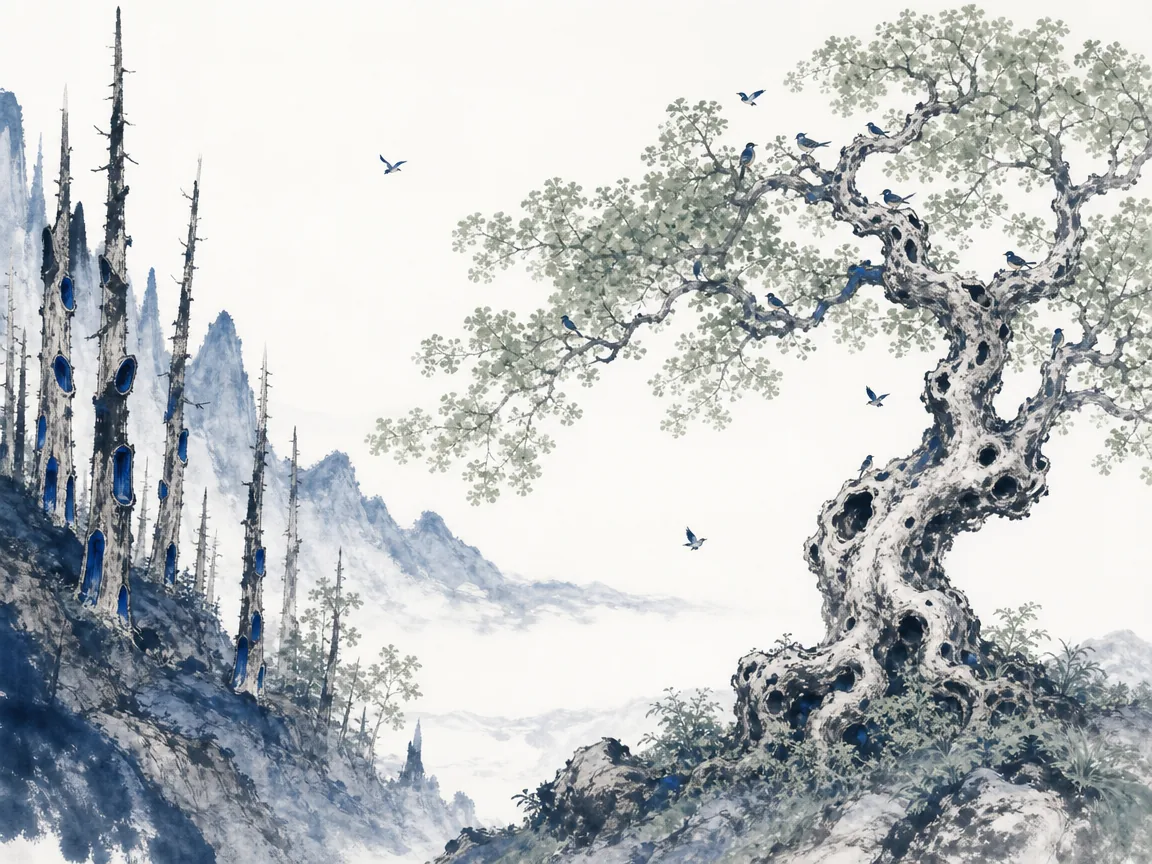
The story begins in the Mountain Tree chapter of the Zhuangzi, a text that modern scholars generally attribute to the broader Zhuangzi school rather than to Zhuangzi himself alone [1]. Zhuangzi is walking through a mountain and sees a massive tree with flourishing branches and dense foliage. Woodcutters pass by it and do not stop. When he asks why, they explain: "It is of no use." Zhuangzi tells his disciples: "This tree has survived because it is useless." [2]
On the surface, this is a simple reversal of conventional wisdom. We are taught that value is measured by function — a tree is worth something if it can become a beam, a table, a ship. A person is worth something if they can contribute, produce, solve problems. But Zhuangzi flips the equation: the tree's greatness lies precisely in its inability to serve anyone's agenda. Its usefulness would have been its destruction. Its uselessness has been its salvation.
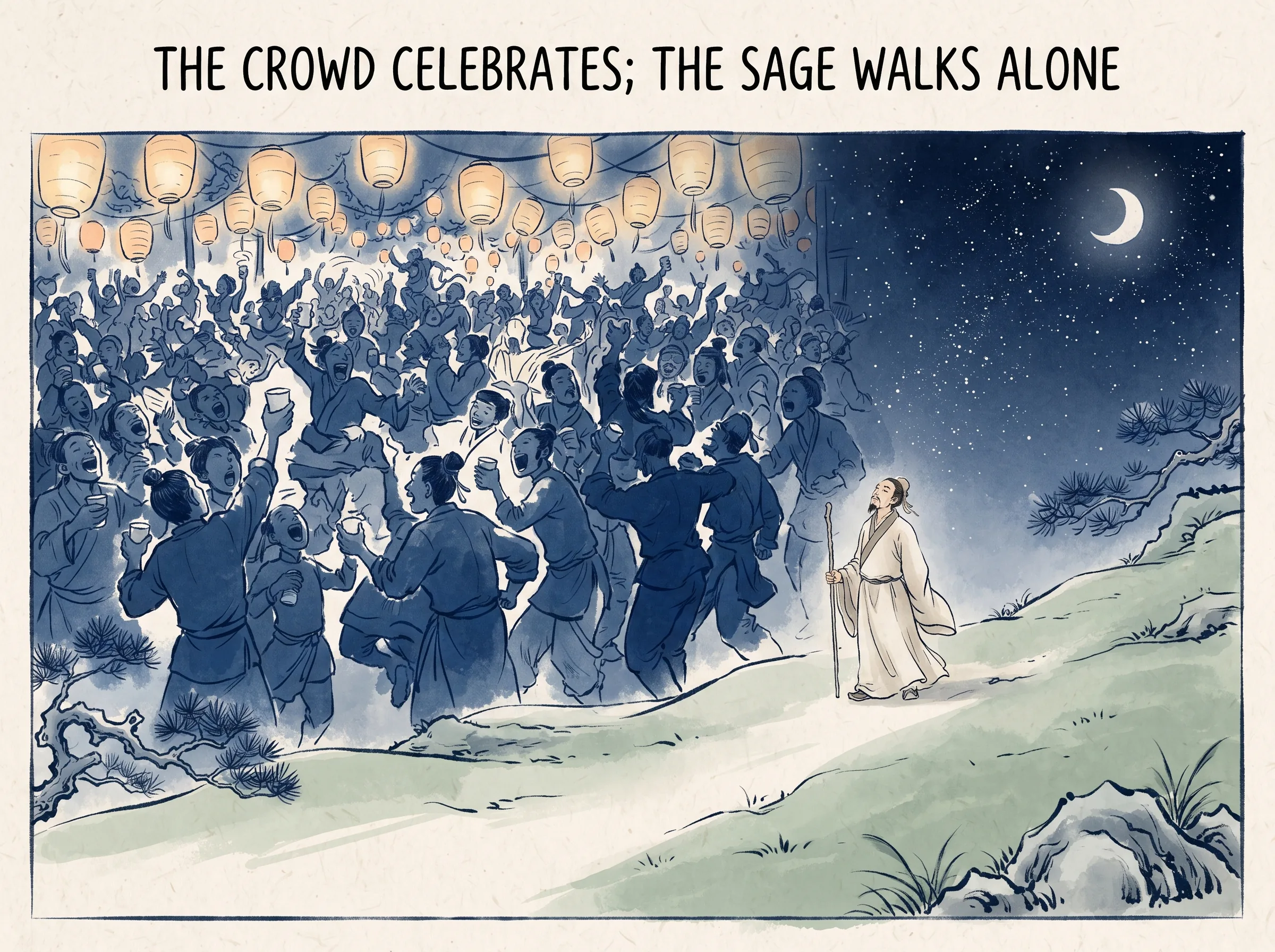
The deeper point is subtle but devastating. When your worth is defined by external utility, you become vulnerable to the very systems that praise you. The more useful you are, the more you can be taken — by employers, by expectations, by obligations that never end. Your skills become liabilities if they belong to others more than to you. Your competence becomes an endless conveyor belt of demands. Zhuangzi saw this clearly: usefulness is a double-edged sword, and for many, it cuts deeper than any failure ever could.
Continue with the deeper interpretation and practical application.
ChiDestiny members get access to the full analysis, modern applications, and the growing Chinese Wisdom Library.
FAQ
Is Zhuangzi telling us to be useless on purpose?
No. Zhuangzi is not advocating deliberate uselessness as a life strategy. The tree survived because it was useless, and the goose died because it was useless — and Zhuangzi himself acknowledges that positioning yourself strictly between useful and useless is still not enough. His teaching is about not being fixed to either pole, about understanding that rigidity in any direction can become a trap. Usefulness and uselessness are both tools, not identities.
How do I apply this without becoming manipulative or opportunistic?
Zhuangzi's flexibility is not the same as calculation. There is a difference between adapting to circumstances with awareness and manipulating situations for personal gain. The key distinction lies in what remains constant: your inner nature, your integrity, your sense of who you are. Flexibility changes your tactics; it does not change your character. You can be useful when the situation calls for it without becoming a tool. You can be useless when the situation calls for it without becoming lazy or dishonest. The center is not your strategy — it is your character.
Is this teaching only for people who feel trapped by productivity culture?
The insight applies to anyone who has ever felt that their worth depends on what they produce or achieve — which, in practice, includes almost everyone in a modern society. It is not limited to those who identify as burned out or disenchanted. Even high achievers who feel empty despite success, or people who have never questioned whether they are "enough," can benefit from Zhuangzi's perspective. The question is not whether you are currently struggling with productivity anxiety — it is whether you have ever wondered what you would be worth if nothing you did impressed anyone.
Where can I read more about this parable?
The Mountain Tree chapter appears in the twentieth chapter of the received text of the Zhuangzi, traditionally attributed to the Zhuangzi school of thought. Standard English translations of this chapter can be found in academic editions of the text. The Stanford Encyclopedia of Philosophy provides scholarly context on the composition and interpretation of the Zhuangzi's Outer Chapters, including the Mountain Tree chapter [3], reflecting the enduring wisdom of Zhuangzi Chapter 20.
To explore these themes from another angle, read our related reflection on Why Chasing Happiness Makes You Less Happy — and What Zhuangzi’s Ancient Idea of “Highest Joy” Can Teach You.
For a deeper comparative examination of these ideas, explore our related study on Why Do You Keep Chasing Goals That Don’t Make You Feel Free?.
Sources & Further Reading
[1] *Zhuangzi Tongyi — Mountain Trees (山木篇) – Shidian Guji*
[2] *Chapter 20 — The Mountain Tree — Zhuangzi*
[3] Zhuangzi (Stanford Encyclopedia of Philosophy/Fall 2025 Edition)
Further Reading
- Standard English translations of the Zhuangzi with chapter-by-chapter commentary
- Scholarly introductions to Daoist philosophy and the Inner, Outer, and Miscellaneous chapters of the Zhuangzi
- Studies on the concept of wu wei and its relationship to flexibility and non-attachment in Daoist thought
The deepest tragedy is not being useless. It is spending your whole life proving you are useful — until usefulness is all that remains, and you have forgotten who you were before the world began asking what you could do for it.
Zhuangzi's mountain tree does not prove anything. It simply exists, tall and uncut, living out its years precisely because no one could find a use for it. That is not a lesson in laziness. It is a lesson in freedom — the freedom to be more than what others need you to be.
Start by asking one question today: where in your life are you performing usefulness instead of living fully? You do not need to drop everything. You only need to remember, as Zhuangzi did over two thousand years ago, that you are not a tool. You are a life. And a life is worth more than anything it can produce.







[…] To explore these themes from another angle, read our related reflection on Why the Deepest Tragedy Is Spending Your Whole Life Proving You Are Useful. […]