
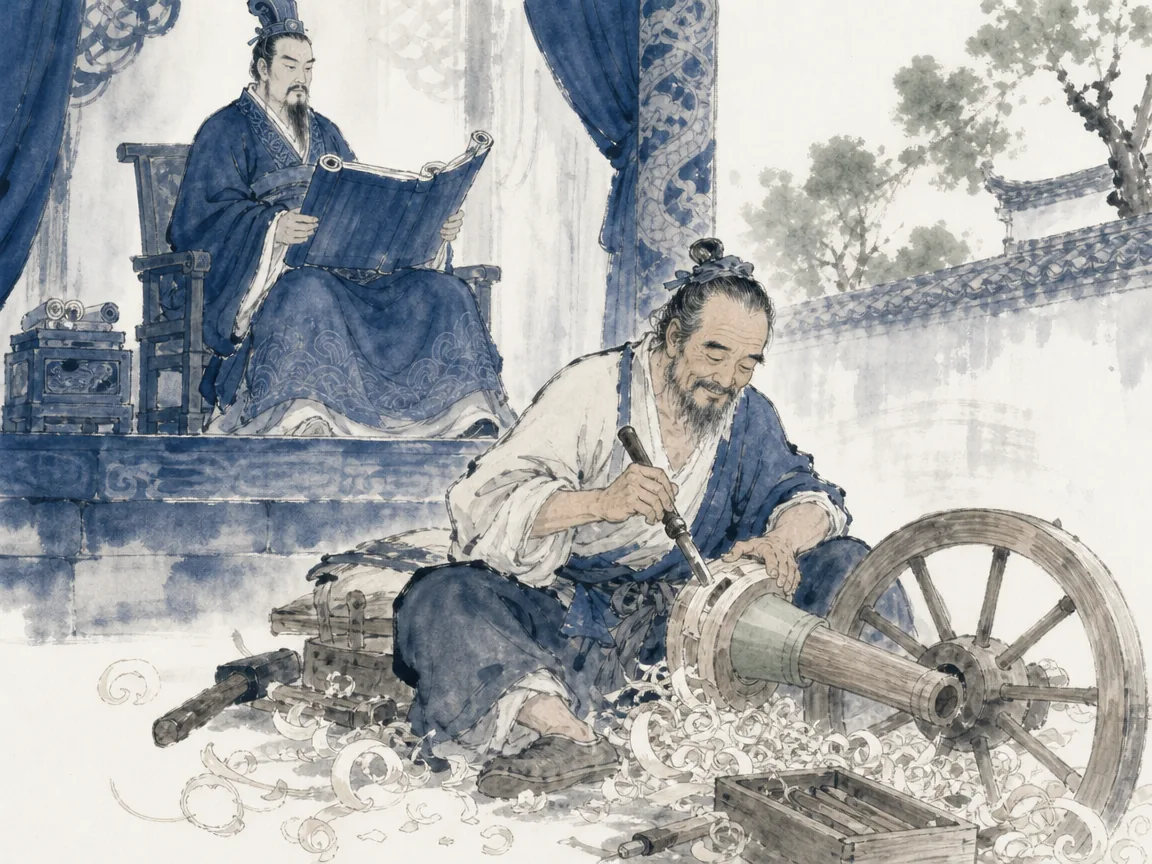
We have never had so much access to wisdom. Our devices hum with courses, podcasts, books, and methods promising to fix our anxiety, clarify our purpose, and help us live better. And yet a familiar emptiness persists. We finish another module, collect another certificate, memorize another framework — and the restlessness remains. The problem may not be that we lack knowledge. The problem may be that we have mistaken knowledge for transformation.
Two thousand three hundred years ago, a collection of thinkers associated with the Daoist tradition offered a sharper diagnosis. The Zhuangzi, a text preserved in a received version of thirty-three chapters revised by the scholar Guo Xiang (d. 312 C.E.) [1], contains a chapter named Tian Zifang that begins with a quiet but devastating question: what kind of teacher actually changes a life? The answer it offers runs against the grain of our information-saturated age. A true teacher does not fill your mind with answers. A true teacher shows you how small your world has become—a foundational perspective explored in Zhuangzi Chapter 21 Meaning.
This article draws on several stories from the Zhuangzi to explore a persistent modern paradox — why consuming more knowledge often leaves us more empty — and to consider what the text means when it suggests that genuine growth is subtractive rather than additive, silent rather than loud, and embodied rather than performative.
Zhuangzi Chapter 21 Meaning: The Paradox of More Knowledge, Less Peace
The contemporary condition is easy to describe. We wake to algorithms offering optimization. We scroll through lists of habits, mindsets, and strategies designed to close the gap between where we are and where we think we should be. Self-improvement has become an industry, and the underlying promise is straightforward: consume enough of the right content, and you will become someone new.
But the result many people report is not peace. It is fatigue. It is the odd sense that you have learned about calm while remaining deeply unsettled. This is not a failure of willpower. It may be a failure of category. The Zhuangzi challenges the assumption that growth is cumulative. According to one strand of Daoist thinking, the deeper problem is not that we know too little, but that we know in the wrong way — accumulating concepts without letting them change how we meet the world.
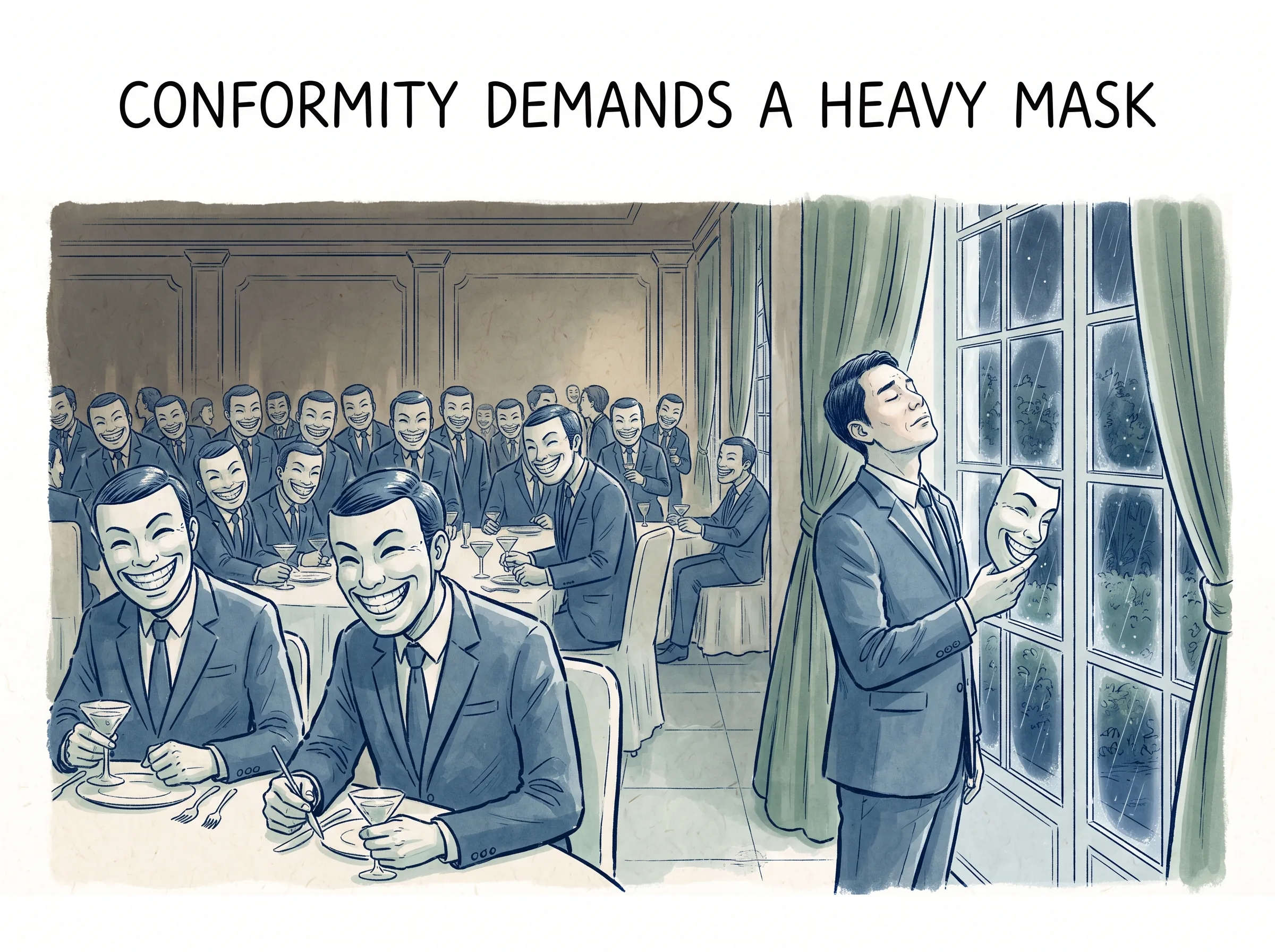
The text suggests something uncomfortable: that information can become another form of clutter. When every insight is collected, archived, and shared without being lived, learning stops being transformation and becomes decoration. The Tian Zifang chapter opens by placing this tension in conversation with an older question about teachers. If the goal is not to accumulate more but to see more clearly, what should a teacher actually do?
The Teacher Who Stands Beyond Praise
One of the chapter's opening scenes features Tian Zifang sitting with Duke Wen of Wei. Tian Zifang speaks admiringly of a fellow townsman named Xigong, but when the duke asks who his real teacher is, he names Dongguo Shunzi — and then explains why he never praises him.
According to the story, Dongguo Shunzi possesses a presence that cannot be reduced to words. He has the appearance of a zhenren, often translated as "true person" or "genuine human," and he moves through the world with a clarity that makes praise feel inadequate. When someone behaves contrary to the Dao, he does not scold or lecture. He simply stands in his own state, and in that presence, the other person's restless attachments begin to dissolve. As Tian Zifang puts it in the narrative, encountering such a person makes "one's idle thoughts fall away."
The point is subtle but radical. You can praise a good argument. You can praise a useful technique. But you cannot praise a whole way of being into existence. The deepest teachers are not performers of wisdom; they are embodiments of it. And the effect they produce is not admiration but humility — the sudden recognition that your own mind is narrower than you supposed.
Modern readers may find this counterintuitive. We are taught to seek mentors who give us frameworks, action plans, and quotable insights. Yet the Zhuangzi implies that the most consequential teachers are often the ones who do not try to teach at all. They do not hand you answers. They change the scale by which you measure your own life.
Continue with the deeper interpretation and practical application.
ChiDestiny members get access to the full analysis, modern applications, and the growing Chinese Wisdom Library.
FAQ
Does the Zhuangzi reject learning altogether? No. The text distinguishes between information accumulation and genuine understanding. It criticizes the habit of treating knowledge as a commodity to be collected, not the pursuit of insight itself.
Are the stories in the Tian Zifang chapter historically accurate? The Zhuangzi is not a single-author historical record. It is a collection of texts associated with the Daoist tradition, revised by Guo Xiang and preserved in a thirty-three-chapter version [1]. The stories function as philosophical teaching tools rather than documentary history.
What does "the Dao is present in a glance" mean in practice? It means that deep understanding is not always linguistic. Presence, character, and lived clarity can communicate what words cannot. In everyday terms, it suggests paying attention to how people live, not only to what they say.
How do I find a teacher if none seems available? The Zhuangzi implies that if you have not encountered such a teacher, you can cultivate the conditions that make recognition possible — quiet reflection, honest self-examination, and a willingness to see your own limitations without defensiveness, reflecting the enduring wisdom of Zhuangzi Chapter 21 Meaning.
To explore these themes from another angle, read our related reflection on Why You’re Exhausted No Matter How Hard You Try (According to Zhuangzi).
For a deeper comparative examination of these ideas, explore our related study on Under Heaven: The Grand Survey of Chinese Philosophy and the Solitary Spirit of Zhuangzi.
Sources & Further Reading
[1] Zhuangzi — Stanford Encyclopedia of Philosophy. Discusses the received thirty-three-chapter version compiled by Guo Xiang and the complex authorship of the Zhuangzi text.
Further Reading
- Zhuangzi: Basic Writings, trans. Burton Watson — accessible translations of key chapters including stories from the Outer Chapters.
- The Complete Works of Zhuangzi, trans. A.C. Graham — scholarly translation with detailed commentary on textual issues and philosophical themes.
- Zhuangzi Chapters by Lisa Raphals — studies on the rhetorical and pedagogical strategies of the text.







[…] To explore these themes from another angle, read our related reflection on Why Knowledge Won’t Save You: What Zhuangzi Teaches About True Transformation. […]