

We've all felt it — that quiet anxiety when we're trying to be liked by everyone, or worse, when we're consciously choosing who to reward with our attention, kindness, or opportunity. Maybe it shows up at work: you find yourself deferring to the colleague whose opinion matters most to your career, while quietly sidelining someone quieter. Or it surfaces in friendship: you invest heavily in the people who make you feel validated, while taking for granted those who've been consistently there. The instinct feels human. But it often breeds resentment — in others, and in ourselves.
This pattern is so common that we barely notice it. We call it "building rapport" or "investing in the right relationships." But underneath, it's a form of selective care — a way of distributing warmth and opportunity unevenly, based on what each person can give us back. The cost is rarely visible in the moment. It shows up later: in team dynamics that fracture under perceived bias, in friendships that feel transactional, in the slow erosion of our own sense of integrity—a foundational perspective explored in Daodejing Chapter 5.
Ancient Chinese thought offers a different frame. The Daodejing, one of the foundational texts of Daoist philosophy, contains a passage that has been read as chillingly detached — and then misunderstood even further. But beneath its stark surface lies a surprisingly humane vision of fairness: one that doesn't require us to become cold, but instead invites us to examine why we pick and choose who deserves our genuine regard. What follows is not a rejection of love or closeness. It is an invitation to understand what happens when our preferences begin to shape our treatment of others — and how a stance of balanced centering might serve us better than the restless chase for favoritism.
Daodejing Chapter 5: The Hidden Cost of Playing Favorites
The desire to be liked — and to like those who like us most — is deeply ingrained. Psychologically, it makes sense: we gravitate toward reciprocity, toward people who mirror our values and reward our efforts. But when this instinct hardens into a strategy — when we begin consciously curating who receives our time, energy, and goodwill — something subtle but significant shifts.
Favoritism, even well-intentioned favoritism, creates invisible hierarchies. In the workplace, a manager who consistently champions certain employees over others may believe they are recognizing talent or loyalty. But those on the receiving end of exclusion do not experience it as discernment. They experience it as arbitrariness. Trust erodes. Collaboration gives way to competition. And the favorites themselves — rather than flourishing — often grow anxious, knowing their position depends not on merit but on proximity to favor.
The same dynamics play out in personal relationships. When we reserve our deepest investment for a select few, we send an implicit message to everyone else: you matter less. Even if we never say it aloud, the pattern communicates it. And those who feel the difference — the colleague who is never called into confidence, the friend who is always the last to receive a thoughtful response — learn to adjust their expectations accordingly. They pull back. They stop reaching. The relationship, once capable of depth, becomes functional at best.

There is also a cost to the person doing the favoring. Choosing favorites requires constant calculation: Who is useful? Who appreciates me? Who can I count on? This calculus is exhausting. It turns every interaction into a quiet audit. And over time, it distances us from our own spontaneity — from the capacity to simply be present with someone without weighing what they bring to the table.
The problem, then, is not that we have preferences. We all do. The problem is when those preferences dictate how we treat people — when favoritism becomes the default architecture of our relationships rather than an occasional human slip.
What Laozi Means by Impartiality — And Why It Isn't Cold
One of the most cited passages from the Daodejing comes from Daodejing Chapter 5: "Heaven and Earth are impartial; they treat all things as straw dogs." The Chinese original, commonly rendered from the received Wang Bi textual tradition, reads: Tiān dì bù rén, yǐ wàn wù wéi chú gǒu [1]. The second line extends the metaphor: "The sage is impartial; they treat the people as straw dogs."
The phrase "straw dogs" — chú gǒu — has provoked centuries of debate. In ancient Chinese ritual practice, straw dogs were ceremonial objects used in sacrifices: crafted with care, treated with reverence before the rite, and returned to the earth afterward [2]. They were not insults. They were symbols of something deeper — the natural cycle of use, respect, and release.
Yet the passage is often read as nihilistic, even cruel. "Heaven and Earth don't care about us," the translation seems to say. "We are nothing." But this reading misses the point entirely. The passage is not stating a fact about cosmic indifference. It is describing a mode of being — one that operates without partiality, without the human habit of sorting the world into those who deserve special treatment and those who do not.

The Daodejing does not ask us to stop caring. It asks us to examine the conditions under which our care becomes selective — and therefore unstable. When we love some and neglect others based on what they can do for us, our love becomes conditional. It is not love at all, but a quiet contract. And contracts, as any relationship built on them will tell you, are fragile. For the word-for-word source text and commentary, consult the complete classical translation and commentary of The Function of Emptiness: The Cosmic Bellows and Impartial Care.
True impartiality, as the text frames it, is not the absence of feeling. It is the presence of clarity. It means seeing each person as they are, rather than as a mirror of our own needs. It means responding to situations with appropriateness rather than reactively reaching for those who confirm our sense of worth. This is not coldness. It is a different kind of warmth — one that does not fluctuate with the moods of favor or disfavor.
The Daodejing attributes this stance not only to nature but to the ideal leader — the shengren, or "sage." The sage does not rule through charisma or selective reward. The sage governs by creating conditions in which everyone can find their place. This is a radical proposition for any culture — ancient or modern — that equates good leadership with the ability to inspire loyalty through personal attachment.
The Practice of Holding the Empty Center (Xū Zhōng, 虚中) — Without Clinging
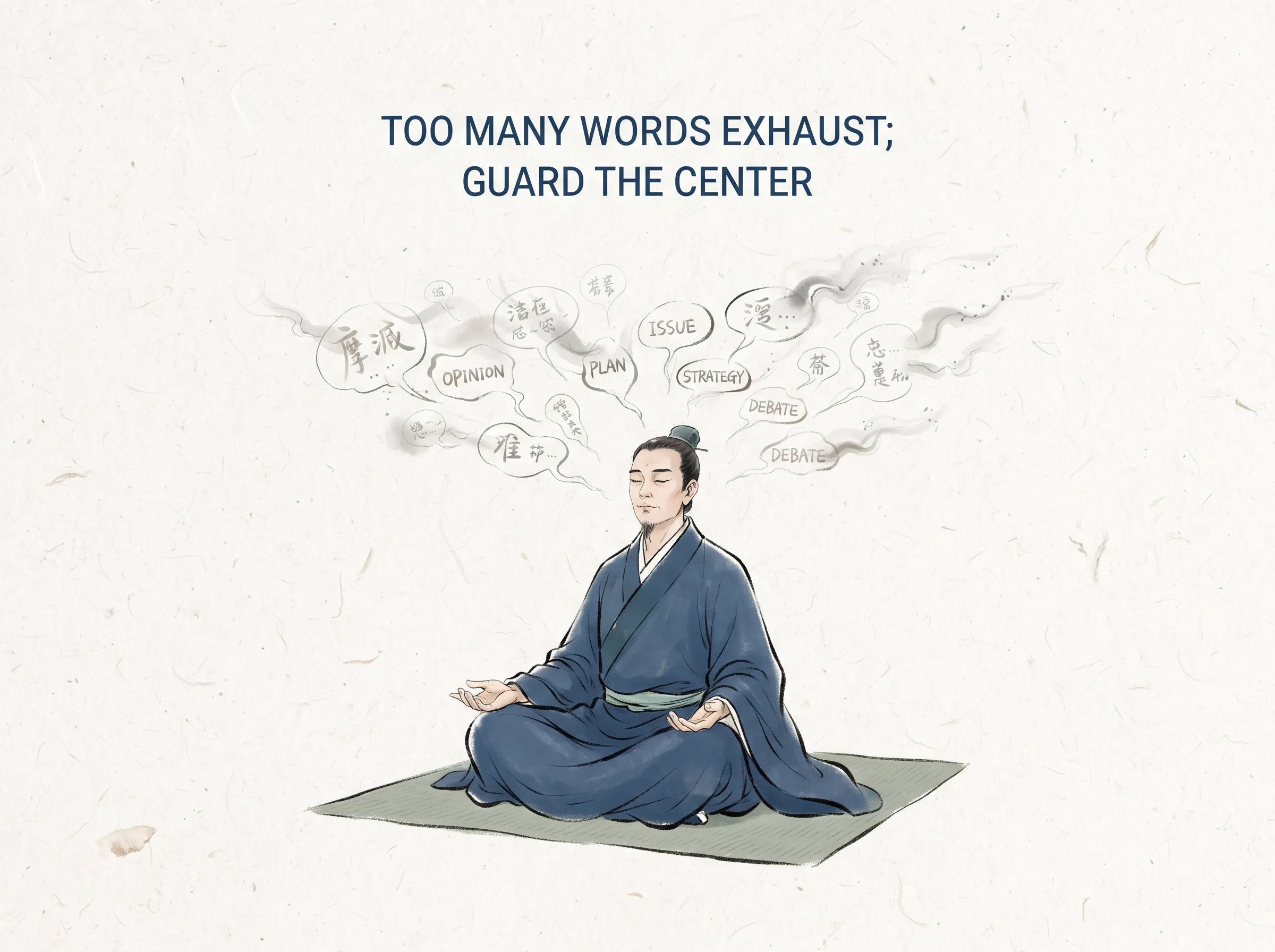
The latter part of Chapter 5 introduces another key concept. After the imagery of straw dogs, the text turns to the metaphor of the bellows — the empty chamber that, precisely because it is hollow, produces endless wind when operated [3]. The passage concludes with the instruction to "maintain the center" — shǒu zhōng — rather than exhaust oneself through excessive speech or action.
The phrase xū ér bù qū, dòng ér yù chū; duō wén shù qióng, bù ruò shǒu yú zhōng is subject to textual variation across manuscript traditions, and scholars continue to discuss the precise meaning of key terms [4]. What is relatively stable across interpretations, however, is the core insight: emptiness is not lack — it is potential. A vessel that is empty can be filled. A mind that is not cluttered with fixed opinions can respond freshly to each situation.
This is the principle behind holding the empty center (xū zhōng, 虚中) — the centered emptiness that allows genuine response rather than reactive preference. It is not the same as detachment, which implies withdrawal. Nor is it the same as indifference, which implies disregard. It is closer to what we might call presence with equanimity: showing up fully for each person and each moment without being pulled into the gravity of our own attachments.
In leadership, this translates into a distinct style. A leader who operates from holding the empty center (xū zhōng, 虚中) does not build teams around insiders. They do not reward loyalty to personality but cultivate fairness across the board. Decisions are made transparently. Credit is distributed according to contribution, not closeness. Criticism, when needed, is offered consistently — not withheld from favorites and amplified for outsiders.
In friendship and family, the principle is equally revealing. We often believe that closeness requires differential treatment — that loving someone means showing it through visible preference. But holding the empty center (xū zhōng, 虚中) suggests a different model: the capacity to hold space for multiple people without ranking them. You can love your sibling deeply without diminishing your friend. You can be devoted to your partner without treating your colleagues as lesser. The centering practice is not about dividing your love into smaller portions; it is about expanding your capacity to hold everyone without the exhausting work of comparison.
On social media — perhaps the most visible arena of modern favoritism — the principle cuts in a different direction. We curate our connections. We amplify certain voices and silence others. We perform loyalty publicly and reserve genuine engagement for a private circle. The algorithm rewards this behavior, but the human cost is real: relationships become performances, and authenticity becomes a scarce resource.
A Simple Daily Practice for Notice and Release
The path toward more balanced treatment of others does not require a dramatic overhaul. It begins, as the Daodejing itself suggests, with observation — with noticing where our default patterns of attraction and avoidance are leading us.
A practical exercise, rooted in the spirit of the text, looks like this:
- Notice your defaults. For one week, simply observe. When you choose who to respond to first, who to invite, who to credit — pause and ask: Am I making this choice because of merit, or because of affinity? You do not need to judge the answer. Just let it be seen.
-
Ask the fairness question. In any situation where you feel tension — a conflict at work, a strained friendship, a family dynamic — ask yourself: If I were treating everyone in this situation with equal regard, what would I do differently? This question does not demand that you act identically toward everyone. People have different needs. But it does ask that your responses be guided by those needs rather than by your preferences.
-
Cultivate the centered stance. When you feel the pull toward someone — the urge to invest extra energy, to smooth things over, to avoid confronting them — take a breath. Consider whether your response is proportionate to the situation, or whether it is inflated by your own desires. The centered observer is present. They respond. But they are not controlled by the tug of favoritism.
This practice is not about becoming emotionally flat. It is about becoming emotionally honest — about recognizing when our affections are serving connection and when they are serving our own need for security, validation, or control.
Fairness Without Coldness — A Closing Thought
The temptation to play favorites is not a moral failing. It is a human one. We are wired for connection, for reciprocity, for the comfort of knowing where we stand with the people around us. But the Daodejing reminds us that a life built on selective care is a life built on sand. It shifts with every mood, every gain, every loss.
Impartiality, properly understood, is not the enemy of love. It is its foundation. When we treat people fairly — not identically, but with genuine regard for who they are and what they need — we create conditions in which real relationships can flourish. Not the relationships we choose because they are easy, but the ones we commit to because they matter.
The next time you feel the pull to favor someone — to give them the benefit of the doubt, the extra opportunity, the unearned grace — pause. Ask yourself what is driving that impulse. And consider, however briefly, what it would look like to meet the moment from a place of centered fairness instead.
FAQ
Q: Does Laozi's teaching mean we should stop caring about people individually?
No. The Daodejing does not advocate emotional detachment or indifference. The passage in Chapter 5 describes a stance of impartiality — treating people without the distortion of selective preference — not a rejection of care itself. The text distinguishes between reactive favoritism and genuine, clear-eyed regard.
Q: How is "straw dogs" different from calling people names?
The term chú gǒu refers to ceremonial objects made of straw, used in ancient Chinese sacrifice. They were treated with respect during the ritual and returned to nature afterward — a symbol of the natural cycle rather than a term of contempt. The passage uses them as a metaphor for how Heaven and Earth treat all things: without partiality, without clinging, and without malice.
Q: Can impartiality work in close relationships like marriage or parenting?
The principle can be applied thoughtfully. Impartiality does not mean treating everyone exactly the same — parents have different responsibilities to different children, partners share a bond that is distinct from other relationships. What it means is that our treatment should not be governed by unconscious preference, transactional calculation, or the desire to be liked. Close relationships benefit from honesty and fairness just as much as professional ones.
Q: Is the Daodejing the work of a single author?
Scholars generally agree that the Daodejing was not the product of a single author in the modern sense. The text appears to have emerged from a tradition of wisdom sayings, compiled and expanded over time. The figure of "Laozi" is traditionally regarded as its author, but the historical details remain debated, and the text likely reflects contributions from multiple sources across the fourth century BCE and beyond [5].
To explore these themes from another angle, read our related reflection on Why Great Achievement Looks Imperfect — Laozi’s Lesson for Modern Success.
Deepen your understanding of these principles in our reflection on From Control to Profound Virtue: Laozi’s Chapter 10 for Modern Life.
Sources & Further Reading
[1] Chinese Text Project – Daodejing Chapter 5 — Wang Bi received text of the Daodejing, Chapter 5. See
[2] On the ritual use of chú gǒu (straw dogs) in ancient Chinese practice, see discussions in scholarly treatments of the Daodejing and related texts such as the Zhuangzi and Huainanzi.
[3] Daodejing Chapter 5, Wang Bi version — the bellows (feng qiu) metaphor and the instruction to "maintain the center."
[4] Textual variants between the Wang Bi received text and the Mawangdui silk manuscripts regarding Chapter 5 are discussed in academic literature on early Chinese textual history.
[5] Laozi — Stanford Encyclopedia of Philosophy — Stanford Encyclopedia of Philosophy, "Laozi" entry. See
Further Reading
- Henricks, Robert G. Dao De Jing: A New Translation of the Tao Te Ching. Shambhala, 2000.
- Lau, D.C. trans. Lao Tzu: Tao Te Ching. Penguin Classics.
- The Mawangdui Silk Texts — discovered in 1973, these Han dynasty manuscripts provide important variants for the Daodejing text and continue to inform scholarly debate on its composition.







[…] The practice of leading without imposing personal will resonates with Laozi’s broader teachings on equitable governance; explore our companion analysis on Why the Best Leaders Don’t Play Favorites — Ancient Wisdom for Modern Life. […]
[…] For a deeper comparative examination of these ideas, explore our related study on Why the Best Leaders Don’t Play Favorites — Ancient Wisdom for Modern Life. […]