
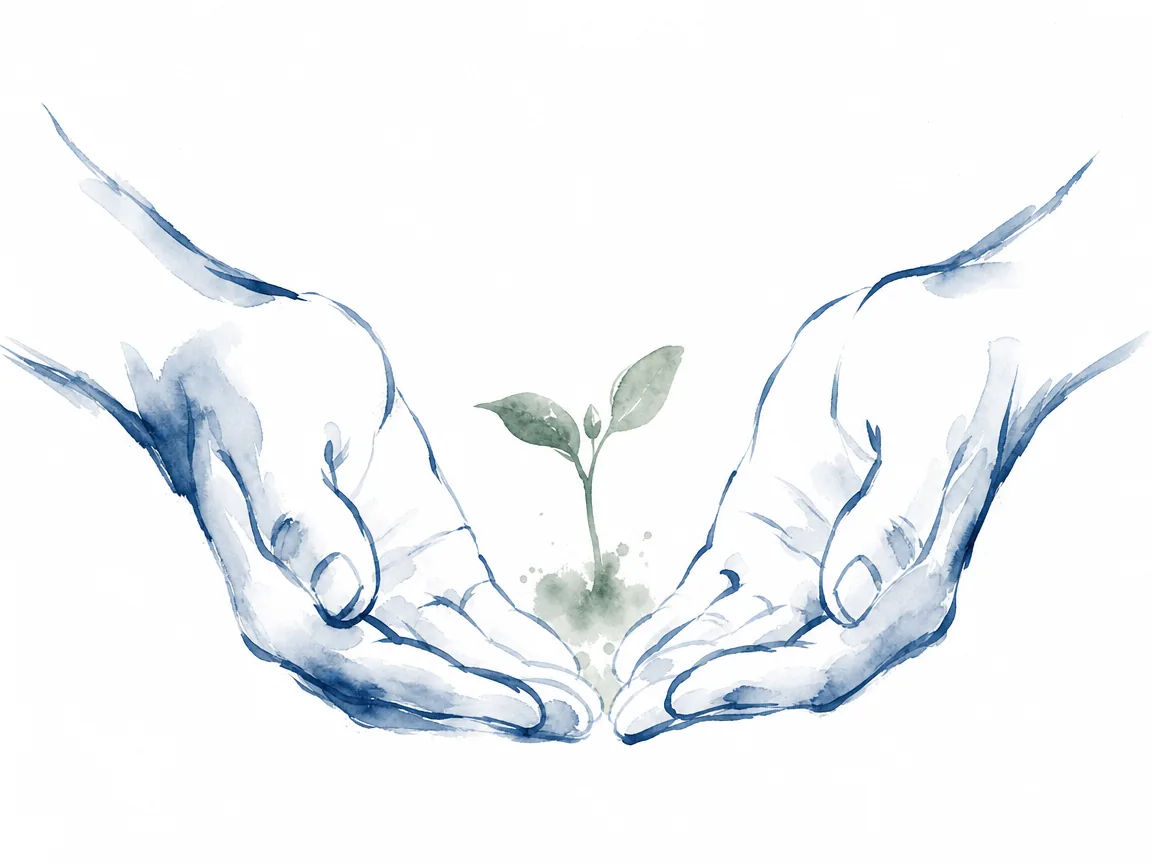
You have probably felt it — that tight grip you maintain on everything: your schedule, your relationships, your career trajectory, even your own inner state. The modern world rewards precision, optimization, and relentless control. Self-help culture tells us to set bigger goals, track more metrics, and never let our guard down. But what if the highest form of cultivation is not tightening your grip at all?
More than two millennia ago, Laozi wrote a chapter that reads almost like a direct response to this condition. In the tenth chapter of the Daodejing (道德經), he asks a series of questions that cut straight to the core of a fractured life: Can your spirit and body stay together? Can you soften your energy like an infant? Can you cleanse your inner mirror so it reflects clearly? Can you care for others without imposing your will? Can you open and close your gates and still remain receptive? And perhaps most radically — when you have created, led, or nurtured something, can you let it be without claiming it? This principle is central to Laozi Chapter 10 Meaning.
The answer, according to this tradition, is not found in stronger willpower but in profound virtue (xuándé, 玄德) — a quality of action that creates without possessing, guides without dominating, and nourishes without making others owe anything in return. For readers who have tried every productivity system and still feel worn down, this chapter offers something different: not another method for doing more, but a reorientation toward how to be less fragmented, less rigid, and less consumed by the need to control outcomes.
Laozi Chapter 10 Meaning: The Hidden Cost of Internal Fragmentation
One of the first questions Laozi poses is whether the spirit and body can remain unified — a state described in classical Chinese as "embracing the soul and unity" (zài yíngpò bào yī, 载营魄抱一). According to traditional commentaries, this means dwelling in the natural center of one's being rather than scattering one's attention across endless external demands. The idea is not mystical abstraction but a recognition of something many people experience directly: a sense of being pulled apart from within [1].
Chronic anxiety, burnout, and persistent inner exhaustion often do not come from external demands alone. They come from a life lived in internal conflict — the body exhausted while the mind races forward, rational goals clashing with unacknowledged emotional needs, the surface appearance of composure hiding a state of constant inner friction. The World Health Organization recognizes burnout as a syndrome resulting from chronically unmanaged workplace stress, marked specifically by energy depletion, growing mental distance from one's work, and a sense of reduced professional efficacy [2]. While this definition applies to occupational contexts, the underlying pattern — living in a state of sustained internal strain — extends far beyond the workplace.
Laozi's question is essentially diagnostic: Where am I pulling myself apart? Modern life rarely asks this. It asks instead whether you are optimizing enough, achieving enough, managing enough. But a life without internal cohesion is like a building with a cracked foundation — no amount of exterior renovation will stop the settling. The first step toward mastery, then, is not acquiring another skill but noticing where your own energy is leaking through internal division.
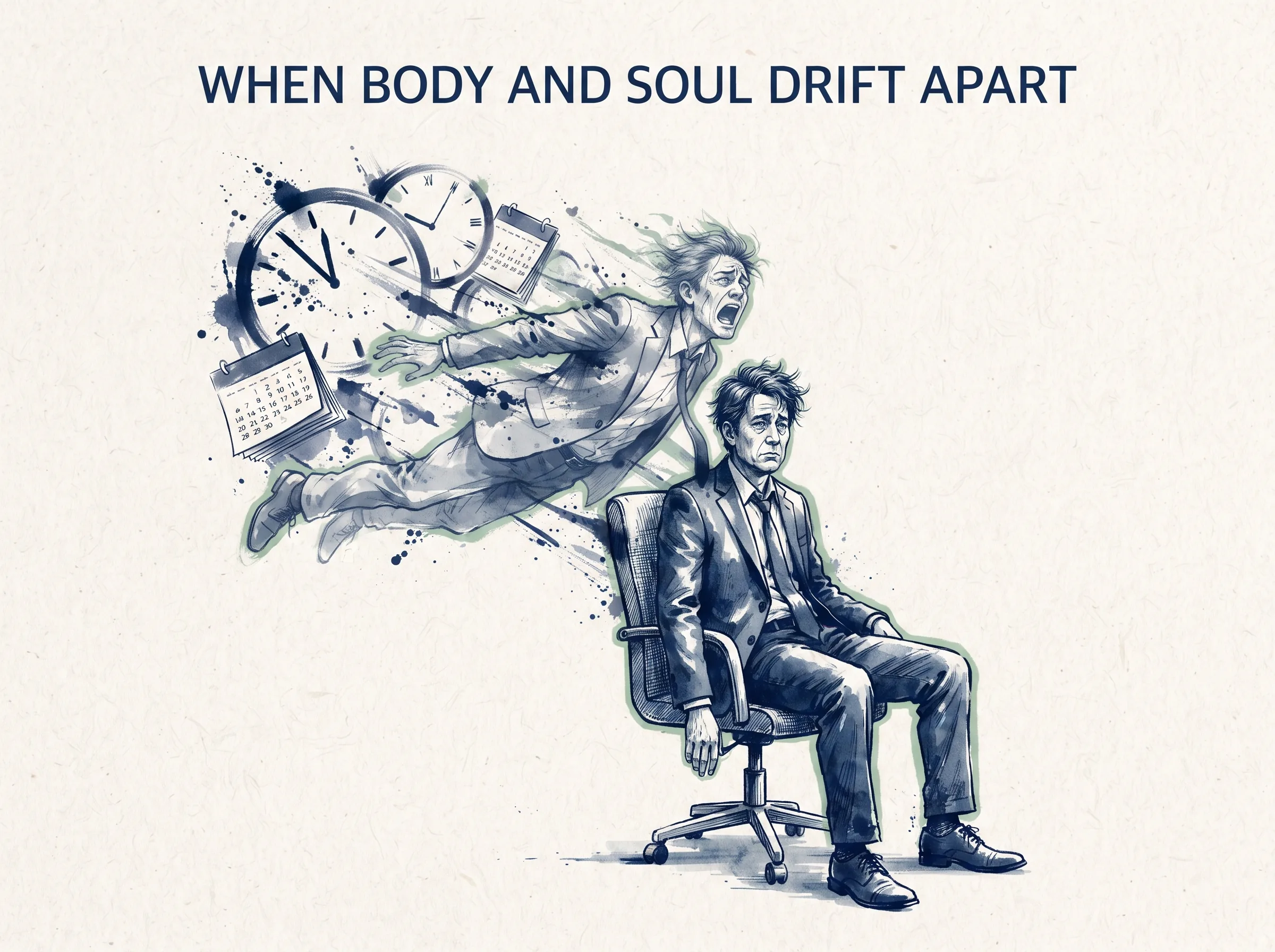
Practical check-in: Over the past week, notice three moments when your body and mind felt at odds — your body wanted rest while your mind pushed for more, or you were physically present but mentally rehearsing an argument. These are not minor inconveniences; they are signals that embracing oneness (bào yī, 抱一) — gathering yourself back into one place — may be needed.
Softness as a Cultivable Strength
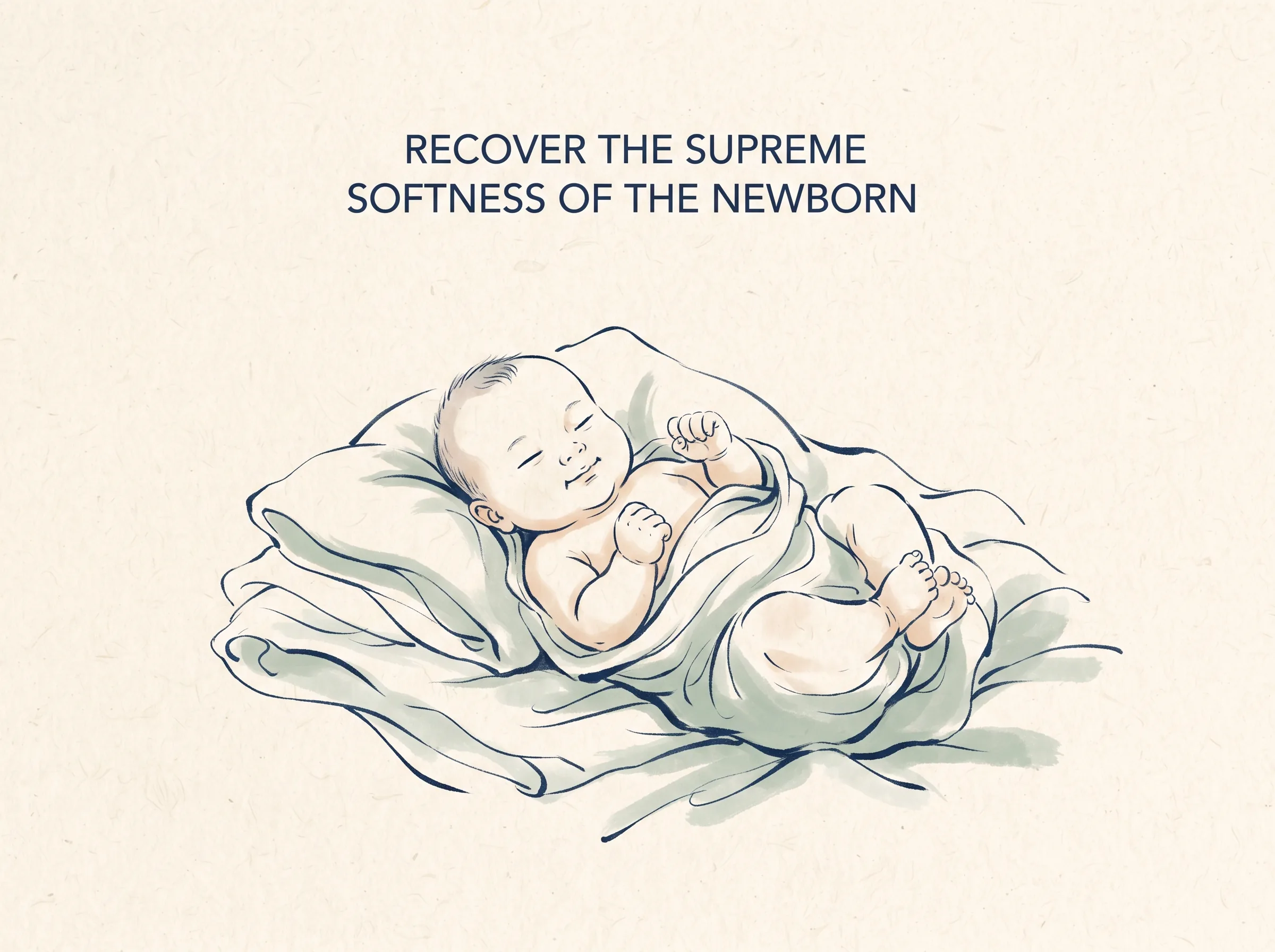
The second major image in Laozi Chapter 10 Meaning is perhaps the most famous in all of classical Chinese philosophy: "Gather your qi to achieve supreme gentleness; can you be like a newborn infant?" (Zhuān qì zhì róu, néng rú yīng'ér hū, 专气致柔,能如婴儿乎) The infant here is not a call to immaturity but a symbol of a state before life has hardened you into rigid patterns of defense (fángyù, 防御), ambition, and constant self-protection. For the complete classical Chinese text and line-by-line commentary behind these inquiries, consult our translation of Cultivating Inner Capability: Embracing the Primal Wholeness of the Newborn.
Traditional interpretation understands this as returning to a natural, unforced flow of vital energy — a state in which the nervous system is not locked in chronic alert [1]. The modern parallel is striking. Many high-performing people live in a body that has learned to tense up as a default setting: shoulders raised, jaw clenched, breath shallow, mind racing ahead of the present moment. The belief that tension equals competence is so deeply embedded that softness is often read as weakness — a failure of discipline rather than a sign of integrated strength.
But Laozi is not suggesting you become passive or naive. He is pointing to something more precise: softness as a cultivated capacity. A flexible reed bends in the storm and survives; the rigid oak snaps. This is not poetic ornament — it describes a real difference in how systems respond to pressure. When a person's energy is scattered and rigid, every stimulus triggers an immediate defensive reaction. When that same energy is gathered and soft, the person can respond without being hijacked by reactivity. For an expanded study on how the infant archetype offers an antidote to chronic fatigue, read our guide on what Laozi knew about sustainable strength.
Practical practice: Once per day, pause for two minutes and consciously release three areas of habitual tension — the space between your eyebrows, your jaw, your shoulders. Breathe into your lower abdomen rather than your chest. This is not meditation in a formal sense; it is simply redirecting your physiology away from a chronic state of alert and toward a state in which clear judgment becomes possible. Softness is not the absence of strength — it is strength that has stopped wasting itself on unnecessary tension.
Cleaning the Inner Mirror
The third question in the chapter asks whether one can cleanse the mysterious mirror (díchú xuánlǎn, 涤除玄览) so that it operates without blemish. Traditional commentators understand the mysterious mirror (xuánlǎn, 玄览) as the deepest faculty of perception, the inner capacity to see clearly, and cleansing (díchú, 涤除) as the removal of obscurations such as desire, fear, and personal agenda [1]. What emerges is a surprisingly precise description of what modern psychology might call cognitive bias and emotional projection.
We do not see the world as it is; we see it through the accumulated filter of our own conditioning. A person who feels inadequate may interpret neutral remarks as criticism. Someone consumed by anxiety may read ordinary uncertainty as impending disaster. A person driven by control may see disobedience wherever there is only a different approach. The mirror is not broken — it is simply dirty.
Knowledge alone does not clean the mirror. In fact, knowledge can sometimes add more layers of dust — new opinions, new frameworks, new ways of being certain. Laozi's point is that true discernment requires first removing the distortions of the self, not accumulating more information. This is why the chapter moves from cleansing perception to the question of governance: a mind clouded by self-interest will project that same agenda onto others, whether in a family, a team, or a community.
Practical practice: Before making an important judgment about someone else's motives or the outcome of a situation, ask yourself: What am I bringing to this that may be distorting what I see? Name it honestly — your fear, your desire to be right, your need for things to go a certain way. Setting that aside, even briefly, is itself a form of cleaning the mirror.
Leading Without Imposing Your Will
The fourth question — whether one can care for the people and govern without acting from personal will — moves the chapter from personal cultivation to social application. Classical commentary reads this as a warning against ruling through clever schemes and imposed designs, advocating instead a leadership that trusts the natural order rather than replacing it with human ambition [1].
This is where Laozi's wisdom becomes particularly relevant to modern readers. The impulse to control is rarely malicious. Parents want the best for their children. Managers want teams to succeed. Friends want to help. But care becomes control the moment it refuses to trust another person's own capacity to find their way. When a parent decides every choice for a child, the child is not being guided — they are being shaped into someone else's design. When a manager micromanages every decision, the team is not being supported — it is being suffocated. When a friend constantly offers solutions to problems the other person is already handling, the friendship is not being nurtured — it is being overridden.
Laozi is not arguing against leadership, care, or involvement. He is drawing a line between support and suffocation, between creating conditions for growth and imposing your own blueprint. The highest form of guidance, in this view, is one in which the guided person feels free — not controlled, not managed, but allowed to become themselves.
Practical check-in: Identify one relationship in your life where you find yourself repeatedly trying to steer the outcome. Ask: Am I supporting this person's own path, or am I trying to make them follow mine? The difference is subtle but decisive, and recognizing it is often the first step toward changing it.
The Discipline of Opening and Closing
Life requires both expression and rest, both action and withdrawal. The fifth question in Chapter 10 asks whether, when the gates of heaven open and close — a phrase traditional commentators understood as referring to the natural rhythms of emergence and retreat — one can remain in the posture of the receptive, the feminine principle symbolized by the receptive feminine (cí, 雌) [1]. This is not about gender but about a mode of being: receiving rather than initiating, listening rather than speaking, containing rather than projecting.
Modern culture glorifies the open gate — constant output, visibility, busyness, availability. Silence, rest, and withdrawal are often treated as failures or signs of laziness. But a system that only opens and never closes eventually runs out of energy. A organism that only inhales and never exhales cannot survive. The discipline of knowing when to close — when to stop consuming, stop producing, stop performing, and simply be — is itself a form of mastery that the optimization industry rarely teaches.
Practical practice: Schedule one block of time each week where your sole commitment is to close the gate — no input, no output, no performance. Sit quietly, walk without a destination, rest without guilt. This is not indulgence; it is maintenance of the very capacity that makes sustained action possible.
Seeing Clearly Without the Hunger to Control
The sixth question asks whether, even with full clarity and understanding, one can avoid the trap of arrogance — the temptation to use insight as a tool of dominance rather than a ground for genuine understanding. Laozi warns that the moment clarity hardens into superiority, wisdom becomes a weapon. The person who knows most is not necessarily the one who serves best; they are often the one who imposes their knowing most forcefully [1].
This is perhaps the chapter's sharpest observation. Ignorance can be harmless; arrogance born of knowledge is far more dangerous. The truly mature person does not lack understanding — they have simply learned not to let understanding become a justification for controlling others. Humility, in this sense, is not ignorance disguised as modesty. It is the hard-won wisdom to hold knowledge lightly, to remain open to what you do not yet see, and to recognize that every perspective is partial.
The Eight Words That Define Profound Virtue
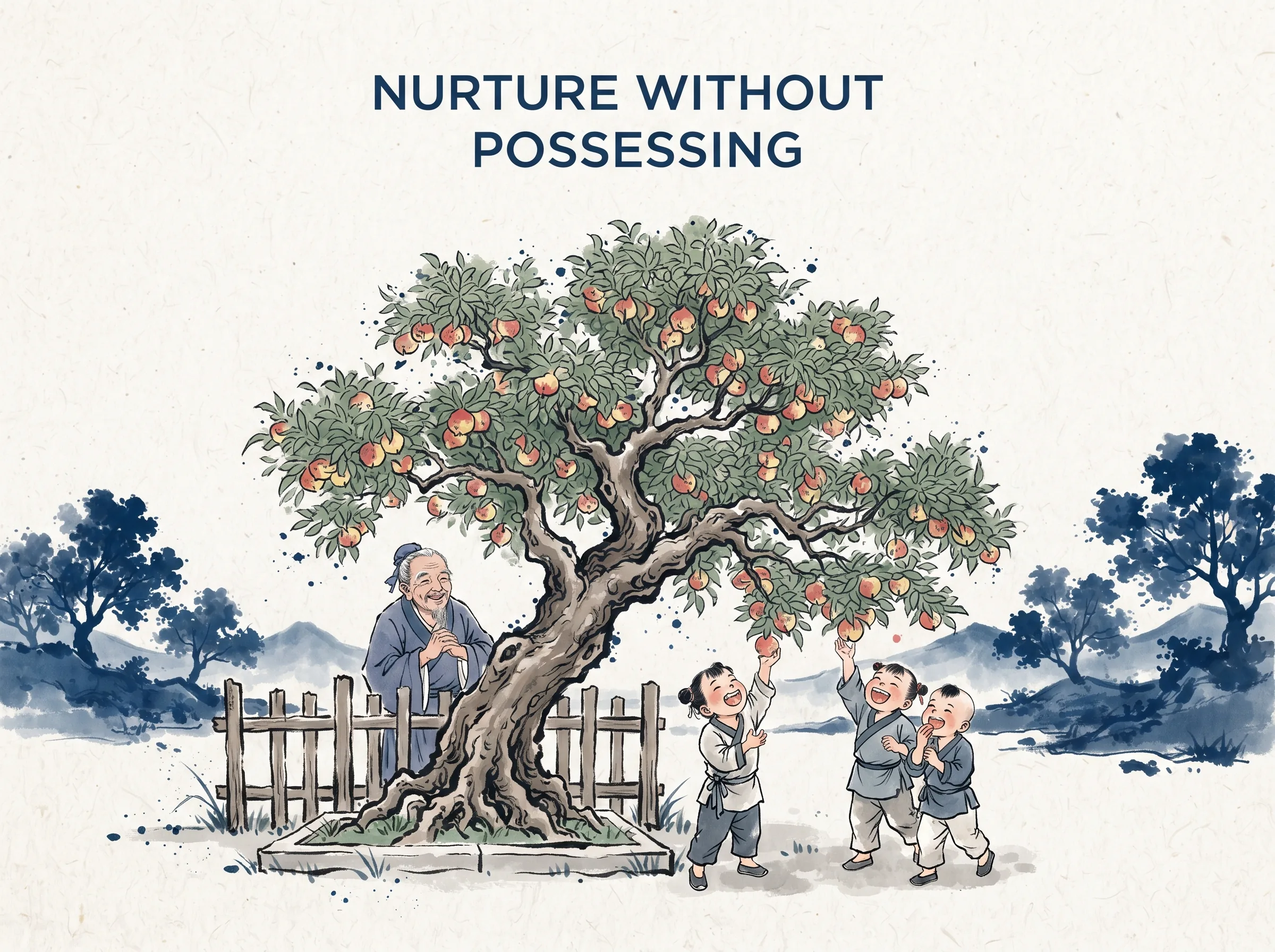
The chapter culminates in eight characters that have become one of the most widely quoted passages in the entire Daodejing: "Giving birth without possessing, acting without presumption, leading without dominating — this is called profound virtue" (Shēng ér bù yǒu, wéi ér bù shì, zhǎng ér bù zǎi, shì wèi xuándé, 生而不有,为而不恃,长而不宰,是谓玄德) [1].
These lines are not a call to do less. They are a call to do things differently — to create without hoarding, to lead without demanding gratitude, to participate in the world without making everything revolve around your ego. This is the standard Laozi sets for maturity: not the ability to acquire and control, but the ability to engage fully and still let go.
For the modern reader, this is both radical and practical. Every area of life — parenting, work, friendship, creative projects — can be examined through these eight words. The question is never whether you are capable of acting, but whether your action leaves room for others to be themselves.
Putting It All Together
Laozi's tenth chapter does not offer a checklist for success. It offers a mirror. The questions it poses — about unity, softness, clarity, non-coercion, receptivity, humility, and non-attachment — are not easy. They are meant to be lived, not merely understood. And they are especially urgent for those who feel the weight of a world that measures worth by control, achievement, and visible results.
If you want to carry this forward, begin with a single practice: at the end of each day, ask yourself one question from the chapter. Did I hold myself together, or did I fragment? Did I soften, or did I harden? Did I see clearly, or did I project? Did I lead, or did I impose? Did I rest, or did I push through? Did I know, or did I assume? Did I create, or did I try to own the outcome?
These are not questions that produce quick fixes. They produce something steadier: a life that is less driven by the need to control everything and more guided by the wisdom of knowing when to let go.
Frequently Asked Questions
Q: Is Laozi saying we should stop trying and just give up? No. Laozi is not advocating passivity or neglect. He is distinguishing between action driven by fear and control, and action that arises from clarity and alignment. The chapter assumes you will act, create, lead, and care — but it asks whether those actions are informed by necessity or by anxiety. Profound virtue is not inaction; it is action without the hunger to possess the result.
Q: Does "being like an infant" mean I should act immaturely? Not at all. The infant in Laozi's imagery represents a state of natural ease — not ignorance, but the absence of the rigid structures that adult ambition builds. An adult can cultivate this softness without losing maturity, responsibility, or discernment. It means approaching life with flexibility rather than force, openness rather than defensiveness.
Q: How is this different from Western ideas of minimalism or mindfulness? There are overlaps, but the difference lies in the philosophical grounding. Western mindfulness often focuses on stress reduction and attention training. Laozi's approach is broader — it addresses the structure of power, the nature of virtue, and the relationship between the self and the world. The concept of profound virtue (xuándé, 玄德), for example, has no direct equivalent in Western self-help literature; it describes a mode of being that creates and leads without claiming ownership or dominance.
Q: Can someone apply this if they are in a high-control job or relationship? Yes, but the application may look different depending on the situation. In environments where control is expected — such as certain leadership roles or caregiving responsibilities — the practice might begin as small acts of releasing the need to manage every detail, building trust in others' capacities, and noticing where your anxiety is driving your behavior rather than genuine necessity. The chapter invites reflection, not reckless abandonment of responsibility.
The practice of leading without imposing personal will resonates with Laozi’s broader teachings on equitable governance; explore our companion analysis on Why the Best Leaders Don’t Play Favorites — Ancient Wisdom for Modern Life.
Sources & Further Reading
[1] Digital Classic Website (Shùwèi Jīngdiǎn, 數位經典) / Laozi Daodejing Full Text (老子道德經全文) — Chapter 10 with Wang Bi commentary.
[2] Stanford Encyclopedia of Philosophy — "Laozi."
[3] World Health Organization — "Burn-out an occupational phenomenon."
Further Reading
- Daodejing (道德經) — Chapter 10, available in multiple translations for comparative study.
- Zhuangzi (莊子) — Explores themes of softness, spontaneity, and non-action through parable and dialogue.
- The Analects (論語) — Offers the Confucian counterpoint to Daoist non-action, focusing on cultivated virtue and social responsibility.
- WHO guidelines on occupational burnout — For readers interested in the intersection of ancient wisdom and modern mental health frameworks.






