
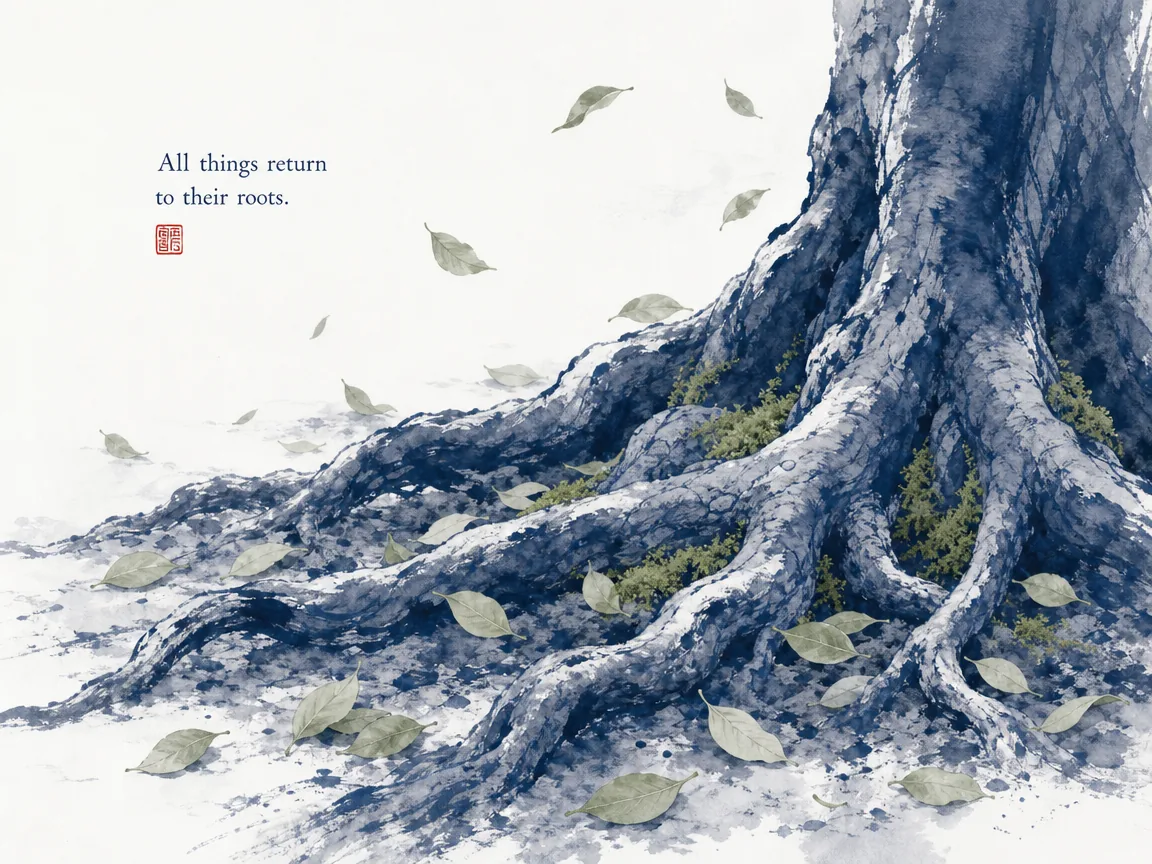
Daodejing Chapter 16: A Mind Too Full
You wake up to a flood of messages telling you what to want, what to fear, and who to become. Notifications stack up. Feeds refresh. Someone else's success story arrives before you've finished your first cup of coffee. More information has never been available, and yet more people feel lost, anxious, and exhausted. The paradox is unmistakable: we live in an age of information overload, but the problem may not be a lack of data—it may be that our minds are too full to hold it.
A classic text from ancient China, commonly attributed to Laozi and referred to as the Tao Te Ching, offers a striking diagnosis for this condition over two millennia ago. Modern scholarship suggests that the Tao Te Ching did not emerge from a single author at a single moment, but rather developed through long compilation and transmission [Stanford Encyclopedia of Philosophy]. Daodejing Chapter 16 opens with what some translators render as an instruction to empty the mind fully and hold fast to stillness — not as an escape from the world, but as a way to stop being pulled apart by it. The core insight is simple: when a heart is crowded with other people's voices, expectations, and anxieties, it cannot hear itself.
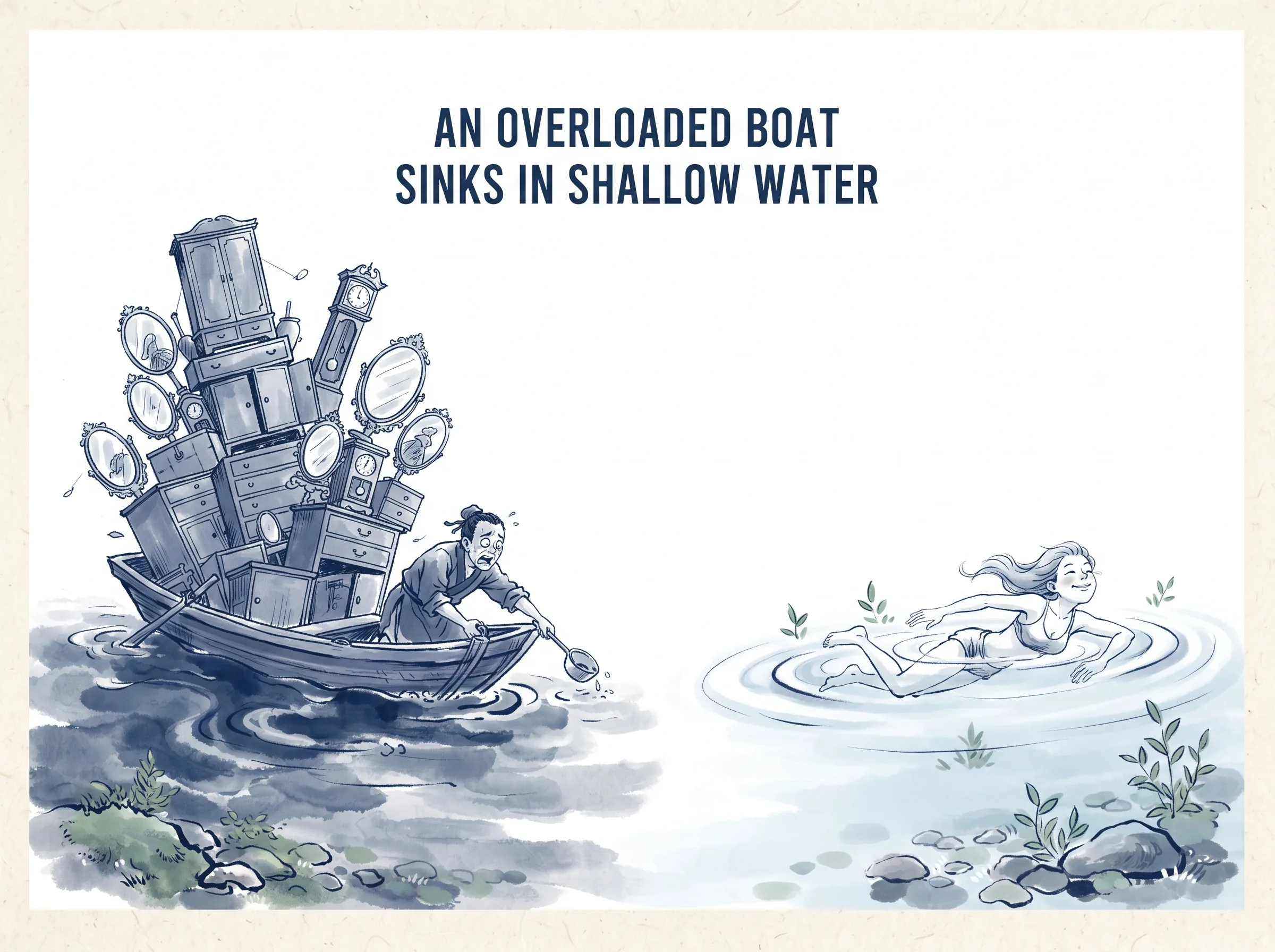
Research on digital technology and social media use suggests a correlation between certain online behaviors — particularly social comparison and negative interaction — and higher levels of anxiety and depression, though findings are mixed and heavily influenced by the quality of those online experiences [PubMed Central]. The pattern is familiar enough that we don't need a study to recognize it: endless scrolling, comparison, and reactive consumption of content leave many people feeling more informed and less at peace. Laozi's answer to this is not to delete every app or retreat to a mountain, but to practice something far harder — to empty what does not belong to you and to recover the stillness that lets you see clearly.
Emptying to See Clearly
The Chinese term for void or openness (xū, 虚) — often translated as "emptiness" — is rarely understood correctly in modern self-help culture. It is not weakness. It is not laziness. It is the deliberate clearing of mental space so that genuine judgment can arise. A cup already filled with muddy water cannot receive clear water. A mind already stuffed with borrowed desires, borrowed fears, and borrowed opinions cannot arrive at its own conclusions.
This does not mean ignoring information. It means not letting information stack up inside you without a filter. Before reacting to the next headline, the next career trend, or the next announcement that you are falling behind, a useful pause is simply this: Does this desire come from my own root, or is it something I have absorbed from outside? That single question can prevent years of chasing the wrong path.
Practical stillness begins with small interruptions in the habit of reaction. When a notification arrives, wait three seconds before opening it. When someone shares an opinion that triggers anxiety, ask yourself whether that anxiety belongs to you. When a new opportunity appears and everyone around you seems excited, pause long enough to consider whether it fits your actual capacities and values. These are not grand gestures. They are the daily practice of attaining utmost emptiness (zhì xū jí, 致虚极) — creating inner room by letting go of what was never yours to carry.
Continue with the deeper interpretation and practical application.
ChiDestiny members get access to the full analysis, modern applications, and the growing Chinese Wisdom Library.
FAQ
What does "returning to the root" actually mean in practice? It means identifying what is genuinely yours — your nature, your limits, your long-term direction — and letting go of what was absorbed from outside pressure, comparison, or borrowed ambition. In practice, it looks like pausing before major decisions, distinguishing your own values from cultural noise, and building a life that fits your actual capacities rather than someone else's template.
Is Laozi's teaching relevant to career and financial decisions? Yes, particularly because modern professional life is saturated with external signals about what counts as success. The concept of knowing the constant (zhī cháng, 知常) — encourages people to evaluate opportunities not by their short-term appeal but by their long-term sustainability. A career chosen to chase trends rather than align with genuine ability and interest tends to produce burnout, not fulfillment.
Does "returning to the root" mean withdrawing from society or avoiding ambition? No. Chapter 16 is not an invitation to isolation. Laozi is not advising people to stop working, stop caring, or stop participating in the world. The teaching addresses the quality of engagement, not the quantity. Action from clarity is encouraged. Action from panic, comparison, or borrowed desire is what is cautioned against.
How is "knowing the constant" different from accepting fate or giving up? They are opposites. Knowing the constant means understanding how things actually work — your own rhythms, the natural limits of effort, the cycles through which trends rise and fall. Accepting fate in a passive sense means surrendering to circumstances without agency. Laozi's point is precisely the reverse: only by understanding reality clearly can you act effectively. Ignorance of the constant is what leads to harmful, reckless action.
Closing Thought
Modern anxiety is rarely caused by a lack of information. It is caused by having too much information that does not belong to you — voices that are not yours, expectations that were never yours to carry, desires you inherited rather than discovered. Laozi's guidance in Chapter 16 cuts through the noise with remarkable simplicity: empty what is foreign, hold fast to stillness, watch for the cycle behind the surface, and return to what is yours.
The world will not slow down. Trends will continue to shift. Notifications will keep arriving. But within that noise, a person who has returned to their root moves differently. They do not react to every stimulus. They do not confuse volume with value. They act from clarity rather than fear. And in an age defined by distraction, that kind of inner order is perhaps the rarest and most powerful advantage anyone can cultivate.
If this reflection resonated with you, consider exploring the broader teachings of the Tao Te Ching on simplicity, balance, and natural alignment. Each chapter offers a different angle on the same central question: how to live well in a world that constantly pulls you outward.
To explore these themes from another angle, read our related reflection on Beyond Hustle: Why Speed Without a Root Is the Greatest Risk.
For a deeper comparative examination of these ideas, explore our related study on The Art of Not Proving: What Laozi Can Teach Us About Silence in the Age of Performance.
Sources & Further Reading
[1] Stanford Encyclopedia of Philosophy — Laozi. Covers scholarly debates on the historical Laozi, the composite nature of the Tao Te Ching, and the role of key manuscript traditions such as the Mawangdui silk texts and the Wang Bi commentary.
[2] Social Networking Sites, Depression, and Anxiety: A Systematic Review (PubMed Central). Summarizes mixed but meaningful findings linking negative social comparison and interaction on social media to higher levels of anxiety and depression.
Further Reading
- Tao Te Ching, Chapter 16 — various translations, including those by D.C. Lau, Stephen Mitchell, and Arthur Waley.
- Mawangdui silk manuscripts of the Laozi — foundational archaeological discoveries that illuminate textual variation in early versions of the Tao Te Ching.
- Wang Bi commentary on the Tao Te Ching — one of the most influential classical interpretations of the text.







[…] The wisdom of Daodejing Chapter 16 Translation addresses a fundamental human dynamic: how we navigate ambition, quietude, and the natural flow of existence. In the classical tradition, this passage serves as both a metaphysical mirror and a practical compass for daily living and leadership. Explore how this principle translates into contemporary daily life in our guide to Returning to Your Root: Laozi’s Antidote to the Modern Noise. […]