
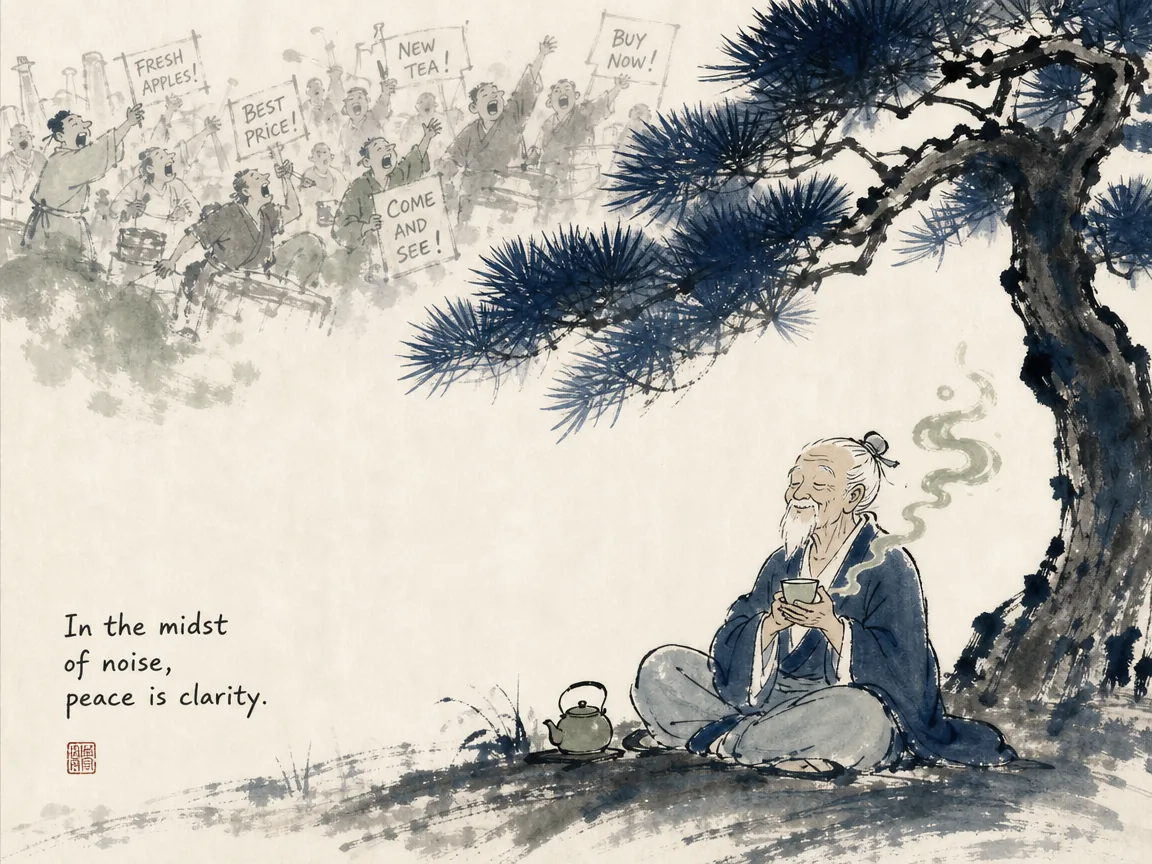
We live in an era that rewards the visible. From the moment we wake to a feed of curated achievements, public opinions, and performative vulnerability, we are surrounded by a quiet but relentless pressure: never be ordinary, never go unacknowledged, never let a moment pass without signaling who you are and what you stand for. Not proving yourself is read as indifference. Not speaking up is taken as agreement. Not being seen feels, increasingly, like not existing.
Yet there is a different kind of clarity—one that does not come from constant self-display but from the ability to hold back, to listen before reacting, to let the water settle before drawing conclusions. This is the insight at the heart of one of the most striking chapters in the Dao De Jing (道德经), traditionally attributed to Laozi (老子). Written over two thousand years ago, it describes a person of genuine mastery not as someone who shines brightest, but as someone who knows how to conserve depth, preserve boundaries, and resist the compulsion to perform. For anyone tired of the exhausting arithmetic of modern visibility—where worth is measured in likes, mentions, and constant self-justification—this ancient text offers a radical and calming counter-narrative—a foundational perspective explored in Daodejing Chapter 15.
What follows is not a call to withdrawal or passivity. It is an invitation to reconsider one of the quietest forms of strength available to us: the strength of not needing to prove anything at all.
Daodejing Chapter 15: The Modern Compulsion to Be Seen
Social life has acquired a new architecture, one designed around attention. Every platform, from professional networks to casual messaging apps, operates on systems that reward disclosure, velocity, and presence. To remain invisible is often interpreted as disengagement; to hold back is frequently read as weakness or indifference. The result is a cultural environment in which people feel compelled to announce their opinions before they have fully formed them, to showcase achievements before they have had time to settle, and to defend themselves at every turn—even when no one is accusing them of anything.
Research on social media stress identifies a relevant pattern: the visibility and permanence of online behavior can generate psychological strain, particularly when it interacts with impression management—the effort to control how one is perceived by others [6]. When our actions are exposed, recorded, and subject to evaluation, the pressure to perform becomes structural rather than personal. We do not feel this pressure simply because we are insecure; we feel it because the environment is engineered to reward constant self-demonstration.
The paradox is that the more we perform, the more exhausted and exposed we become. Performance requires energy. It demands that we maintain a coherent image across contexts, audiences, and time. And because that image is always vulnerable to scrutiny, it requires constant reinforcement. What begins as occasional self-expression becomes a near-continuous task of self-editing, self-monitoring, and self-promotion.
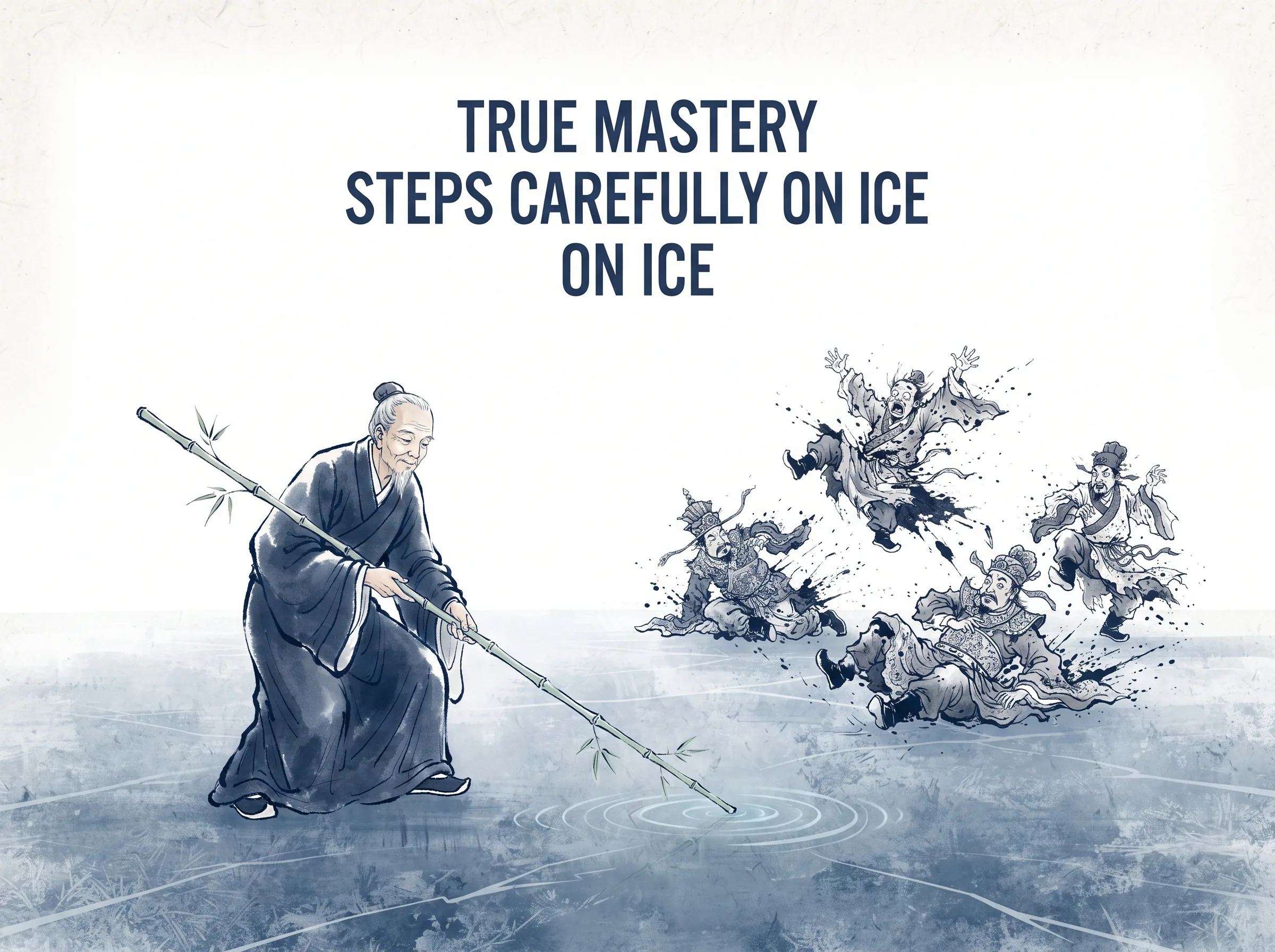
This raises a simple but uncomfortable question: What are we afraid will happen if we simply do not prove ourselves?
Perhaps we fear being forgotten. Perhaps we fear losing opportunity, influence, or respect. Perhaps we fear that silence will be mistaken for emptiness. None of these fears are trivial. But they are worth examining—not to dismiss them, but to understand whether they are grounded in reality or amplified by the very environment that profits from our urgency.
Continue with the deeper interpretation and practical application.
ChiDestiny members get access to the full analysis, modern applications, and the growing Chinese Wisdom Library.
Frequently Asked Questions
Does this mean I should never defend myself or speak up?
No. Laozi's counsel of restraint addresses the everyday pressure to perform, prove, and declare. It does not apply to situations where speaking up is a moral duty, where silence would enable harm, or where visibility is a matter of safety. Restraint and courage are not opposites. The question is always contextual: What does this situation require?
Is not proving yourself the same as being passive or indifferent?
No. The distinction lies in motivation. Passivity arises from fear, apathy, or resignation. The posture described in Chapter 15 arises from conscious choice—choosing to conserve energy, to preserve inner order, and to act only when action is truly called for. The difference between the two is visible in the aftermath: passivity leaves regret and stagnation; deliberate restraint leaves clarity and readiness.
How do I know when I am acting from anxiety versus acting from clarity?
Anxiety tends to produce urgency, defensiveness, and a need for immediate resolution. Clarity tends to produce patience, openness, and a willingness to let things unfold. One useful test is to ask: If no one were watching, would I still feel the need to act this way? Anxiety is often performative even when it does not look like it. Clarity is not.
Can this approach help in competitive environments like business or academia?
It can, with an important caveat. In competitive environments, visibility and self-presentation are often rewarded. The question is not whether to participate in those systems but whether to participate in a way that preserves your inner order. Laozi's insight is not that you should withdraw from competition. It is that you should not confuse visibility with value, or performance with substance. The most sustainable form of success is one that does not require constant self-exhaustion to maintain.
Bringing It Together
The urge to prove ourselves is not a personal failing. It is a rational response to an environment that treats visibility as currency. But rational responses can become habits, and habits can become cages. Laozi's fifteenth chapter offers a different rhythm—one of caution, openness, patience, and restraint. It does not promise ease. It promises something more valuable: the possibility of moving through the world without being dragged by it.
The people who truly understand life, the chapter suggests, are not the ones who shine brightest. They are the ones who know how to hold back, how to let water settle, and how to remain open rather than full. In a noisy, hyper-visible world, that is not a small thing. It may be the most important thing.
If you find this perspective resonant, consider starting with a single practice: the pause. Before your next response—whether spoken, written, or acted upon—take one breath. Ask yourself what is being asked of you and whether your impulse to act is driven by genuine need or by the habit of performance. From that small space, clarity often begins to emerge.
To explore these themes from another angle, read our related reflection on Returning to Your Root: Laozi’s Antidote to the Modern Noise.
For a deeper comparative examination of these ideas, explore our related study on Beyond Hustle: Why Speed Without a Root Is the Greatest Risk.
Sources & Further Reading
[1] David Hinton, Dao De Jing (translation) — Widely regarded as one of the most accessible and philosophically rigorous English translations of the text.
[2] D.C. Lau, Lao Tzu: Tao Te Ching (Penguin Classics) — A scholarly translation with detailed notes on textual variants and interpretive issues.
[3] Robert Henricks, Lao Tzu: Tao Te Ching: A New Translation Based on the Recently Discovered Ma-wang-tui Texts — Incorporates findings from the Mawangdui silk manuscripts, offering insights into earlier textual forms of the Dao De Jing.
[4] Laozi — Stanford Encyclopedia of Philosophy entry providing an overview of Laozi's life, textual history, and philosophical ideas, including discussion of the Guodian, Mawangdui, Wang Bi, and Heshang Gong manuscript traditions.
[5] Dao De Jing — Chinese Text Project digital edition, offering access to multiple transmitted versions of the text for comparative study.
[6] Social network sites (SNS) an archetype of techno-social stress: A systematic review – PMC







[…] For a deeper comparative examination of these ideas, explore our related study on The Art of Not Proving: What Laozi Can Teach Us About Silence in the Age of Performance. […]