
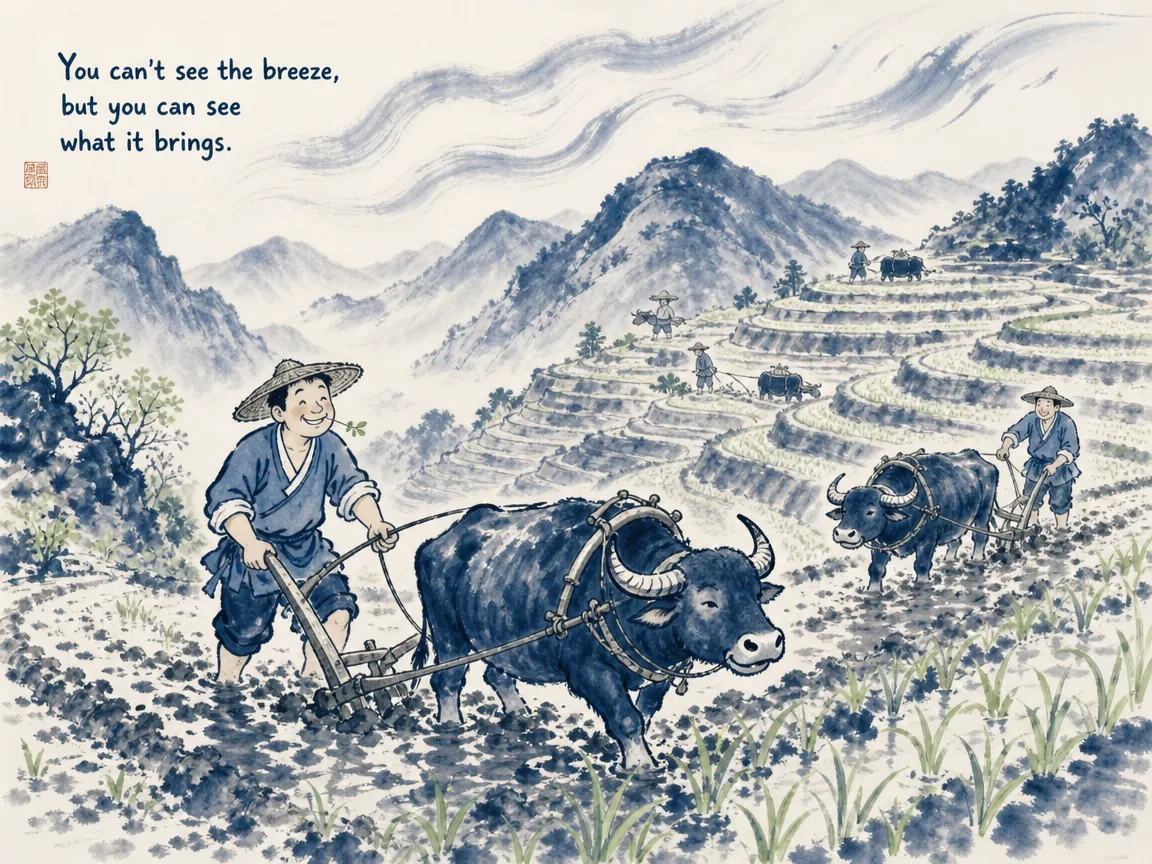
In one of the most counterintuitive passages in classical Chinese philosophy, the Daodejing places the leader whom people praise and admire in second position — below someone the people merely know exists. Laozi's seventeenth chapter offers a ranking of governance that runs sharply against every instinct of modern management culture, which tends to equate visibility, gratitude, and centralized authority with good leadership. What it suggests instead is that the deepest form of order is the one that recedes into the background, so thoroughly embedded in the environment that those who benefit from it feel they accomplished everything themselves.
This insight applies far beyond ancient statecraft. The dynamic Laozi describes — a relationship where the one in a position of influence becomes so structurally present yet subtly handled that others grow autonomously — shows up in every context where someone with more power, knowledge, or resources guides someone with less. Parents raise children. Managers lead teams. Teachers educate students. We govern our own habits and desires. In each case, the question is the same: does the authority figure become the center around which everyone else orbits, or do they create conditions in which others recover their own capacity to act? This principle is central to Daodejing Chapter 17.
The answer, in Laozi's framework, determines not only how effective a leader is but whether the people under their influence become self-sufficient or quietly dependent. The chapter's final sentence — "When the work is done and the affair is accomplished, the people all say, 'We have done it naturally'" — captures a vision of leadership that is almost invisible, yet profoundly powerful. Understanding it requires unpacking not just what Laozi said but what he meant by key concepts like wuwei and ziran, which are often misunderstood in translation.
Daodejing Chapter 17: The Four Levels of Order
The seventeenth chapter of the Daodejing presents a hierarchy of governance arranged in descending order of quality. The received text, as preserved in the Wang Bi commentary tradition, reads: "The highest — the people barely know he exists; the next — the people love and praise him; the next — the people fear him; the next — the people scorn him. When trust is insufficient, distrust arises. Calmly, he values his words. When the work is accomplished and the affair succeeds, the people all say, 'We have done it naturally'" [1]. Some manuscript witnesses preserve a slightly different opening, reading "the people know he exists" rather than "the people barely know he exists," suggesting the textual tradition carried minor variants even in early transmission [1].
The shock of this passage lies in its placement. Most readers expect praise to sit at the top. After all, being loved and admired seems like an unambiguously positive outcome. But Laozi ranks it second — above fear and contempt, yes, but still below a leader whom people barely notice. The reason is structural, not moral. A leader who must be praised has become the focal point of the system. Attention has been drawn away from the people's own lives and toward the leader's presence. The order now revolves around a person rather than around stable conditions and shared purpose.
Fear-based order, while clearly inferior, actually reveals something important about why praise alone is insufficient. People who obey out of fear produce surface stability. They follow rules when watched. But inside that compliance sits tension, calculation, and self-protection. A family held together by fear may look orderly from the outside while members quietly brace for the next reprimand. A team managed through intimidation may hit quarterly targets while employees hoard information and avoid accountability. The system works until the threat disappears — and then it often unravels quickly.
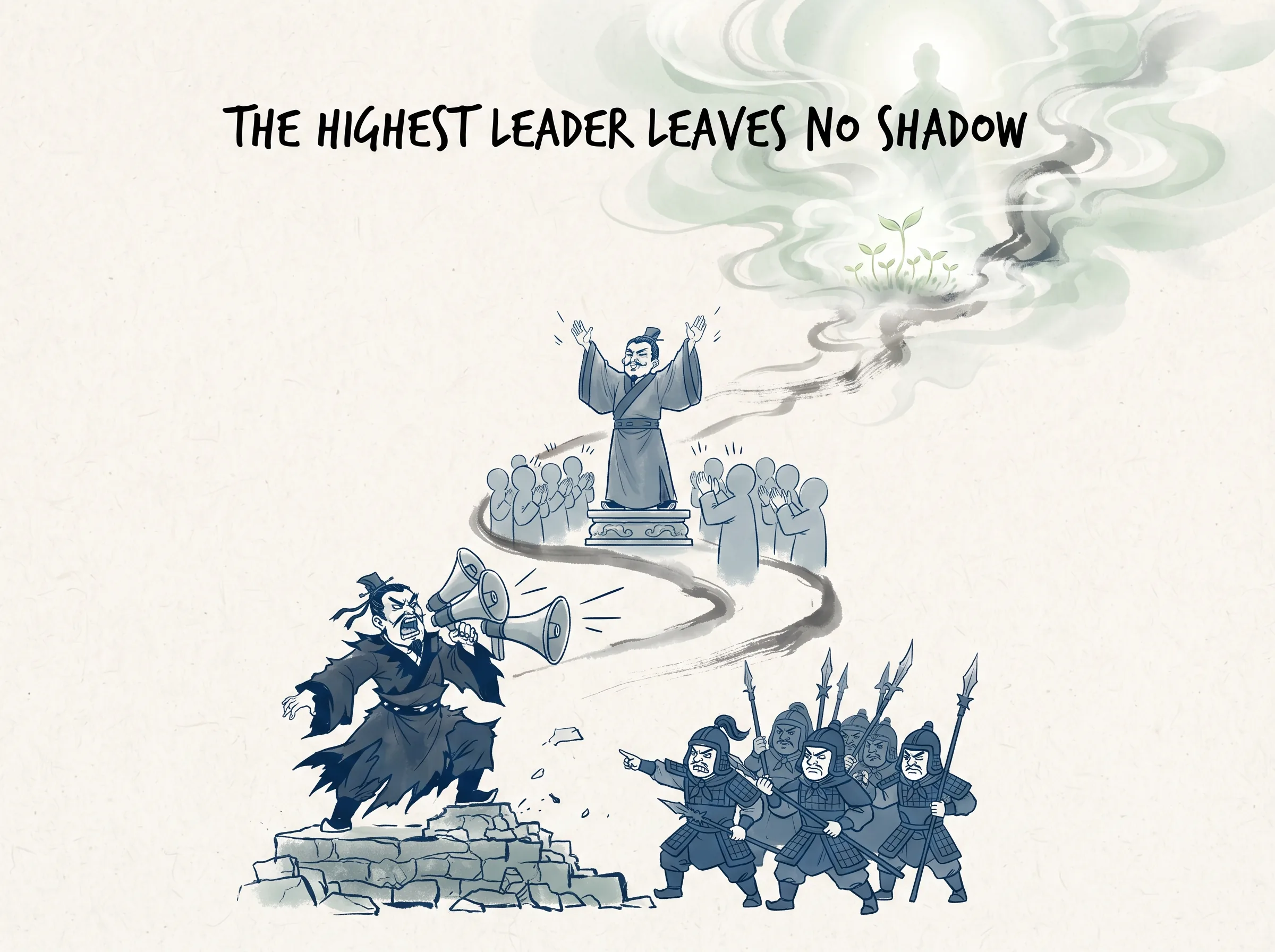
Scorn and resistance, the lowest tier, mark a deeper breakdown. When trust erodes completely, people stop pretending. They mock, resist, and withdraw their cooperation openly. Laozi does not blame the people for this. His diagnosis points upward: "When trust is insufficient, distrust arises." The problem is not that the governed are naturally rebellious but that the governing has failed to build reliable conditions for trust.
The top tier — the one people barely know exists — sounds almost paradoxical. How can a leader be effective while remaining practically invisible? The answer lies in what Laozi means by the kind of action that produces this result, and the concept he uses to describe it.
Continue with the deeper interpretation and practical application.
ChiDestiny members get access to the full analysis, modern applications, and the growing Chinese Wisdom Library.
FAQ
Is the exact wording of Chapter 17 the same in all ancient versions of the Daodejing? No. The received text, which comes primarily from the Wang Bi commentary tradition, is the version most commonly cited in modern translations. However, excavated manuscripts such as the Mawangdui silk texts and the Guodian bamboo slips preserve variant readings. One notable difference appears in the opening line: some versions read "the people know he exists" while the received text reads "the people barely know he exists" [1]. These variants do not change the chapter's overall structure but remind readers that the Daodejing circulated in multiple forms before settling into its later standard edition.
Does Laozi personally authorship mean these ideas came from a single individual 2,500 years ago? Scholarly consensus does not support that simplified account. Current research treats the Daodejing as a composite text formed through multiple collections, with a relatively stable form emerging around the third century BCE rather than being the work of a single author at a fixed point in time [2]. The figure of Laozi remains important in the tradition, but attributing the exact words of Chapter 17 to a specific person living exactly 2,500 years ago goes beyond what the historical evidence can sustain.
Can wuwei be interpreted as doing nothing at all? No. According to scholarly analysis, wuwei does not mean total inaction. Translators have offered renderings such as "non-assertive action," "non-coercive action," and "effortless action" to capture its meaning [2]. More broadly, the concept contrasts with action driven by self-serving desire — interference that imposes one person's will onto the natural development of another. In the seventeenth chapter, wuwei describes a mode of governance that produces order without making itself constantly visible.
Should I stop leading altogether if I want to practice this kind of influence? Not at all. The chapter does not argue for the elimination of leadership but for a transformation of how leadership operates. The highest form of influence creates conditions in which others can act autonomously rather than replacing their judgment with your own. This requires active investment — in clear communication, consistent follow-through, stable structures, and patient restraint — but it directs that investment toward building self-sufficiency in others rather than consolidating dependence on yourself.
Summary
Laozi's seventeenth chapter offers a radical redefinition of effective influence: the best leaders, parents, teachers, and managers are not the ones people praise and depend on most but the ones whose work becomes so embedded in the environment that those served feel they achieved success on their own. The hierarchy moves from barely visible order, through praise-based authority, through fear-based control, to contempt born of broken trust. The mechanism that sustains the highest tier is wuwei — action that does not coerce or over-interfere — and the linguistic discipline of gui yan, which treats words as precious rather than disposable.
The practical implication is not to withdraw from responsibility but to redirect it. Instead of asking "How can I be more visible and more needed?" ask "How can I build conditions where people succeed without me?" That question applies equally to a team you manage, a child you raise, a student you teach, and the inner voice you carry with you throughout the day.
If this framework resonates with you, the next step is to identify one relationship or system in your life where you currently occupy too central a role. Observe how much of the structure depends on your direct intervention. Then experiment with small, deliberate reductions — less frequent direction, more space for others to decide, greater reliance on established process rather than personal authority. Watch what happens. The result may not be immediate, and it may not look dramatic. But over time, the pattern Laozi described a long time ago may begin to show itself in your own experience.
Discover the historical and philosophical roots in the classical foundation in Matching Heaven: The True Warrior Does Not Provoke or Lose Temper.
For a deeper comparative examination of these ideas, explore our related study on Dispersing Delusion: When People No Longer Fear Death.
Sources & Further Reading
[1] Laozi (Collation Edition, 匯校版) – Wikisource (維基文庫). Available at
[2] Laozi (Stanford Encyclopedia of Philosophy/Fall 2024 Edition). Available at
[3] Metaphysics in Chinese Philosophy (Stanford Encyclopedia of Philosophy). Available at
Further Reading
Chinese Text Project — Daodejing Chapter 17 Parallel Text Edition






