
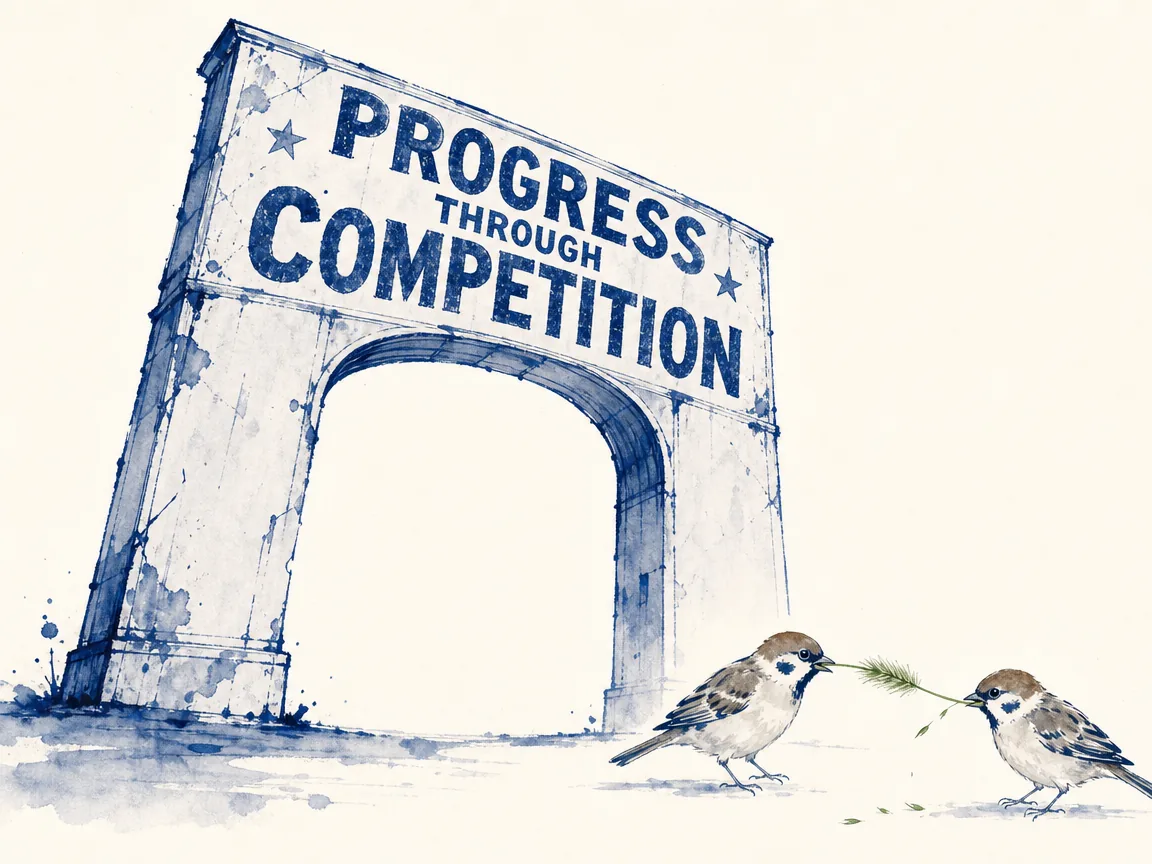
When a company loudly advertises "work-life balance" while its employees regularly miss deadlines because they're working late every night, something is worth noticing. When social media is filled with performances of compassion and justice, yet real communities struggle with basic trust, something deeper is at play. When families insist most urgently on "filial piety," the insistence itself may signal a fracture. These observations feel familiar precisely because they reveal a pattern that cuts across cultures and eras.
The Chinese philosopher Laozi captured this pattern over two millennia ago in one of the most diagnostically sharp passages in human thought. In Daodejing Chapter 18 of the Tao Te Ching (Daodejing), he writes: "When the Great Tao is lost, benevolence and righteousness appear; when wisdom emerges, great pretense follows; when the six relatives are out of harmony, filial piety and kindness are praised; when the state is in chaos and confusion, loyal ministers arise." [3]
Laozi is not denying these virtues. Benevolence, wisdom, filial piety, and loyalty all have value. What he is doing is far more subtle: he is pointing out that their prominence is a symptom, not a sign of health. Virtue becomes loudly proclaimed precisely where it has already fallen out of natural practice. The shout is the diagnosis; the silence of the lost order is the disease.
Daodejing Chapter 18: The Patch and the Garment
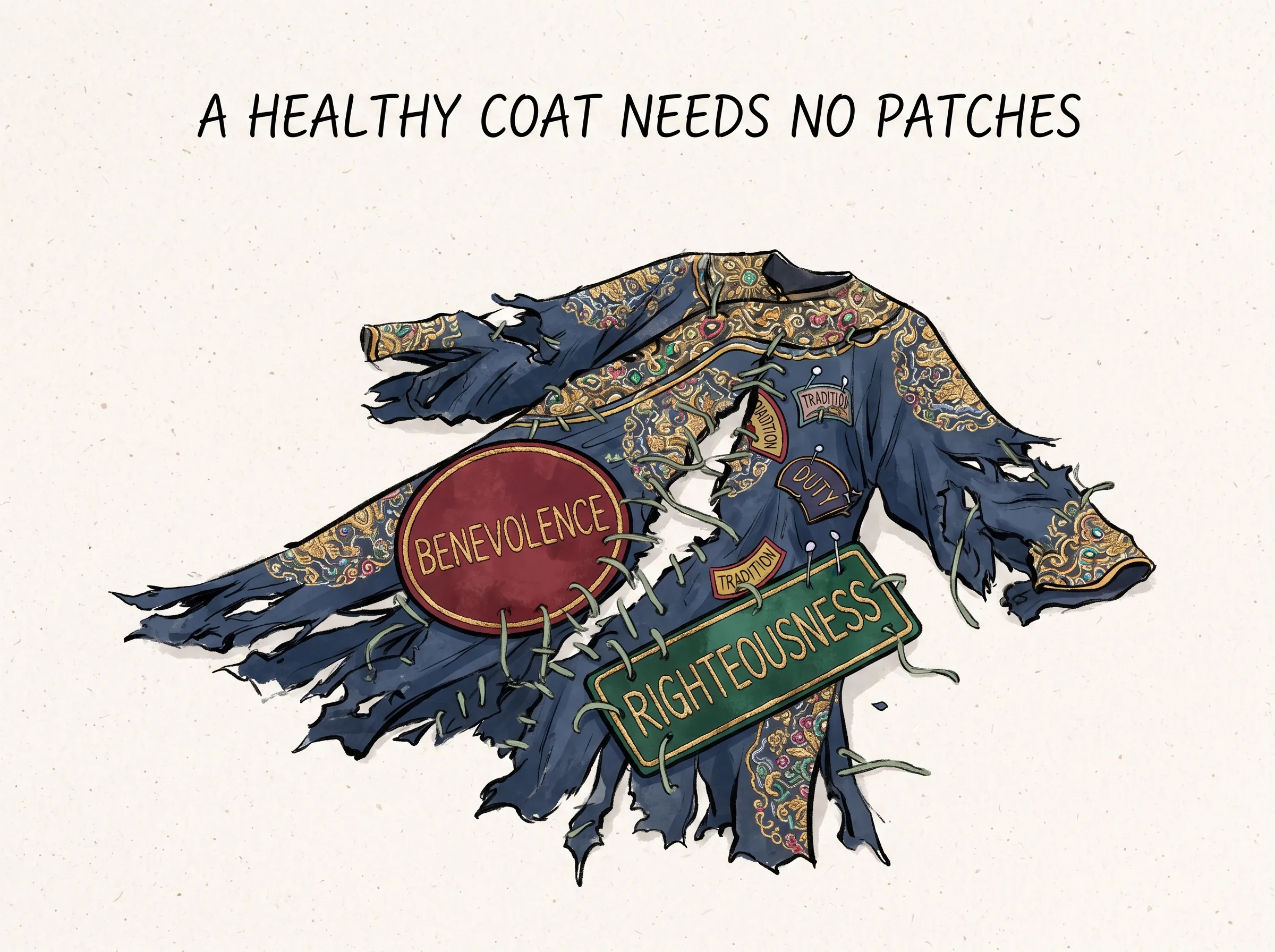
A useful metaphor helps clarify what Laozi is getting at. Imagine a well-worn garment. When the fabric is intact, you do not notice patches — the garment simply functions. When the fabric wears through, patches multiply. Eventually, the patchwork may cover so much of the original cloth that people mistake the repairs for the garment itself.
Virtues like benevolence, wisdom, filial piety, and loyalty are like patches. They can be useful, sometimes necessary. But they are not the garment. When a social order is healthy, people relate to one another without needing constant moral reminders. When that order frays, virtues are elevated into slogans, and we confuse the slogan with the reality it attempts to replace.
Continue with the deeper interpretation and practical application.
ChiDestiny members get access to the full analysis, modern applications, and the growing Chinese Wisdom Library.
FAQ
Does Laozi think virtues like benevolence and loyalty are worthless? No. Laozi does not reject these virtues. He questions the conditions that make them necessary to proclaim. In his view, virtues are valuable but derivative — like medicine for an illness, not health itself. The ideal is a social order where virtue arises naturally, without the need for constant moral reinforcement [3].
Is this idea unique to Laozi, or do other traditions share it? Similar diagnostic sensibilities appear across traditions. Confucianism, for instance, also recognizes that moral language can become empty when divorced from genuine practice. However, Laozi's formulation is distinctive in its directness: the very prominence of a virtue signals a prior loss. Other traditions tend to focus more on cultivating virtue; Laozi asks what must have been lost for virtue to require such cultivation.
Can this framework lead to cynicism or moral relativism? It can, if misunderstood. Laozi is not saying "all virtue is hypocrisy." He is saying "the loudness of virtue's proclamation is a clue." The difference matters. Cynicism dismisses all moral language. Laozi's approach scrutinizes the conditions behind it. A healthy application leads not to indifference but to clearer thinking about what actually needs to be repaired.
How does this relate to the concept of burn-out in modern workplaces? Laozi's fourth statement — that loyal ministers arise in chaotic states — maps closely onto what modern organizations call burn-out: a syndrome resulting from chronic, unmanaged workplace stress [4]. Factors such as excessive workload, low control, poor communication, and inadequate organizational support create conditions where a few individuals absorb systemic failure through personal sacrifice . Praising those individuals without addressing the underlying conditions is, in Laozi's terms, mistaking the patch for the garment.
Discover the historical and philosophical roots in the classical foundation in The Way of Heaven: Bending the Great Bow to Balance Abundance and Scarcity.
For a deeper comparative examination of these ideas, explore our related study on Honoring Agreements: Reconciling Great Enmities Leaves Lingering Resentment.
Sources & Further Reading
[1] Religious Daoism — Stanford Encyclopedia of Philosophy — Religious Daoism — Stanford Encyclopedia of Philosophy. Discussion of the Daode jing's view that Confucian virtues emerge when the Dao is abandoned.
[2] Dao De Jing — Project Gutenberg — Dao De Jing — Project Gutenberg. Translation and textual notes on variant readings across received and early manuscript versions.
[3] Burn-out an occupational phenomenon — World Health Organization — Burn-out an occupational phenomenon — World Health Organization. ICD-11 classification and definition of burn-out as an occupational phenomenon.
[4] WHO guidelines on mental health at work — NCBI Bookshelf — WHO guidelines on mental health at work — NCBI Bookshelf. Overview of workplace psychosocial risk factors contributing to burn-out.
Further Reading
- Tao Te Ching Chapter 18 — Multiple English translations available; for comparative study, consult editions by D.C. Lau, Stephen Mitchell, or Roger Ames and David Hall.
- Tao Te Ching Chapter 38 — Often read alongside Chapter 18 for its discussion of the hierarchy of Dao, De, ren, yi, and li.
- Zhuangzi — Contains complementary reflections on authenticity, naturalness, and the limits of moral performance.






