
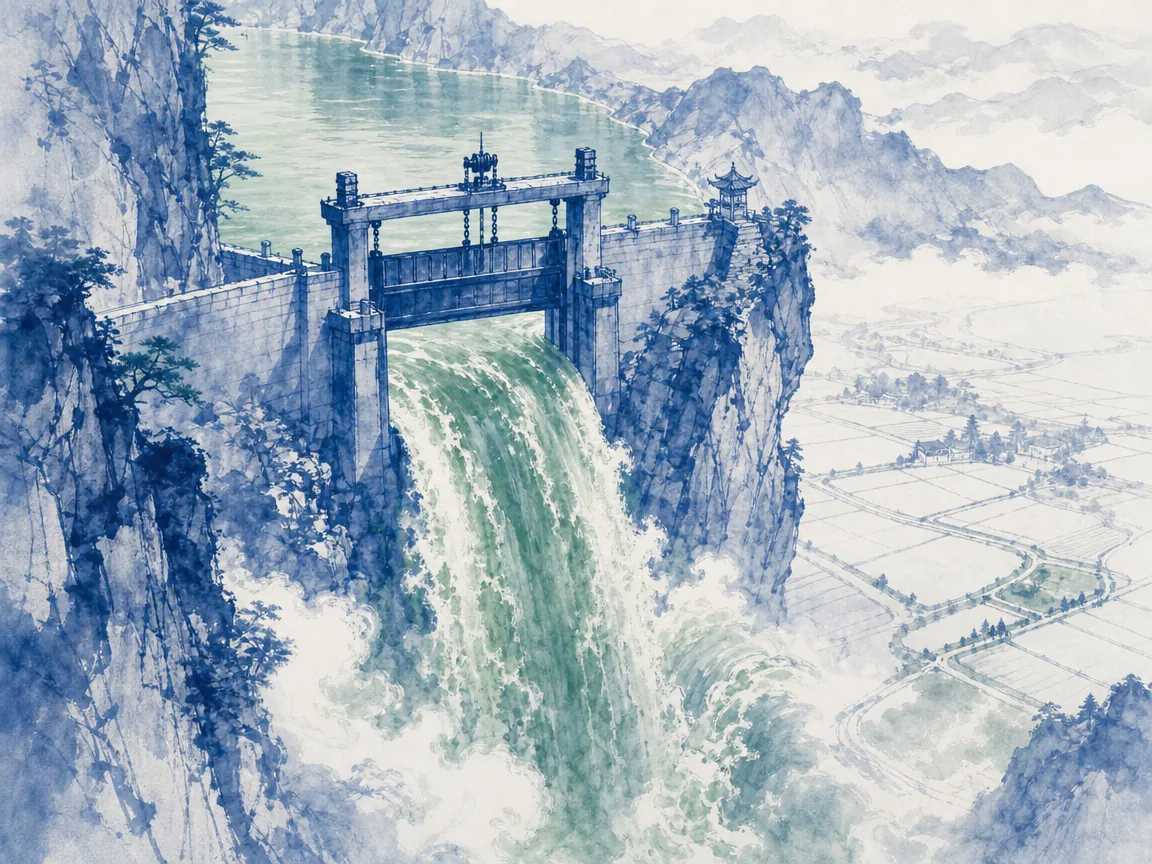
We tend to believe that victory is decided in the heat of the moment — by a flash of genius, a courageous stand, a brilliant last move. History seems to confirm this instinct. We remember the names of great commanders, the dramatic battles, the moments when everything hung in the balance. But there is another way to read the same history, one that reveals a quieter truth: the outcomes we celebrate as triumphs were often already written long before the fighting began.
This insight lies at the heart of Sun Tzu's Art of War, specifically in the chapter commonly translated as Formative Power (the Chinese title is 形篇, literally the chapter on "form" or "strategic disposition"). Sun Tzu writes: "The victorious soldier first secures victory, then seeks battle; the defeated soldier fights first, then hopes to win." [1] At first glance, this seems almost paradoxical. How can you win before you fight? The answer, Sun Tzu suggests, is that real victory is not something you create in the chaos of combat. It is something you design in advance — through how you position your resources, how you control the rhythm of events, and how you shape the conditions under which any contest will take place—a foundational perspective explored in Sun Tzu Chapter 7 Strategy.
The question this raises is not merely philosophical. It cuts to the heart of why some organizations, strategies, and systems produce sustainable success while others burn bright and collapse. A brilliant tactical move can deliver a stunning short-term win. But wins that endure — the kind that compound over time rather than exhausting themselves — tend to come from a different source: structural advantage. This is the distinction between winning a battle and building a system that generates wins.
Sun Tzu Chapter 7 Strategy: The Illusion of the Decisive Moment
The most persistent myth in strategy is that the decisive moment arrives at the climax — the final push, the last stand, the moment when all effort converges into a single act of will. We tell stories this way because drama demands it. But in reality, the decisive moment is almost always an illusion. What looks like a sudden breakthrough is more often the visible tip of a structure that was laid long before anyone noticed it.
Sun Tzu makes this point with characteristic sharpness. He argues that the skilled fighter does not seek glory in battle but instead creates conditions in which victory becomes the natural outcome. In the Formative Power chapter, he contrasts two kinds of warriors: one who fights first and then prays for success, and one who secures victory first and only then engages. The difference is not courage or intelligence — it is timing and preparation. "He who excels at making plans wins before he fights" is the practical upshot of this insight [1].
Consider how this plays out in ordinary life. A company that wins a major contract often appears to have pulled off a remarkable feat — a stunning pitch, a last-minute turnaround, a stroke of luck. But the people behind the scenes know that the real work happened months earlier: relationship-building, reputation-cultivation, strategic positioning. The "decisive moment" was not decisive at all. It was merely the public revelation of an outcome that had been structured long before.
This pattern repeats across every domain. The athlete who looks unstoppable on game day has spent years building the physical and mental architecture that makes dominance feel effortless. The investor who seems to have a gift for timing the market has usually spent decades cultivating a framework for evaluating opportunity — and that framework, not intuition, is what actually generates results. The writer whose prose appears inspired was, in truth, the product of relentless revision and structural thinking about language.
The lesson is uncomfortable because it undermines our deepest intuitions about heroism and effort. We want to believe that brilliance and effort in the moment are what matter. Sun Tzu tells us they are not. What matters is what you build in the silence before anyone is watching.
What "Victory Before Battle" Actually Means
The principle that "the victorious army wins first and then seeks battle" (shèng bīng xiān shèng ér hòu qiú zhàn, 胜兵先胜而后求战) appears in the Formative Power chapter of Sun Tzu's Art of War, one of the most widely read strategic texts in human history [1]. In other words, a capable strategist establishes the conditions for success before entering the contest. Understanding this principle requires moving beyond a word-for-word translation and entering a way of thinking that is fundamentally structural rather than tactical.
At its core, "victory before battle" means designing a position from which defeat becomes unlikely and success becomes probable — without needing to rely on extraordinary effort at the critical moment. It is the difference between a general who arranges his army on high ground with supply lines secure and an enemy struggling on difficult terrain, and a general who throws his forces into a risky engagement hoping for a miracle. In the first case, victory has already been partially achieved through positioning. In the second, victory is a hope.
Think of it like a game of chess. A master player does not win because of a single brilliant combination executed under pressure. She wins because she has spent the first thirty moves building a position where the winning move becomes almost obvious — where the opponent's options have been systematically narrowed and the path to checkmate has been gradually revealed. The final move looks dramatic to the observer. To the player, it is simply the conclusion of a logic that was established long ago.
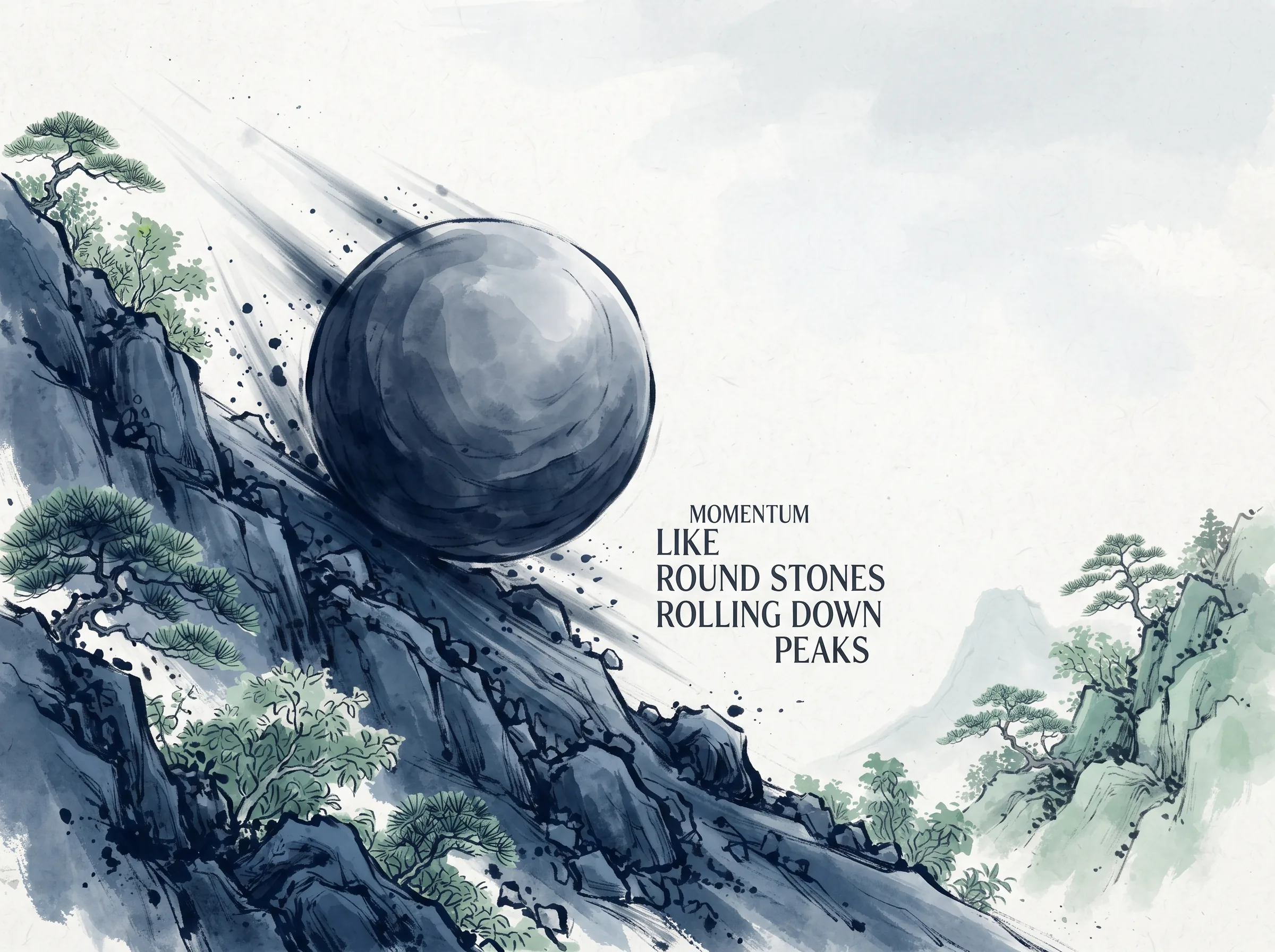
Sun Tzu extends this logic to warfare, but it applies equally to business, career decisions, relationships, and personal projects. In each domain, the question is not "How do I perform better when things get hard?" but "How do I arrange things so that 'hard' is less likely to determine the outcome?"
This requires a shift in what we value. We reward people who perform under pressure — the quarterback who throws the winning touchdown, the founder who pivots at the last second, the negotiator who lands the deal against the odds. These performances are real and impressive. But Sun Tzu would suggest that the most valuable skill is not the one that produces these heroic moments but the one that makes them unnecessary. The best negotiator is not the one who commands the room at the eleventh hour but the one who has already structured the terms so that agreement is the natural path. The best leader is not the one who saves the company in a crisis but the one who built a company that rarely enters crisis.
The Anchoring of Early Choices
Why does early positioning matter so much? One reason comes from modern psychology, specifically the concept of anchoring described by Daniel Kahneman and Amos Tversky. Their research showed that people tend to rely too heavily on initial information — the "anchor" — when making subsequent judgments. Once an initial frame is set, all later decisions bend around it, often insufficiently [1].
While Kahneman's anchoring effect is a cognitive bias rather than a strategic principle, it illuminates a deeper structural truth: early choices constrain later possibilities. Once a path is chosen, resources flow along it, identities crystallize around it, and the cost of redirection grows with every passing month. A company that commits to a particular technology stack will spend years building on it, even if a superior alternative emerges. An individual who chooses a career trajectory early will accumulate expertise, relationships, and habits that make switching costly. The initial anchor pulls everything after it.
This is not merely a psychological observation. It is a structural one. In complex systems, small differences at the beginning can produce enormous differences at the end — a phenomenon sometimes called path dependence. A correct early decision compounds: each subsequent choice becomes easier, each resource allocation becomes more effective, each relationship builds on the last. An incorrect early decision also compounds: correcting it requires not just fixing the original error but undoing the entire chain of consequences that followed from it.
The practical implication is stark: if early choices matter disproportionately, then the most important strategic work is not what you do at the moment of decision but what you do before the decision — the reflection, the scenario-planning, the deliberate questioning of assumptions. Most people skip this phase. They move quickly to action because action feels productive. Sun Tzu's framework suggests that the productive action is the quiet, unglamorous work of structuring the field before anyone knows a game is being played. For the original military treatise and commentary, read the complete strategic translation and classical commentary of Manoeuvring: Turning the Devious into the Direct and Orchestrating the Host.
Positioning in Three Dimensions
Sun Tzu's conception of strategic advantage can be understood through three interrelated dimensions of positioning: resource placement, pace and rhythm, and constraint design. While these are not explicitly enumerated as a triad in the classical text, they emerge clearly from the operational logic of the Formative Power chapter and related passages [1].
Resource placement asks a deceptively simple question: where are your key assets concentrated? In war, this means positioning troops where they can decide the outcome — high ground, secure supply lines, defensible terrain. In business, it means allocating capital, talent, and attention to the areas that matter most rather than spreading them thinly across everything. Most organizations distribute resources according to inertia or urgency, not strategy. The disciplined approach requires identifying the few points of leverage and concentrating there until the position becomes formidable.
Pace and rhythm concerns who controls the timing of engagement. The party that sets the pace forces the other to react, and reaction is always at a disadvantage. Hannibal controlled the pace in Italy for years, forcing Rome to respond to his movements rather than the reverse. The Roman strategy eventually shifted when they adopted what became known as the Fabian approach — refusing to engage on Hannibal's terms and instead stretching the conflict across time [2]. In personal life, pace control looks like protecting your calendar, setting deadlines on your own schedule, and refusing to be pulled into other people's urgencies.
Constraint design is the most sophisticated dimension. It asks: how can you structure the conditions of competition so that your opponent's strengths cannot be fully brought to bear? In military terms, this might mean drawing an enemy into terrain where their numerical superiority becomes irrelevant. In business, it might mean operating in a market segment where competitors' scale is a liability rather than an asset. The goal is not to match your opponent at their strength but to redefine the battlefield so that their strength counts for less and yours counts for more.
These three dimensions are not independent. Resource placement determines what you have available. Pace and rhythm determines when you use it. Constraint design determines whether your opponent can effectively counter it. Together, they form a coherent framework for understanding what Sun Tzu meant by "securing victory before battle."
The Friction Between Plan and Reality
Any structural theory of strategy must account for a complication that Sun Tzu himself acknowledged: plans do not execute themselves. The gap between intention and outcome is what the Prussian general Carl von Clausewitz called "friction" — the force that makes seemingly simple things difficult in practice [1].
Friction takes many forms. Information is incomplete or delayed. People make errors or act on misread instructions. Equipment fails. Weather interferes. Morale fluctuates. Coordination breaks down. In war, these are the invisible agents of chaos that no amount of planning can fully eliminate. Clausewitz observed that in war, "everything is very simple, but the simplest thing is difficult" — a succinct description of friction's effect [1].
The implication for structural thinking is critical. A strategy that depends on perfect execution is not a strong strategy — it is a fragile one. Real structural advantage must absorb friction without collapsing. This means building in redundancy, designing for error tolerance, and creating systems that can withstand unexpected setbacks without losing their essential function.
This is where the distinction between fragility and resilience becomes vital. A fragile system is one that works beautifully under ideal conditions but shatters when conditions deteriorate. A resilient system is one that may not look optimal in perfect conditions but continues to function — and even improve — under stress. The Japanese concept of wabi-sabi, with its appreciation of imperfection and transience, captures something of this wisdom: beauty and strength are not found in flawless execution but in the capacity to endure and adapt.
In organizational design, this translates to practices like maintaining slack capacity, diversifying supply chains, cross-training employees, and creating decision-making structures that can function even when key individuals are absent. These practices do not make a system more efficient in the narrow sense — they make it more robust. And in a world governed by friction, robustness is more valuable than efficiency.
Rome and Hannibal: Tactical Brilliance Versus Structural Endurance
The Second Punic War offers one of history's clearest demonstrations of the gap between tactical brilliance and structural endurance. Hannibal Barca crossed the Alps with an army that included elephants, descended into Italy, and proceeded to defeat Roman forces in a series of devastating engagements — most famously at Cannae, where his double-envelopment tactic annihilated a significantly larger Roman army [2]. By any measure of battlefield performance, Hannibal was one of history's greatest commanders.
Yet Hannibal did not win the war. Rome did.
The reasons for this outcome are instructive. At Cannae, Hannibal's forces surrounded and destroyed a Roman army numbering perhaps 80,000 men — one of the most complete tactical victories in military history [2]. But this victory, devastating as it was, did not break Rome. The Roman state possessed resources — manpower, financial reserves, a network of alliances — that no single battle could exhaust. Even after Cannae, Rome continued to raise armies and fight [2].
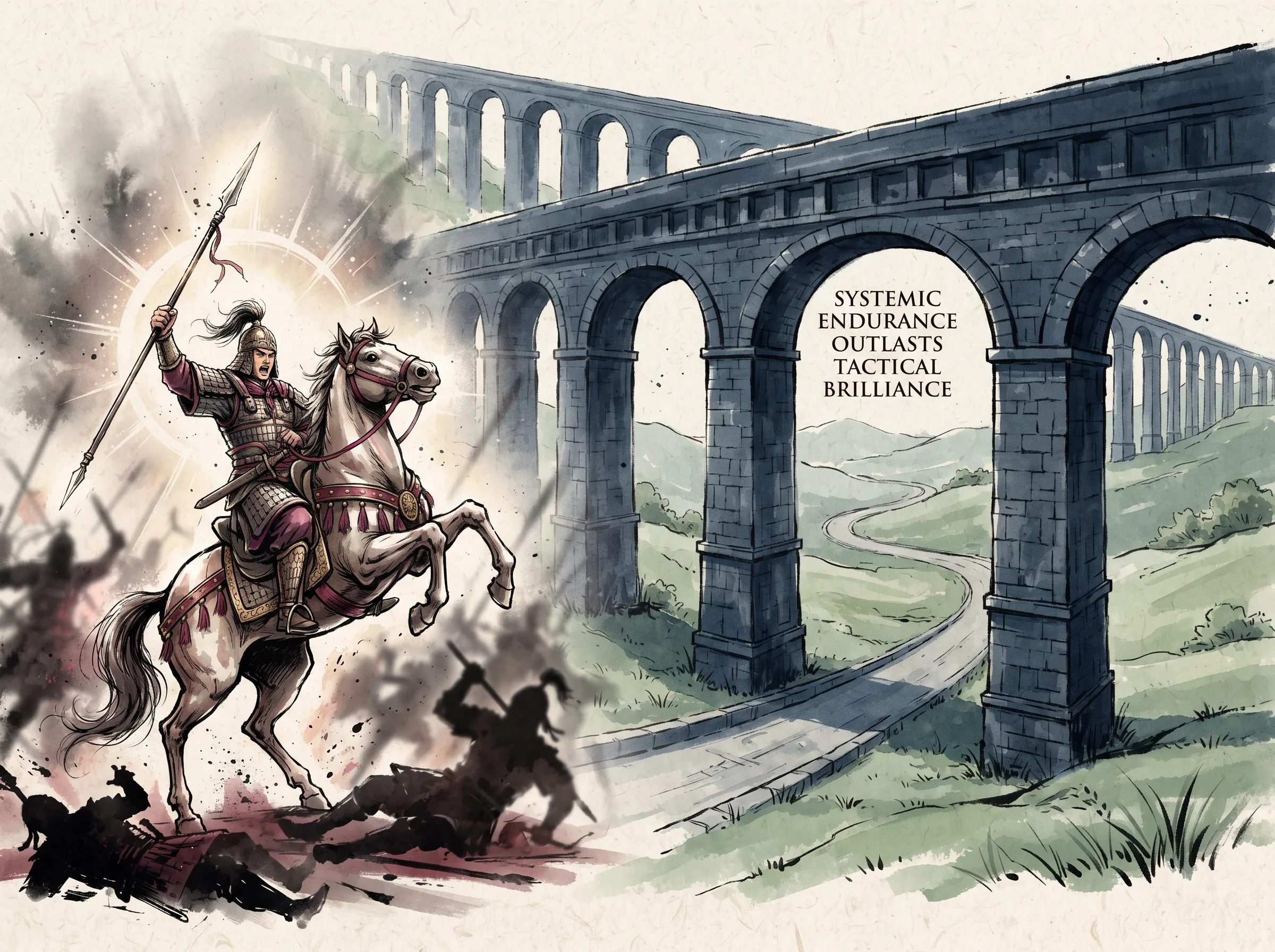
Hannibal's strategic predicament (strategic dilemma: 战略困境) — his inability to convert tactical success into strategic victory — stemmed from a structural limitation: he lacked the resources to sustain a prolonged campaign far from home. Every victory consumed his army; Rome's victories consumed only a fraction of its reserves. The Roman Senate, learning from early disasters, adopted a strategy of avoidance and attrition. As the Encyclopædia Britannica records, the dictator Quintus Fabius Maximus, nicknamed "Cunctator" (the Delayer), pursued a strategy of avoiding direct confrontation with Hannibal while persistently harassing his operations [2]. This was not glorious strategy. It was structural strategy — and it worked.
The moral is clear: Hannibal won the battles but lost the war because his victories depended on conditions that could not be reproduced. Each Cannae-style engagement required perfect conditions — the right terrain, the right timing, the right intelligence about Roman movements. Rome's victory, by contrast, depended on conditions that were continuously available: manpower, allies, institutional stability. One kind of win was brilliant but brittle. The other was unglamorous but durable.
This pattern recurs throughout history and in everyday life. The startup that wins through a viral product launch but has no sustainable business model. The athlete who peaks too early and burns out. The relationship that burns bright in passion but has no structure for handling ordinary difficulties. Brilliance without structure is a beautiful but temporary advantage. Structure without brilliance is unglamorous but enduring. The optimal position combines both — but if forced to choose, structure wins.
From Ancient Warfare to Modern Systems
The logic of "victory before battle" extends far beyond military campaigns. It appears wherever systems compete, wherever outcomes depend on structure rather than momentary effort. One of the most transparent modern examples comes from platform economics — specifically, the development of digital payment infrastructure.
When Taobao launched as an e-commerce platform in China, a fundamental problem blocked growth: trust. Buyers were reluctant to pay sellers they had never met. Sellers were reluctant to ship products to buyers who might never pay. The market existed in potential — there was demand on both sides — but the structural conditions for exchange were absent. This is precisely the kind of problem that "victory before battle" thinking is designed to address: how do you create a winning outcome by changing the structure of the game rather than competing harder within the existing rules?
The solution — Alipay's escrow system — was a structural intervention. Rather than trying to persuade buyers and sellers to trust each other directly, Alipay inserted itself as a trusted intermediary: buyers paid Alipay, Alipay held the funds, the seller shipped the goods, and only after the buyer confirmed receipt did Alipay release the payment to the seller. This small structural change unlocked enormous latent value. It did not compete with existing payment methods; it created the conditions under which a new kind of transaction became possible at scale.
The deeper strategic insight here is that the most powerful competitive moves are often those that redefine the rules rather than optimize within them. Alipay did not win by offering lower fees or better customer service than existing banks. It won by creating a new structural position — a trusted intermediary in a low-trust environment — that made competition on traditional terms irrelevant. This is "victory before battle" in a commercial context: designing the conditions so that your advantage is structural rather than contending.
The same logic applies to individual careers, creative projects, and personal relationships. The person who builds a reputation for reliability before they need a reference. The writer who publishes consistently for years before seeking a publisher. The partner who invests in communication patterns before a crisis tests them. In each case, the advantage is not a momentary performance but a pre-built structure that makes success the default path.
The Pattern Behind Sustained Success
Across war, business, and life, a consistent pattern emerges: those who achieve lasting success are not necessarily the most brilliant in any single moment. They are the ones who design systems where brilliance is not required to survive. This is not a call for mediocrity. It is a call for intelligence about where intelligence should be applied.
Sun Tzu's Art of War has been read for two millennia as a manual for winning battles. But its deepest teaching is about something else: how to make battles unnecessary. The highest form of strategy is not victory in combat but the creation of conditions in which combat is either avoidable or, if it occurs, tilted decisively in your favor before a single weapon is drawn.
This perspective reframes every dimension of competitive life. In business, it shifts the focus from competitive tactics to competitive architecture — from marketing campaigns to business model design, from price competition to structural differentiation. In personal development, it shifts the focus from performance under pressure to the cultivation of conditions where pressure is unlikely to be decisive. In leadership, it shifts the focus from heroic intervention to institutional design.
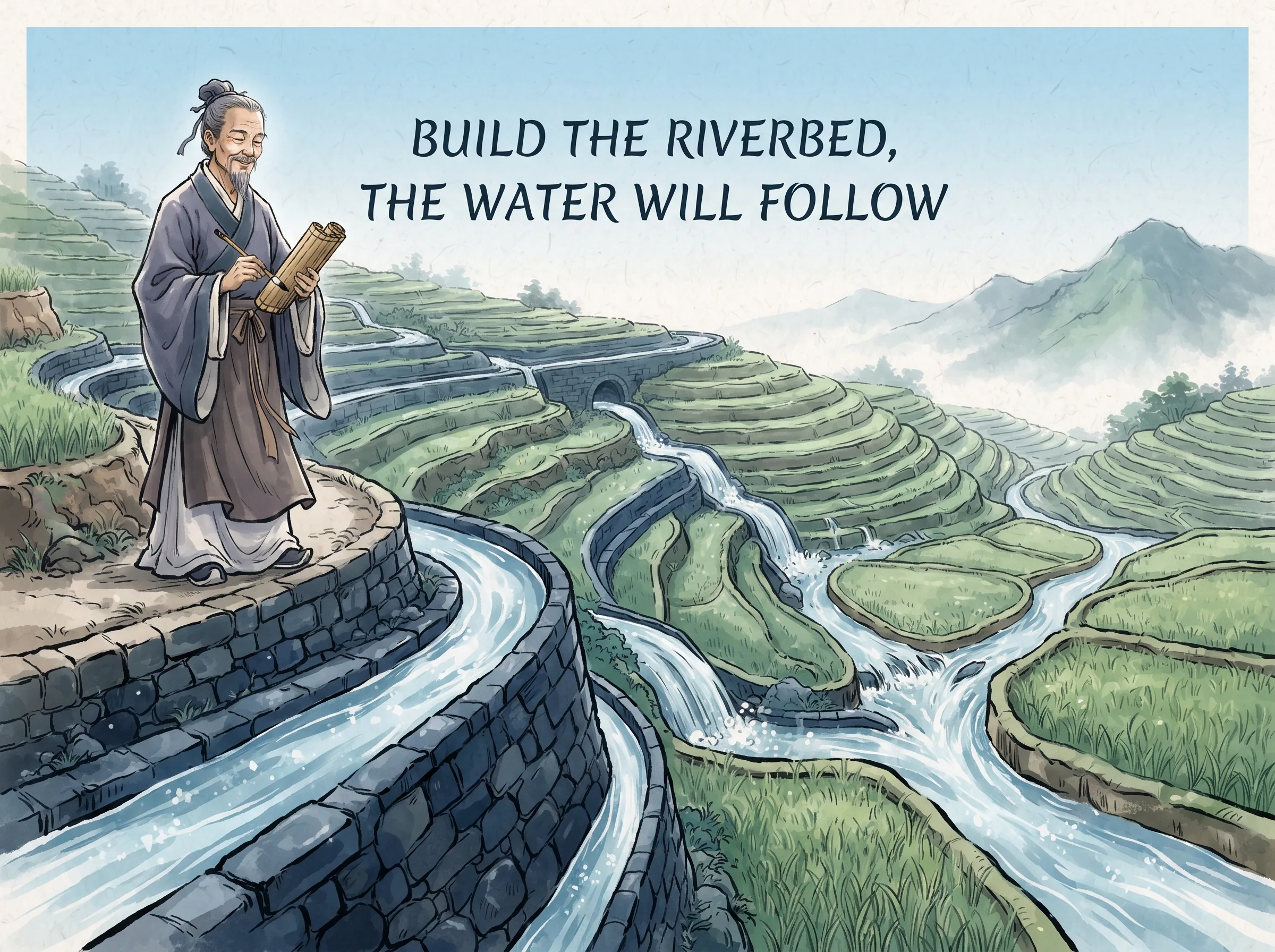
The Roman historian Polybius, writing about the Punic Wars, captured something of this dynamic when he observed that Rome's ultimate success rested not on any single general's genius but on the resilience of its political and military institutions. The Roman system could absorb catastrophe and continue functioning. Hannibal's system could produce miracles but could not reproduce them [2]. This is the essential distinction: systems that generate wins are fundamentally different from individuals who win once.
The practical upshot is this: invest your energy where it compounds. Build structures that endure. Design for friction, not perfection. Anchor your early choices deliberately, knowing that they will shape everything that follows. And when the moment of contest arrives — as it inevitably will — let it be a confirmation of what you have already built, not a test of whether you can invent victory from nothing.
FAQ
Is Sun Tzu's "victory before battle" the same as being cautious or avoiding conflict?
No. Sun Tzu is not advocating passivity. He is advocating a different kind of activity — the activity of preparation and structuring that makes conflict favorable before it begins. A warrior who "secures victory first" is not someone who refuses to fight but someone who fights only when the outcome is already tilted in their favor. This is aggressive preparation, not avoidance.
How do I know if I'm building structure or just delaying action?
Structure-building and delay-differ in intent and method. Structure-building involves deliberate decisions about resource allocation, positioning, and constraint design — the three dimensions discussed above. Delay, by contrast, is actionless waiting. The key test is whether your current efforts are changing the underlying conditions or merely postponing a decision that needs to be made. If you are actively designing advantage, you are building structure. If you are simply avoiding a decision, you are delaying.
Can "victory before battle" thinking apply to situations where I have no control over the structure?
Yes, though the scope of application narrows. When you enter a situation with pre-existing structural disadvantages — a hostile market, a difficult relationship, an unfavorable competitive landscape — the "victory before battle" framework still applies, but the task shifts from creating advantage to mitigating disadvantage. You may not be able to redesign the board, but you can still position yourself to minimize the damage of a unfavorable configuration and to identify the narrow pathways where structural advantage can still be built.
Does this approach undervalue adaptability and improvisation?
Not necessarily. The "victory before battle" framework does not reject adaptability — it repositions it. Adaptability is most valuable when deployed within a well-structured position, not when deployed in a vacuum. A tree with deep roots can bend in the storm without breaking; a tree with shallow roots, no matter how flexible, is more vulnerable. The structural approach builds the roots so that adaptability has something to work with.
The distinction between brilliant victories and enduring ones is not a distinction between two kinds of people but between two kinds of thinking. One thinks in moments; the other thinks in structures. The moment-thinking approach produces spectacular results that are difficult to reproduce. The structural approach produces unglamorous but compounding results that strengthen over time.
If you want to test this framework, start by examining one area of your life where you have experienced repeated short-term success but persistent long-term difficulty. Map the structure: where are your resources concentrated? Who controls the pace? What constraints are you imposing on yourself and your environment? You may find that the gap between your tactical brilliance and your strategic durability is not a personal failing but a structural one — and that closing it requires not more effort in the moment but better design before the moment arrives, reflecting the enduring wisdom of Sun Tzu Chapter 7 Strategy.
To explore these themes from another angle, read our related reflection on Why Plans Fail After They Start: Sun Tzu on Control in Motion.
Deepen your understanding of these principles in our reflection on Why Your Breakthrough Won’t Last—And What Sun Tzu Knew About Real Advantage.
Sources & Further Reading
[1] Polybius, Histories, Book 3 — Perseus Digital Library. Contains accounts of the Second Punic War, including the Fabian strategy and the Battle of Cannae.
[2] 1911 Encyclopædia Britannica, "Punic Wars" — Wikisource. Provides detailed accounts of Hannibal's campaigns, the Battle of Cannae, and Rome's structural resilience during the Second Punic War.
Further Reading
- Sun Tzu, The Art of War — translations by Samuel B. Griffith, Lionel Giles, or Ralph D. Sawyer. The classical text underlying the concept of "victory before battle" (先胜) and the chapter often translated as Formative Power (形篇, literally "form" or "strategic disposition").
- Daniel Kahneman, Thinking, Fast and Slow. The foundational work on anchoring bias and cognitive heuristics relevant to understanding path dependence in strategic decisions.
- Carl von Clausewitz, On War. The classical text introducing the concept of "friction" in military operations and its implications for strategic planning.
- Adrian Goldsworthy, The Punic Wars. A comprehensive modern history of Rome's conflicts with Carthage, providing detailed analysis of Hannibal's campaigns and Roman strategic responses.
- Mary Beard, SPQR: A History of Ancient Rome. Offers broader context on Roman institutional resilience and the structural factors behind Rome's military and political endurance.






