

You have probably met someone like this—the colleague who consistently closes deals, outperforms quarterly targets, and turns every project into a visible success. By all conventional measures, they are winning. Yet somehow, five or ten years later, their career has plateaued, their relationships feel thin, and there is a quiet exhaustion behind their achievements that no promotion seems to fix. You may even recognize this pattern in yourself.
This is not a failure of effort. It is something subtler and more common: winning at the wrong level. Ancient Chinese thought offers a remarkably clear warning about this trap. The tradition asks us to consider not simply whether we are winning, but on which level of a problem we are actually competing. When that level is misaligned with our deeper goals, the more skillfully we fight, the faster we drift away from what matters—a foundational perspective explored in Sun Tzu Chapter 6 Strategy.
The paradox is that chronic tactical success can become a kind of quiet failure. We optimize for what is visible, measurable, and immediately rewarding, while the larger structure beneath our efforts slowly erodes. The Chinese strategist Sun Tzu is often remembered for tactical brilliance, but his most widely cited insight points in a different direction. In the section commonly known as "Attack by Stratagem" in The Art of War (《孙子兵法》, Sūnzǐ Bīngfǎ; the chapter is 《谋攻篇》, Móugōng Piān), he describes a hierarchy of competitive action, placing the highest form of success above direct confrontation [1]. The idea is not anti-military moralizing. It is a principle of dimensional strategy: the most effective competitor shapes conditions before the fight begins, rather than proving superiority through repeated engagement on the battlefield of the moment.
Sun Tzu Chapter 6 Strategy: The Hidden Cost of Local Victory
Local victories are seductive because they arrive quickly, measure easily, and come with clear feedback. A sales target is hit. A debate is won. An email thread ends with the other side backing down. Each outcome delivers a hit of confirmation, and the brain learns to associate action with reward. But when these short-term wins become the primary driver of behavior, they can quietly displace the longer, messier goals that actually sustain a life or an organization.
Donella Meadows, in her systems thinking framework, warns explicitly about this dynamic. She advises paying attention to what is important, not just what is quantifiable, and cautions against maximizing parts of a system while ignoring the whole [1]. What looks like success inside a single metric often creates hidden losses elsewhere. A company that wins every price war may see revenue climb while its brand erodes. A person who optimizes their calendar for maximum productivity may find they have no energy left for relationships, reflection, or the long-term projects that give life direction.
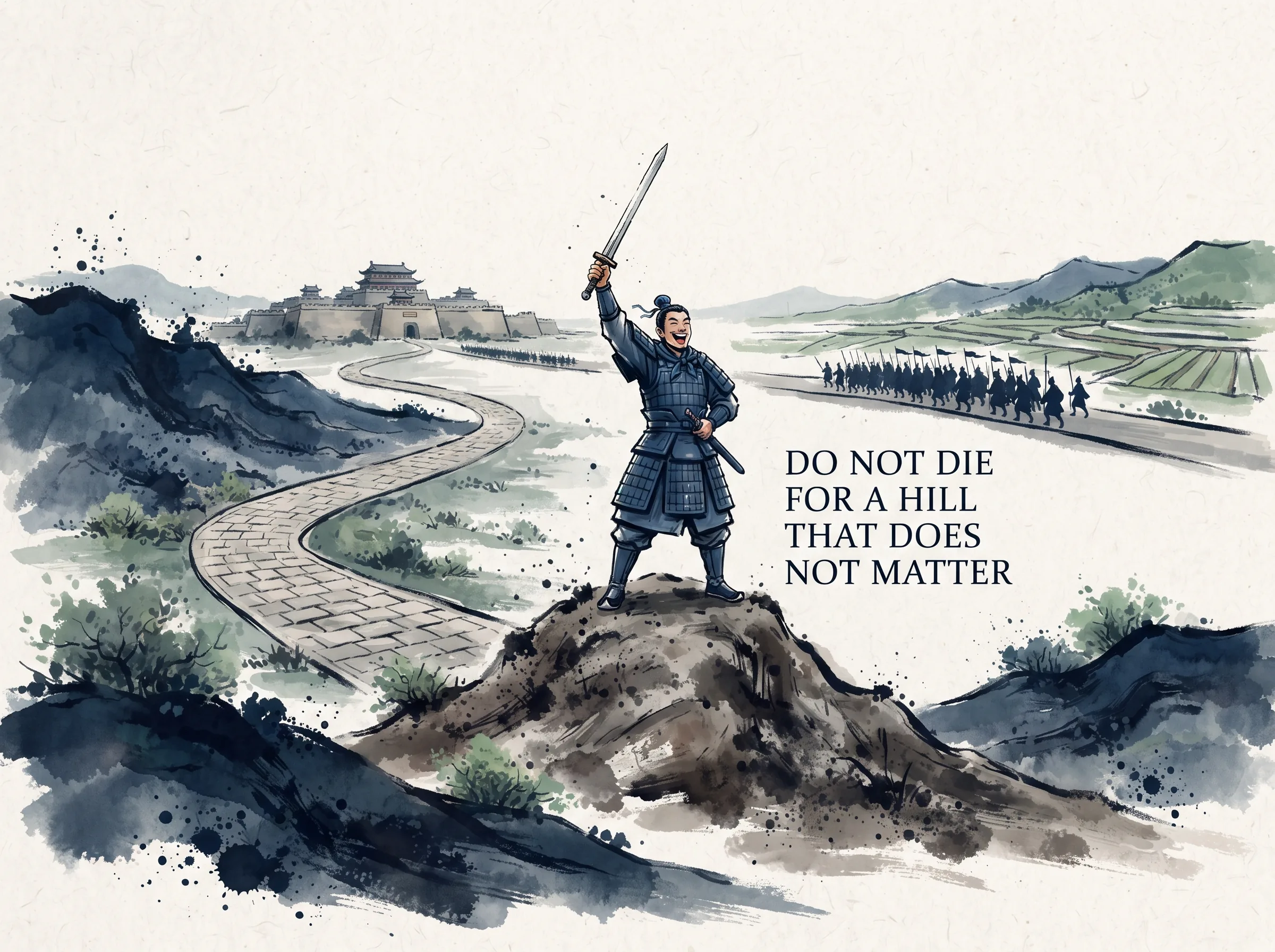
This is not a failure of intelligence or discipline. It is a structural problem. Systems tend to reinforce whatever behavior produces the fastest visible feedback. The more efficiently the system runs, the harder it becomes to notice that it is running in the wrong direction.
The Trap of Goal Displacement
Psychology has a name for the mechanism behind this drift. Daniel Kahneman describes a process of substitution, in which the mind replaces a difficult question with an easier one ]. When the real goal feels abstract or distant, the brain reaches for a proxy it can track. Health becomes weight on a scale. Meaning becomes output per hour. A relationship becomes the absence of conflict rather than the presence of depth.
Once the proxy takes the place of the genuine target, the system enters a self-reinforcing loop. The easiest metric gets rewarded. Effort concentrates on that metric. The real goal is pushed further into the background, not because anyone chose it deliberately, but because the architecture of daily decision-making pulls attention toward what is immediately visible. This is the mechanism behind goal displacement: the means that were meant to serve the end gradually begin to govern it.
The Chinese distinction between root and branches (běn–mò, 本末) captures the same danger in slightly different terms. When capability grows without clarified purpose, it does not produce direction. It accelerates drift. For the original military treatise and commentary, read the complete strategic translation and classical commentary of Weak Points and Strong: Directing the Rival and Flowing Like Water Through the Void.
What Chinese Wisdom Says About Levels of Conflict
Sun Tzu organizes competitive action into levels. At the lowest level, you clash directly. Above that, you disrupt alliances. Higher still, you counter strategy. The highest level is to shape conditions so thoroughly that the opponent loses the will or capacity to fight before contact occurs. This is not a call for passivity. It is a call for strategic placement.
The lesson for modern readers is practical. Most of us spend our days fighting at the lowest available level — responding to messages, winning arguments, closing tasks — because that is where feedback is immediate. The higher levels require patience, restraint, and a willingness to invest in conditions that will not pay off for months or years. That is precisely why most people never practice them.
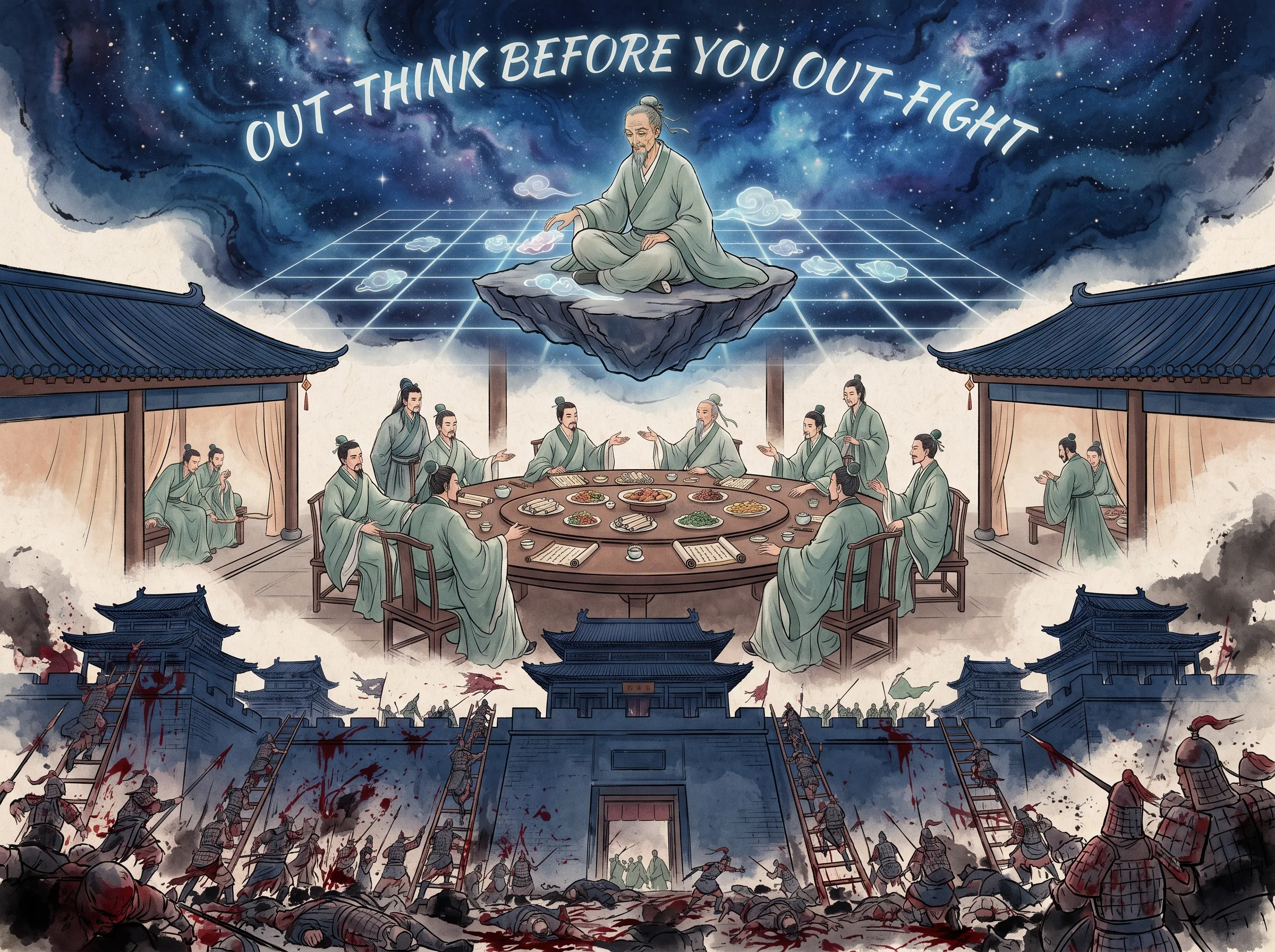
A brief historical example often illustrates this point. According to traditional accounts recorded in Sima Qian's Records of the Grand Historian (Shiji), Xiang Yu was tactically dominant on the battlefield but ultimately lost to Liu Bang, who built wider alliances, secured logistics, and competed on the level of structure rather than single engagements. Whether read as history or as parable, the pattern is recognizable: the ability to win every encounter is not the same as the ability to shape the outcome of the larger contest.
Three Questions to Reset Your Level
The problem is not that you lack ability. It is that ability without a clarified level of competition becomes a fast path in the wrong direction. Before investing more effort, it helps to pause and diagnose where you actually stand.
1. What problem am I trying to solve? Strip away the metrics and the momentum. What is the genuine objective behind the activity? In business terms, this is sometimes called first-principles thinking. In Chinese thought, it aligns with returning to the root rather than trimming the branches. If the real goal is long-term well-being, then winning every argument at home may be counterproductive. If the real goal is lasting value creation, then maximizing quarterly revenue through price cuts may be self-defeating.
2. What is my current system rewarding? Look honestly at the feedback loop you are embedded in. Are you being reinforced for activity or for progress? For visibility or for depth? For short-term results or for sustainable capacity? Systems tend to produce exactly what they are designed to measure. If the measure is narrow, the behavior will be too.
3. On which level should this be decided? This is the question Sun Tzu would push you toward. Many problems that feel urgent belong to a higher layer than the one you are currently occupying. A team conflict may seem like a personnel issue but is often a structural one. A career setback may feel personal but is frequently a mismatch between your current tactics and a strategy you have not yet articulated.
What It Means to Fight on the Right Level
Redefining strength in this way does not mean avoiding effort. It means directing it where it compounds rather than where it merely occupies time. The Daoist idea of effortless or non-forcing action (wúwéi, 无为) is often misunderstood as passivity, but in its strategic reading it means alignment—acting in harmony with the structure of a situation rather than against it. The most effective move is not always the most visible one. Sometimes the wisest action is the one that prevents the battle from happening at all.
This perspective may feel uncomfortable if you have built your identity around being the person who wins. It asks you to slow down the impulse to respond, to resist the temptation to prove yourself in the arena that is most immediately available, and to invest instead in the higher-level conditions that determine which arenas exist in the first place.
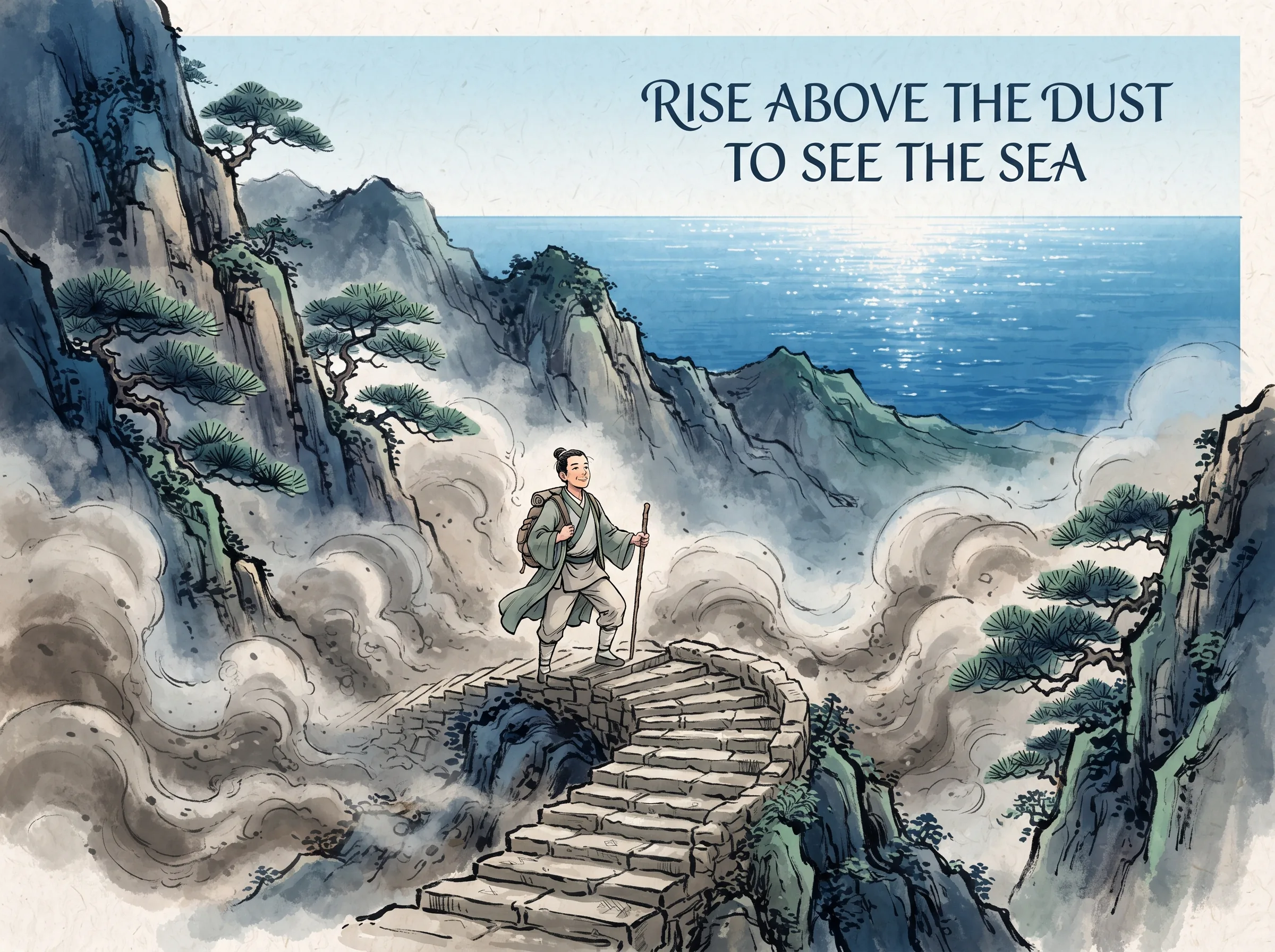
The alternative is not inaction. It is a different kind of action — one that prioritizes structure over speed, purpose over performance, and long-term alignment over short-term validation. That is a harder discipline to practice, especially in environments that reward the opposite. But it is also the discipline that separates those who accumulate wins from those who build something that lasts.
FAQ
Q: Does this mean I should stop pursuing goals and metrics altogether? No. Metrics and goals remain useful tools. The warning applies when they replace the underlying purpose rather than serving it. The question is not whether to measure, but whether the metric you are optimizing for actually corresponds to the outcome you care about.
Q: How do I know when I am fighting on the wrong level? A practical sign is when your efforts produce visible short-term gains but leave a longer-term structure weaker. If you are winning more battles while the overall direction drifts, you may be operating at too low a level. Another indicator is feeling busy and accomplished but unsure what any of it adds up to.
Q: Can ancient Chinese strategy really apply to modern work and relationships? The principles are not tied to any specific era. Concepts like dimensional thinking, goal displacement, and the distinction between root and branches address structural patterns that appear in any competitive environment, whether a battlefield, a corporation, or a family.
Q: What if my organization rewards short-term results and punishes long-term thinking? Then the challenge is not simply personal discipline but system design. As systems thinkers note, behavior is shaped by the architecture of incentives. Changing your approach may require either finding leverage within the existing structure or selecting a context where higher-level thinking is valued.
The pattern is widespread and often invisible to those caught in it. Winning the wrong battles is safer than admitting you do not yet know which battles matter. But clarity at the higher level is the only thing that turns accumulated effort into genuine achievement. Start by asking not how to win the next fight, but on which level the fight should belong.
If you would like to explore this further, consider mapping out one ongoing challenge in your life or work and listing the three levels at which it could be addressed. Identify which level you are currently occupying and which level the real problem belongs to. The gap between those two levels is often where the most useful next step lives, reflecting the enduring wisdom of Sun Tzu Chapter 6 Strategy.
To explore these themes from another angle, read our related reflection on Designing Your Position: How Ancient Chinese Wisdom Explains Why Willpower Alone Fails.
For a deeper comparative examination of these ideas, explore our related study on How to Know When Not to Fight: Ancient Chinese Wisdom for Escaping Losing Battles.
Sources & Further Reading
[1] Dancing With Systems – The Donella Meadows Project — Systems thinking principles, including the emphasis on focusing on what is important rather than merely quantifiable and the warning against optimizing subsystems at the expense of the whole.
[2] The Art of War (《孙子兵法》, Sūnzǐ Bīngfǎ), “Attack by Stratagem” (《谋攻篇》, Móugōng Piān) — Referenced in podcast analysis for the concept of competing at higher strategic levels rather than through direct confrontation. Exact chapter numbering and classical Chinese phrasing are presented here based on the source transcript rather than independently verified in the provided materials.
[3] Records of the Grand Historian (Shiji; 《史记》, Shǐjì) — Traditional historical source commonly cited for the contrast between Xiang Yu's tactical brilliance and Liu Bang's strategic approach. Presented here as traditional characterization rather than independently verified detail.
[4] Kahneman, Daniel. Thinking, Fast and Slow — Referenced for the psychological mechanism of substitution, where the mind replaces a difficult question with an easier one.
[5] Meadows, Donella H. Dancing with Systems — Referenced for the systems-thinking observation that organizations often behave according to visible, measurable feedback rather than important but less quantifiable goals.






