

Most organizations celebrate a single breakout success as if they have discovered the secret formula. A new product goes viral. A startup lands a headline-making acquisition. A team ships a feature that makes every competitor look behind. The celebration is understandable—there is genuine reason for pride. But beneath that momentary triumph lies a pattern that repeats with unsettling regularity: the same companies that nail one innovation often struggle to replicate it, and the advantage they fought so hard to win dissolves within a few years.
Why does this happen? The answer is not that these organizations lacked vision or talent. It is that they mistook a momentary strike for a sustainable strategy. They built on a single brilliant move instead of constructing a system that could keep generating brilliant moves. Modern business culture is saturated with narratives about disruption, silver bullets, and the one decision that changes everything. There is something seductive about these stories. They are clean, dramatic, and easy to share at a conference. But they are also misleading—a foundational perspective explored in Sun Tzu Chapter 9 Strategy.
Over two thousand years ago, a Chinese military strategist observed the same pattern on the battlefield and articulated a framework that still explains it with remarkable clarity. He argued that real advantage is never a single move. It is a rhythm—a continuous cycle between the stable, sustaining foundation and the decisive, surprising strike. Sun Tzu describes this cycle as the interplay of the conventional and the extraordinary (qí–zhèng, 奇正), and understanding it may be the most practical thing a modern leader can do to build something that lasts.
Sun Tzu Chapter 9 Strategy: The Illusion of the One Brilliant Move
Organizations tend to remember the flash and forget the foundation. When a competitor achieves a striking success, the natural reaction is to study the visible breakthrough—the product launch, the marketing campaign, the sudden market shift—and try to reproduce it. This impulse is psychologically understandable. Complex systems are hard to analyze. Uncertainty makes people anxious. As Nobel laureate Daniel Kahneman has shown, the human mind naturally gravitates toward quick, intuitive judgments when faced with complexity [1]. We prefer a clean story we can tell ourselves over a messy reality we must wrestle with.
That preference has real consequences for strategy. A clean story about one brilliant move is far easier to communicate than a patient account of infrastructure, ecosystem development, and slow structural accumulation. The latter is not dramatic. It does not fit on a keynote slide. But the former is also fragile. When an organization treats a single breakthrough as its entire strategy, it has no mechanism to regenerate advantage once that breakthrough is copied, commoditized, or simply overtaken by the next wave.
This is not to say breakthroughs are unimportant. They are essential. But they are downstream from something more fundamental. The breakthrough is the visible fruit. The question is whether there is a root system deep enough to support it.
The Sustaining Foundation (Zhèng, 正)
The first term in the cycle is the sustaining or conventional foundation (zhèng, 正). It is often reduced to “the main force” or “conventional tactics,” but that reading oversimplifies Sun Tzu's idea. In organizational terms, zhèng is the stable, predictable structure that holds everything together: processes, culture, ecosystem relationships, customer lock-in, institutional memory, technical architecture, and the accumulated knowledge that does not live in any single person's head.
This foundation does not win by itself. A strong foundation is not a weapon. Its role is to constrain the opponent, control the tempo, and create the conditions in which an extraordinary move (qí, 奇) can land effectively. Without a stable base, any strike is speculation rather than strategy. With one, a strike becomes surgical.
The connection to broader Chinese thought runs deep. The Daoist tradition frequently emphasizes that deep roots produce flourishing branches—that stability below the surface is what allows extraordinary growth above it. Sun Tzu applies this same logic to competition. The structure you build before the conflict begins determines the shape of the conflict itself. Victory is designed before the battle, not created within it.
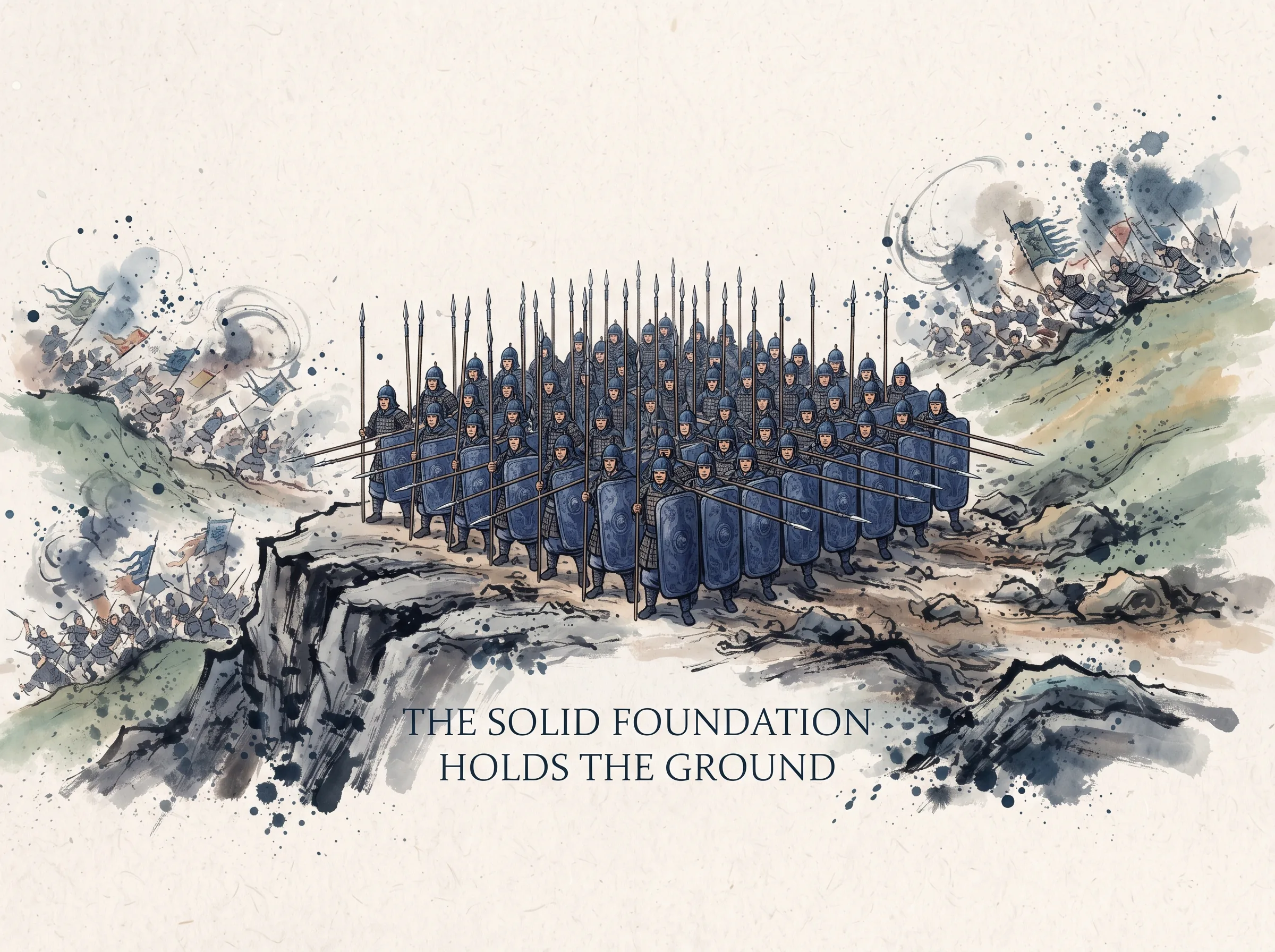
For modern organizations, zhèng means asking difficult questions about what is invisible but essential. How sticky is your customer relationship? How deep is your process maturity? What ecosystem position gives you leverage that cannot be easily replicated? Revenue and headcount are measures of size, not foundation. A true sustaining base is measured by structural advantage—by the ways in which competitors must navigate around you even when they are playing optimally.
The Decisive Strike Within Structure (Qí, 奇)
The second term is the extraordinary or unorthodox move (qí, 奇). It is the sudden, surprising action that catches the opponent off guard, exploits a vulnerability, and changes the trajectory of the competition. This is what people notice and what makes headlines. It is also what gets misunderstood when separated from the sustaining foundation (zhèng, 正).
An extraordinary move is only effective when the opponent's attention, resources, and options are already constrained by the organization's foundation. Think of it as tension in a spring. The stronger and more deliberate the compression, the more powerful the release. Without compression, there is no spring—only a loose coil with no capacity to strike. For the original military treatise and commentary, read the complete strategic translation and classical commentary of The Army on the March: Reading Terrain, Observing Signs, and Psychological Leadership.
Startups that chase viral moments without building retention, platform depth, or ecosystem positioning are attempting the extraordinary (qí, 奇) without the conventional foundation (zhèng, 正). The result is usually a spike followed by a decline. The same pattern appears in larger organizations that launch ambitious initiatives without the operational backbone to sustain them. The launch is impressive. The follow-through is absent.
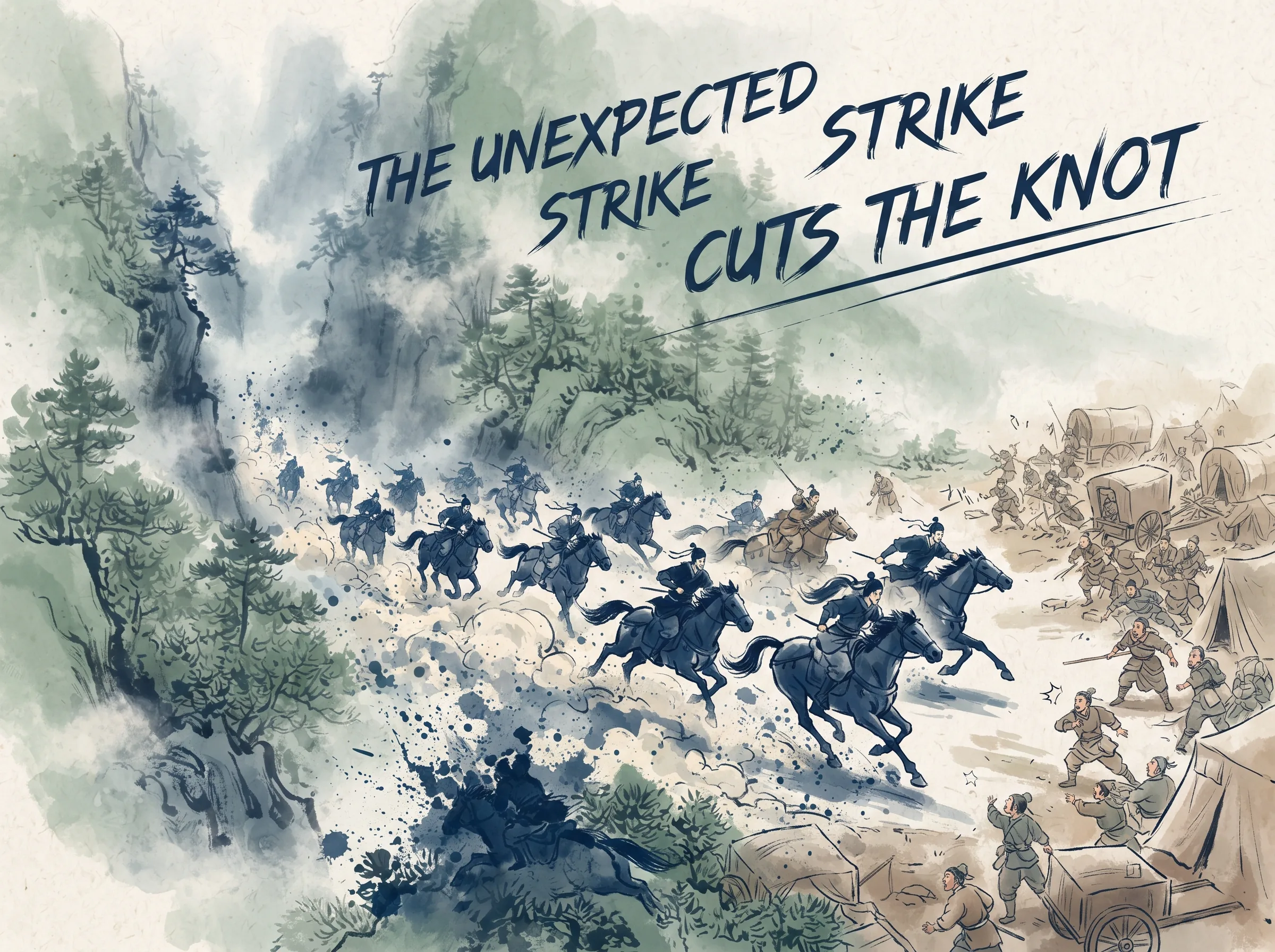
This distinction matters because it changes how leaders evaluate risk. An unrooted breakthrough is gambling disguised as strategy. An extraordinary move embedded in a strong foundation is calculated leverage. The difference is not in the boldness of the move but in the quality of the foundation beneath it.
The Never-Ending Cycle (Qí Zhèng Xiāng Shēng, 奇正相生)
The most important sentence in Sun Tzu's discussion of this topic is not about winning a single battle. It is about perpetual renewal: “the extraordinary and the conventional give rise to each other” (qí zhèng xiāng shēng, 奇正相生), like a circle with no beginning or end [2]. When an extraordinary move succeeds, it is observed, imitated, and eventually absorbed into everyone's new baseline. What was once extraordinary becomes ordinary. The organization that stops there loses ground. The organization that understands the cycle keeps moving.
This is the generative loop at the heart of sustained advantage: the conventional foundation creates the conditions for an extraordinary move; that move succeeds and is copied; the copied breakthrough becomes the new conventional baseline; and the cycle begins again at a higher level. The wheel turns. There is no final destination, only continuous motion.
In Daoist terms, this reflects the principle of perpetual transformation (biànhuà, 变化) that lies at the center of the cosmic order. Nothing is static. Stability is not the absence of change but the ability to manage change systematically. An organization that reaches equilibrium is not mature—it is stagnating.
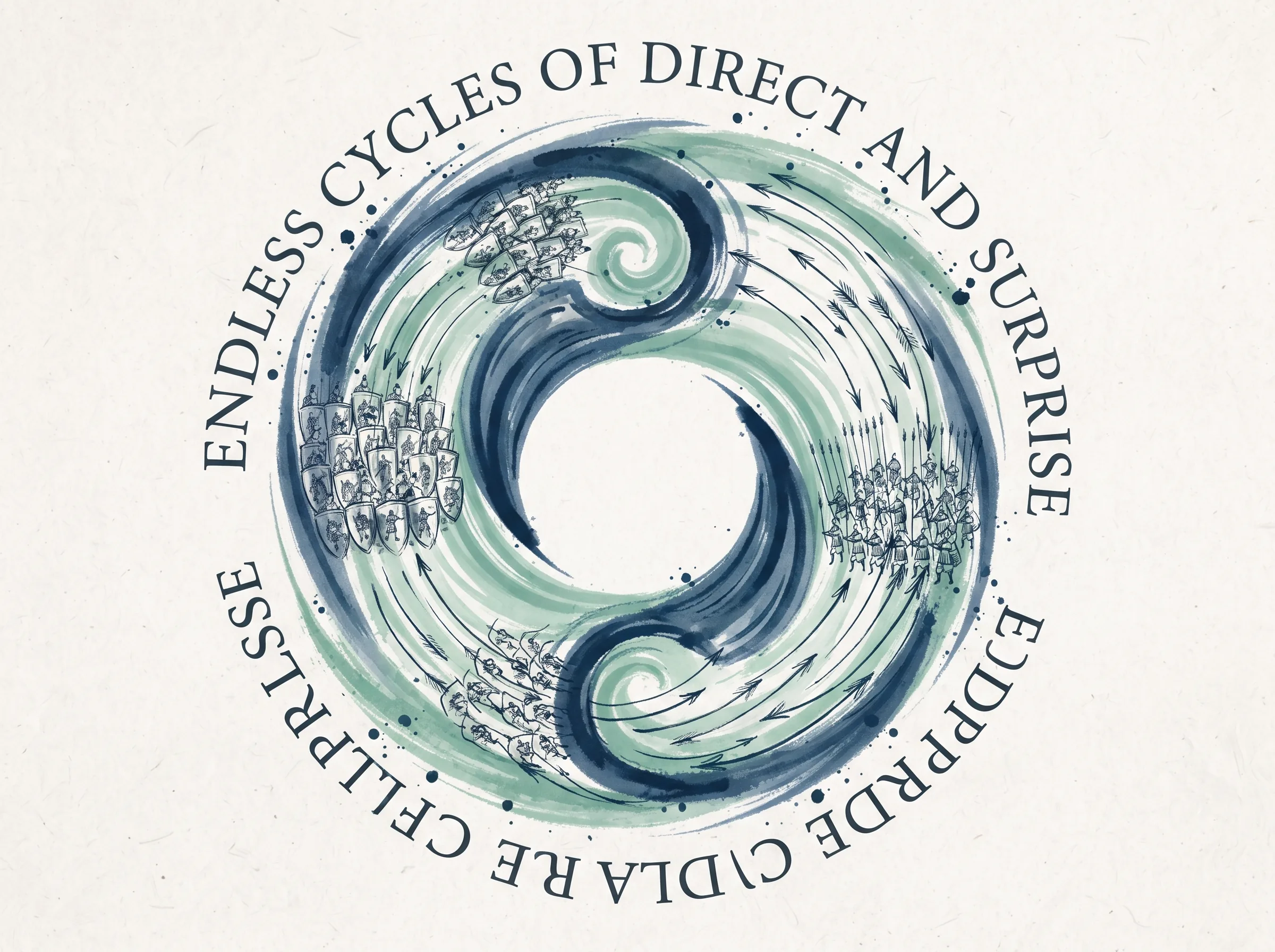
The practical implication is clear. Any strategy built on a single breakthrough is structurally incomplete. The only durable approach is one that treats the cycle itself as the strategy.
A Modern Case: The Pattern Behind the Breakthrough
NVIDIA's rise in AI provides a useful case study for this framework. Many observers describe NVIDIA's dominance as a lucky bet on the right moment—a company that happened to be in the right place when the AI wave arrived. This reading mistakes visibility for causation.
What is visible is the breakthrough. What is invisible to casual observation is the decade-plus accumulation that made the breakthrough possible. NVIDIA released the first version of CUDA in November 2006, creating a software environment that allowed developers to use C as a high-level language for GPU general-purpose computing [3]. This was not a marketing gimmick. It was infrastructure. Over time, it grew into a toolkit containing GPU-accelerated libraries, a compiler, development tools, a runtime, and a vast ecosystem of applications [3]. Thousands of applications and the libraries and frameworks underpinning machine learning and deep learning came to rest on this foundation.
When the AI training and inference surge arrived, NVIDIA was not gambling. The moment revealed an advantage that had been built long before anyone expected it. Developers, researchers, and enterprises were already invested in the CUDA ecosystem. The migration costs were high. The toolchain was mature. The community was large. The extraordinary outcome (qí, 奇)—a dominant position in AI infrastructure—was real. But it emerged from a sustained foundation (zhèng, 正), not in spite of it.
The lesson is not that NVIDIA is destined to stay on top forever. It is that its current advantage can only be understood by looking backward past the visible breakthrough to the patient structural work that preceded it. Any organization admiring NVIDIA's success should ask what sustaining foundation made it possible before trying to replicate the extraordinary result.
Three Questions for Sustained Advantage
The framework translates into a simple self-audit for any organization seeking lasting competitive edge:
Is my sustaining foundation (zhèng, 正) strong enough? Look beyond revenue. Customer stickiness, process depth, ecosystem position, and institutional capability matter more than any single financial metric. Revenue measures output. The foundation measures the structural conditions that make output repeatable.
Is my extraordinary move (qí, 奇) embedded in the foundation, or floating above it? Breakthroughs that cannot be sustained are not breakthroughs—they are distractions. Before celebrating a win, ask whether it has been woven into the organization's deeper architecture or whether it stands alone as an isolated achievement.
Am I cultivating the next cycle before the current breakthrough fades? Waiting until after a success to start the next round of accumulation is too late. The best organizations begin building the next foundation while the current breakthrough is still delivering results.
These questions are not exhaustive. They are diagnostic—meant to surface the structural gaps that strategy documents often smooth over.
Designing Victory Before the Battle
Sun Tzu's central claim throughout the text is that the outcome of competition is designed before conflict begins. This is done through structure, rhythm, resource allocation, and cognitive positioning. It is not about manipulation. It is about systems thinking—aligning your environment so that favorable outcomes emerge naturally rather than being forced into existence through repeated desperate efforts.
This resonates with the Daoist concept of “effortless action” (wúwéi, 无为). It does not mean passivity. Rather, it is the discipline of shaping conditions in advance so that the right actions become the easiest actions. When the foundation is sound, the breakthrough does not need to be invented from scratch each time. It arises from the system itself.
The difference between organizations that sustain advantage and those that do not is rarely a difference in talent, vision, or ambition. It is a difference in how they understand the relationship between foundation and breakthrough. The organizations that last treat the conventional–extraordinary relationship (qí–zhèng, 奇正) not as a choice between stability and innovation, but as a single generative cycle.
FAQ
What exactly do the conventional (zhèng, 正) and the extraordinary (qí, 奇) mean in Sun Tzu's original context? In the military context of The Art of War, the conventional refers to the sustaining formation—the disciplined base that holds the line and constrains the opponent. The extraordinary refers to the unorthodox, decisive strike that exploits openings created by that sustained pressure. Sun Tzu summarizes the relationship as “engage with the conventional; win with the extraordinary” (fán zhàn zhě, yǐ zhèng hé, yǐ qí shèng, 凡战者,以正合,以奇胜). This line has been interpreted across many centuries of commentary, and modern translators render the terms differently [4]. The core idea, however, remains consistent: conventional force establishes the conditions, and unorthodox action delivers the decisive blow.
Is Sun Tzu's framework applicable to business, or is it only about warfare? Sun Tzu's framework describes structural relationships in competition, not tactics specific to ancient battles. Business strategists have applied the conventional–extraordinary model (qí–zhèng, 奇正) to corporate strategy for decades. As noted in scholarly discussions of Sun Tzu translations, many modern books apply his ideas to management and negotiation, though these are interpretations rather than literal translations [4]. The value of the framework lies in its abstraction: it describes how advantage is generated through the interaction of stability and surprise, a pattern that recurs across domains.
Can an organization have too much stability and not enough surprise? Yes. An organization overly focused on the conventional foundation (zhèng, 正) risks becoming rigid, slow, and vulnerable to competitors that introduce novel approaches. Too much stability leads to stagnation; too much unorthodox action (qí, 奇) creates unpredictability without depth—constant innovation that never accumulates into durable advantage. The healthiest organizations maintain tension between the two, using the foundation to create space for breakthroughs and breakthroughs to renew the foundation.
How do I know if my organization's breakthrough is a genuine extraordinary move (qí, 奇) or just a temporary spike? Ask three questions: Can competitors replicate it easily? Does it reinforce your existing structural position? Will it still matter in two to three years if no further investment is made? If the answer to any of these is yes, the breakthrough may be real but insufficiently rooted. If the answer to all three is no, the breakthrough is likely a spike rather than a sustained advantage.
Next Steps
The path from understanding the conventional–extraordinary cycle (qí–zhèng, 奇正) to applying it requires moving from reflection to structure. Start by mapping your organization's sustaining foundation: document what truly supports your competitive position, separate visible metrics from invisible foundations, and identify the gaps. Then evaluate your recent breakthroughs—not by their headline impact but by how deeply they are embedded in that foundation. Finally, begin the next cycle before the current one peaks. The organizations that last are not the ones that win the most battles. They are the ones that keep the wheel turning, reflecting the enduring wisdom of Sun Tzu Chapter 9 Strategy.
To explore these themes from another angle, read our related reflection on When Chaos Works for You: The Chinese Strategy for Thriving in Uncertainty.
Deepen your understanding of these principles in our reflection on Why the Strongest Often Lose First: Sun Tzu’s Hidden Lesson on Resource Curves.
Sources & Further Reading
[1] Kahneman, Daniel – Biographical – NobelPrize.org
[2] *The Art of War — which translation to read — and the text free*
[3] *CUDA Refresher — Getting started with CUDA | NVIDIA Technical Blog*
Further Reading
- The Art of War (Arthur Waldron translation, Norton Critical Editions) — for a widely used scholarly translation with historical context
- Thinking, Fast and Slow by Daniel Kahneman — on the cognitive biases that make organizations prefer quick wins over patient foundation-building
- The Myth of the AI Bubble by various analysts — for contemporary perspectives on NVIDIA's ecosystem positioning






