

It is tempting to believe that a series of correct decisions must lead to a correct outcome. If each choice is sound, if each step is well-reasoned, then the path itself should be reliable. Yet history, business, and personal life are full of people and organizations that made every decision look right — and arrived somewhere disastrous. The problem is rarely that someone made a wrong call. The problem is often that someone made the right call for the wrong structure.
This is one of the most quiet and dangerous traps in strategy. You can optimize every local decision and still lose the war. The ancient Chinese strategist Sun Tzu understood this over two thousand years ago. His teaching in The Art of War was never simply about winning engagements. It was about ensuring that every engagement served a larger design. The same insight was rediscovered independently, in different language, by Western military theorists and, more recently, by the mathematics of optimization and systems science. The lesson is practical: local correctness does not guarantee global success, and understanding why is the first step toward building strategies that endure—a foundational perspective explored in Sun Tzu Chapter 8 Strategy.
Sun Tzu Chapter 8 Strategy: The Mathematics of the Trap
A common intuition about decision-making is that if you always choose the best available option, you will eventually reach the best possible outcome. Mathematically, this intuition describes what is called a greedy algorithm — an approach that selects the most favorable immediate option at every step without considering what lies further ahead. The method is elegant and easy to explain. It is also frequently wrong.
Greedy algorithms work perfectly in simple problems. But most real-world problems do not have that property. Many problems are multi-peak: the landscape of possible outcomes contains many hills, and the tallest hill may sit behind a valley that any uphill-only strategy will refuse to cross.
Imagine a hiker who wants to reach the highest peak on a range. If the hiker always steps upward, they will quickly reach the top of the nearest hill. From there, every remaining direction leads downhill. A purely local optimizer stops — unaware that the true summit is reachable only by first descending into a valley and climbing again. The hiker did nothing wrong at any individual step. The hiker simply optimized the wrong objective.
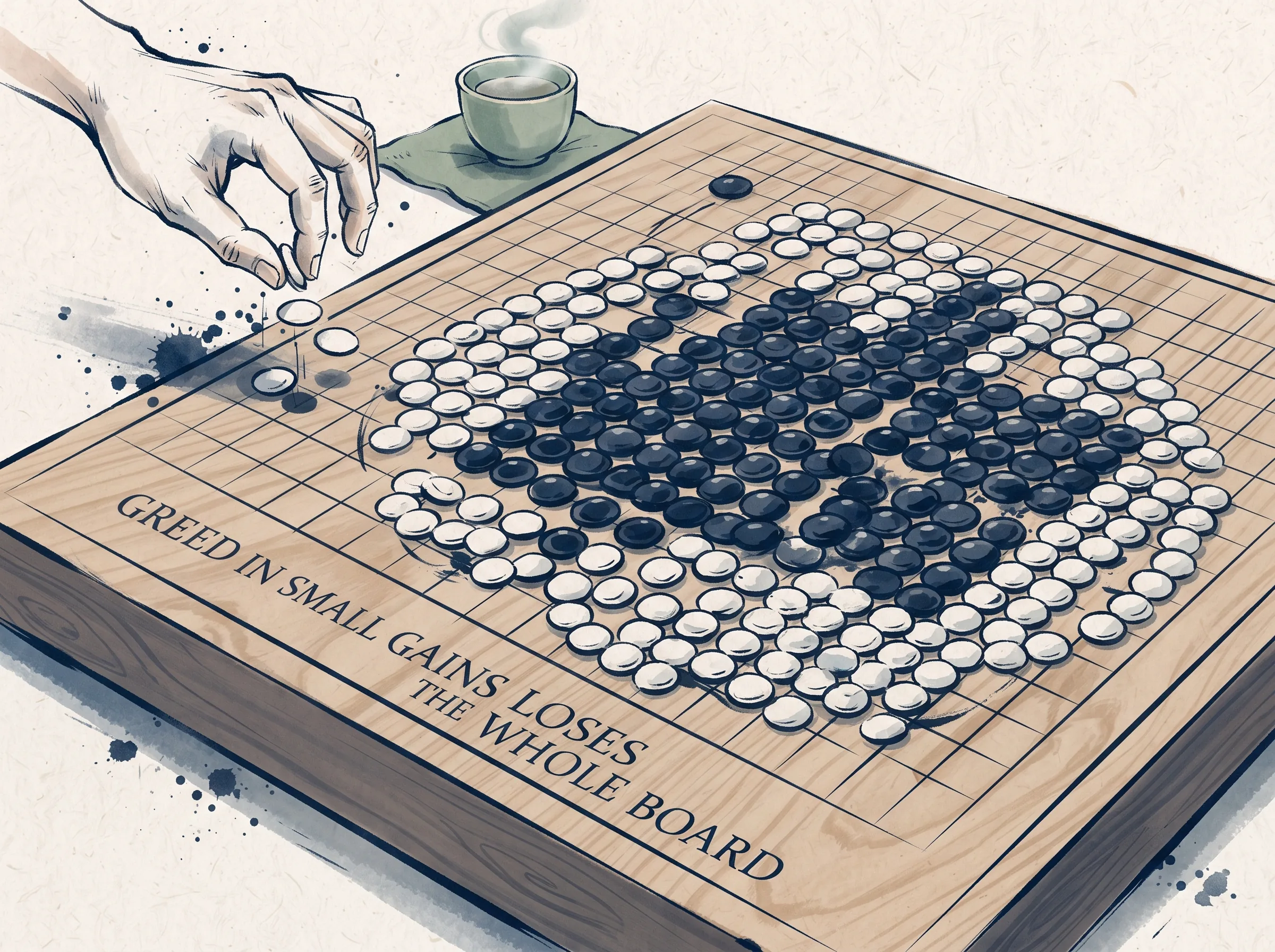
This is not a metaphor for laziness or poor judgment. It is a structural feature of complex systems. Local optimization solves the problem in front of you. It does not solve the problem of the system you are in.
In organizational terms, this looks like a department that consistently hits its targets while the company drifts. In personal terms, it looks like someone who builds an impeccable routine, clears every inbox, and maximizes productivity — yet feels increasingly adrift from what matters. The individual moves are correct. The overall direction is not.
Sun Tzu's Answer: Let the Local Serve the Whole
Sun Tzu's Art of War is often read as a manual for tactics. Those readings are not mistaken. But they miss the deeper architecture of the text: Sun Tzu is equally concerned with structure — with the relationship between individual actions and the overall shape of a conflict.
One of the most quoted passages reads: "The shape of water is to avoid the high and hasten to the low; the shape of war is to avoid what is solid and attack what is vacant" (as Sun Tzu famously formulated: bīng xíng xiàng shuǐ… bì shí ér jī xū, 兵形象水,水之形避高而趋下,兵之形避实而击虚). It appears in the chapter usually translated as “Weak Points and Strong,” or “Empty and Full” (Xūshí, 虚实), which examines strength and weakness across the entire field of conflict [The Art of War, Sun Tzu Chapter 8 Strategy, “Weak Points and Strong” (《孙子兵法·虚实篇》)].
Most readers stop at the tactical takeaway: do not attack strength; attack weakness. The deeper reading requires noticing that Sun Tzu frames the advice with the image of water. Water is described in relation to terrain, slope, obstruction, and destination. It flows downward because of the landscape around it, not because down is inherently valuable.
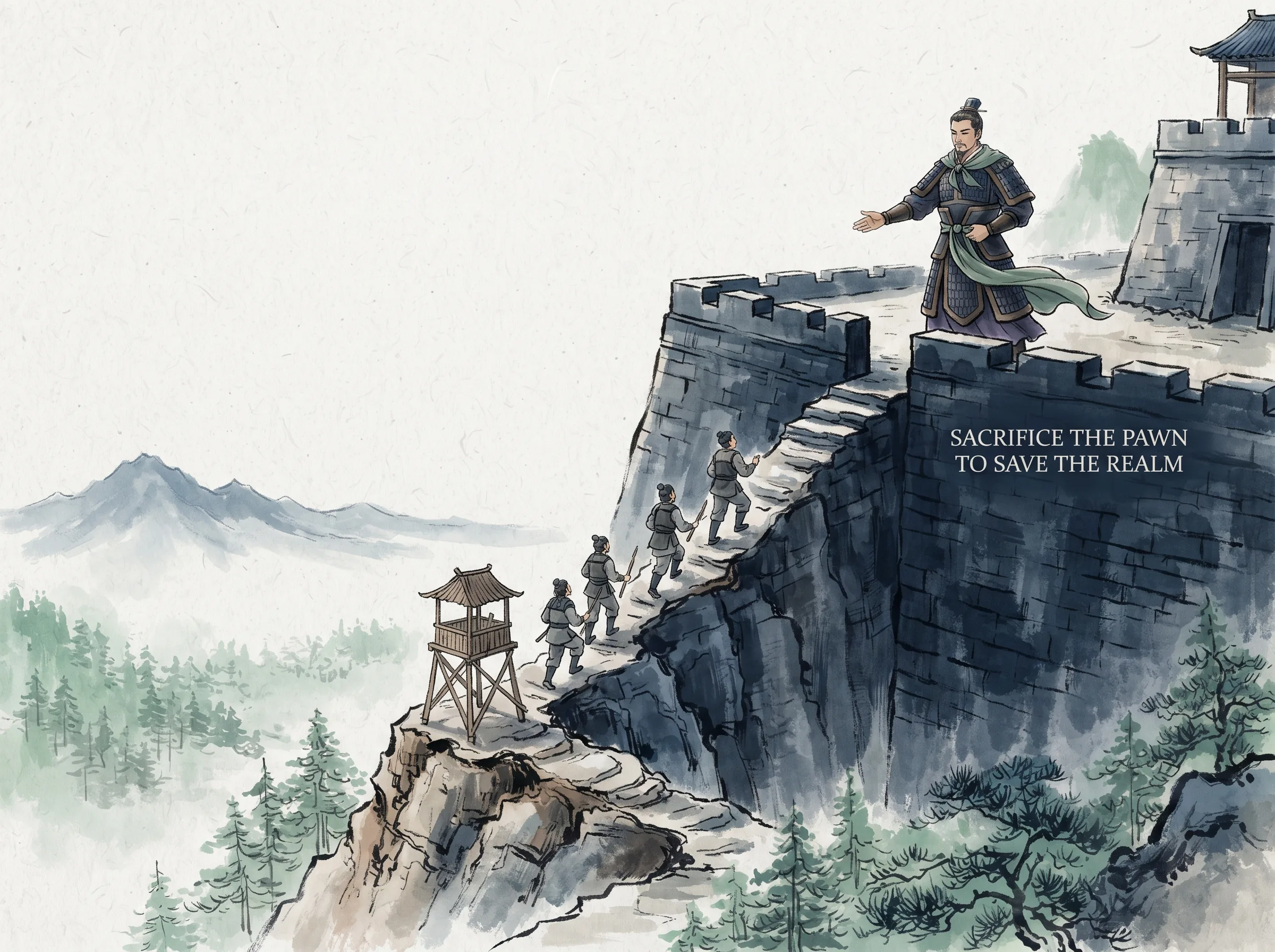
The local move — attacking the vacant, avoiding the solid — only makes sense within a coherent understanding of the whole situation. Taken in isolation, "attack weakness" can become a recipe for chasing every easy target, winning every skirmish, and exhausting yourself. The choice of where to apply force must be determined by strategic potential or momentum (shì, 势): the advantage generated by positioning, timing, morale, terrain, and the opponent's disposition.
In modern language, strategic potential (shì, 势) is close to what systems thinkers call the structure of incentives and constraints in a given context. A move that looks optimal in one structure may be disastrous in another. The wise strategist does not ask, "What is the best move right now?" but "What move serves the shape of the whole?"
This is why Sun Tzu repeatedly warns against fixation on individual battles. Victory belongs to those who understand the relationship between the part and the whole — who know when to fight, when not to fight, and when to let the enemy's own momentum defeat it.
What Clausewitz Confirmed Two Millennia Later
Western strategic thought arrived at a parallel conclusion through a different path. Carl von Clausewitz developed the concept of center of gravity (German: Schwerpunkt). In On War, he describes it as "a centre of power and movement, on which everything depends" . Strategy must identify the enemy's center of gravity and concentrate force against it. For the original military treatise and commentary, read the complete strategic translation and classical commentary of Variation of Tactics: Contextual Flexibility and the Five Fatal Flaws of Leadership.
The center of gravity is not always the same thing. It may reside in an army, a capital city, an alliance, or the shared interests holding a coalition together. The point is structural: every conflict has some key node or relationship that, if disrupted, causes the rest of the system to loosen or collapse.
A commander can win battle after battle and still lose the war if those victories are aimed at the wrong targets. Each battle reinforces the local logic ("we are succeeding"), while the actual center of gravity goes unchallenged.
The Russian campaign of 1812 offers a stark illustration. After heavy losses at Borodino, the Russian army continued its retreat. Many expected it to defend Moscow at all costs. From a local perspective, holding the capital would demonstrate resolve, boost morale, and deny the enemy a prize.
Instead, General Mikhail Kutuzov ordered Moscow abandoned. The center of gravity of the Russian war effort was not Moscow but the Russian army itself. As long as the army remained intact, Russia could continue to fight. If it were destroyed defending the capital, the war would end regardless of who held the city.
Napoleon entered a largely evacuated city that was then set ablaze. Moscow offered no supplies, shelter, or political settlement. Stretched across long supply lines and exposed to winter, the French army began to disintegrate. Kutuzov accepted a locally painful loss to protect the structural core of the war effort. A victory that weakens the system's backbone is not a victory at all.
Modern Echoes: When Local Optimization Devours the System
The pattern repeats wherever complex systems operate. Business is one of the clearest arenas.
Consider Nokia, once dominant in mobile telecommunications. For much of the 2000s, its leadership made individually defensible decisions: improving Symbian, refining devices, expanding distribution, and answering threats with incremental upgrades and cost adjustments. None was obviously wrong.
Yet the industry was shifting from hardware and standalone software toward integrated ecosystems combining devices, operating systems, app stores, developers, and services. Apple and Google built ecosystems. Nokia continued to optimize a product line . Each step was internally rational. Together, they compounded a strategic error: investing in the architecture of the past while the architecture of the future emerged elsewhere.
Organizations rarely fail because they lacked talent, discipline, or effort. They fail because their optimization machinery became too effective at improving what was already there. Local excellence masks structural obsolescence.
The same dynamic appears in personal life. A person may perfect a morning routine, maximize daily productivity, and check every professional box — only to discover that none of it adds up to a life they recognize. This is not a failure of work ethic. It is a failure of structural vision.
In a coupled system, an improvement in one place transmits pressure, cost, and consequence elsewhere. You may increase efficiency in one department while creating bottlenecks in another; win a negotiation while eroding trust; or accumulate wealth while exhausting the relationships that give wealth meaning.
The costs are rarely visible at the point of action. They appear downstream, in places the optimizer never intended to touch. By the time they become apparent, correction may require more disruption than anyone is willing to accept.
Three Practices from the Classical Mind
1. Mark Your Sacrifice Zones
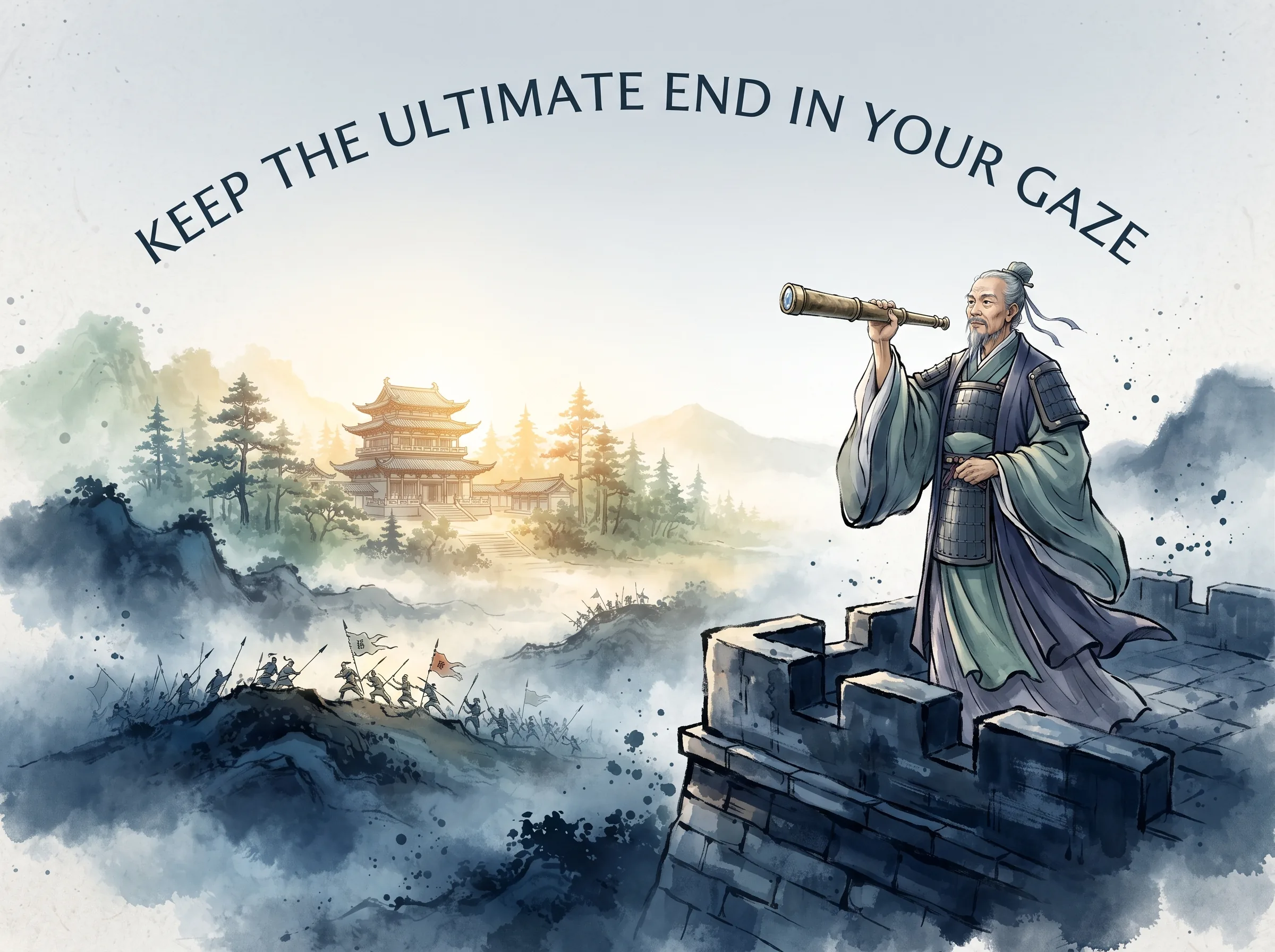
Not everything worth noticing deserves preservation. A system that tries to optimize every node simultaneously will either stall or distort itself. A mature design deliberately marks out areas where inefficiency—or even temporary failure—can be tolerated (deliberate tolerance of localized sub-optimality: 成熟的设计会有意识地划定可以承受低效率甚至暂时失败的区域). Systems engineers sometimes describe these as sacrifice zones.
In Sun Tzu's framework, this is knowing what not to defend. In Clausewitz's, it is concentrating force on the center of gravity while accepting vulnerability elsewhere. The practical question is not "What should I save?" but "What is the backbone of my system, and what can I release without collapsing it?"
2. Train System Sensitivity
Before committing to a move, ask not only "Is this the right decision?" but "Where does the pressure from this decision travel?"
Training system sensitivity means mapping second- and third-order consequences before acting. Before approving a project, launching a product, or making a career move, write down three ways the decision could create hidden costs elsewhere. Its value lies in interrupting the assumption that a locally good move is globally harmless.
3. Introduce Controlled Randomness
Local optimization tends to tighten structures until they become fragile. Every redundant path is eliminated and every uncertain option narrowed. The system becomes efficient — and brittle.
Sometimes the best response is not a smarter decision within the current framework but a deliberate loosening of the framework itself. Exploring an adjacent field, partnering with an unfamiliar organization, or funding an uncertain experiment can create pathways that pure optimization would never discover.
This is not recklessness but structural variety. In evolutionary biology, genetic diversity allows populations to adapt when conditions change. In strategy, optionality plays a similar role. A plan that leaves room for unexpected directions is often more resilient than one that maximizes a single projected outcome.
Closing Reflection
Winning every engagement does not equal winning the structure. This is the lesson Sun Tzu taught, Clausewitz restated, and the mathematics of optimization confirms. The greedy algorithm is powerful in the right domain. But in complex, multi-peaked, deeply coupled systems, it is also a reliable path to local success and global failure.
Sun Tzu's real teaching is not how to fight beautifully. It is how to ensure that every fight serves the whole. He asks us to see beyond the next decision to the shape of the entire game, identify what truly matters — the center of gravity, the backbone, the strategic potential (shì, 势) — and orient every local choice around it.
The practical takeaway is simple but demanding: stop asking only whether your next move is correct. Start asking whether it is useful to the system you are trying to build, not just to the problem you are trying to solve. That shift is where strategy begins.
FAQ
Is local optimization always wrong?
No. In simple, single-peak problems, local optimization works well. The danger arises in complex, multi-dimensional situations where the best overall outcome requires accepting short-term losses, changing direction, or ignoring attractive but misleading local signals.
Does Sun Tzu advise against fighting?
Not exactly. He advises against fighting indiscriminately. Sometimes the strongest move is not to fight at all, or to fight somewhere other than where the enemy expects. The point is to serve the whole, not accumulate isolated wins.
How do I know what my "center of gravity" is?
Ask what, if destroyed or neutralized, would cause the entire system to lose its coherence or ability to continue. That is likely close to the center of gravity.
Can I use these ideas in personal life?
Yes. The same logic applies to career decisions, relationships, health, and learning. The question "Does this serve the whole?" is as relevant to personal life as to organizational strategy.
To explore these themes from another angle, read our related reflection on How Sun Tzu’s ‘Empty and Full’ Teaches You to Make Opponents Waste Their Strength.
For a deeper comparative examination of these ideas, explore our related study on Why You Keep Feeling Certain About Decisions (While Walking Into Mistakes).
Sources & Further Reading
[1] greedy algorithm — NIST Dictionary of Algorithms and Data Structures.
[2] Carl von Clausewitz: ON WAR. Book 8, Chapter 4 — Translated by J. J. Graham (1873).
[3] KUTUZOV, Mikhail Illarionovich Golenishchev — Napoleon.org biographical entry.
[4] The Art of War, Chapter 6 — “Weak Points and Strong”** (《孙子兵法·虚实篇》) — Also translated as “Empty and Full” (Xūshí, 虚实).
Further Reading
- Sun Tzu, The Art of War — Translations by Samuel B. Griffith, Ralph D. Sawyer, or Thomas Cleary.
- Carl von Clausewitz, On War (Vom Kriege) — Book VIII, particularly Chapters 3–4.
- Daniel Kahneman, Thinking, Fast and Slow.
- Donella Meadows, Thinking in Systems: A Primer.






