
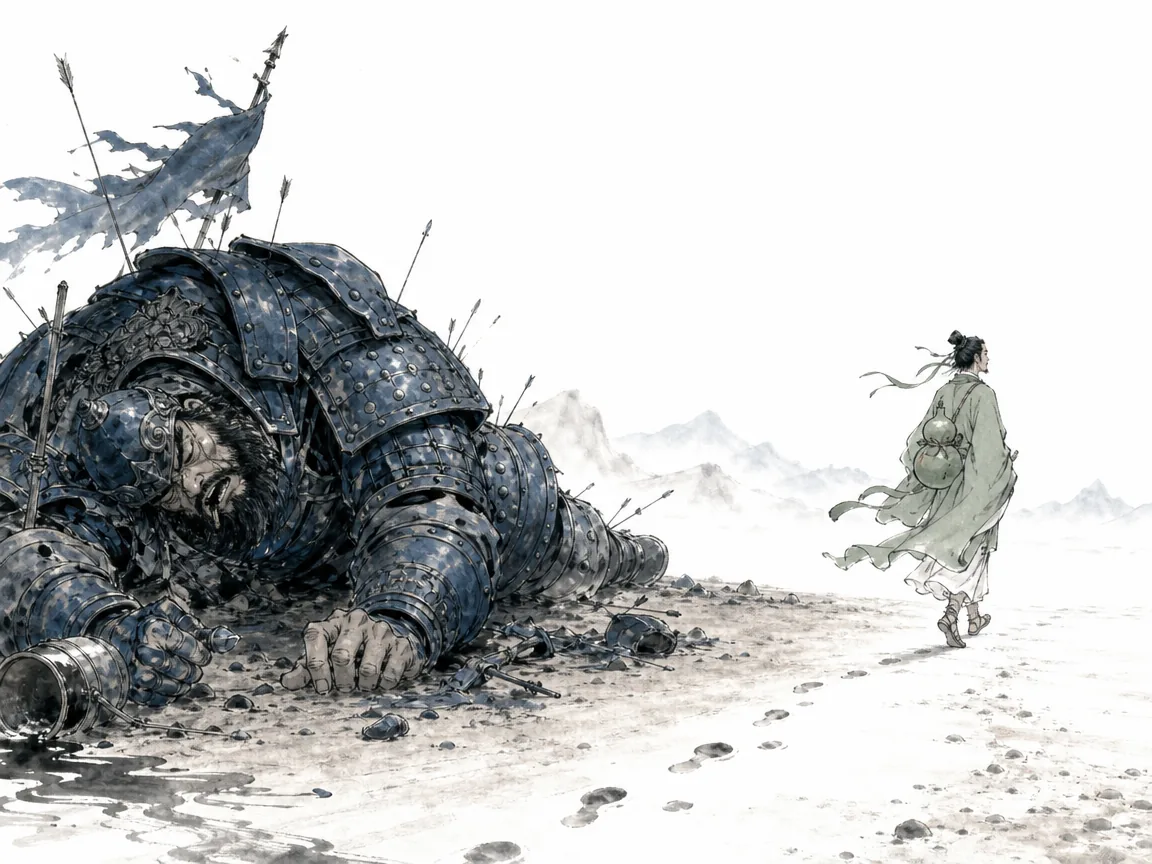
Most of us enter competition expecting that brilliance will decide the outcome. We picture the sharpest strategist, the boldest move, the moment when one side's talent overwhelms the other. It is a compelling story — and it is almost certainly wrong. Sun Tzu's second chapter, known in Lionel Giles's translation as Waging War [1]/Waging_War), flips that expectation on its head. What he describes, across two thousand years, is a much quieter and far more realistic truth: victory belongs not to the side with the highest peak, but to the system whose resources decay the slowest.
This insight is not abstract philosophy. It shows up wherever competition stretches over time — in business, in organizations, in personal life. The startup that raises the most capital does not necessarily survive. The athlete who trains hardest without recovery does not necessarily win. The person who pushes through every obstacle at full intensity is often the first to burn out. Sun Tzu understood long before modern management theory that the question is not "how do I win this battle?" but "can my system survive this war?" This principle is central to Sun Tzu Strategy.
Sun Tzu Strategy: Who Really Wins?
It is natural to focus on moments of brilliance. A breakthrough product, a decisive negotiation, a charismatic leader who rallies the team. These things are visible and dramatic, and they reward our instinct for hero narratives. But Sun Tzu warns us that this focus can blind us to what actually determines outcomes over time.
In Waging War, he argues that duration and cost structure matter more than any single brilliant action. The chapter opens not with tactics but with logistics — the grinding, unglamorous reality of sustaining any prolonged effort. His point is stark: prolonged conflict benefits no state [1]/Waging_War). This is not a counsel of pacifism. It is a recognition that time is never neutral. Every day a competition drags on, hidden costs accumulate — friction, fatigue, organizational decay, diminishing returns on overextension. Short-term rational decisions become long-term fatal ones when stretched across time.
The modern parallel is everywhere. Companies that optimize for quarterly margins while neglecting operational resilience. Individuals who treat rest as a weakness rather than a structural necessity. In each case, the error is the same: confusing a strong start with a sustainable system.
Time Is Never Neutral
The most important sentence in this chapter, in Giles's rendering, is perhaps the simplest: "There is no instance of a country having benefited from prolonged warfare" [1]/Waging_War). Sun Tzu is not saying war is always bad. He is saying that duration itself is a force multiplier for every existing problem.
When conflict is prolonged, weapons grow dull and ardor is damped [1]/Waging_War). Strength is exhausted. Treasure is spent. The state cannot equal the strain. What looks like a manageable cost in month one becomes catastrophic by month twelve, not because the initial assessment was wrong, but because time amplifies every hidden variable.
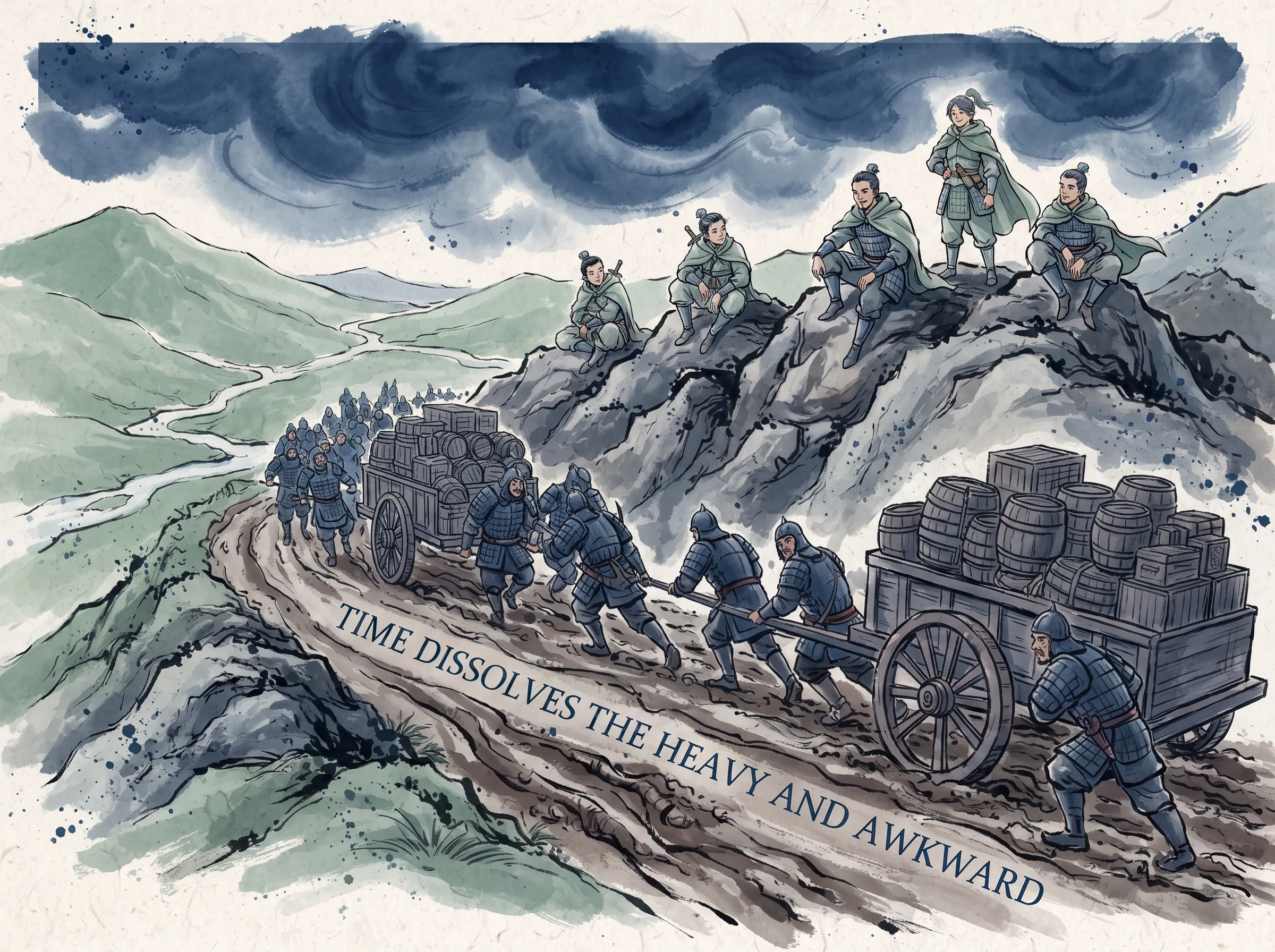
This is why the question of endurance matters more than the question of intensity. A system that can sustain moderate pressure for a long time will often defeat a system that peaks higher but collapses sooner. The difference is not intelligence or courage — it is the shape of the resource curve over time, reflecting the enduring wisdom of Sun Tzu Strategy.
To explore these themes from another angle, read our related reflection on Why You’re Stronger on Some Paths Than Others: Sun Tzu’s Friction Framework for Modern Life.
For a deeper comparative examination of these ideas, explore our related study on Why Knowing What to Do Isn’t Enough: Sun Tzu’s Hidden Lesson on Adaptation.
Resources Are Curves, Not Numbers
We tend to think of resources as static quantities: how much capital do we have? How many people are on the team? How much inventory is in the warehouse? Sun Tzu pushes us to think dynamically. True resource health is defined by three variables working together: the rate of consumption, the rhythm of replenishment, and the system's load capacity.
A resource curve that looks healthy can fracture suddenly. The danger is not gradual depletion but structural imbalance that tips the system past its breaking point. In the months before a collapse, everything may appear functional on the surface. Processes run. People show up. The numbers look acceptable. But underneath, tension, friction, and overextension have accumulated to a critical threshold. Once that threshold is crossed, decline accelerates rapidly.
Amazon's early choices illustrate this principle in the commercial world. In 1997, the company expanded its distribution center capacity from 50,000 to 285,000 square feet and opened a second distribution center in Delaware [2]. At the time, this looked expensive and unglamorous — exactly the kind of investment that makes short-term financial metrics look worse. But Amazon's leadership framed it differently: sustained investment in systems and infrastructure was necessary to support customer convenience, selection, and service as the company grew [2]. The resource curve was being shaped deliberately, not optimized for the quarter but engineered for the decade.
Turning the Enemy's Strength Against Them
Sun Tzu introduces a concept that goes beyond simple conservation of resources: forage on the enemy [1]/Waging_War). In his framing, a wise general makes a point of drawing supplies from the opponent. One cartload of the enemy's provisions is equivalent to twenty of one's own [1]/Waging_War). For the original military treatise and commentary, read the complete strategic translation and classical commentary of Energy and Momentum: The Dynamic Interplay of Direct and Indirect Maneuver.
Read literally, this sounds like plunder. Read structurally, it is something far more sophisticated. The principle asks: can each action you take simultaneously weaken the adversary and strengthen your own position? The highest form of competitive design is not to out-spend your opponent in a race to the bottom, but to create a system where your opponent's own effort becomes a source of your advantage.
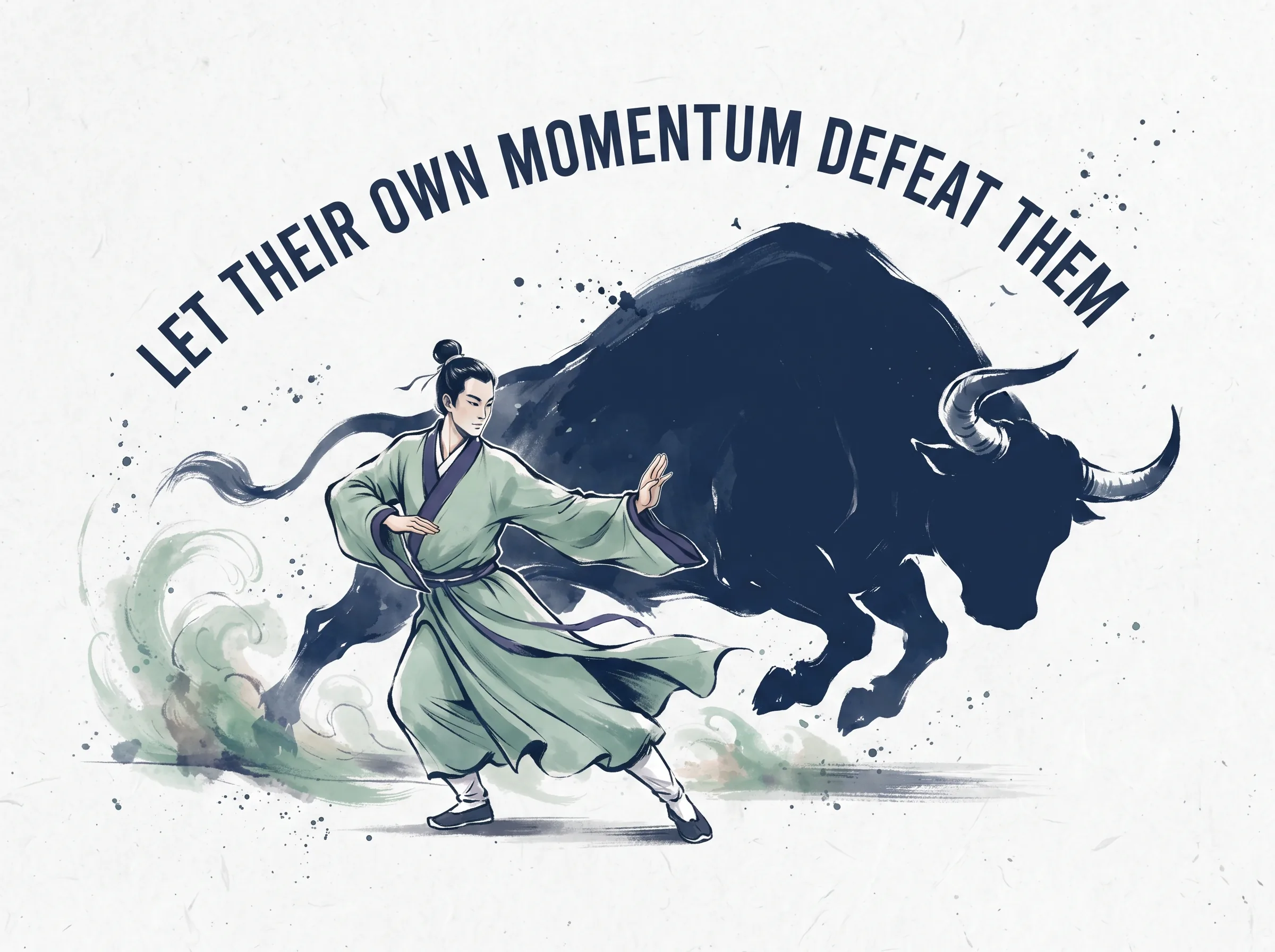
In business, this appears in platform models that make competition itself expensive for rivals. In open-source ecosystems, it appears when contributing code strengthens the commons that everyone depends on. The key insight is that the goal is not to win by having more of everything — it is to win by designing a structure where the competition works against the opponent's long-term sustainability.
The Case for Redundancy
Redundancy is often misunderstood as waste. In a calm environment, spare capacity looks like inefficiency. Backup systems look like unnecessary cost. Extra inventory looks like poor planning. But in conditions of sustained pressure, redundancy is not a luxury — it is survival infrastructure.
At the Tehran Conference in 1943, Joseph Stalin spoke about the importance of "the machine" in the war and expressed admiration for American productive capacity, noting that the United States would soon be producing ten thousand planes every month [3]. His emphasis was on sustained output, not heroic gestures. When conflict extends over years, the question is not who has the most inspiring leader on a given day, but who can keep producing, repairing, and supplying under continuous strain.
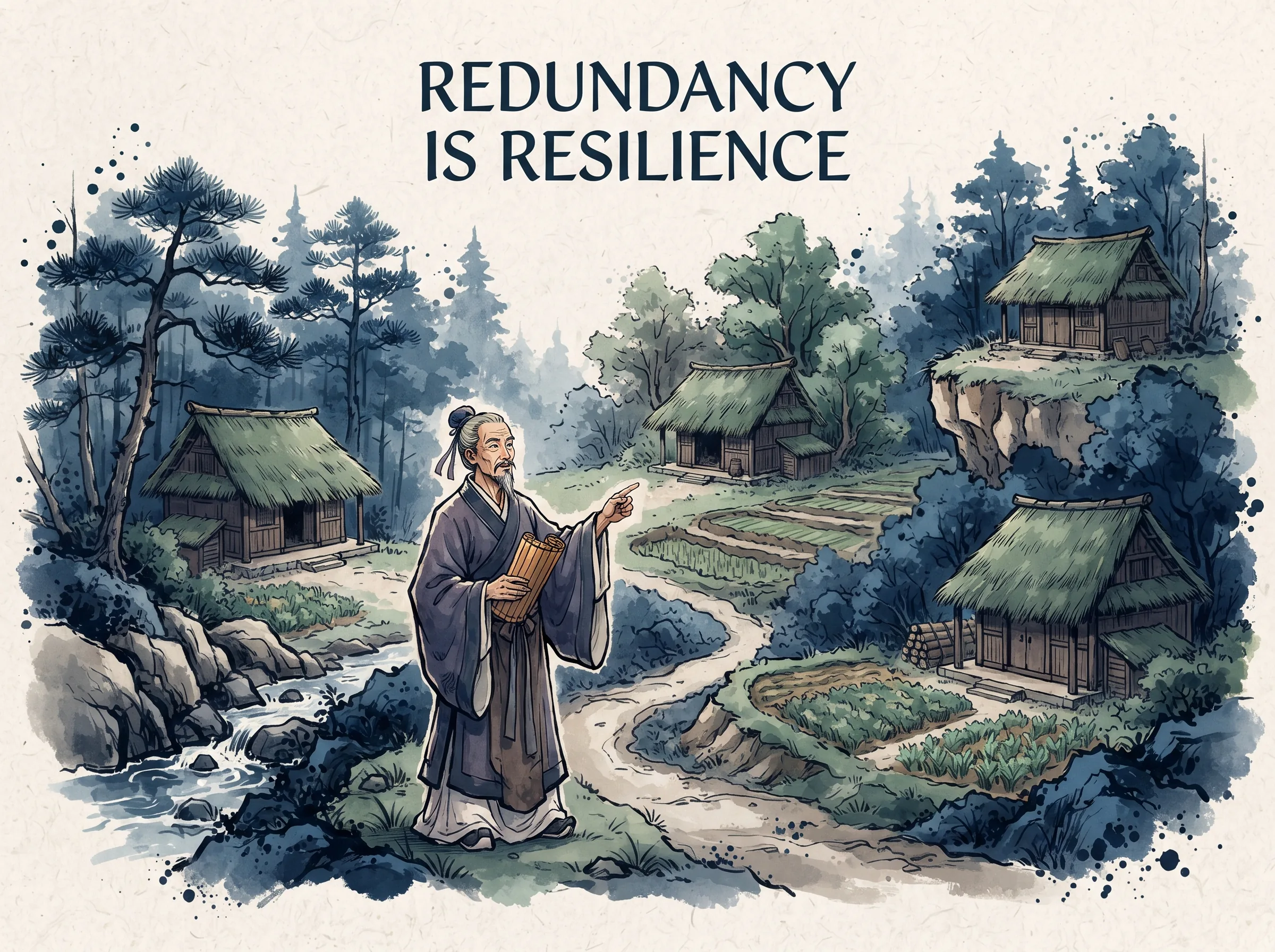
Sun Tzu's broader philosophy consistently favors structures that absorb shock over strategies that gamble on perfect conditions. A system with slack — spare capacity, alternative supply routes, reserves of energy and attention — can endure disruptions that would break a system running at maximum efficiency. The trade-off is real: redundancy costs more in normal times. But the cost of zero redundancy in crisis times is far higher.
From Heroism to Engineering
The dominant cultural model of competition is hero-dependent: win through individual brilliance, decisive moments, inspired leadership. Sun Tzu offers a different model: system engineering. Win by designing a structure that does not stall, run out, or break under time.
This shift in worldview is subtle but profound. The hero model asks, "How do I win this battle?" The engineering model asks, "Can my system survive this war?" The latter is not pessimism. It is what Chidestiny would call the deepest realism — a clear-eyed view of what actually determines outcomes when time, friction, and uncertainty are given their full weight.
The implication for anyone engaged in long-term competition — whether in business, creative work, or personal development — is practical. Before asking how to win, ask: what kind of system am I building? Does it conserve resources intelligently? Does it replenish what it consumes? Does it have enough structure to endure friction without fracturing? Can it turn the opponent's energy against them rather than meeting force with equal force?
These are not flashy questions. They are the questions that separate systems that collapse from systems that endure.
Practical Guidance
If you want to apply these principles, start with diagnostics before tactics. The following steps are oriented toward building structural endurance rather than chasing decisive moments.
Map your resource curve. Identify not just how much you have, but how fast you consume, how regularly you replenish, and what your system can actually bear. A spreadsheet of assets is useful; a timeline of consumption and recovery is essential.
Question your dependence on peaks. If your success requires repeated high-intensity sprints with no recovery built in, you are building on a fragile curve. Introduce deliberate downtime, backup plans, and lower-friction routines for sustaining effort over time.
Design for friction, not just flow. Assume that delays, disruptions, and unexpected costs will occur. Build margins into schedules, budgets, and energy levels. Redundancy is not wasted — it is insurance against the moments when everything else fails.
Seek actions that compound your position while draining your opponent's resources (strengthen oneself while depleting the rival: 壮大己方,同时消耗对方). Before committing to a competitive move, ask: does this strengthen my structure, or does it merely win a point? The former builds endurance. The latter burns it.
Frequently Asked Questions
Is Sun Tzu saying we should avoid competition altogether? No. Sun Tzu is not advocating pacifism. He is arguing that when competition is necessary, the smartest approach is one that minimizes duration and cost while maximizing structural endurance. The goal is not to avoid conflict but to win it efficiently and sustainably.
Does this mean we should never take bold risks or make ambitious investments? Not at all. The chapter does not argue against investment or ambition. It argues against investing in ways that degrade the system's long-term capacity. Amazon's 1997 infrastructure expansion [2] was itself a bold investment — but it was designed to build endurance, not to finance a short-term spectacle. The distinction lies in what kind of curve you are shaping.
How does this apply to personal life, not just business or warfare? The same principle operates anywhere effort is sustained over time. Personal burnout often follows the same pattern as organizational collapse: a curve that looks stable until it isn't. Recovery, redundancy in energy and attention, and structures that do not depend on constant peak performance are all applications of the same logic.
Is this approach too conservative? Shouldn't we sometimes go all-in? "All-in" strategies can work in specific, time-limited contexts where speed is itself a structural advantage. Sun Tzu's point is that such strategies carry enormous risk when prolonged. The question is not whether bold moves ever make sense, but whether your overall system can absorb the cost when those moves do not produce immediate results.
Conclusion
Sun Tzu's Waging War does not give us a manual for winning quick victories. It gives us something rarer: a framework for understanding why the strongest-looking competitors often fall first, and how to build systems that do not share that fate. The insight is simple but demands discipline: victory belongs to the side whose resource curve decays the slowest, not the one whose peak is highest.
For anyone navigating long-term competition — in business, in creative work, or in personal pursuits — the practical takeaway is to shift attention from intensity to structure. Design systems that consume wisely, replenish steadily, and absorb shock without fracturing. The goal is not to look impressive in any single moment, but to remain viable across all of them.
If you want to explore this thread further, consider reading Sun Tzu's second chapter in a complete translation and reflecting on what "foraging on the enemy" might mean in your own context. The deeper you go, the more the chapter reveals itself not as an ancient military text, but as a living guide to competitive endurance.
Sources & Further Reading
[1] The Art of War (Giles)/Waging War – Wikisource, the free online library — /Waging_War) — Lionel Giles's translation of Sun Tzu's Chapter 2, including key passages on prolonged warfare and foraging on the enemy.
[2] 2018 Letter to Shareholders — Amazon's 1997 shareholder communication documenting infrastructure expansion and the philosophy of sustained investment.
[3] Historical Documents – Office of the Historian — U.S. State Department record of the 1943 Tehran Conference, including Stalin's remarks on the importance of industrial production in warfare.
Further Reading
- Sun Tzu, The Art of War, Chapter 2 — additional translations by Ralph Sawyer and others offer useful comparative perspectives on key passages.
- Nassim Nicholas Taleb, Antifragile: Things That Gain from Disorder — explores the distinction between robust systems and those that improve under stress, relevant to the discussion of resource curves and redundancy.






