
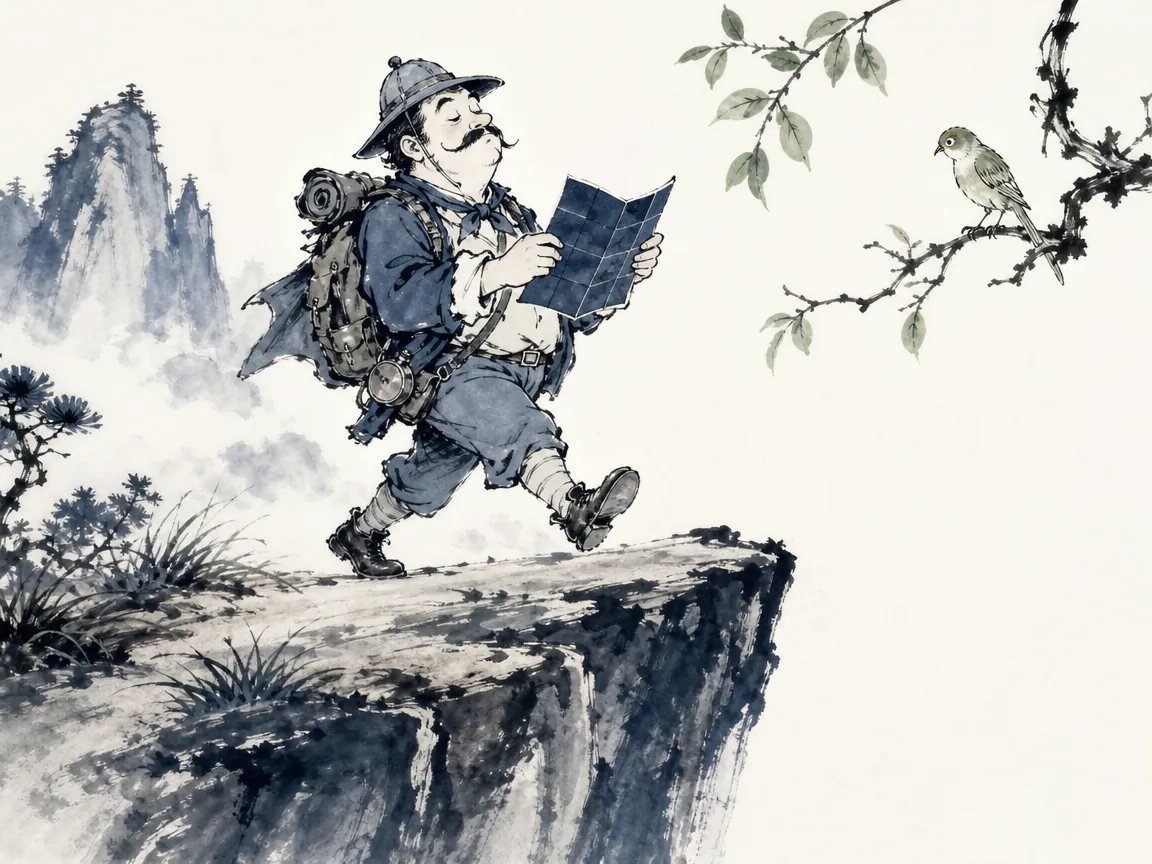
The most dangerous moment in any important decision is not when you feel lost—it is when you suddenly feel like you finally understand what is going on. You have connected the dots, told yourself a coherent story, and something in your mind clicks into place. The feeling is warm. It is reassuring. And it is often the exact moment before a mistake happens.
We routinely collapse three different things in our heads. We confuse explanation with understanding, and understanding with control. You can explain why a market moved upward last quarter without being able to predict when it will turn. You can reconstruct the chain of events in a failed partnership without having been able to stop it. Explanation sorts the past; control reaches into the future. They are not the same, yet our brains link them automatically—a foundational perspective explored in Sun Tzu Chapter 4 Strategy.
This is not a moral failing or a simple lack of preparation. It is a structural feature of how human cognition works. The ancient Chinese strategic tradition and modern psychology, separated by millennia, converge on the same warning: the greatest risk in any decision is not uncertainty itself but the false certainty we build on top of incomplete information. The question this essay explores is not how to eliminate doubt, but how to stay flexible when certainty feels tempting.
Sun Tzu Chapter 4 Strategy: The Gap Between Explanation and Control
Daniel Kahneman devoted decades to studying how people judge under uncertainty, and one of his most precise observations concerns what he called the illusion of validity [1]. When we construct a plausible narrative explaining recent events, we gain a vivid sense of insight—a feeling that we see clearly what is happening. Kahneman noted that this felt experience has little connection to actual predictive accuracy, especially when predictions are based on limited data [1]. The more compelling the story, the more we trust it, even though the evidence may be thin.
Consider a manager who can give a confident, detailed explanation for why a product launch succeeded. She cites timing, team chemistry, and market conditions. The story hangs together beautifully. Yet that same manager may struggle to predict whether the next launch will succeed, because the explanatory story and the predictive capacity operate on different levels. The past can always be made to look coherent after the fact; the future does not obligate us with the same courtesy.
This gap is not new. Long before Kahneman named it, Chinese strategic thinkers observed that clarity about what has happened does not grant mastery over what will happen. The danger lies in the automatic mental leap: I can explain it → I understand it → I can control it. The leap feels natural because the brain prefers coherence over caution. But in complex systems, coherence is cheap. Accuracy is expensive.
What Overconfidence Actually Is (And Why It Feels Like Insight)
Kahneman described overconfidence not as arrogance or bad character but as a structural cognitive bias—a predictable pattern built into how we process information once an explanation takes hold [1]. When the mind settles on a working story, it tends to do three things at once: it underestimates remaining uncertainty, it overestimates the accuracy of its own judgment, and it quietly ignores counter-evidence that has not yet appeared. The bias is not that we lack information; it is that the information we have arranges itself into a feeling of closure.
This is precisely where ancient Chinese strategic thought intervenes. Sun Tzu wrote in the Laying Plans chapter: "Before a battle is fought, the victory that gains many calculations shows superiority; the victory that gains few calculations shows inferiority. How much more so if it gains no calculations at all?" [2] The Chinese term suan here is often translated as "calculation," but in context it refers to systematic pre-war deliberation—not scheming or cleverness. Sun Tzu is not saying the smart person wins by outthinking the enemy once. He is saying the person who runs repeated, disciplined comparisons across multiple scenarios reduces the probability of error over time. The underlying assumption is humility: you do not get it right on the first try, so you must keep checking yourself.
Kahneman and Sun Tzu are speaking different languages, but they point in the same direction. Kahneman warns that a formed explanation triggers automatic overconfidence. Sun Tzu responds by recommending structured recalibration—many small corrections instead of one bold declaration. The difference between them is not a contradiction but a complement: one diagnoses the trap, the other offers a protocol for staying out of it.
The Iceberg You Cannot See
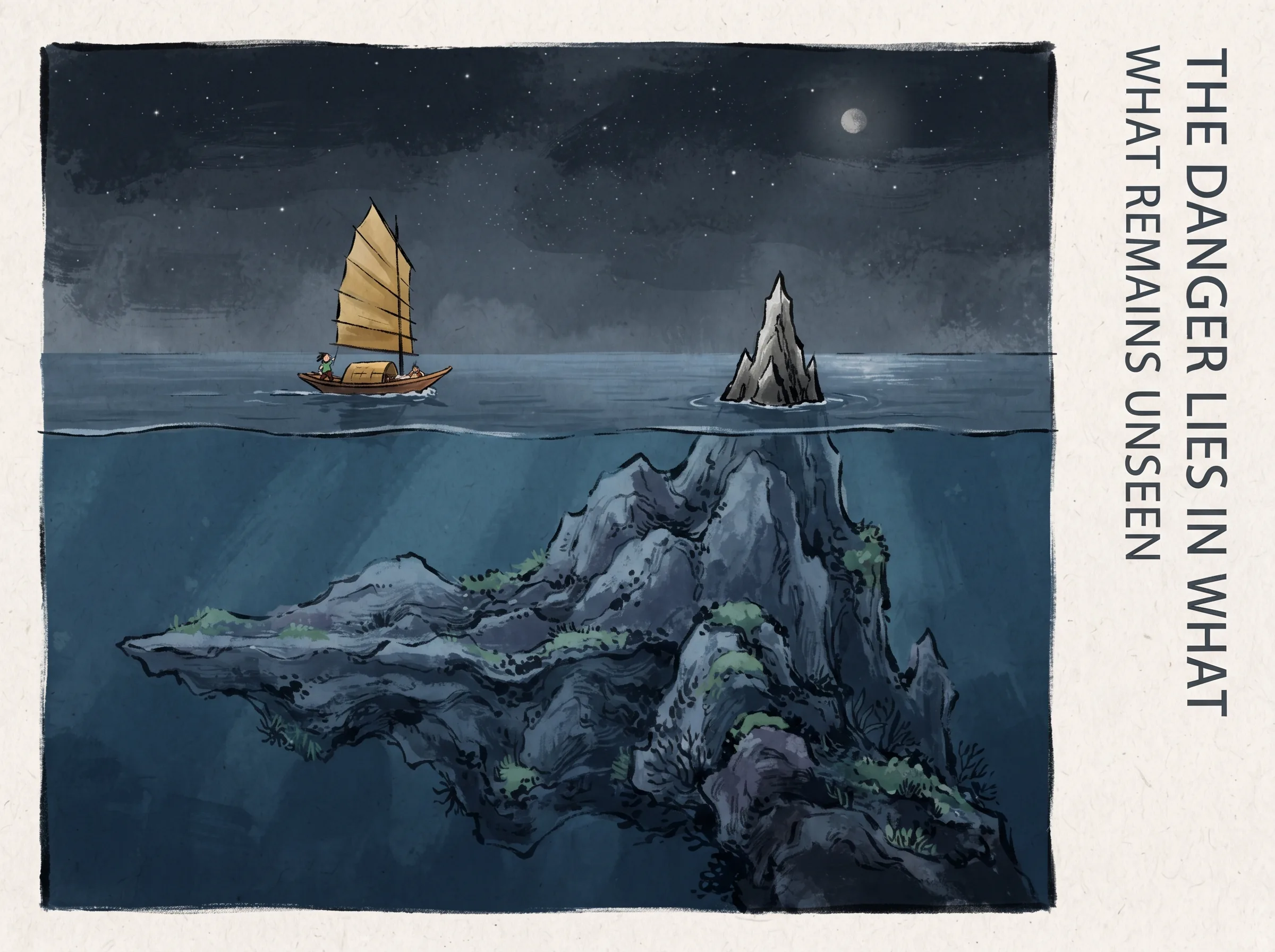
Even when we apply Sun Tzu's discipline of repeated calculation, a deeper problem remains. Carl von Clausewitz observed in On War that friction—the accumulation of small disruptions, unexpected events, and inherent unpredictability—distinguishes real war from war on paper [3]. Friction is not concentrated at a few points like resistance in a machine; it is distributed everywhere [3]. It combines with chance in ways that make many outcomes fundamentally uncalculable in advance [3].
Clausewitz's point carries beyond military strategy. In any complex decision—launching a project, entering a market, investing capital—the variables that actually determine outcomes are rarely the ones you can see and name. Hidden friction, contingent timing, coupled dependencies, and systemic feedback loops sit below the surface of every plan. What can be explained is usually the tip of the structure. The rest is implicit, often invisible until it manifests as a surprise. For the original military treatise and commentary, read the complete strategic translation and classical commentary of Tactical Dispositions: Becoming Invincible and Awaiting the Enemy’s Vulnerability.
This is where the Daoist sensibility quietly enters the conversation. A recurring theme in early Chinese thought is that mastery begins with the honest acknowledgment of limits. The Dao De Jing speaks of knowing when one does not know as true wisdom, and of recognizing boundaries as a form of strength rather than weakness. Whether this is read as epistemological humility or as practical guidance for action, the posture is the same: do not confuse the map with the territory, and do not mistake the absence of visible obstacles for the absence of risk.
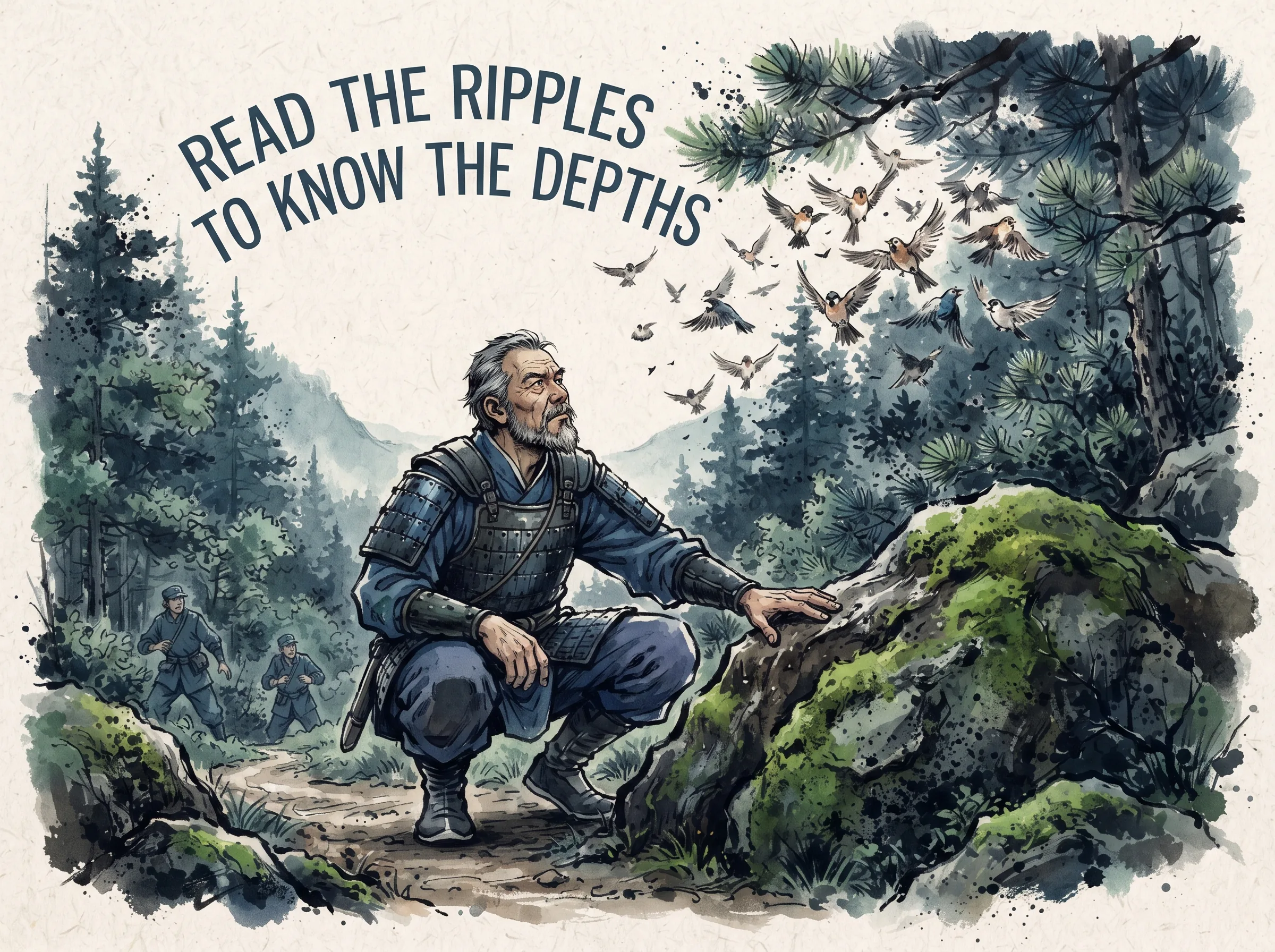
The implication for decision-making is sobering but liberating. If absolute certainty is impossible—not because we are lazy or uninformed but because complexity itself resists total prediction—then the goal shifts. The goal is not to arrive at a point where you are completely sure. The goal is to build decisions that remain corrigible, resilient, and survivable even when you turn out to be wrong.
Three Practices Rooted in Strategic Thought
The shift from demanding certainty to managing uncertainty is not abstract. It translates into concrete habits. Here are three practices drawn from the intersection of Chinese strategic thought and modern decision science.
Presume Failure First
Sun Tzu wrote: "The skillful leader subdues the enemy without having to risk his life; he wins without having to shed blood" [2]. More immediately relevant is the principle that precedes it: "Make yourself invincible, and wait for the moment when the enemy can be defeated. Invincibility lies in the defense; the possibility of victory lies in the attack" [2]. The classical principle—"invincibility rests with oneself, but victory depends on the enemy" (不可胜在己,可胜在敌, bù kě shèng zài jǐ, kě shèng zài dí)—shifts the locus of control inward [2]. You cannot guarantee the conditions for success, but you can guarantee the conditions for survival.
In practice, this translates into a simple inversion exercise. Before committing to a plan, assume it has already failed. Work backward to identify the most plausible causes of failure. Ask: If this goes wrong, what will have gone wrong? Where is the weakest link? What am I assuming that, if false, unravels everything? This is sometimes called a pre-mortem in modern decision frameworks, and it works because it interrupts the brain's optimism bias without requiring pessimism. The exercise does not ask you to doubt yourself; it asks you to look at your own assumptions with the same seriousness you would give a rival's critique.
Build a Continuous Correction Loop
Sun Tzu also wrote: "Military tactics are like unto water; for water in its natural course runs away from high places and hastens downward. So in war, avoid what is strong and strike at what is weak" [2]. He further observed: "War presents no fixed conditions; just as water shapes its course according to the ground, so a soldier shapes his victory according to the enemy he faces. Thus we say that there are not constant conditions in war" [2]. The imagery is deliberate: strategy is not a blueprint but a flow. It must adjust to what is actually present, not to what was imagined at the start.
This insight shares deep ground with the OODA loop—Observe, Orient, Decide, Act—a model developed by military strategist John Boyd to describe how effective decision-makers operate under pressure. The critical step in the loop is orientation, because that is where all incoming information is filtered through existing mental models, cultural background, and prior experience. Bias accumulates most visibly at this stage. The remedy is not to eliminate orientation—which is impossible—but to make it revisable. Schedule regular checkpoints during any significant undertaking and ask a single disciplined question: What new evidence would change my mind? If the answer is "nothing," you have stopped thinking and started performing certainty.
Institutionalize Dissent
A single person can guard against their own biases; a group cannot easily do the same. When everyone in a room agrees, the cost of dissent rises sharply, and the illusion of collective correctness strengthens. This is why organizational mechanisms for disagreement matter.
The concept of a "tenth man"—originating in Israeli intelligence tradition—requires that when nine people reach a consensus, the tenth must argue the opposite position. The purpose is not contrarianism for its own sake but the deliberate preservation of an alternative view before commitment hardens. Red-team exercises operate on a similar principle: assign someone the role of adversary and ask them to stress-test the plan as if they were trying to defeat it.
Confucian thought supports this discipline under a different frame. The Analects repeatedly emphasize the virtue of listening, self-examination, and the moral obligation to correct one's errors. Self-cultivation (xiushen) is not a solitary spiritual exercise but a social practice—one that includes making space for voices that challenge your assumptions. An organization that institutionalizes dissent is not dysfunctional; it is practicing a form of strategic humility.
When Certainty Becomes Collective
Individual overconfidence is manageable. Collective overconfidence is structural. When a team or an organization converges on a single narrative, the mechanisms that normally correct error—doubt, revision, external challenge—begin to atrophy. Analysis continues, but its function changes. It is no longer a tool for testing; it becomes a tool for justification.
This pattern has recurred throughout history. In the lead-up to major military campaigns, planners often produce extensive briefings, detailed intelligence assessments, and sophisticated models. The danger emerges not when analysis is absent but when it stops being questioned. Plans are built on a foundation of estimates that have hardened into assumptions no one feels licensed to challenge. Resources are allocated, timelines are set, and the organization moves forward with a confidence that reflects internal consistency rather than external accuracy.
The lesson for everyday decision-making is practical. If you are leading a project, ask: Who is responsible for raising doubts? When was the last time someone changed their mind because of new evidence rather than because they were overruled or persuaded? If those answers are unsatisfactory, the problem is not a lack of information—it is a lack of permission to revise.
The Quiet Question That Changes Everything
There is a subtle but consequential shift that occurs when ancient strategic thought meets modern decision science. It can be captured in a single question.
Instead of asking, Am I right?, ask: If I am wrong, will this still be survivable?
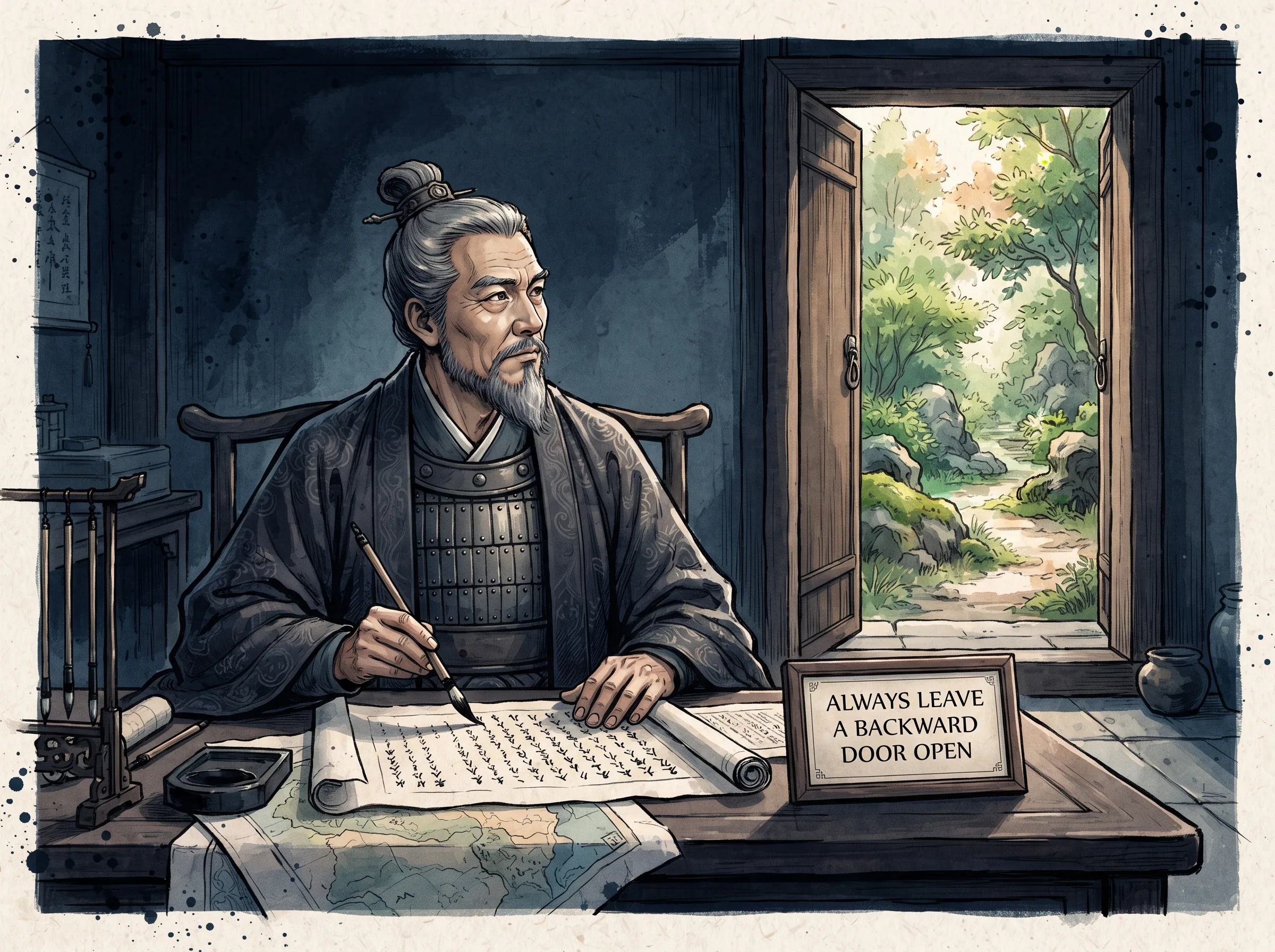
The first question seeks confirmation. The second seeks resilience. The first assumes that correctness is achievable and desirable; the second assumes that error is possible and plans should reflect that possibility. This is the pivot from zhuqiu queiding (pursuing certainty) to guanli budingxing (managing uncertainty with margin and flexibility). It is also where the practical value of Sun Tzu, Clausewitz, and the broader Chinese strategic tradition becomes clearest.
None of these thinkers promised that certainty is attainable. Sun Tzu promised that repeated, disciplined calculation improves odds. Clausewitz promised that friction cannot be eliminated but can be managed. Kahneman promised that recognizing overconfidence as a structural bias is the first step toward mitigating its effects. What they all share is a refusal to treat confidence as a substitute for rigor.
The strategist who keeps adjusting is not weaker than the one who pretends to have arrived. In a complex world, the ability to revise is often the strongest advantage available.
FAQ
Q: If overconfidence is so common, how do I know when my certainty is justified versus illusory? Look for external disconfirming evidence, not internal coherence. A story that feels complete is not the same as a conclusion that has survived serious challenge. Ask someone outside your immediate circle to find flaws in your reasoning, and treat their objections as data rather than disagreement.
Q: Doesn't requiring constant revision slow down decision-making? It slows the initial decision but speeds the overall outcome. Decisions built on unexamined certainty tend to require more correction later, often under worse conditions. Building in checkpoints and dissent mechanisms upfront reduces the cost of late-stage pivots.
Q: How is Sun Tzu's idea of "calculation" different from simply planning more thoroughly? Planning thoroughly can still produce a single fixed plan. "Calculation" in Sun Tzu's sense means running multiple scenarios, comparing assumptions, and staying open to revision. It is iterative rather than linear.
Q: Can these practices work in fast-moving situations where there is no time for deliberation? Yes, but they work best when practiced before the pressure arrives. Habits of presumption, correction, and dissent are most effective when they are embedded in routine, not invented in crisis.
Next Steps
The shift from chasing certainty to managing uncertainty is not a one-time insight but a daily practice. Start small. Before your next important decision, write down three assumptions that, if wrong, would undermine the plan. Schedule one checkpoint during execution to ask whether anything has changed your mind. Assign someone to play devil's advocate, and thank them when they do.
These are modest actions. They are also the opposite of the illusion of validity. They remind you that understanding is provisional, that certainty is often a signal to pause rather than to proceed, and that the wisest decisions are not the ones that feel most confident but the ones that remain flexible enough to survive being wrong, reflecting the enduring wisdom of Sun Tzu Chapter 4 Strategy.
To explore these themes from another angle, read our related reflection on Why the Strongest Opponents Sometimes Collapse Without Warning.
For a deeper comparative examination of these ideas, explore our related study on Why the Best Leaders Stop Searching for Heroes.
Sources & Further Reading
[1] Kahneman, Daniel. "Biographical." NobelPrize.org. Nobel Prize Outreach AB.
[2] Sunzi Bingfa (The Art of War). WikiSource.
[3] Clausewitz, Carl von. On War, Book 1, Chapter 7 — "Friction in War." clausewitzstudies.org.






