
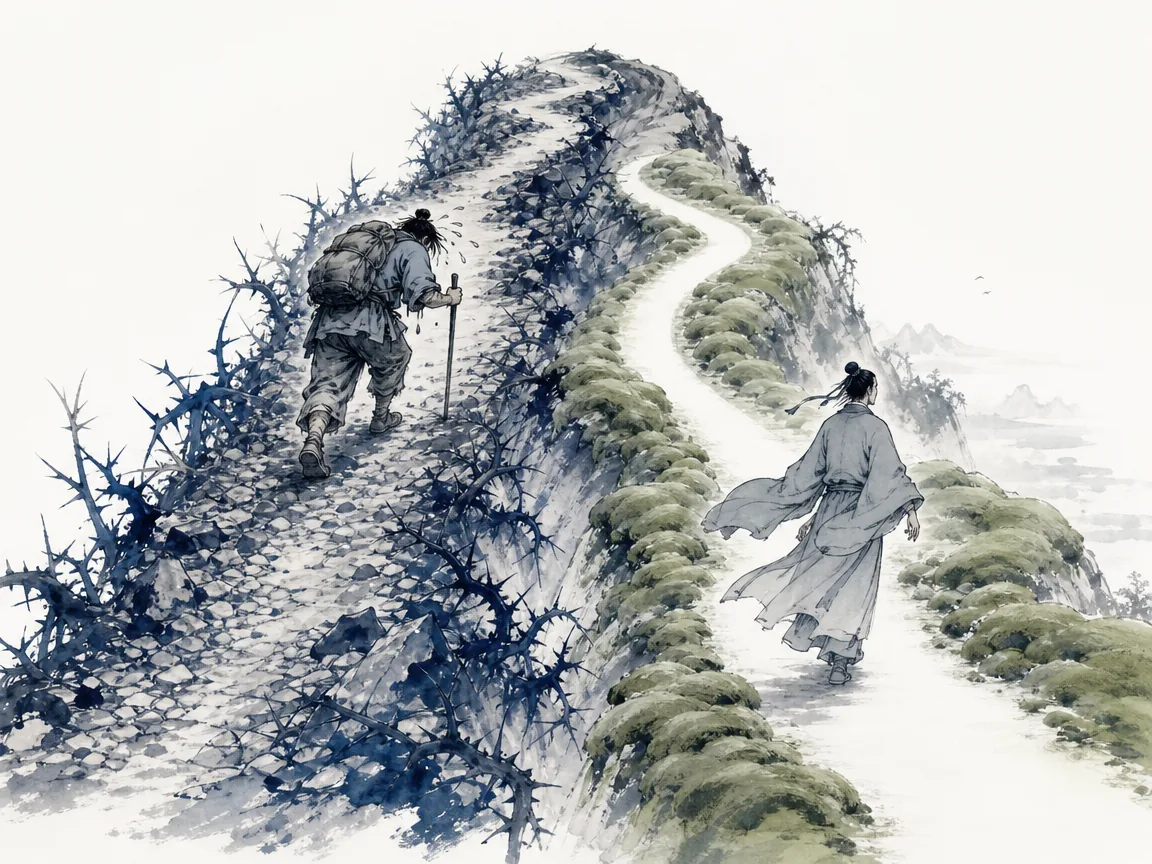
Have you ever watched two people with similar talent, drive, and resources land in wildly different places? One seems to glide forward while the other, doing everything "right," barely moves. The instinctive explanation is that one person simply lacks what the other has — more skill, more grit, more intelligence. But what if the real difference isn't inside either of them at all?
A 2,500-year-old strategic text offers a different answer. In the Terrain Chapter of Sun Tzu's Art of War, the ancient general argued that outcomes aren't determined by strength alone but by the relationship between capability and environment. The same force that becomes unstoppable on one stretch of ground can collapse on another. Sun Tzu wasn't describing hills and valleys in a narrow sense; he was mapping something far more general — how the shape of a landscape changes the cost of every action taken within it—a foundational perspective explored in Sun Tzu Chapter 16 Strategy.
What if we read that insight through a modern lens? Not as a manual for battlefield tactics, but as a framework for understanding why some career moves feel effortless while others drain you, why some businesses dominate their markets while similar companies struggle in adjacent ones, and why stepping onto a new path can make even a strong organization suddenly feel weak.
Sun Tzu Chapter 16 Strategy: The Question Nobody Asks
We grow up with a story: succeed if you work hard enough and build enough capability. Fail if you don't. This ability-centric view feels intuitive. But it assumes the world is flat — that effort applied anywhere produces proportional results. Reality rarely works that way.
A company can have world-class engineering and still lose because it entered a market where organizational habits, supplier relationships, and customer expectations worked against it. An individual can be excellent at their job and still stall because the industry structure rewards a completely different kind of skill. The person hasn't changed. The direction has.
Sun Tzu's central observation in the Terrain Chapter is exactly this: you cannot separate what you are from where you are standing. A force that dominates open ground may shatter in narrow passes or distant stretches where supply lines break. Strength is real, but strength only becomes decisive when it meets terrain that lets it flow.
This is not a call to stop developing capability. It is a call to add a second question to the first one everyone asks. Don't just ask, "Am I strong enough?" also ask, "Am I on ground that matches my strength?"
What Is Friction, and Why Does It Matter?
If we translate Sun Tzu's idea into a contemporary vocabulary, the key concept is friction. Friction is the invisible tax every action pays as it moves through an environment. Distance slows you. Information gaps blind you. Organizational routines resist change. Cultural mismatches create hidden costs. Logistics strain your energy before you even begin.
Your result is not simply your ability. It is your ability multiplied by your terrain's friction coefficient. When friction is high, even considerable strength gets compressed. When friction is low, modest strength can be amplified.
The crucial insight is that friction is almost always asymmetric. The same environment that feels like a highway to one person can feel like a swamp to another. A platform that is a moat for an incumbent may be an impenetrable wall for a newcomer. A regulatory landscape that is familiar terrain for one firm is an alien continent for another. The terrain does not judge who deserves to succeed. It simply charges different costs to different actors.
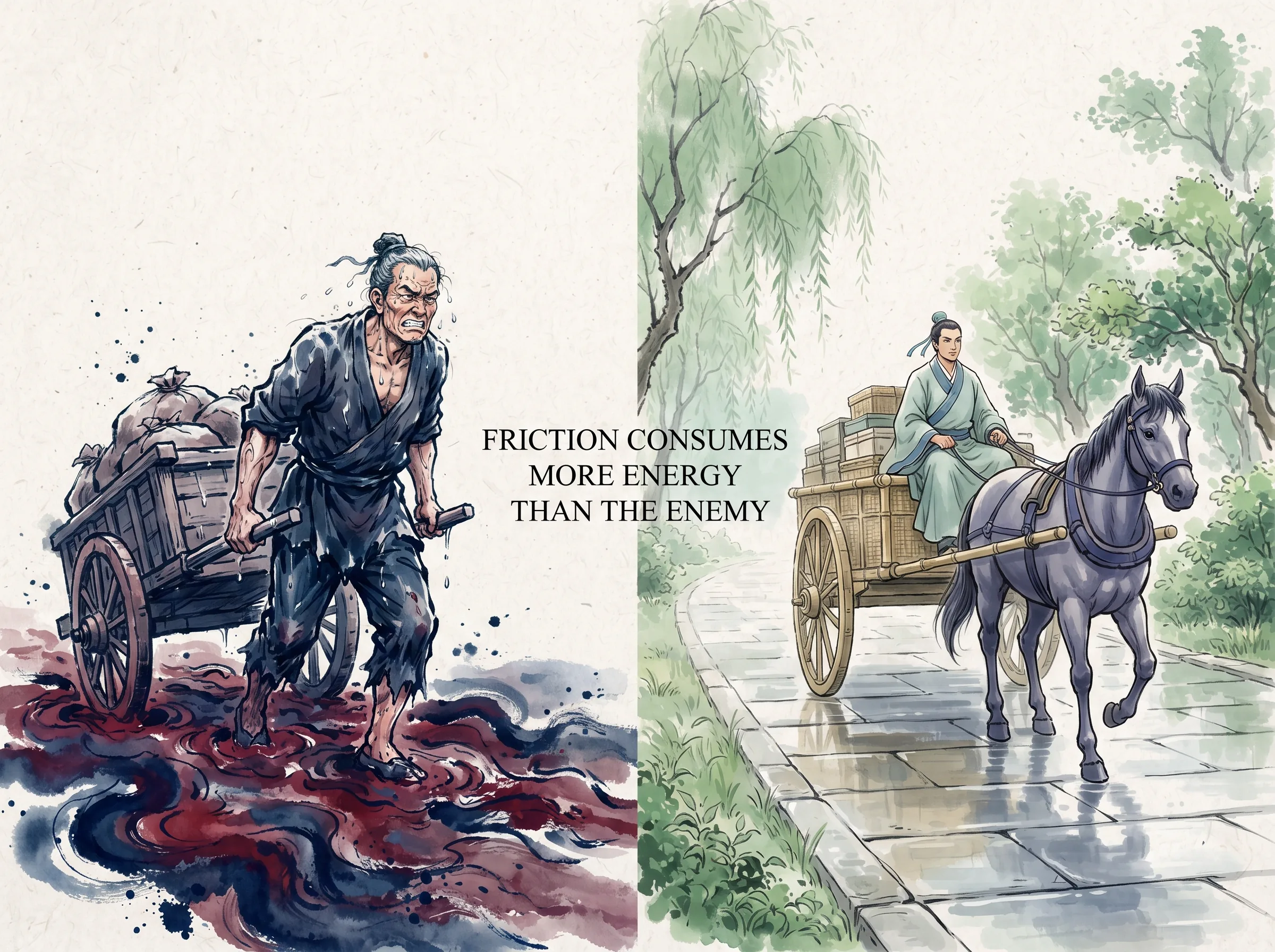
This is why "just work harder" rarely solves structural problems. If you are standing in terrain that extracts a high friction fee from your particular mix of skills, culture, and resources, no amount of additional effort closes the gap. You are not fighting a weaker opponent. You are fighting a cost structure.
Continue with the deeper interpretation and practical application.
ChiDestiny members get access to the full analysis, modern applications, and the growing Chinese Wisdom Library.
FAQ
Is the "friction" concept from Sun Tzu's original text? No. Sun Tzu wrote about terrain in practical, military terms. The framing of terrain as a "friction function" is a modern interpretive lens applied to his observations. The six terrain types — open, suspended, supporting, narrow pass, precipitous, and distant — are drawn from the Terrain Chapter of Sun Tzu's Art of War, though the exact terminology varies across translations.
Did Cao Cao really lose at Red Cliffs because of disease and unfamiliarity with water warfare? Traditional historical accounts, including those in the Records of the Three Kingdoms, note that Cao Cao's northern troops faced significant challenges with water warfare and that disease affected his forces during the campaign. However, the precise details and relative importance of each factor remain subjects of historical discussion. The friction reading presented here is an interpretive application, not a claim about exact historical causation.
Can this framework help me choose between two career paths? It can provide a useful way to think about the question. Rather than asking only which path aligns with your interests or pays more, consider which path matches your particular configuration of skills, temperament, and resources with a terrain that will produce lower friction. This is a complement to — not a replacement for — other factors in career decision-making.
What if I can't change my terrain? Should I just leave? Not necessarily. Sometimes the most strategic move is to reshape the terrain from within — building new capabilities, forming new alliances, or changing your position within the existing structure so that friction shifts in your favor. Leaving is one option. Creating a more favorable position is another. Both require honest assessment of the friction map, reflecting the enduring wisdom of Sun Tzu Chapter 16 Strategy.
To explore these themes from another angle, read our related reflection on The Game You’re Playing Isn’t What You Think.
For a deeper comparative examination of these ideas, explore our related study on When the Fire Burns You First: Sun Tzu’s Warning on Borrowing Momentum.
Sources & Further Reading
[1] Amazon to close Fresh, Go stores, expanding Whole Foods — Amazon official announcement regarding the closure of Amazon Fresh and Amazon Go physical stores and the expansion of Whole Foods Market locations.
[2] AWS — Our Origins — Amazon's official page documenting the launch of Amazon Web Services in the spring of 2006.
[3] The Art of War by Sun Tzu, particularly the Terrain Chapter (Chapter 10 in most standard editions). Scholarly translations by Samuel B. Griffith and Ralph D. Sawyer provide useful comparative perspectives on terminology and interpretation.
[4] The Three Kingdoms by Luo Guanzhong, for the literary and cultural narrative of the Red Cliffs campaign, keeping in mind that this is a later literary work rather than a strict historical record.
[5] Chen Shou's Records of the Three Kingdoms (Sanguozhi), for the earlier historical accounts on which later retellings are based.







[…] To explore these themes from another angle, read our related reflection on Why You’re Stronger on Some Paths Than Others: Sun Tzu’s Friction Framework for Modern L…. […]