
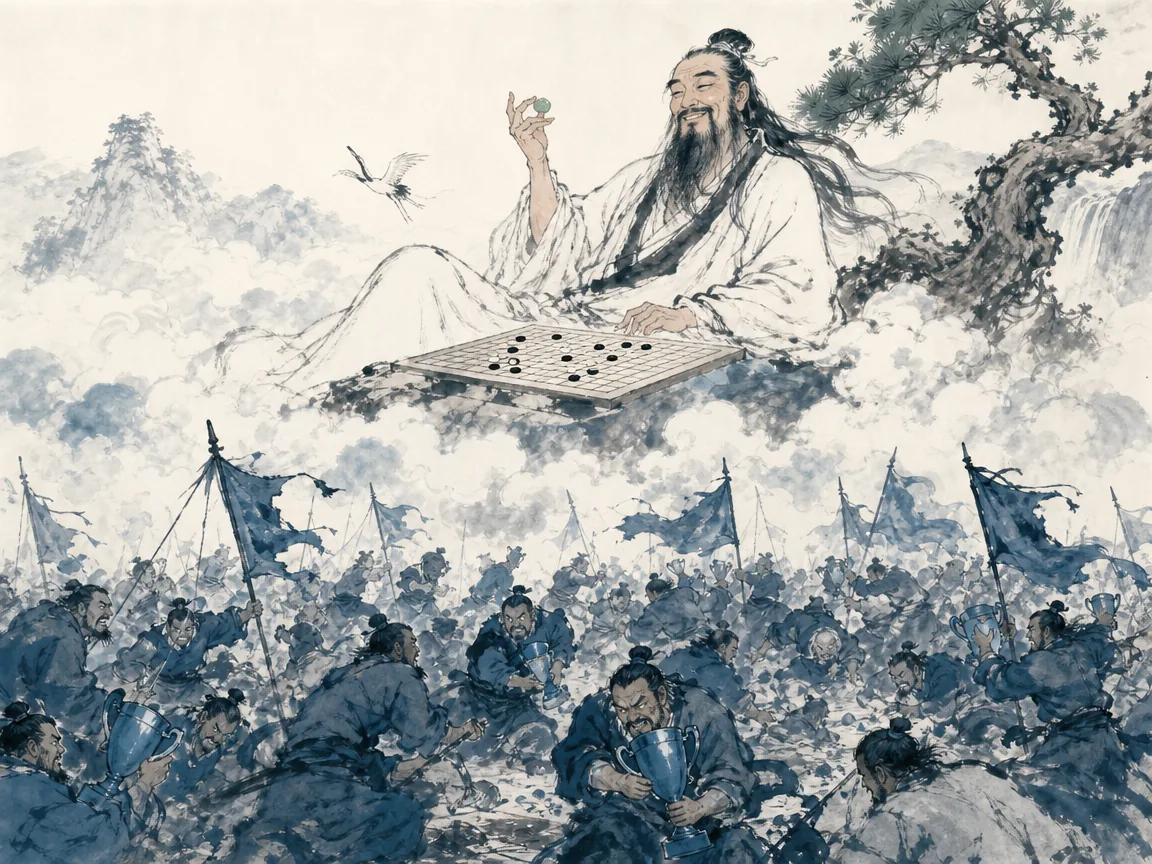
Most advice about decision-making assumes you eventually get to see the full picture. Study the data. Gather more information. Wait until the uncertainty clears. But in practice, the clearest view is often the one you never get — and by the time everything is visible, the moment has passed.
This is why a 1,600-year-old Chinese text on strategy still matters. The Thirty-Six Stratagems does not ask you to wait for certainty. It begins from a different premise: the picture will never be complete, and the best you can do is learn to play well within the limits of what you know—a foundational perspective explored in Sun Tzu Chapter 32 Strategy.
The text is best understood alongside an observation made in contemporary research on one of China's most widely played traditional games. Mahjong is described by AI researchers as a multi-player imperfect-information game, precisely because each player holds concealed tiles that no one else can see [1]. The rules themselves vary across regions and even households [2]. What every player shares is the same condition: you must act while holding incomplete information, while watching others act, while knowing that the next tile drawn could change everything.
The Thirty-Six Stratagems offers a framework for exactly that condition — not as a collection of tricks, but as a way of thinking about choices when you cannot see the whole board.
Sun Tzu Chapter 32 Strategy: Surviving Comes Before Winning
The oldest surviving Chinese military text, traditionally attributed to Sun Tzu, opens its discussion of form with a principle that runs counter to modern hustle culture: "First make yourself un-defeatable, then wait for the enemy to provide the opportunity for victory" (xiān wéi bù kě shèng, yǐ dài dí zhī kě shèng, 先为不可胜,以待敌之可胜) [3].
Whether or not this exact phrasing appears in every translation, the underlying idea is clear and widely recognized across classical Chinese strategic thought: the priority is not to maximize your chances of winning, but to eliminate the possibility of catastrophic loss. In a world of incomplete information, the tail risk — the scenario that ruins you — matters far more than the upside you are chasing.
This is not cynicism. It is risk management grounded in a recognition that most of what you cannot see is also working against you. An investor who accepts modest returns while keeping losses contained will often outperform one who chases outsized gains and remains exposed to a single devastating drawdown. The logic applies beyond finance. In career moves, relationship decisions, and entrepreneurial bets, the question that tends to matter most is not "What is the best outcome?" but "What would make this untenable — and what am I doing to avoid that?"
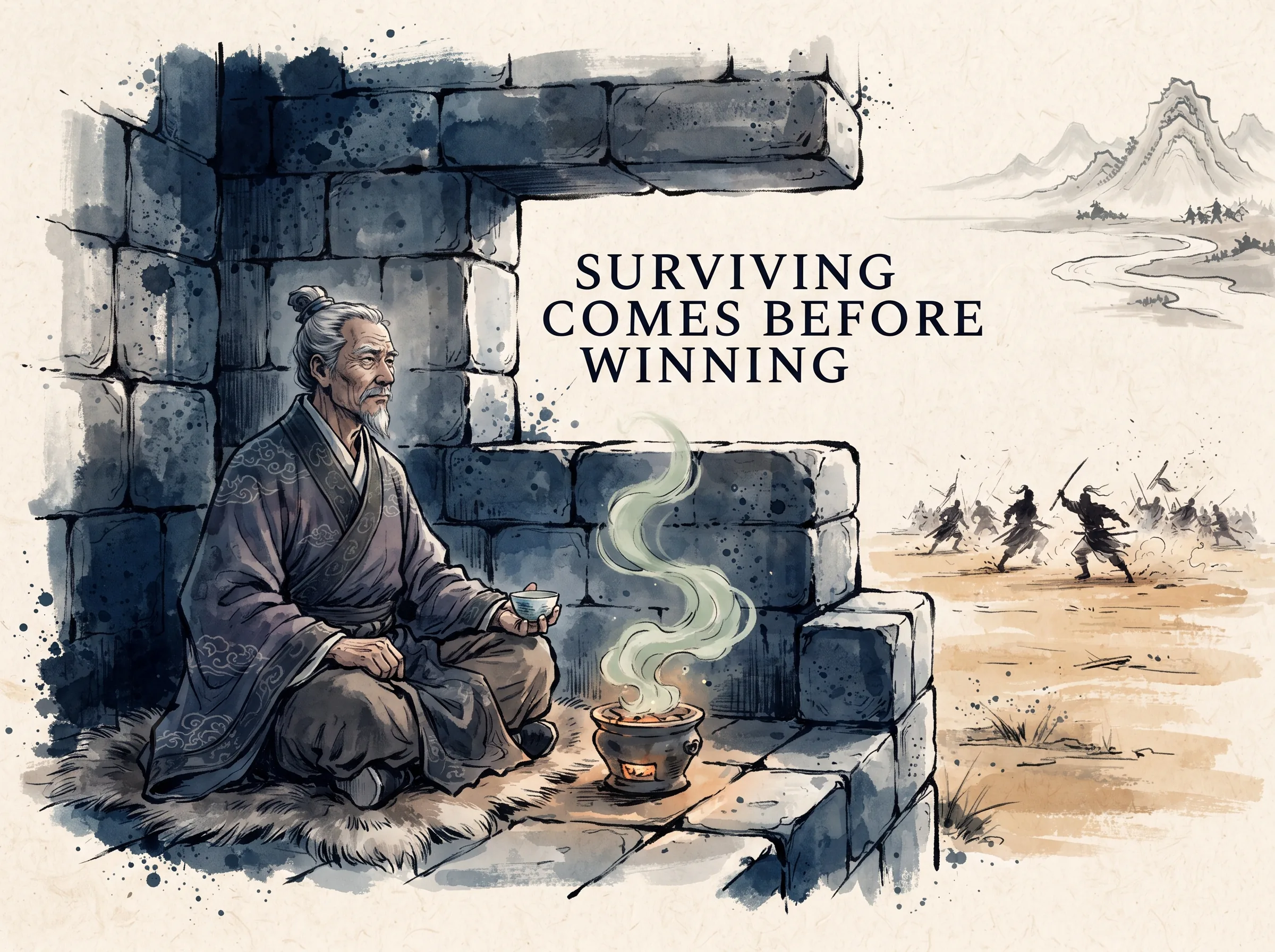
The Thirty-Six Stratagems shares this DNA. Its sections on navigating disadvantage and preserving optionality were not written for people who already hold the advantage. They were written for the moments when the picture looks worse than you hoped, and the only rational move is the one that keeps you in the game.
Continue with the deeper interpretation and practical application.
ChiDestiny members get access to the full analysis, modern applications, and the growing Chinese Wisdom Library.
FAQ
Is the Thirty-Six Stratagems a real ancient text, or is it a later compilation? The text is real, but its origins are debated. Scholars generally agree that the Thirty-Six Stratagems as we know it likely took shape centuries after the Warring States period, possibly during or after the Tang dynasty. Attributions to specific early figures such as Guo Pu have been proposed but remain unconfirmed, and the exact dating of the text is still discussed among specialists. What is clear is that the stratagems reflect strategic ideas that circulated in Chinese military and political thought long before they were collected into their current form.
Does the Thirty-Six Stratagems overlap with Sun Tzu's Art of War? Yes, and the overlap is significant. Both texts share a concern with reading situations accurately, avoiding catastrophic loss, and using information strategically. Sun Tzu is generally more concerned with principles of form and strategy, while the Thirty-Six Stratagems is more oriented toward specific tactics for particular conditions. Many readers treat Sun Tzu as the operating system and the Thirty-Six Stratagems as the application modules — useful, but dependent on the deeper framework for coherent use.
Can these ancient stratagems really apply to modern life? The stratagems were developed for military and political contexts, but the underlying problems they address — incomplete information, shifting alliances, the cost of stubbornness, the value of strategic retreat — are structural features of almost any complex environment. Modern readers commonly apply them to business strategy, personal relationships, and career decisions. The key is not to treat them as literal battle manuals, but as patterns of reasoning that generalize across domains.
What is the single most useful stratagem for everyday decision-making? Many readers find that the principle behind strategic withdrawal (zǒu wéi shàng, 走为上 — knowing when to exit cleanly) is the most practically useful. Not because quitting is admirable, but because the inability to quit is one of the most common sources of unnecessary suffering. The capacity to recognize a losing position and withdraw with minimal damage is, in practice, a rare and valuable skill.
Summary
The world you are deciding in is not a card game with known probabilities. It is more like a Mahjong table: four players, hidden information, shifting dynamics, and draws that change everything without warning. The Thirty-Six Stratagems does not promise certainty. It promises something more realistic — a way of thinking that keeps you grounded when the picture is incomplete, cautious when you have the advantage, flexible when the board shifts, and willing to exit when staying would cost you everything.
The next step is not to memorize all thirty-six stratagems. It is to adopt one habit: before your next important decision, ask what you cannot see, what you are refusing to let go of, and what would make this whole endeavor untenable. The answers to those questions will often point you toward a better choice than the one you were about to make.
For readers who want to explore each stratagem in depth, the Chidestiny series continues with detailed examinations grounded in the strategic foundations of classical Chinese thought. Subscribe to follow along, reflecting the enduring wisdom of Sun Tzu Chapter 32 Strategy.
To explore these themes from another angle, read our related reflection on Should You Move First — Or Redefine the Board?.
For a deeper comparative examination of these ideas, explore our related study on How to Know When Not to Fight: Ancient Chinese Wisdom for Escaping Losing Battles.
Sources & Further Reading
[1] Suphx: Mastering Mahjong with Deep Reinforcement Learning — Academic paper describing Mahjong as a multi-player imperfect-information game with hidden information
[2] Singapore Mahjong Rules — Reference on standard Mahjong rules, including four-player structure and concealed tiles
[3] Sun Tzu's Art of War, Tactical Dispositions (军形篇) — Classical Chinese military text containing the principle of "securing invincibility before seeking victory" (先为不可胜,以待敌之可胜)
[4] The Thirty-Six Stratagems — Traditional Chinese strategic text, authorship and dating debated among scholars
[5] Nan Qi Shu (Book of Southern Qi, 《南齐书》), Biography of Wang Jingze (王敬则传) — Historical record containing the proverbial military reference: "Of Duke Tan's thirty-six stratagems, departure is the best course" (檀公三十六策,走是上计)






