
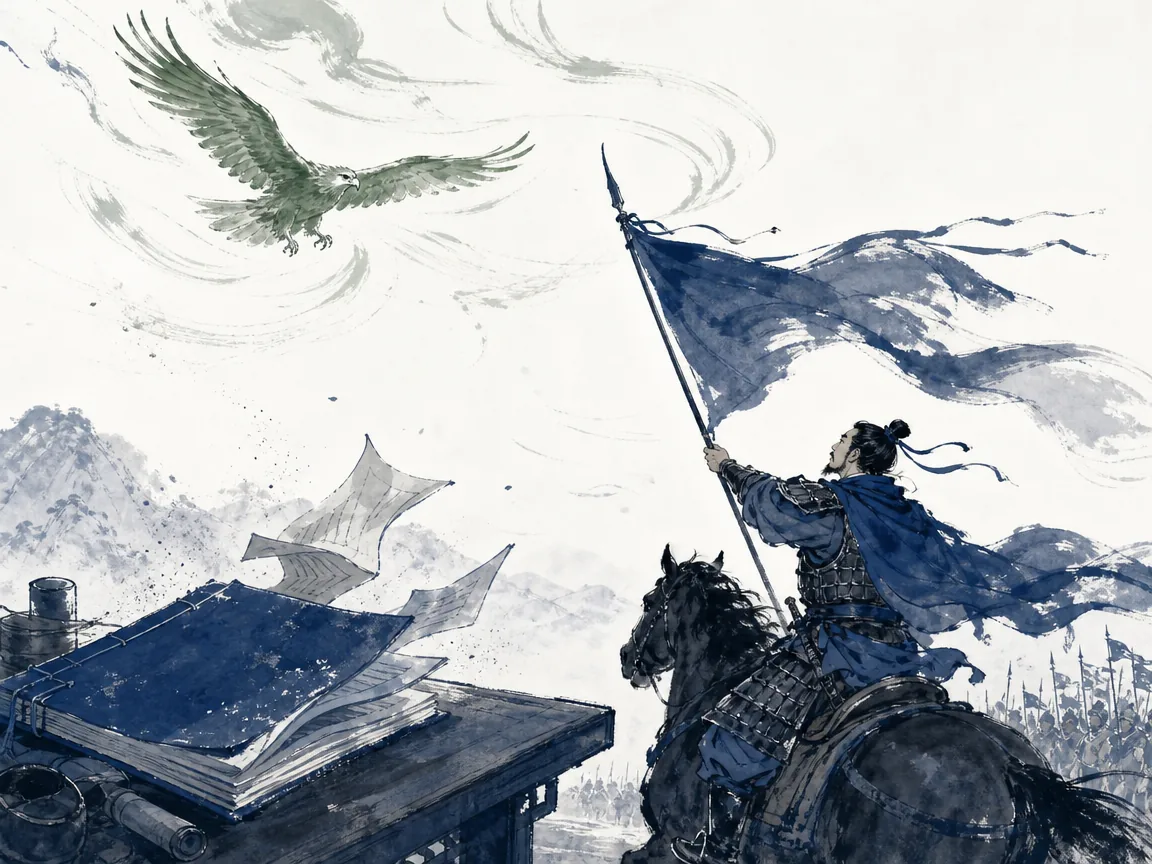
Every leader has said it. "We need to change." Every boardroom has debated it. And yet most organizations remain stubbornly locked in place, grinding through familiar routines long after the world around them has shifted. This is not a failure of vision. It is a failure of structure.
Sun Tzu, writing over two thousand years ago, understood something that modern management theory is only now catching up to. In The Art of War, one of his chapters — commonly known by its Chinese title Jiǔ Biàn (The Nine Variations, 九变) — addresses a theme that runs deeper than battlefield tactics. It asks: what makes a system capable of genuine adaptation, rather than simply reacting faster within the same old logic? The answer, Sun Tzu implies, is not found in individual cleverness or sheer willpower. It is found in the architecture of the system itself—a foundational perspective explored in Sun Tzu Chapter 15 Strategy.
If everyone knows change is necessary, why do most organizations remain trapped? The answer lies in a form of organizational inertia that no amount of motivational language can dissolve. True adaptability is not a mindset — it is a structural property.
Sun Tzu Chapter 15 Strategy: The Three Locks That Trap Organizations
Organizational failure is rarely caused by a single decision or one bad leader. More often, it emerges from the invisible architecture that shapes every decision before it is made. Three interlocking barriers — structural, incentive, and cognitive — form a system so tightly woven that even well-intentioned individuals find themselves unable to move it.
Structural lock refers to the hierarchy, processes, and information channels designed for a previous environment. A reporting line built to coordinate a stable product cycle becomes a bottleneck when speed matters. A budget allocation formula tuned to maximize returns on an existing business starves emerging ones before they can compete. The organization has not chosen stagnation; its architecture simply makes change prohibitively expensive.
Incentive lock is perhaps the most rational trap of all. When KPIs, promotion criteria, and compensation reward maintenance of the status quo, every individual actor makes a perfectly sensible decision. Moving toward an uncertain new direction risks your quarterly score. Staying put pays dividends. The result is what systems theorists call collective irrationality — a group of locally rational actors producing a globally catastrophic outcome [2].
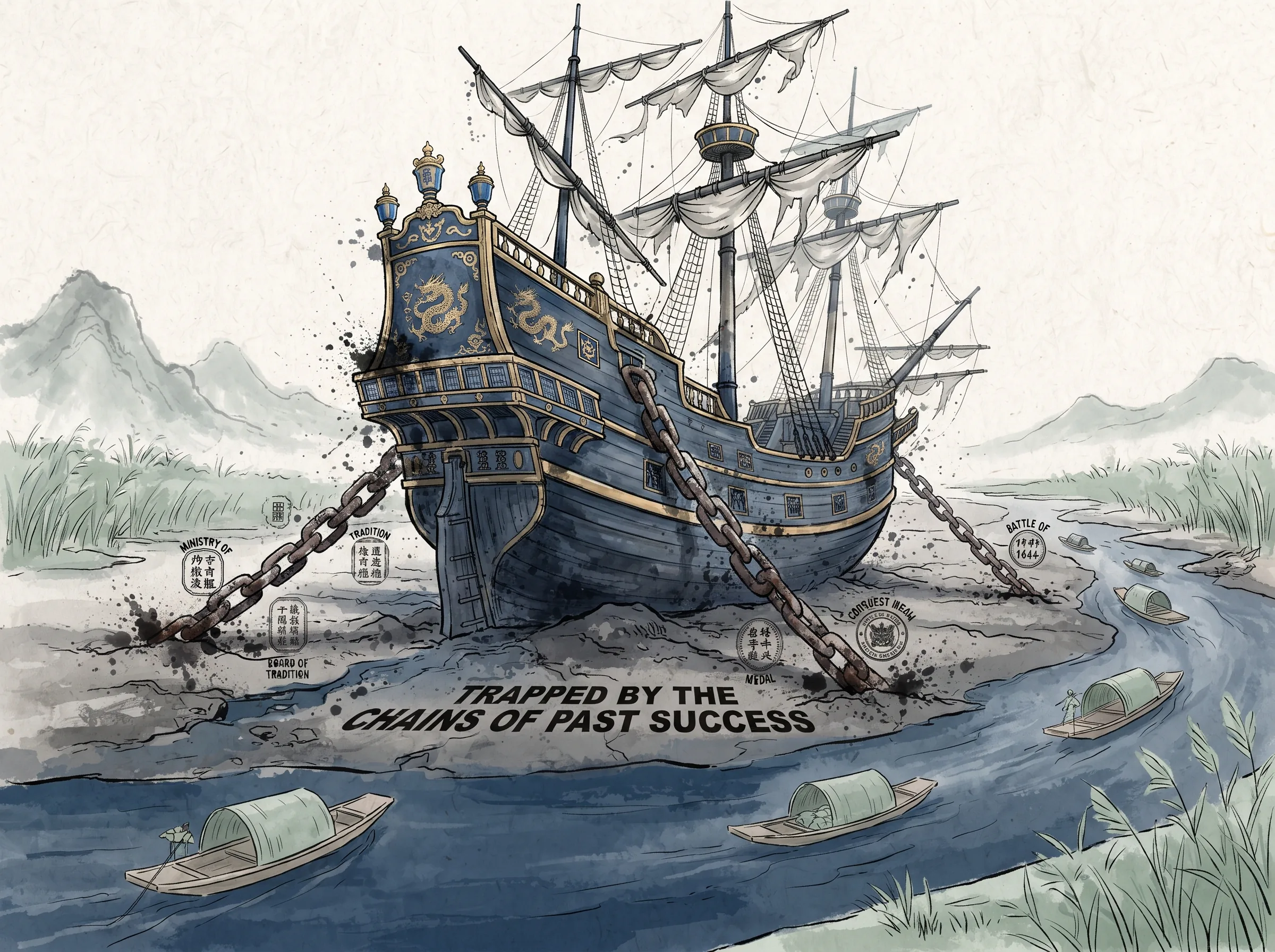
Cognitive lock is the deepest and most subtle. Past success hardens into dogma. "This is how we win" stops being an observation and becomes an assumption so deeply embedded that it is no longer questioned. The more successful an organization has been under its old paradigm, the harder it becomes to see that the paradigm itself may be the obstacle.
These three locks echo a concern that runs through classical Chinese thought: when an organization's structures, incentives, and beliefs no longer match its actual conditions, it has lost its way even if its balance sheet looks healthy. The Confucian tradition, as discussed in philosophical scholarship, emphasizes that names and categories must correspond to reality — that language and institutions lose their grounding when they drift from what they are supposed to describe [3]. An organization that has outgrown its own self-description is in precisely this situation.
Continue with the deeper interpretation and practical application.
ChiDestiny members get access to the full analysis, modern applications, and the growing Chinese Wisdom Library.
FAQ
Is Sun Tzu's Nine Variations really about organizational strategy? Sun Tzu wrote about military campaigns, not modern corporations. However, his strategic thinking has been applied to organizational contexts for decades, and the underlying principles — adaptability, systemic flexibility, recognition of structural constraints — translate well beyond the battlefield. The three-lock framework used here is a modern analytical tool, not a direct reading of Sun Tzu.
What is the difference between strategic change and structural change? Strategic change means choosing a different direction — "we will enter the cloud market." Structural change means altering the mechanisms that determine which directions the organization can consider and pursue — changing how information flows, how people are rewarded, and what assumptions are allowed to go unquestioned. Structural change is harder but more durable.
How do I know if my organization has a cognitive lock? A cognitive lock often reveals itself when the organization responds to new information with confusion, dismissal, or deflection rather than integration. If data consistently arrives that contradicts the prevailing strategy and is rationalized away rather than acted upon, a cognitive lock is likely in place. The most dangerous organizations are those where no one can articulate why the current approach persists when the evidence suggests it should change.
Can small organizations experience the same locks as large ones? Yes. While large organizations tend to exhibit these locks more visibly due to their complexity, small teams can develop structural locks through informal hierarchies, incentive locks through informal reward structures, and cognitive locks through founder mythology or early success narratives. The dynamics scale with organizational size but appear in principle at any scale.
Conclusion
The most dangerous organization is not the one that does not see the direction it needs to go. It is the one where everyone sees the direction, everyone knows change is necessary, and no one can move the system. This is not a willpower problem. It is a structural one.
Sun Tzu's Nine Variations, read through this lens, offers a timeless reminder: the capacity to adapt is not a personality trait. It is a structural property of the system. The question is never "Do we want to change?" but "Can our system change?"
For leaders seeking to build adaptive organizations, the path forward is not to demand more flexibility from people but to design more flexibility into structures. Test your system under pressure. Diagnose where the locks are. Build mechanisms for continuous unlocking. The goal is not to avoid change but to become the kind of organization that can meet change without breaking, reflecting the enduring wisdom of Sun Tzu Chapter 15 Strategy.
To explore these themes from another angle, read our related reflection on All Present Victories Were Decided Long Before Today.
For a deeper comparative examination of these ideas, explore our related study on Designing Your Position: How Ancient Chinese Wisdom Explains Why Willpower Alone Fails.
Sources & Further Reading
[1] Zizhi Tongjian / Volume 105 — Primary historical account of the Battle of Feishui (383 CE), including troop numbers, the multi-ethnic composition of Former Qin forces, and the roles of regional commanders such as Murong Shao and Zhu Xu.
[2] Microsoft Ditches Its Employee Ranking System For Something Less Internally Destructive | TechCrunch — Contemporary reporting on Microsoft's November 2013 announcement to eliminate its stack-ranking evaluation system, replacing it with a model focused on impact and growth rather than forced distributions.
[3] Xunzi (Stanford Encyclopedia of Philosophy) — Scholarly overview of Xunzi's philosophical framework, including his concept of the rectification of names (zhèng míng, 正名) and the relationship between linguistic categories and reality. Used here as a conceptual parallel to organizational alignment.
Further Reading
-
Sun Tzu, The Art of War — Selected chapters, including "The Nine Variations" (九变篇), are available in multiple English translations. Standard scholarly translations include those by Lionel Giles and Ralph Sawyer.
-
Book of Jin (《晋书》, Jin Shu) — The official history of the Jin dynasty contains extensive coverage of the Former Qin period and the Battle of Feishui, providing an earlier primary source than the Zizhi Tongjian.
-
Complexity and Organization Theory — Scholars such as Karl Weick and Amy Edmondson have written extensively on organizational adaptation, psychological safety, and the structural conditions that enable or constrain organizational learning.







[…] To explore these themes from another angle, read our related reflection on Why Knowing What to Do Isn’t Enough: Sun Tzu’s Hidden Lesson on Adaptation. […]
[…] To explore these themes from another angle, read our related reflection on Why Knowing What to Do Isn’t Enough: Sun Tzu’s Hidden Lesson on Adaptation. […]