

You've probably experienced it: a strategy that worked brilliantly last year now feels like it's pushing against a wall. The execution is sound. The team is motivated. The metrics looked perfect on paper. And yet, progress stalls, competitors seem to shift lanes effortlessly, and you can't quite name why.
The problem may not be your execution at all. The problem may be that the ground beneath your strategy has quietly moved—a foundational perspective explored in Art of War Chapter 14.
This is not a new observation. Over two millennia ago, Sun Tzu addressed it in a chapter often overlooked by modern readers — The Nine Variations (九变). Most people treat this chapter as advice about being flexible or adapting your tactics. But its deeper lesson runs further: the constraints that define what is even possible in a competitive system are themselves in constant motion. When those constraints drift, applying yesterday's decision framework to today's reality produces failure — not from poor judgment within a stable system, but from judging a world that no longer exists.
Art of War Chapter 14: The Map Is Not the Territory
There is a persistent intuition that strategy is about finding the best path within a fixed set of rules. We picture the competitive landscape as a stable board: the geography is given, the scoring system is clear, and our job is simply to play well within those boundaries. This model feels comfortable because it reduces complexity to calculation.
But real competitive systems do not work this way. Constraints are not a stable border around which you optimize — they are fluid, responsive, and constantly reshaped by external forces. What was feasible last quarter may be impossible this month. What was once a barrier can suddenly become a bridge. The map you are navigating with may still be detailed and well-drawn, but the territory it represents has already changed.
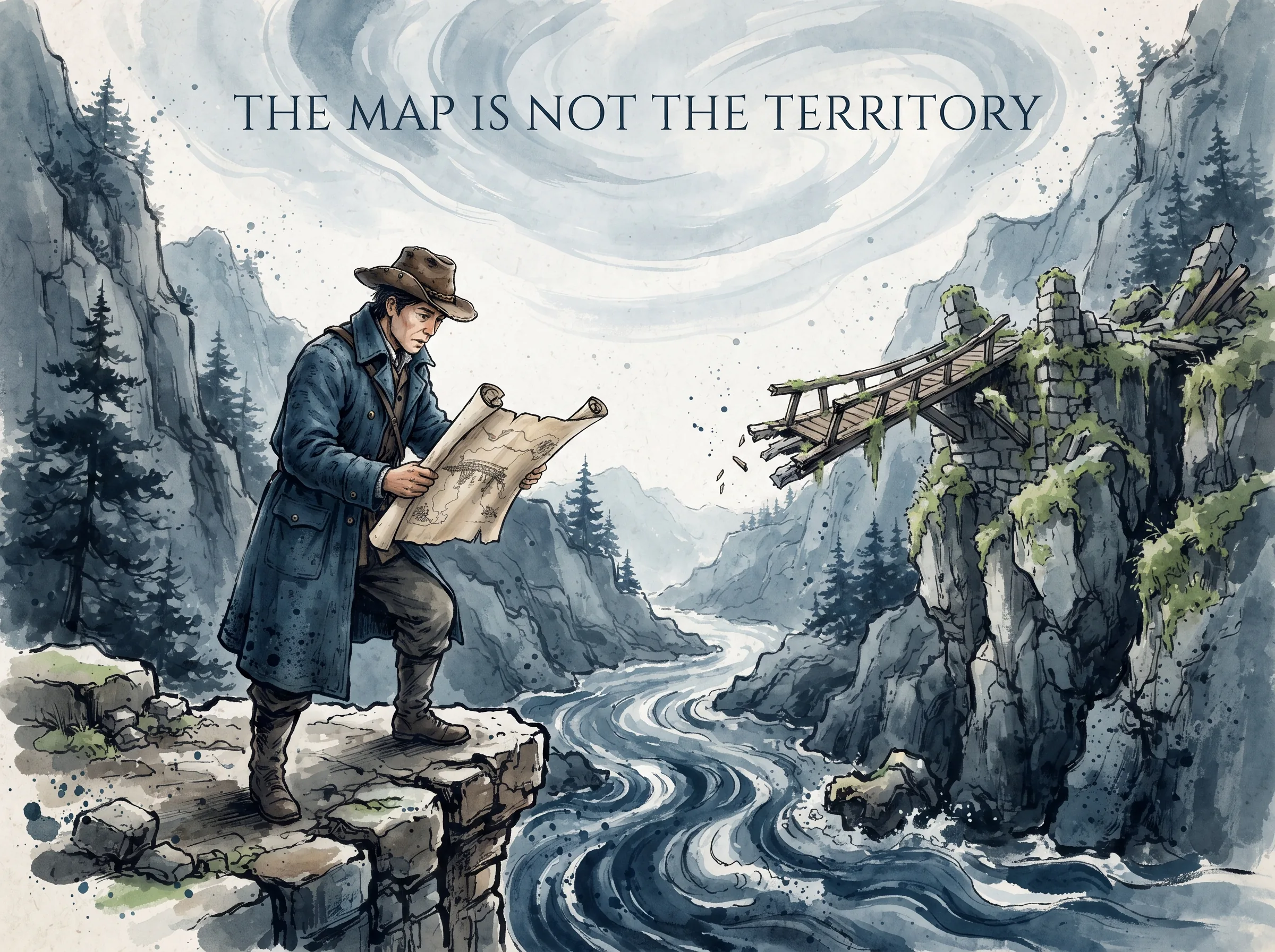
This insight reframes strategic failure entirely. A strategy does not fail because it was poorly executed within its context. It fails because its context dissolved while the strategy was still being applied. Sun Tzu's Nine Variations asks us to look beyond the visible battlefield and notice when the underlying conditions of competition itself have shifted.
Continue with the deeper interpretation and practical application.
ChiDestiny members get access to the full analysis, modern applications, and the growing Chinese Wisdom Library.
FAQ
Q: Is constraint drift the same as bad execution? No. Bad execution means applying a sound strategy poorly within a stable environment. Constraint drift means the environment has changed in ways that make the strategy itself misaligned, regardless of how well it is executed. The difference is subtle but critical: one is solved by better discipline; the other is solved by updating the framework.
Q: Can I predict constraint drift before it happens? Not precisely. The value of the framework is not prediction but early detection. By making assumptions explicit and monitoring them for signs of change, you can often spot drift weeks or months before it becomes visible to organizations that do not practice this discipline.
Q: Does Sun Tzu's Nine Variations really address this, or is that a modern reinterpretation? The chapter is traditionally understood as advice on adapting to varying conditions in warfare. The language of "constraint drift," "three layers," and "phase transition" is a modern analytical framing applied to Sun Tzu's insight, not a claim that he used those exact terms. What the chapter does emphasize — that the strategist must recognize when circumstances have changed sufficiently to require a different approach, and that rigid adherence to a prior plan can be more dangerous than flexibility — aligns closely with the drift framework.
Q: How do I know when to act on drift versus when to just persist? Persistence is appropriate when the constraints are stable and the strategy simply needs more time or better execution. Drift demands action when the underlying conditions your strategy depends on are actively changing. The test is not "am I working hard enough?" but "are the conditions that made this strategy work still in place?"
Closing Thought
The most dangerous strategic failure is not the one that looks like a mistake. It is the one that looks like dedication — working harder at a plan whose foundation has quietly dissolved. Sun Tzu's Nine Variations reminds us that the first obligation of any strategist is not to execute better within the current system but to ask whether the system itself is still the one they thought it was.
The next step is simple but uncommon: take your best strategy, write down the conditions it assumes will remain stable, and check each one against the world as it actually is today — not as it was when you designed the strategy. You may find that the most important decision is not what to do next, but which framework to stop carrying forward, reflecting the enduring wisdom of Art of War Chapter 14.
To explore these themes from another angle, read our related reflection on Why You Miss the Warning Signs — And How Sun Tzu Predicted It 2,500 Years Ago.
Deepen your understanding of these principles in our reflection on Sun Tzu’s Art of Asymmetrical Advantage: “Steep Drop, Short Trigger” (势险节短).
Sources & Further Reading
[1] Le Chatelier's Principle — Purdue University Chemistry Education. Describes how chemical equilibria shift in response to changes in concentration, pressure, and temperature.
[2] MILITARY INSTITUTIONS AS A DEFINING FEATURE OF THE SONG DYNASTY — Journal of Chinese History, Cambridge Core. Discusses Song military centralization, the "strengthening the trunk and weakening the branches" policy, and the nuance required in narratives of civil-military relations.
[3] Kahneman, Daniel. Thinking, Fast and Slow. Anchor effect and judgment under uncertainty.
[4] Kahneman, Thinking, Fast and Slow
Further Reading
- Sun Tzu, The Art of War, Chapter 9 (九变 / The Nine Variations) — classical source for the principle of adapting to varying conditions.
- Strategic Commentary Series — Slow Reading The Art of War, Chapter 14 (慢读《孙子兵法》第十四篇) — contemporary analysis of the Nine Variations chapter and the concept of constraint drift.






