
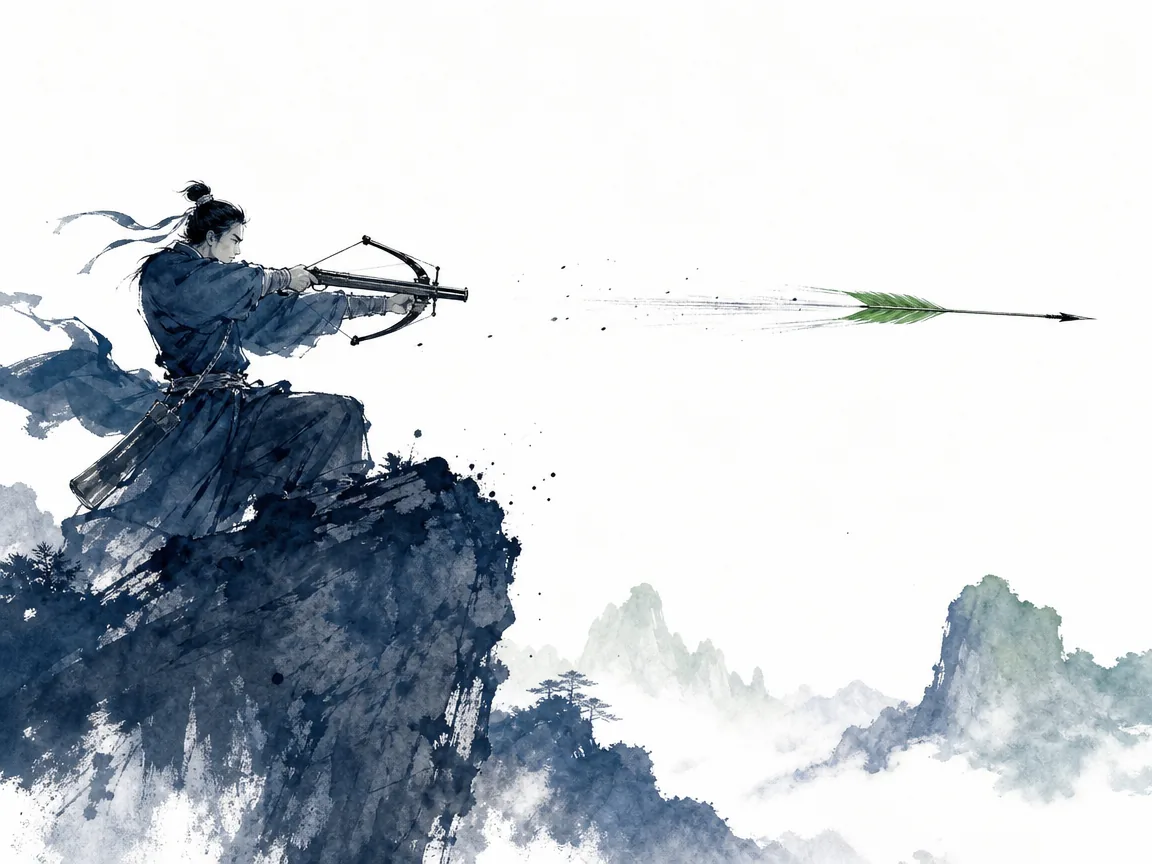
A smaller player suddenly upends an established giant. The market reshapes overnight. Competitors scramble, analysts rush to find the explanation, but the truth is often simpler—and stranger—than everyone assumes. The victor didn't win because it had more resources. It won because it accumulated enough asymmetry in one place and released it in a moment too short for opponents to react.
This is the essence of strategic momentum (shì, 势), a concept from Sun Tzu's Art of War, and specifically the principle known as “steep drop, short trigger” (shì xiǎn, jié duǎn, 势险节短). Rather than a generic piece of timing advice, this framework describes how energy density and release velocity determine outcomes far more reliably than raw force ever does. It is a philosophy of competitive advantage that applies equally to military campaigns, market strategy, and organizational decision-making—a foundational perspective explored in Art of War Chapter 10.
Winning is not about total resources. It is about concentrating enough advantage into a moment that the opponent cannot absorb, respond to, or redistribute against. Understanding “steep drop, short trigger” (势险节短) changes how we think about preparation, patience, and the willingness to act decisively when the window opens.
Art of War Chapter 10: Steep Drop, Short Trigger (势险节短)
Sun Tzu's discussion of strategic momentum (shì, 势) in Art of War Chapter 10 of the Art of War describes how decisive advantage is generated through the relationship between accumulated position and the speed of its release. The classical formulation, “its momentum is steep; its timing is brief” (qí shì xiǎn, qí jié duǎn, 其势险,其节短), is sometimes rendered as “the situation is dangerous; the rhythm is compressed.” A more intuitive version for modern readers might be: create a steep drop, then strike with a short trigger.
Two components work together. The steep drop (xiǎn, 险) is the asymmetry built across key dimensions. It is the gap that forms when one side has accumulated genuine advantage in intelligence, preparation, positioning, or technology while the opponent remains unaware or unprepared. The short trigger (jié duǎn, 节短) is the release of that accumulated advantage in a compressed instant. The strike must be fast enough that the opponent cannot redistribute, adapt, or reinforce.
Sun Tzu used vivid imagery to make this point. He compared effective momentum to mountain torrents that move boulders — not because water is harder than stone, but because force is concentrated. He also compared the release of energy to a hawk's strike — devastating not because of brute strength, but because power is focused into a single instant of contact The underlying principle is consistent: true impact comes from the density and velocity of energy release, not from its sheer volume.
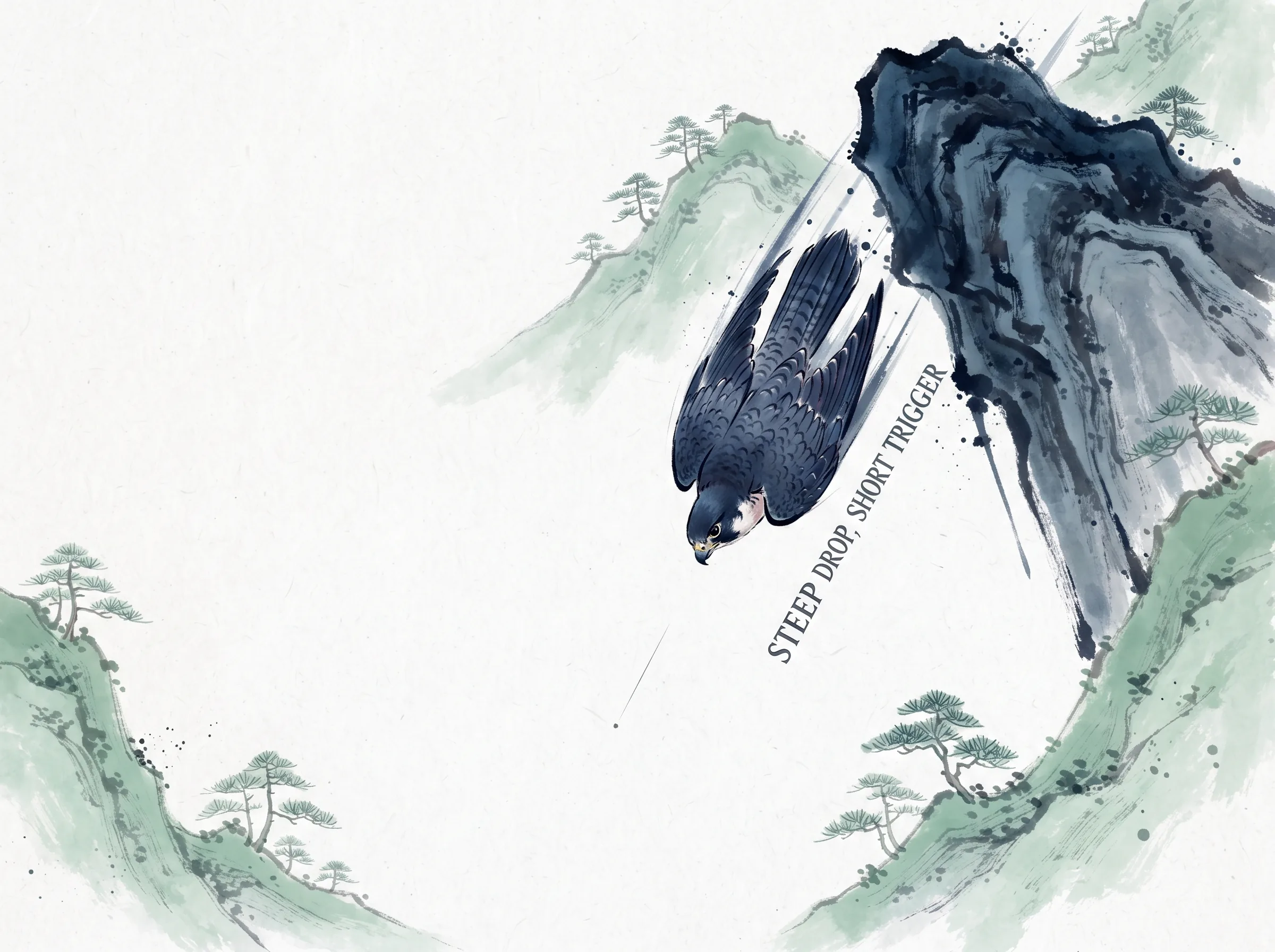
This is not simply "timing matters." It is a framework about energy density — how much advantage you accumulate across meaningful dimensions — and release velocity — how quickly you convert that advantage into action before the window closes. When both are present, small inputs can produce outsized outcomes.
Why Most Organizations Miss the Moment
Knowing that timing matters is not the same as getting it right. Most organizations — in business, in government, in any competitive field — fall into one of two predictable traps.
Premature release happens when an organization acts before the threshold of asymmetry has been crossed. There is an innate human sensitivity to opportunities — once effort has been invested, there is a temptation to convert it into results immediately. But releasing advantage before it has accumulated a sufficient gap (luòchā, 落差) means the action will lack decisive impact. What could have been a turning point becomes a costly probe.
Overdelayed release is the opposite failure. Here, decision-makers wait for a more convenient or "safer" moment. But stored strategic energy (shìnéng, 势能) does not remain constant. Competitors learn. Markets shift. Windows close. The longer you wait, the more the asymmetry you built evaporates, and the more the opponent adapts.
There is a further complication: the paradox of the center of gravity. In strategic theory, the center of gravity is the source of an opponent's power — the node whose collapse causes the broader system to lose cohesion. But the center of gravity is also where the opponent defends most heavily. Direct confrontation at that point often means spending massive resources against maximum resistance, neutralizing the very strategic momentum (shì, 势) the framework is meant to create. True strategic momentum requires finding the gap — the dimension the opponent overlooks — and building asymmetry there before striking.
The Six-Day War: A Lesson in Dimensional Accumulation and Compressed Release
The 1967 Six-Day War is widely studied as a textbook example of these principles in action. Israel faced an adversary with superior numbers and geographic advantage. Victory did not come from matching Egypt and its allies force for force. It came from a campaign of deep preparation followed by an operation of extraordinary compression. For the original military treatise and commentary, read the complete strategic translation and classical commentary of Terrain: The Six Grounds, Six Calamities, and the Sovereign Nature of Independent Command.
The “steep drop” (xiǎn, 险) was built across multiple dimensions over time. Israeli intelligence gathered detailed knowledge of Egyptian dispositions and capabilities. Training was highly refined (jīngxìhuà, 精细化) and scenario-specific. Weapons and tactics were tailored to the actual threat. Cognitive preparation — understanding how the opponent would think and react — was thorough None of these advantages alone would have guaranteed victory. Together, they created a genuine dimensional gap.
The “short trigger” (jié duǎn, 节短) came on June 5, 1967, when Israel launched Operation Focus (מבצע מוקד). The attack struck at a precise structural moment: Egyptian forces were transitioning from morning patrol routines into battle-readiness posture, and the window between those states was narrow Israeli aircraft hit multiple airfields nearly simultaneously, destroying much of Egypt's combat capability on the ground before it could be organized The decisive action was not spread across days. It was concentrated into hours.
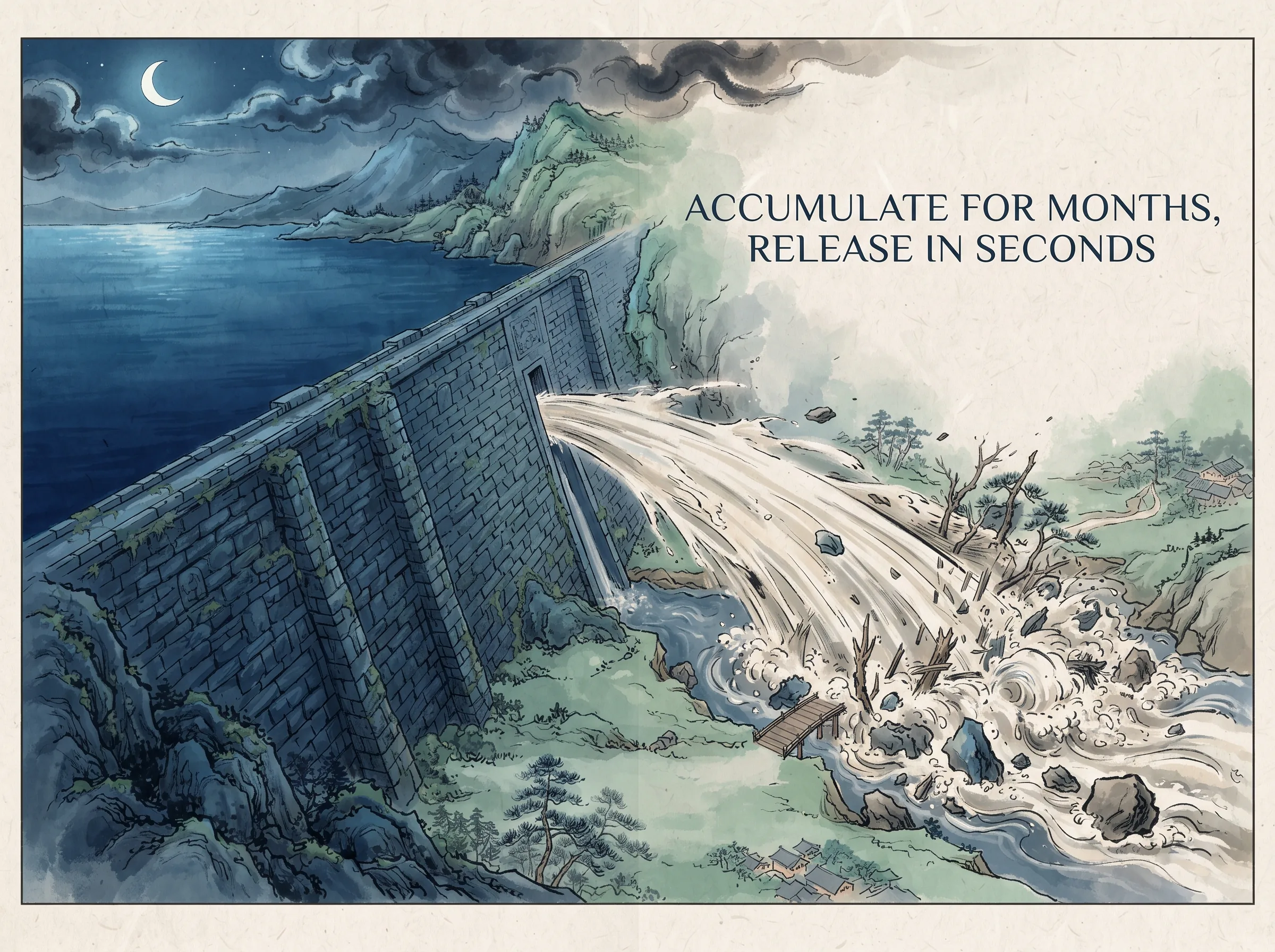
The lesson is not that luck played a role. The lesson is that the “steep drop” (xiǎn, 险) is not self-congratulation about preparation — it is a rigorous question: Have you accumulated real, dimensional, non-imagined advantage? If not, speed alone will not save you. If yes, then the compressed release is what transforms preparation into victory.
TikTok and the Business Parallel: Narrow Front, Synchronized Strike
The same logic appears in commercial competition. Consider how TikTok, developed by ByteDance, rose to global prominence [1].
TikTok did not win by being broader than its competitors. It won by accumulating high-density momentum along a narrowly defined front — algorithm, user experience, and content ecosystem — all working in concert. What ByteDance brought to international markets was not an experimental product. It was a system that had already been stress-tested in China's highly competitive domestic environment [1]. The algorithm had been refined. The creator tools had been optimized. The content loop had been reinforced by millions of daily users.
The timing of TikTok's global rollout was equally strategic. After launching outside mainland China in May 2017 and acquiring musical.ly in November 2017, ByteDance merged the two platforms in August 2018, creating a unified global product [1]. Rather than expanding slowly, country by country, the synchronized global push compressed competitors' reaction time. Major incumbents did not have the luxury of observing TikTok's trajectory and then responding — by the time they recognized the scale of the threat, ByteDance had already secured deep user engagement and network effects in multiple markets simultaneously.
The business parallel to “steep drop, short trigger” (势险节短) is clear: the threat to an incumbent is rarely comprehensive superiority. It is a focused, unreplicable capability gap executed at speed. Startups and challengers do not win by out-resourcing giants. They win by building something the giant cannot easily replicate along one axis and moving faster than the giant can organize a response.
Building “Steep Drop, Short Trigger” (势险节短) in Practice
The framework reduces to three disciplined actions. Each requires patience in one phase and decisiveness in another — and both phases are necessary.
First, build dimensional advantage across overlooked axes. Ask which dimensions your competitors are underinvesting in — data depth, product refinement, community trust, supply chain control, regulatory preparation, or cultural fluency in markets they treat as secondary. The “steep drop” (xiǎn, 险) is not about being stronger everywhere. It is about being meaningfully stronger somewhere specific that others are not.
Second, identify and act within the shrinking time window. Windows appear when structural conditions shift — a regulatory change, a competitor's misstep, a technological transition, an organizational restructure. Recognizing these transitions before they are obvious to everyone else is part of the advantage. Waiting past the window's closure is a decision in itself, and it is almost always the wrong one.
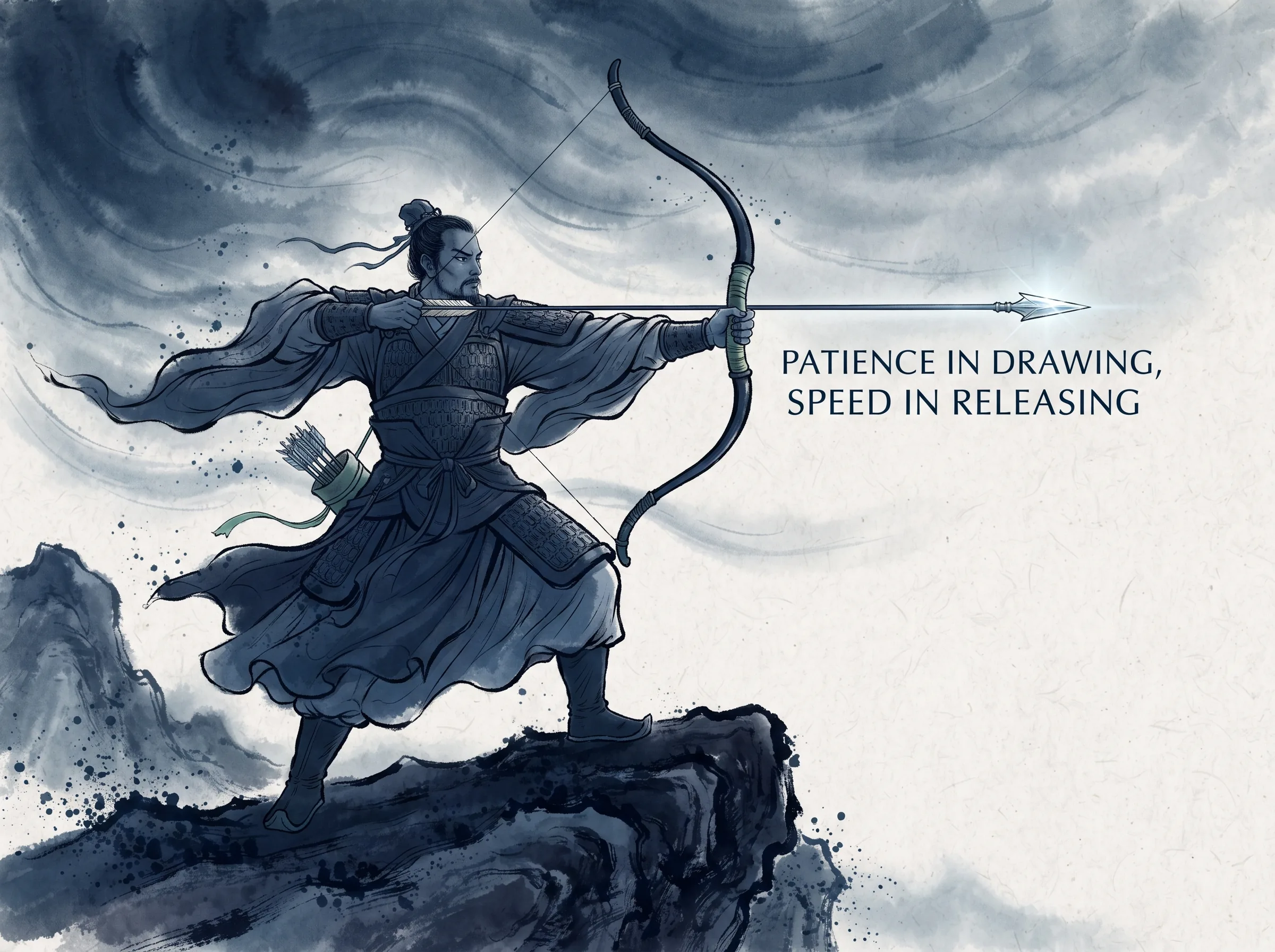
Third, release in a single concentrated action — never spread thin. Incrementalism gives opponents time to adapt. Piloting one market before another, rolling out features one at a time, or diversifying into too many directions at once dissipates the very strategic momentum (shì, 势) the framework is meant to create. The goal is coherence: all prepared elements moving together at the moment of release.
The practical checklist is simple but demanding:
- Is there a real gap (luòchā, 落差) — a genuine, verifiable advantage — and not merely confidence or hope?
- Is the time window closing, or are you assuming it will remain open indefinitely?
- Can you commit to a single concentrated action, or will internal friction scatter the effort?
These questions are not designed to discourage action. They are designed to ensure that when action comes, it carries the density and velocity that “steep drop, short trigger” (势险节短) requires.
What “Steep Drop, Short Trigger” (势险节短) Teaches Us About Patience and Decisiveness
The deeper wisdom of this principle lies in its balance. Building momentum (xùshì, 蓄势) requires patience — the willingness to invest time in preparation without demanding immediate return. Releasing it (shìfàng, 释放) requires decisiveness — the willingness to act fully when the moment arrives, without holding back for additional safety.
Most organizational failures come from imbalance in one direction or the other. Some act too early, mistaking activity for strategy. Others act too late, mistaking caution for prudence. Both patterns share the same root: an inability to distinguish between preparation and waiting, between accumulation and hesitation.
Sun Tzu's insight remains relevant because it names a fundamental truth about competitive dynamics: the world does not reward average strength distributed across time and space. It rewards concentrated advantage released at the right instant. Whether in war, business, or personal decisions, the principle holds.
The final challenge is personal: ask yourself whether you are building real asymmetry, whether you recognize the windows available to you, and whether you have the discipline to concentrate your effort when the time comes. “Steep drop, short trigger” (势险节短) is not a theory for passive observation. It is a framework for active preparation — and for the courage to strike when the moment demands it.
FAQ
What does “steep drop, short trigger” (势险节短) mean in plain language? It is a strategic principle from Sun Tzu's Art of War. The “steep drop” (xiǎn, 险) means building asymmetrical advantage across key dimensions, while the “short trigger” (jié duǎn, 节短) means releasing that advantage in a rapid, compressed action that gives opponents no time to react.
Is “steep drop, short trigger” (势险节短) the same as general “timing is important” advice? No. General timing advice suggests acting at the right moment. “Steep drop, short trigger” specifies how to create the conditions for that moment — by accumulating real, dimensional advantage (the “steep drop,” 险) and then executing a compressed release (the “short trigger,” 节短). Without the drop, speed is meaningless. Without the trigger, the drop dissipates.
How can I tell if I have a real “steep drop” (xiǎn, 险) or just overconfidence? Look for evidence of genuine asymmetry: verified intelligence, proven product-market fit, tested systems, or capabilities your competitors have not yet matched. Overconfidence typically lacks external validation and collapses under scrutiny. A real “steep drop” (xiǎn, 险) is measurable and repeatable, not merely felt.
Does this principle apply outside of business and military contexts? Yes. The underlying logic — accumulate asymmetry, then release it compressedly — applies to personal development, creative work, and any situation where concentrated effort produces disproportionate results. The framework is domain-neutral; its expressions change depending on context.
Sources & Further Reading
- The Art of War, Chapter 7 (“The Chapter on Strategic Momentum,” 势篇), Sun Tzu — classical source for the “steep drop, short trigger” (势险节短) concept
- The Art of War, Chapter 10 (“Terrain,” 地形篇) — contextual reference for terrain and strategic positioning
- Historical accounts of the 1967 Six-Day War and Operation Focus — widely documented in military history literature
Further Reading
- Sun Tzu, The Art of War — complete text for deeper study of strategic momentum (shì, 势), orthodox and unorthodox methods (qí-zhèng, 奇正), and related strategic concepts
- Carl von Clausewitz, On War — foundational text on center of gravity and friction in strategic operations
- Ray Dalio, Principles — frameworks for decision-making under uncertainty and the role of systematic preparation
To explore these themes from another angle, read our related reflection on Why Your Best Strategy Is Failing (and Sun Tzu Knew Why).
For a deeper comparative examination of these ideas, explore our related study on Attack by Stratagem: Subduing the Enemy Without Fighting and the Levels of Engagement.
Sources & Further Reading
[1] ByteDance – Inspire Creativity, Enrich Life






