

We live in an age of constant disturbance. News cycles never rest. Career paths fragment. Relationships shift. The noise is not occasional — it is the baseline condition of modern life, and most of us respond to it the same way: by pushing harder, by eliminating all vulnerability, by believing that if we just work efficiently enough, we can outrun the chaos.
This instinct makes sense. It also reveals a deeper misunderstanding about how systems actually work. The problem is rarely the disturbance itself. The problem is whether your system — mental, professional, personal — has been designed to metabolize disturbance at all. A system that has never practiced absorbing shocks does not become stronger when chaos arrives. It fractures—a foundational perspective explored in Sun Tzu Chapter 25 Strategy.
This insight is surprisingly aligned with classical Chinese thinking about preparedness and structural balance. Ancient military strategy, at its best, was never about brute force. It was about designing systems that could endure uncertainty. One of its clearest modern echoes is what philosopher Nassim Nicholas Taleb named "antifragility" — the quality of certain systems that actually improve when stressed, rather than merely surviving or breaking [1]. The ancient strategist Sun Tzu arrived at a similar conclusion long before the word existed. His advice was not to avoid disturbance, but to ensure you were never caught in a state from which recovery becomes structurally impossible.
Sun Tzu Chapter 25 Strategy: What Kind of System Are You?
To understand how to stay calm during chaos, it helps first to recognize what kind of system you are operating as. Not metaphorically — structurally.
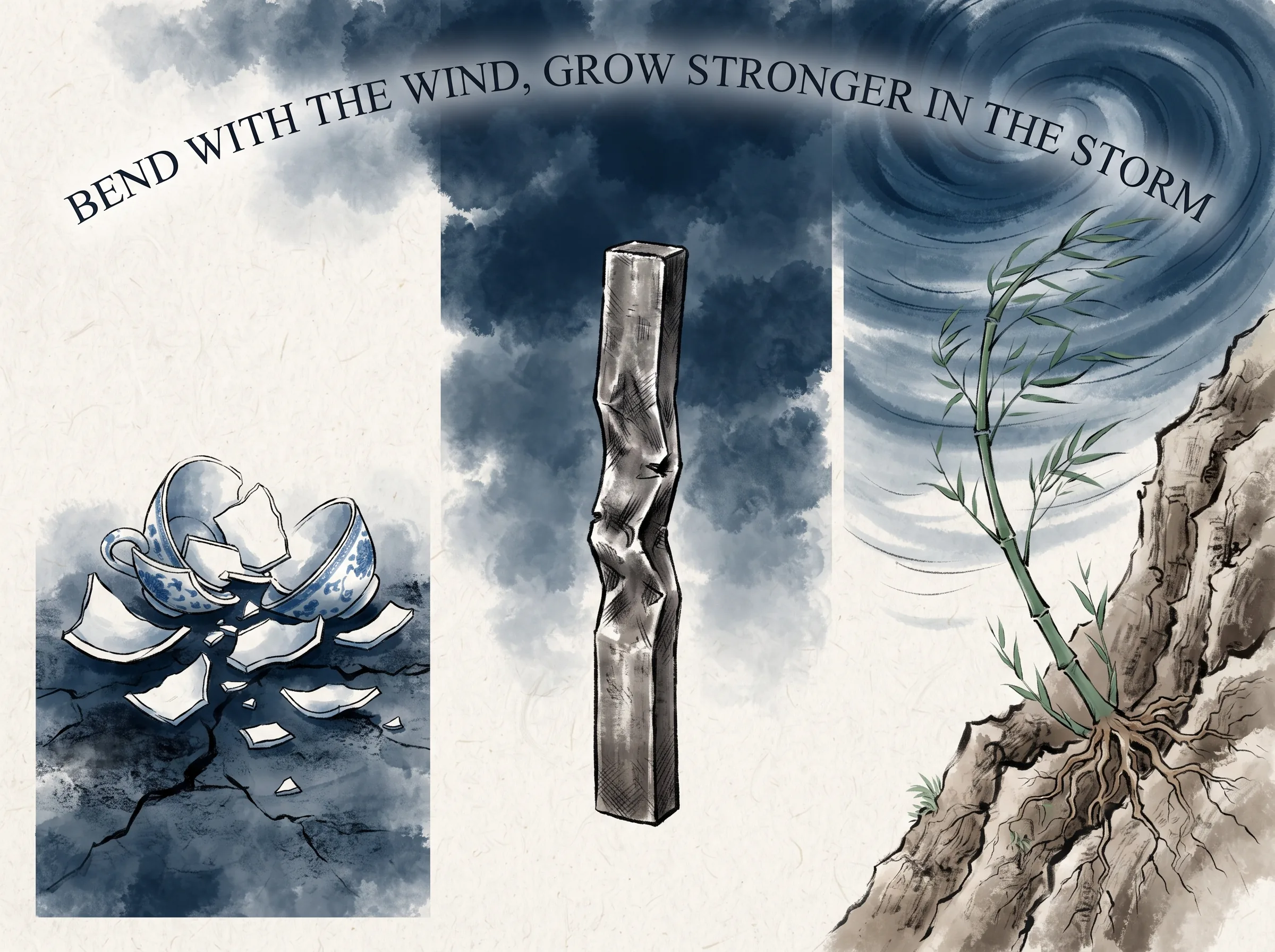
Systems under stress tend to fall into one of three categories. A fragile system breaks under pressure. A resilient system absorbs stress and returns to its original state. An antifragile system uses stress as information and reorganizes itself into a stronger configuration. The distinction between these is not about size, intensity, or how powerful the system appears on a good day. It is about how the system processes disturbance signals [1].
This framework maps directly onto human experience. Some people crumble under criticism. Others absorb it and return to baseline. A third group emerges from difficulty with greater clarity and capability. None of this is about personality alone. It is about the architecture underneath — the hidden design choices that determine whether a setback dismantles you or refines you.
The ancient Chinese strategic tradition understood this intuitively, even if it did not use Taleb's terminology. Sun Tzu's Art of War repeatedly warns commanders against entering situations from which there is no meaningful recovery. These warnings are not about courage. They are about structural awareness.
Continue with the deeper interpretation and practical application.
ChiDestiny members get access to the full analysis, modern applications, and the growing Chinese Wisdom Library.
FAQ
Is "antifragility" an ancient Chinese concept or a modern one?
The term "antifragility" was coined by Nassim Nicholas Taleb in the twenty-first century, though the underlying intuition — that certain systems improve through stress rather than merely resist it — appears across many strategic and philosophical traditions, including classical Chinese thought [1].
Does Sun Tzu explicitly discuss resilience or system design?
Sun Tzu's Art of War focuses on strategy, positioning, and preparation rather than modern systems theory. Passages that echo antifragile thinking — such as warnings against entering irreversible states or advice to maintain logistical surplus — are interpretive connections drawn by contemporary readers, not explicit statements in the text.
Can I build antifragility in my personal life, or is this only relevant to organizations?
Both. The principles of redundancy, fast feedback, and decentralization apply to personal habits, career structures, relationships, and finances, just as they apply to software systems and military logistics. The scale changes; the architecture does not.
What is the most practical first step toward becoming more antifragile?
Begin with redundancy. Identify one area where you are operating at full capacity with no buffer — whether time, energy, finances, or support — and intentionally add a small surplus. Even a modest buffer changes how you respond to unexpected disruption, reflecting the enduring wisdom of Sun Tzu Chapter 25 Strategy.
To explore these themes from another angle, read our related reflection on How Collapse Is Never Sudden: Sun Tzu’s Warning for Modern Systems.
For a deeper comparative examination of these ideas, explore our related study on Protecting Your Mind in the Age of Cognitive Warfare: Sun Tzu’s Warning on Information Manipulation.
Sources & Further Reading
[1] Incerto series — Penguin Random House publisher overview of Nassim Nicholas Taleb's work, including the concept of antifragility.
[2] Completing the Netflix Cloud Migration — Netflix official blog documenting the company's seven-year migration to AWS, completed in early 2016.
[3] Chaos Monkey — Netflix open-source project that randomly terminates production instances to ensure system resilience.
[4] The Military Machine (Chapter 8) — Cambridge History of the Mongol Empire overview of Mongol military organization, including decimal command structure and adaptive use of diverse forces.
Further Reading (延伸阅读)
- Nassim Nicholas Taleb, Antifragile: Things That Gain from Disorder (2012) — the full development of the antifragility concept.
- Sun Tzu, The Art of War — particularly the Xingjun (Military Marching) chapter, which addresses positioning, terrain, and preparedness.
- The Cambridge History of the Mongol Empire, Volume 1 — for detailed historical analysis of Mongol military organization and adaptive strategy.






