

You receive a headline that perfectly confirms everything you already believed about a rival company, a political opponent, or a cultural issue. It feels revelatory — evidence that your instincts are correct. Then, weeks later, you learn it was fabricated, strategically leaked, or algorithmically amplified by actors who understood your biases far better than you understood yourself. This is no longer science fiction. It is the routine texture of modern information life.
The Chinese military strategist Sun Tzu wrote over two millennia ago about a world that, in many structural ways, resembles our own — a world where perception is terrain, where belief can be planted like a mine, and where the most dangerous battlefield is the mind of the opponent. His thirteenth chapter, on the use of intelligence (Yòng Jiàn, 用间), does not merely describe deception as a tactic. It treats cognitive manipulation as the most expensive weapon in any arsenal — one that should be deployed only with extreme caution, and only after understanding that the same mechanisms available to poison others' minds are always available to poison your own—a foundational perspective explored in Sun Tzu Chapter 31 Strategy.
The central question for our age is therefore not whether manipulation exists — it clearly does — but how we cultivate the discernment to navigate it without becoming paralyzed or cynical. Sun Tzu's framework, read alongside the broader currents of classical Chinese philosophy, offers not a checklist for detecting lies but a structure for understanding why some deceptions succeed, why most fail, and what it costs everyone involved when they do.
Sun Tzu Chapter 31 Strategy: The Hidden Cost of Every False Signal
When Sun Tzu addresses the use of intelligence in the Yong Jian chapter, he frames it in economic terms that are surprisingly modern. The strategic value of any deception, he suggests, must be weighed against the full cost of producing and sustaining it — not merely the one-time effort of creation, but the ongoing burden of maintenance and the long-term damage of exposure. Most people, then as now, count only the cost of planting a lie. They forget that a successful deception requires living inside the fiction long enough for it to appear credible, and that when it collapses, the fallout extends far beyond the immediate failure.
This full-cost accounting reveals something important: most cognitive attacks are not economical. The ratio of benefit to total cost — where the costs include the resources needed to implant the narrative, the continuous effort to maintain consistency, and the permanent erosion of credibility once the deception is uncovered — tends to favor restraint. A manipulation that appears profitable on first glance often proves disastrous when the hidden costs are included.
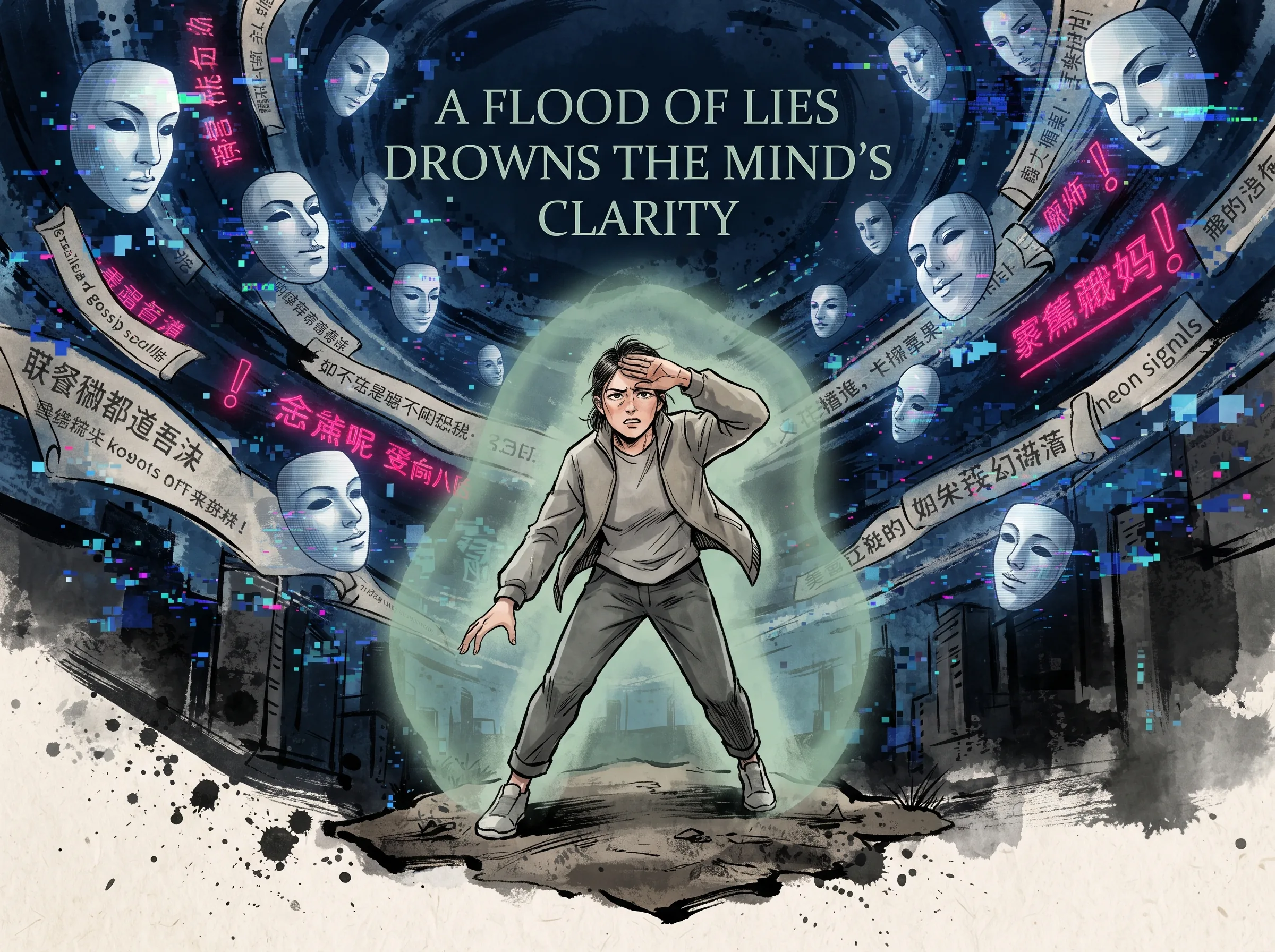
The Daoist concept of wu wei (无为) — often translated as "non-doing" or "effortless action" — aligns with this insight in a subtle way. As the Stanford Encyclopedia of Philosophy notes, the Daoist ideal involves acting not from personal desire or the impulse to force outcomes, but by responding to circumstances as they actually are [1]. Applied to information warfare, wu wei suggests that the most effective stance may not be to actively manufacture counter-narratives, but to cultivate the clarity to see through manufactured ones before investing energy in them. The least costly defense is one that does not require constant combat.
Continue with the deeper interpretation and practical application.
ChiDestiny members get access to the full analysis, modern applications, and the growing Chinese Wisdom Library.
FAQ
Q: Is Sun Tzu's Yong Jian chapter really about information warfare, or is that a modern projection?
The Yong Jian chapter specifically addresses the use of spies and intelligence in warfare. Reading it as a framework for understanding information manipulation is an interpretive extension, not a literal claim about Sun Tzu's intent. However, the chapter's emphasis on the costs of deception, the value of turned intelligence, and the fragility of credibility provides a structure that maps reasonably well onto contemporary concerns about disinformation.
Q: Does Sun Tzu recommend avoiding all forms of deception?
No. Sun Tzu acknowledges that deception is a legitimate component of strategy. What he warns against is the casual or repetitive use of deception — the assumption that it is inexpensive or consequence-free. The Yong Jian chapter treats deception as a high-cost instrument, appropriate only when the anticipated return significantly outweighs the full cost of implantation, maintenance, and potential backlash.
Q: How do I know which sources to trust when I can't verify everything myself?
Sun Tzu's framework suggests evaluating sources not by their volume of output but by the consistency and cost of their credibility. Sources that repeatedly produce accurate information over long periods, especially when correction is possible and inexpensive, tend to accumulate trust capital. Sources that profit from ambiguity or emotional intensity may be accelerating their credibility consumption. This is a heuristic, not a guarantee — but it is one rooted in the economic logic Sun Tzu himself articulated.
Q: Can classical Chinese philosophy really help with something as modern as deepfakes?
The specific technologies are new, but the underlying dynamics — the manipulation of perception, the economics of belief, the fragility of trust — are ancient problems dressed in modern clothing. Classical Chinese philosophy does not offer technical solutions for deepfake detection. It offers a vocabulary and a set of disciplined questions for thinking clearly about when and why beliefs are being shaped, and at what cost.
Conclusion
The age of cognitive warfare is not a departure from history but a continuation of it — only the tools have changed, and the scale has expanded. Sun Tzu's Yong Jian chapter reminds us that manipulation is not free, that trust is finite, and that the most dangerous battles are those fought in the space between a piece of information and the mind that receives it. The practical wisdom of classical Chinese philosophy does not promise protection from every deception. It offers something more durable: the habit of questioning, the discipline of patience, and the recognition that the strongest defense against manufactured belief is a mind trained to see clearly.
The next step is not to become a detective of every headline but to cultivate the stillness that allows discernment to emerge. Start by pausing before sharing, before believing, before acting on information that feels urgently true. Ask the three questions. Check the maintenance cost. Consider the credibility trail. Over time, this practice becomes second nature — and in a world designed to bypass your attention, second nature is the best defense you can build, reflecting the enduring wisdom of Sun Tzu Chapter 31 Strategy.
To explore these themes from another angle, read our related reflection on Why “Winning Every Battle” Can Lose the War.
For a deeper comparative examination of these ideas, explore our related study on Why Knowing What to Do Isn’t Enough: Sun Tzu’s Hidden Lesson on Adaptation.
Sources & Further Reading
[1] Stanford Encyclopedia of Philosophy — Religious Daoism — Discussion of wu wei and the Daoist understanding of non-coercive action.
[2] Stanford Encyclopedia of Philosophy — Confucius — Analysis of xin (trustworthiness) as a central Confucian virtue.
[3] Imperial War Museums — Operation Mincemeat Hackney Mortuary Memorial — Historical record of the 1943 British deception operation, including details about Major William Martin and the false documentation.
[4] Transcript analysis of Sun Tzu's Yong Jian chapter concepts, discussing the economic framing of cognitive manipulation, the ranking of fan jian and si jian, and the three-question decision framework.






