

A 2,500-year-old general once argued that the most important chapter of his masterwork was also the one most readers skip. In the final section of The Art of War, Sun Tzu pivots away from tactics, terrain, and momentum and names something far more fundamental: the work of knowing beforehand. What looks like decisive advantage on the surface, he suggests, is usually the visible tip of investments made quietly, years earlier, in channels most people never build.
This idea does not require belief in destiny or divine insight. It requires only a sober reading of how information moves through systems — and how organizations, leaders, and individuals accumulate or waste time they can never get back. The question this piece explores is practical, not mystical: when people speak of a competitor winning “against the odds,” what invisible preparation usually preceded that moment? And what does a classical Chinese approach to foresight offer to anyone building durable advantage today? This principle is central to Sun Tzu Chapter 30 Strategy.
Sun Tzu Chapter 30 Strategy: Why the Last Chapter Matters Most
The Art of War is commonly read as a manual for strategy, positioning, and timing. Its twelve earlier chapters cover everything from ground to siege to adaptation. Yet Sun Tzu closes with a chapter on information itself, and that closing move is harder to skip than it first appears. It functions less as an afterthought than as a foundation. Without accurate perception, none of the downstream strategies have reliable material to act on.
In classical terms, the text emphasizes that extraordinary results do not come from superior force alone but from foreknowledge (xiān zhī, 先知) — knowing what the opponent does not yet know and moving from a position of prepared clarity. This principle turns the usual narrative upside down. Instead of asking how to win the battle, it asks who built the channels that make the battle winnable before it begins.
The modern parallel is straightforward. Organizations described as “winning fast” rarely did so by accident. They usually had years of invisible preparation behind them: early bets on data systems, relationships with people inside competitors’ ecosystems, patient investment in R&D, and a willingness to absorb short-term cost for long-term positioning. When outsiders call it speed, insiders usually recognize it as compound interest paid in advance.
What “Knowing Beforehand” Actually Means
Sun Tzu is strikingly unsentimental about where reliable foresight comes from. He explicitly rules out three common shortcuts:
- Divination or luck — appealing to fate, omens, or cosmic alignment provides no repeatable edge.
- Blind analogy from past patterns — assuming that what worked before will work now ignores that contexts change faster than nostalgia admits.
- Pure calculation alone — models and spreadsheets describe the world as it was, not as it is becoming.
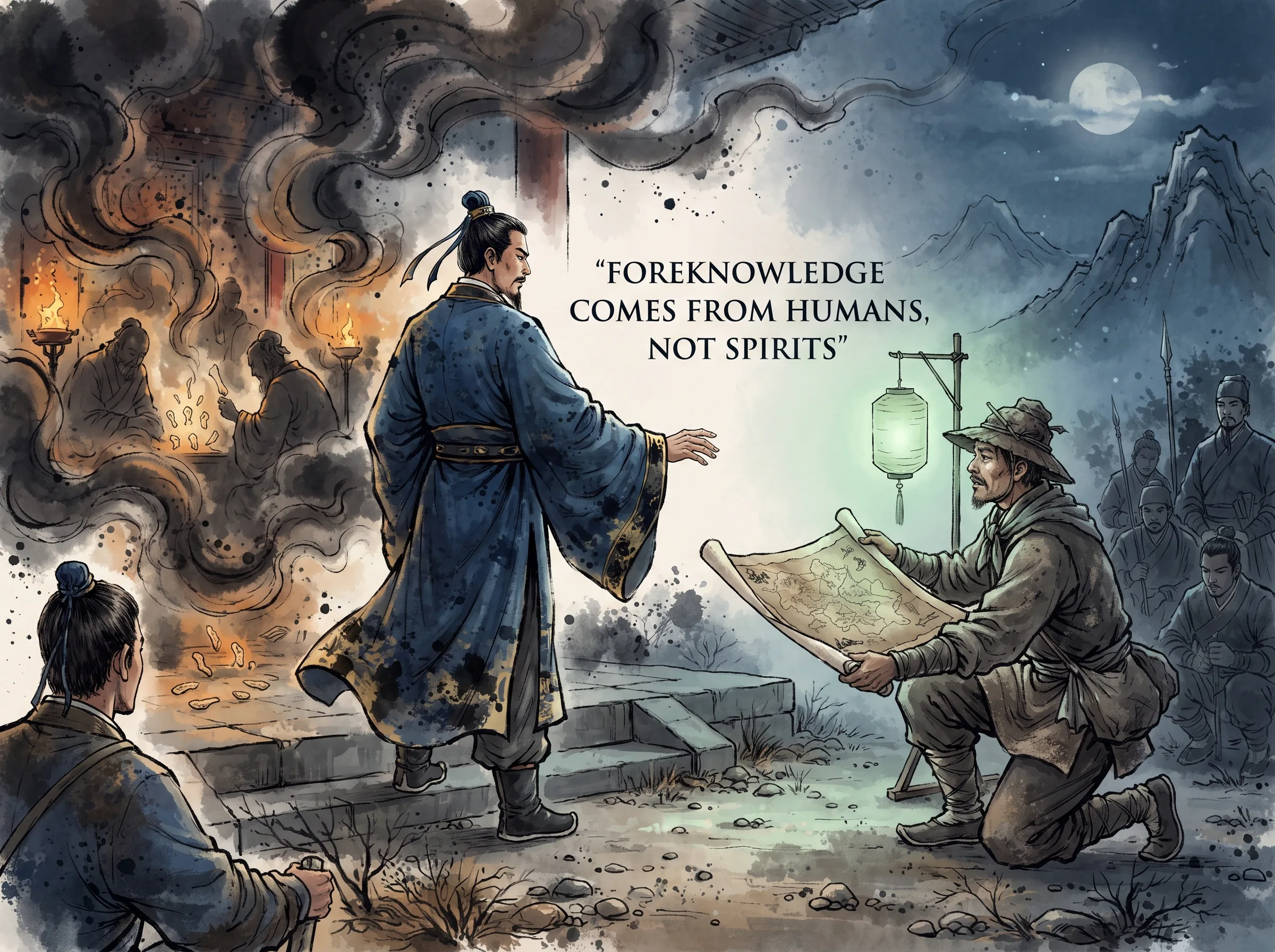
What remains is human intelligence. The text argues that only someone embedded inside an opponent’s system can surface information that cannot be deduced from public data or mathematical exercise alone: the real internal state, the actual morale, the timing of leadership decisions, the cracks in execution.
This distinction matters because it reframes foresight from a trait into a practice. You do not wait for insight to arrive. You build the channels through which it can arrive. A dashboard tells you what already happened. Only deep, structured human insight reveals what is about to happen.
Continue with the deeper interpretation and practical application.
ChiDestiny members get access to the full analysis, modern applications, and the growing Chinese Wisdom Library.
FAQ
Q: Does Sun Tzu really argue that information matters more than tactics? The final chapter reframes the entire work around foresight. Tactical brilliance is treated as secondary to the prerequisite of knowing what the opponent is doing before the opponent knows you know it.
Q: Is the Coventry story true? Popular accounts often claim Coventry was intentionally left undefended to protect codebreaking secrets, but GCHQ identifies that version as a widely spread myth. What is historically documented is that British intercepts confirmed the target that day, and post-attack defenses were strengthened [1].
Q: Did Amazon invent AWS in 2006? No. AWS launched publicly in 2006 [3], but the internal infrastructure and API standardization work traces back to earlier planning, including recognition of the need for reusable foundational services by 2003 [2].
Q: What should I invest in if I cannot afford a large intelligence budget? Start with relationship depth, not budget size. One strong channel inside a competitor or adjacent industry often outperforms dozens of surface-level subscriptions. Even small, consistent investment in people who see the system from the inside compounds faster than generic data, reflecting the enduring wisdom of Sun Tzu Chapter 30 Strategy.
To explore these themes from another angle, read our related reflection on Why Brilliance Alone Isn’t Enough: Building Structures Where Victory Is Already Written.
For a deeper comparative examination of these ideas, explore our related study on Why the Best Leaders Stop Searching for Heroes.
Sources & Further Reading
[1] The Bombing of Coventry in WWII — GCHQ Historical Records
[2] Amazon CEO Andy Jassy’s 2023 Letter to Shareholders
[3] Amazon Web Services Launches — US Press Center
Further reading
- Sun Tzu, The Art of War, final chapter on “Using Spies” — for the classical framework on information and foresight
- Historical analyses of Bletchley Park and WWII codebreaking — for deeper context on intelligence investment and its trade-offs






