
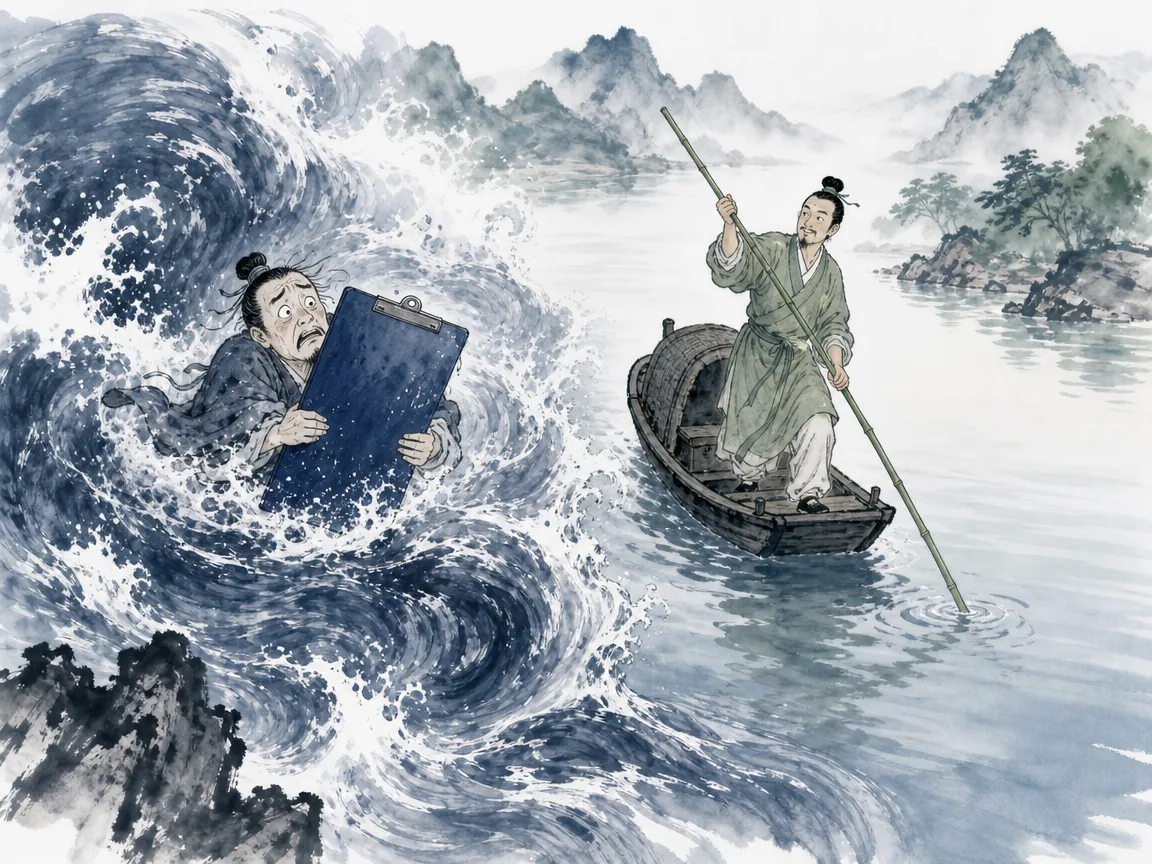
You have spent weeks — maybe months — designing the perfect plan. The timelines are clear, the roles are assigned, the milestones are set. And then you begin to execute. Within days, things start shifting. Deadlines slip. Teams misalign. What looked coherent on paper unravels in practice.
This moment — the transition from planning into action — is where most strategies quietly fail. Not because the plan was bad, but because something fundamental was overlooked: static advantages decay the moment a system starts moving. What matters is not whether you can act, but whether you can stay in control while you act—a foundational perspective explored in Sun Tzu Chapter 23 Strategy.
Ancient Chinese strategic thought understood this tension deeply. Long before modern management theory developed frameworks for execution, thinkers like Sun Tzu were examining what happens when systems transition from stillness into motion. The insight is counterintuitive and unsettling: problems do not begin when plans fail. They begin when plans succeed in launching action.
Sun Tzu Chapter 23 Strategy: The Gap Between Planning and Execution
The gap between planning and execution is where real trouble begins — and not always in the way we expect. We tend to assume that once we have a good plan, the hard part is over and execution will follow smoothly. In reality, execution is where invisible forces surface that no Gantt chart or spreadsheet can capture.
Consider what happens when a marketing campaign launches and then spirals off-script, or when a product launch date keeps slipping despite meticulous scheduling, or when team dynamics shift in ways nobody anticipated. These are not signs of poor planning. They are signs that the system is revealing resistance that only exists in motion.
A static plan is a snapshot — a frozen representation of what the world is supposed to look like. But once you start moving, terrain changes, opponents adapt, and internal coordination gaps emerge. These are not anomalies. They are the normal state of any complex system in motion.
Three Kinds of Friction That Only Appear in Motion
In the 20th century, the Prussian military theorist Carl von Clausewitz introduced the concept of "friction" to explain why the real world of action rarely matches the clean logic of planning. He described friction as the cumulative force that makes simple things difficult and reality diverge from expectation. While Clausewitz developed this idea within the context of European warfare, the pattern it describes is universal — and it appeared in Chinese strategic thought centuries earlier.
What Sun Tzu observed — and what modern organizational theory continues to confirm — is that friction multiplies in three distinct forms once a system begins to move.
Terrain friction is the first. Maps and ground truth diverge. The route you chose on paper looks very different once your team actually walks it. In business terms, this might mean entering a market where regulatory complexity, cultural nuance, or logistical reality makes the path far more difficult than preliminary research suggested. The terrain was always there. You just could not see it from a distance.
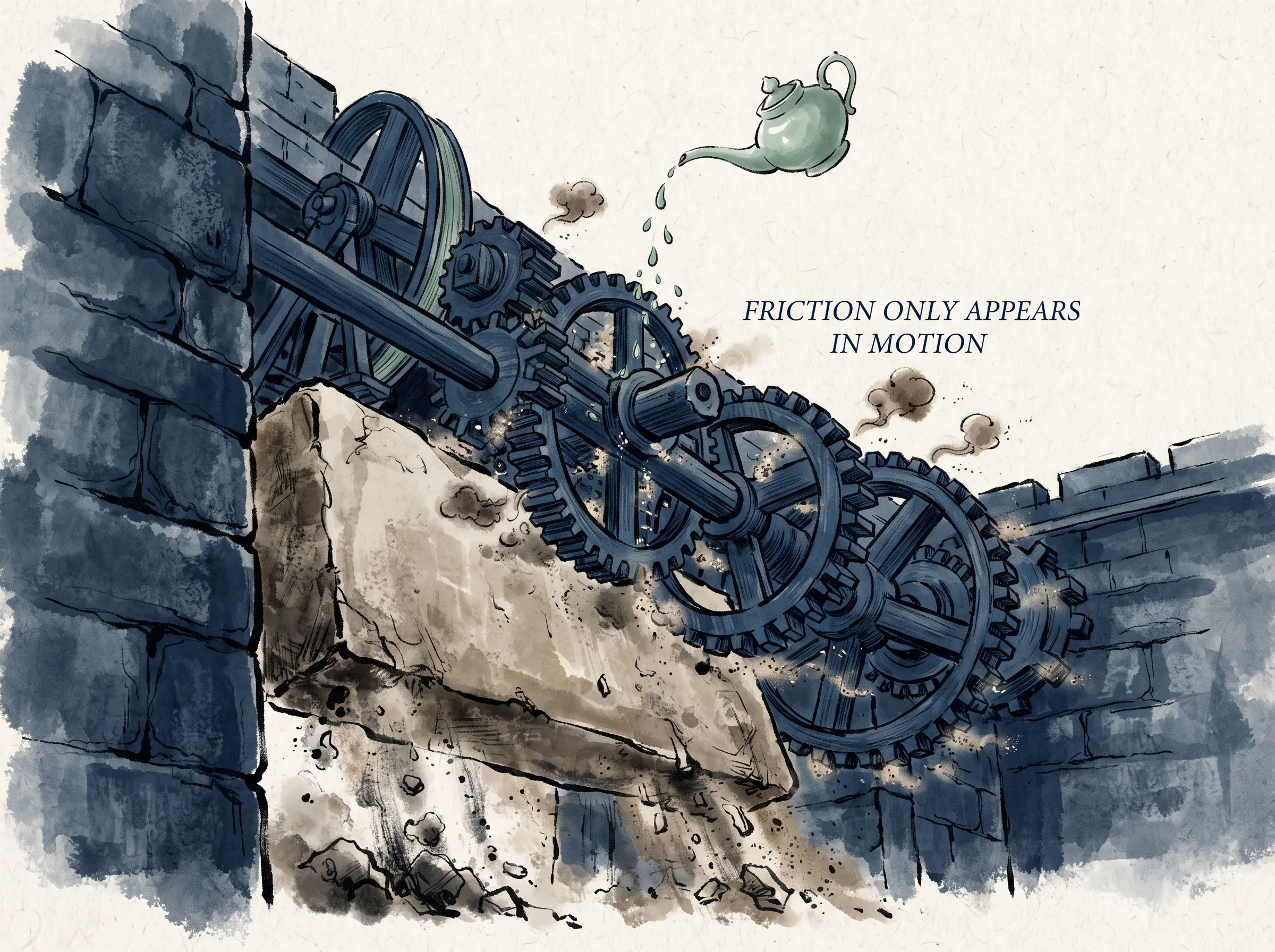
Opponent friction arises from adaptation. Markets, competitors, customers, and colleagues all respond to your moves in ways that past data cannot fully predict. When you enter a new competitive space, you are no longer playing against a static profile — you are playing against actors who are watching you, learning, and adjusting. This is true whether you are a state actor or a startup disrupting an industry.
Internal friction is often the most destructive because it is the hardest to see. Hidden coordination failures, information delays, and misaligned incentives remain invisible when a system is still. But under pressure, they surface as missed signals, duplicated efforts, and slow decision-making. The deeper the organization, the wider the gap between what frontline teams experience and what leadership understands.
These three forms of friction compound each other. Terrain slows you down. Opponents exploit the delay. Internal misalignment prevents you from adapting quickly enough. By the time the problems become visible, the system has already drifted significantly from its original plan.
Continue with the deeper interpretation and practical application.
ChiDestiny members get access to the full analysis, modern applications, and the growing Chinese Wisdom Library.
Frequently Asked Questions
Q: If plans always fall apart in execution, isn't planning pointless?
No. Planning is essential for establishing direction, aligning resources, and creating a shared understanding of objectives. The point is not that planning is useless but that planning is only the beginning. A plan is a hypothesis about how the world will behave. The discipline of control is what lets you test that hypothesis, adjust when it proves wrong, and continue moving without losing coherence. The most effective planners treat their plans as starting points, not blueprints.
Q: Does Sun Tzu actually say "a general on campaign need not await orders from the throne"?
The classical maxim "a general in the field may decline royal commands" (jiāng zài wài, jūn mìng yǒu suǒ bù shòu, 将在外,君命有所不受) is a traditional rendering that appears in strategic commentary. The principle is found in the Art of War, specifically in the chapter on Tactical Dispositions (九变篇), where Sun Tzu writes that there are royal orders a general need not execute. The essence — that commanders in the field require autonomous judgment — is consistently attributed to Sun Tzu across scholarly traditions, even as the precise wording varies across translations and editions.
Q: How do I know when to delegate versus when to intervene centrally?
A useful rule of thumb: delegate decisions where speed and local information matter more than uniformity; reserve central intervention for decisions where consistency across the system is genuinely important. If a local choice affects only one market, one team, or one product line, it likely belongs at the frontline. If it affects the entire organization's strategic direction or brand integrity, it may require central oversight. The key is to define these categories explicitly — ambiguity about where authority lies is itself a source of friction.
Q: Can layered control work in small organizations, or is it only relevant for large ones?
Layered control is relevant at any scale. Even a small team experiences information distortion when the founder or CEO is removed from day-to-day operations. The principle is not about organizational size but about the gap between decision-makers and the reality of action. In a startup of ten people, that gap may be small, but it still exists — and it grows rapidly as the organization scales. Building distributed judgment early, before hierarchy becomes rigid, makes the transition smoother.
What Comes Next
Understanding that friction is inevitable is not the same as learning to navigate it. The transition from recognizing the problem to building systems that can handle it requires deliberate practice — designing feedback loops, clarifying decision authority, and creating cultures where bad news travels faster than good news.
For those interested in exploring this topic further, the intersection of classical Chinese strategy and modern organizational theory offers rich ground. Works on systems thinking, military history, and strategic management all touch on the dynamics described here, each from a different angle. The core insight — that control in motion requires a different kind of design than control in stillness — is one that transcends any single tradition or discipline.
If you are leading a team, running a project, or building an organization, the question is not whether plans will unravel. It is whether your system is designed to adapt when they do, reflecting the enduring wisdom of Sun Tzu Chapter 23 Strategy.
To explore these themes from another angle, read our related reflection on Why the Strongest Opponents Sometimes Collapse Without Warning.
For a deeper comparative examination of these ideas, explore our related study on Why You Miss the Warning Signs — And How Sun Tzu Predicted It 2,500 Years Ago.
Sources & Further Reading
[1] German Soldiers in Russia, 1812: Introductory Text • Making War, Mapping Europe • Department of History and Cultural Studies — Information on Napoleon's 1812 Russian campaign, including supply difficulties, scorched-earth tactics, the multinational composition of the Grande Armée, and casualty figures.
Further Reading
- Sun Tzu, The Art of War (孙子兵法) — Primary text referenced for strategic concepts including distributed command authority and the importance of continuous intelligence-gathering.
- Carl von Clausewitz, On War (Vom Kriege) — Source of the concept of "friction" in military operations and its relevance to the gap between planning and execution.
- Daniel Kahneman, Thinking, Fast and Slow — Discussion of the planning fallacy and how decision-makers systematically underestimate the time, costs, and risks of future actions.
- Donella Meadows, Thinking in Systems — Framework for understanding how information flows and distorts within complex systems.
- Classical Military Commentary Series — Slow Reading The Art of War: Marching (慢读《孙子兵法》第二十三篇·行军) — Conceptual analysis of strategic mobility and organizational control.






