
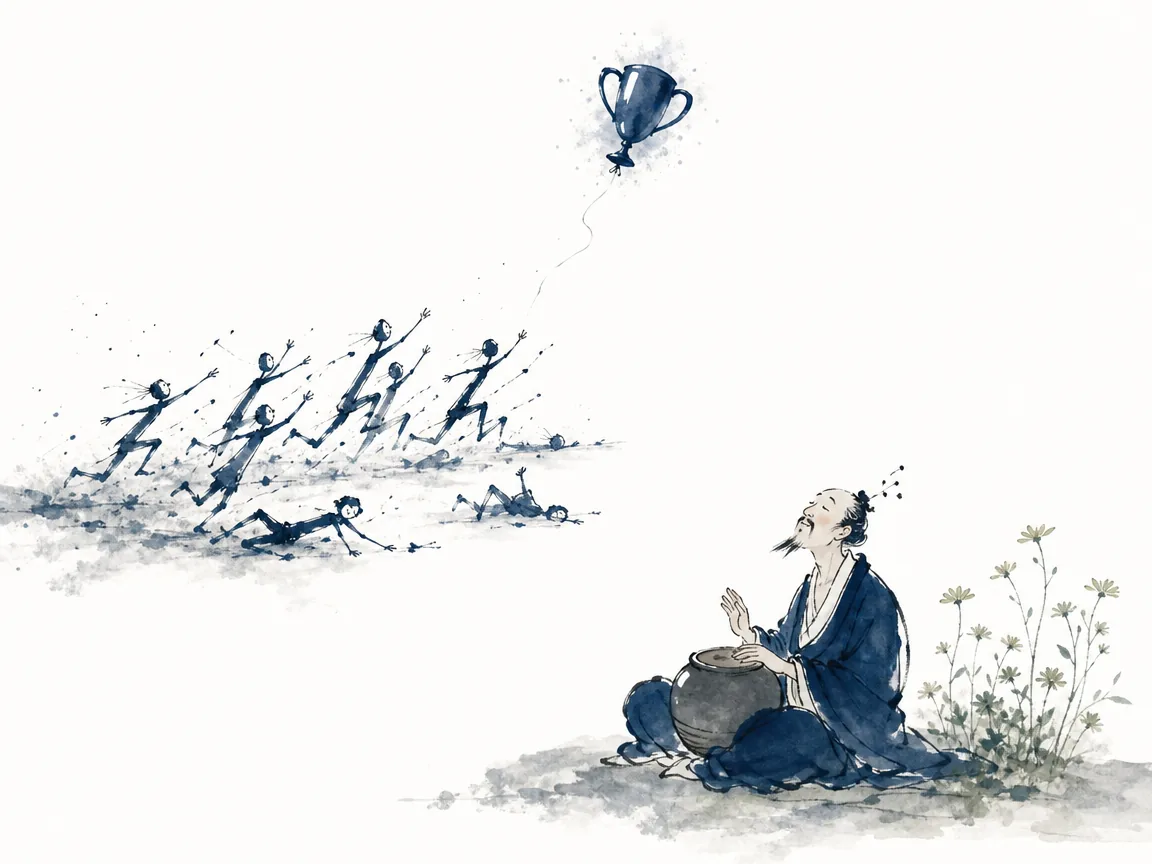
We live in an age that treats happiness as a destination. Scroll through any social media feed, browse any bookstore's self-help section, or simply listen to everyday conversation, and the message is remarkably consistent: if you just earn more money, build the right relationships, reach the next milestone, or optimize your routine, happiness will arrive. And when it doesn't — when the promotion arrives and the excitement fades within weeks, when the new relationship settles into ordinary routine, when the vacation ends and Monday returns — the assumed conclusion is that you haven't found the right formula yet. You need to try harder, want it more, adjust your approach.
But what if the problem isn't that you haven't found enough happiness? What if the problem is that you have been understanding happiness wrong? This principle is central to Zhuangzi Chapter 18.
More than two thousand years ago, a thinker in the Zhuangzi tradition asked nearly this exact question. Chapter 18 of the Zhuangzi — traditionally titled "Complete Happiness" or "Ultimate Joy" (至乐) — opens not with advice on how to feel better, but with a radical challenge to the whole project of happiness-chasing [1]. The chapter suggests that ordinary joy, the kind we measure in acquisitions and approvals, may be precisely what keeps us trapped in a cycle of wanting and losing. The deepest peace, it proposes, comes not from getting what we desire, but from understanding why desire itself becomes a cage.
Zhuangzi Chapter 18: and Why It Fails
The happiness most people pursue is conditional. It arrives when circumstances align: you get the job, the partner stays, the health scan is clear, the bank account grows, the applause comes. And it vanishes when those conditions shift. This is what the Zhuangzi tradition identifies as a fundamental misunderstanding — joy built on external conditions is not freedom, it is dependency [1].
There is a quiet paradox at the heart of this kind of happiness. The more you possess, the more you have to lose. The richer you become, the more anxiety attends your wealth. The more famous you grow, the more vulnerability attaches to your name. Zhuangzi observed this pattern long before modern psychology gave it a name: every possession carries its own specific anxiety [1]. The wealthy fear poverty. The powerful fear displacement. The long-lived fear aging. The celebrated fear scandal. Each position on the ladder of success comes with a corresponding fear — and that fear becomes the price of the view.
Modern life has engineered this dynamic into near-perfection. Social media rewards the pursuit of external validation with a feedback loop that mirrors, in miniature, the ancient pattern Zhuangzi described. A post earns likes — temporary satisfaction. The next post needs more — escalation. Self-worth becomes tethered to fluctuating metrics. The result is not happiness but a kind of emotional rent, paid daily to forces outside your control.
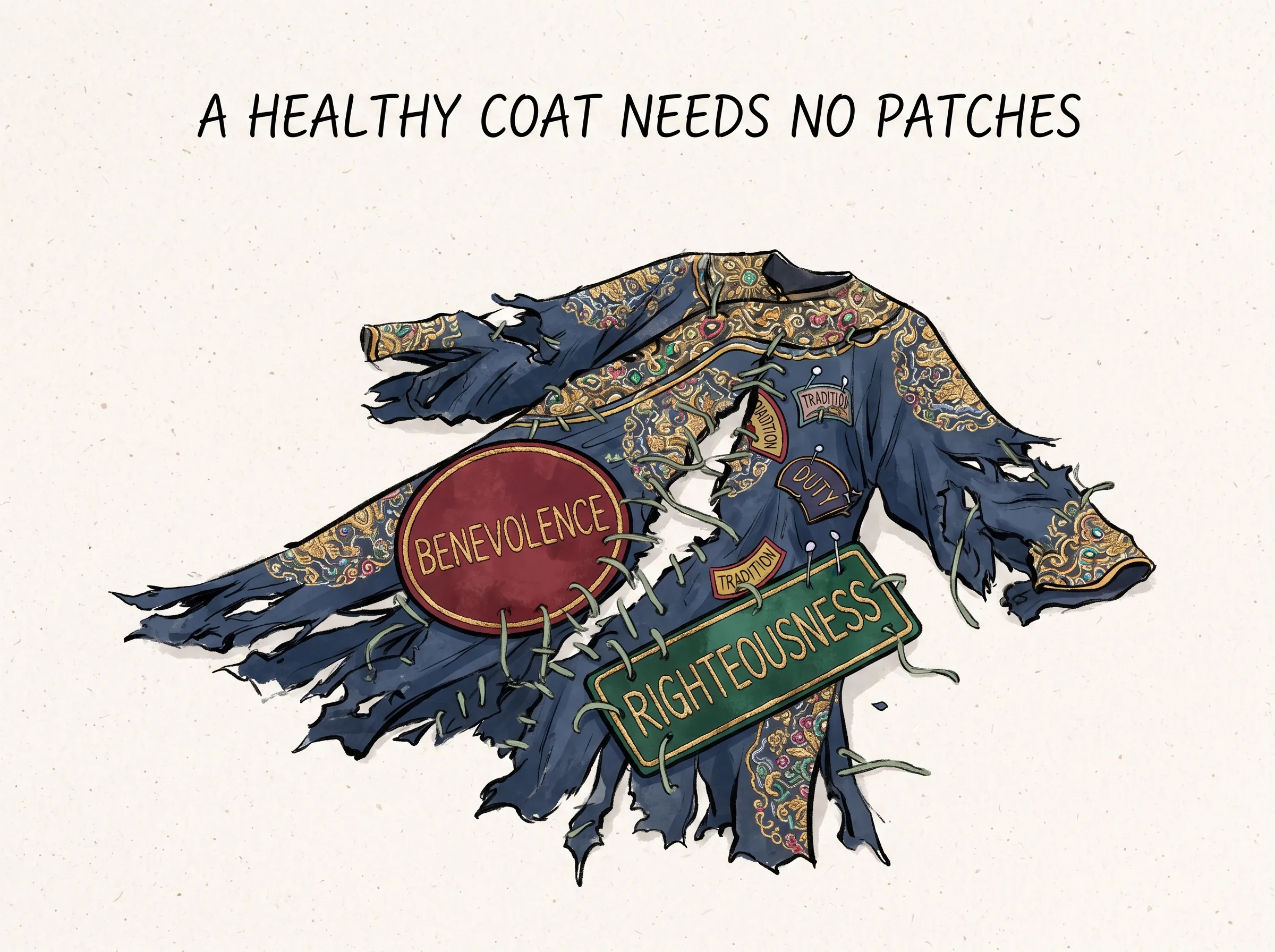
This is what the chapter identifies, in later summaries of its thought, as joy dependent on external things — a happiness that belongs to the object, not to the person. When the object changes, the happiness changes. When the object leaves, the happiness collapses. The heart becomes a slave to whatever comes and goes.
Continue with the deeper interpretation and practical application.
ChiDestiny members get access to the full analysis, modern applications, and the growing Chinese Wisdom Library.
FAQ
Is Zhuangzi saying we should stop caring about anything? No. The chapter explicitly acknowledges that Zhuangzi felt sorrow when his wife first died. The point is not emotional suppression but emotional breadth — allowing yourself to feel while also holding that feeling within a larger context. Caring deeply and being devastated by loss are not the same thing.
Can this philosophy really help with anxiety and depression? The ideas in the Zhuangzi have been explored by readers and practitioners for centuries as a framework for finding peace amid life's uncertainties. Some modern psychological approaches, such as acceptance and commitment therapy, share certain resonances with this tradition — particularly the emphasis on psychological flexibility and values-based living rather than direct symptom elimination. However, this is a philosophical perspective, not a clinical treatment, and those struggling with significant mental health concerns should seek professional support.
If happiness isn't about getting what I want, what should I aim for instead? Zhuangzi would likely reframe the question. Instead of asking "What should I aim for?" you might ask "What am I aiming away from?" Much of human suffering comes not from what we lack but from our resistance to what is. The cultivation of ultimate joy (zhì lè, 至乐) is less about acquiring a new state and more about releasing the grip of constant wanting. It is the difference between filling a cup and stopping the spill.
Does accepting transformation mean I should stop trying to improve my life? Not at all. Zhuangzi's teaching is often misunderstood as promoting passivity. But understanding that everything changes is actually the best reason to act wisely now. A flower blooms precisely because it knows it will fade. A relationship flourishes precisely because both people know it may end. Effort without attachment to outcome is not laziness — it is the most honest way to engage with life.
Zhuangzi's chapter on Complete Happiness does not offer a quick fix. There is no five-step program, no morning routine, no mantra to repeat until the anxiety lifts. What it offers is something rarer: a genuine rearrangement of how you see the world.
The next step is not to add something to your life but to subtract something from it. Notice where your peace depends on outcomes you cannot control. Notice where your joy is held hostage by things that will inevitably change. Notice where you are loving someone by trying to keep them forever, when what they might need most is to be loved exactly as they are — here now, and eventually, gone.
You do not need to become indifferent. You need to become awake. And awakening, Zhuangzi suggests, is the closest thing to joy there is.
Discover the historical and philosophical roots in the classical foundation in Tian Zi-fang: The True Scholar in Casual Clothes and the Arrow of Mind.
For a deeper comparative examination of these ideas, explore our related study on From Fear to Flow: What Zhuangzi’s Da Zong Shi Teaches Us About Death, Loss, and True Freedom.
Sources & Further Reading
[1] Zhuangzi (Stanford Encyclopedia of Philosophy/Fall 2014 Edition) — Discusses Chapter 18 ("Complete Happiness") and its themes of accepting death as part of natural processes.
[2] The Emotions in Early Chinese Philosophy (Stanford Encyclopedia of Philosophy) — Provides context on how early Chinese philosophers, including those in the Daoist tradition, understood emotions and their role in philosophical practice.
[3] Can Seeking Happiness Make People Happy? Paradoxical Effects of Valuing Happiness – PMC — Experimental research examining how valuing happiness can sometimes lead to less positive emotional reactions (fǎnyìng, 反应), with findings that depend on specific contexts and populations.
[4] Culture shapes whether the pursuit of happiness predicts higher or lower well-being – PMC — Cross-cultural research showing that the relationship between the motivation to pursue happiness and well-being varies significantly across cultures, with differences explained by how people socially engage in the pursuit of happiness.
Further Reading (not cited as direct evidence)
- Online interpretation and discussion materials on the Zhuangzi, Chapter 18 ("Complete Happiness")
- ctext.org Zhuangzi full translation online resource






