
Zhuangzi Chapter 17 Meaning: A Zhuangzi Guide to Breaking Out of Your Intellectual Well
You have probably felt it — the sudden, unshakable certainty that follows the moment you learn enough about something to stop looking further. A new term picked up from a podcast. A headline consumed and internalized. A professional framework that seems to explain everything at once. In that moment, doubt evaporates, and confidence surges. You are not stupid. You are simply standing inside a river that looks, from where you are, like the whole ocean.
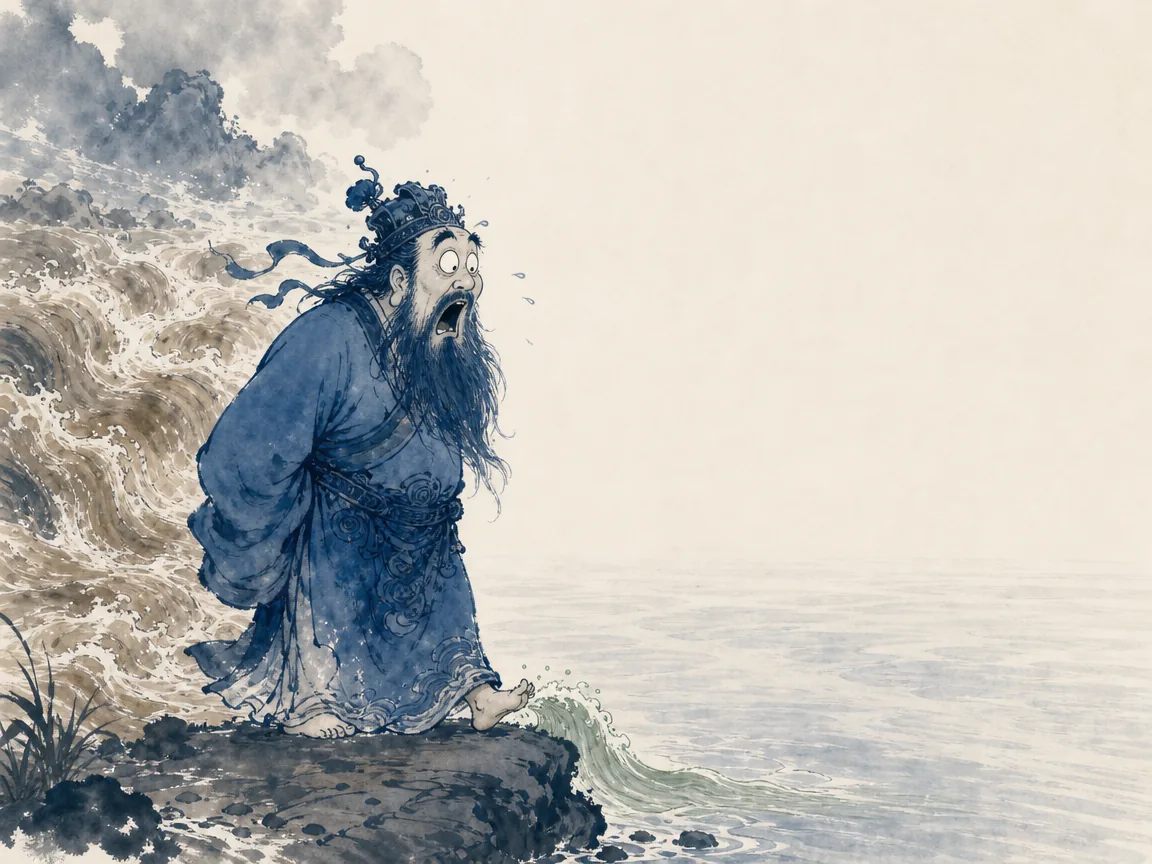
Two thousand three hundred years ago, the Chinese philosopher Zhuangzi wrote a text called Autumn Floods — the seventeenth chapter of the Zhuangzi — that cuts straight to this mechanism [1]. It opens with a scene of breathtaking clarity: autumn rains swell the Yellow River until its waters widen beyond the far banks, and the River God, looking out over his domain, becomes convinced that all beauty in the world now belongs to him. He has not learned wisdom. He has learned only the scale of his own blindness.
Zhuangzi does not scold him. He sends him on a journey eastward, toward the Northern Sea, where the water stretches beyond vision, and where a deeper presence awaits. What follows is not a lecture on modesty but a quiet dismantling of the architecture of self-deception. The insight at the heart of it is both simple and radical: overconfidence is rarely born from total ignorance. It is born from bounded experience mistaken for total truth.
1. The River God's Mirage: When Partial Knowledge Becomes Absolute Delusion
The River God swells with pride after the autumn floods reach the Yellow River, its waters so wide that oxen and horses cannot be distinguished across the far shore [1]. At that moment, he believes all of beauty is contained within his waters. Zhuangzi writes nothing about the River God confusing the Yellow River for the ocean. Rather, the story unfolds as a gradual revelation of scale: only when he travels eastward and reaches the Northern Sea, gazing out and seeing no limit, does he understand the width of his former blindness [1]. His confession is not an apology; it is a structural correction. He acknowledges that had he not arrived at the threshold of the Northern Sea, he would have remained for long in the ridicule of those who understand the Dao [1].
This is the first layer of the trap. The River God is not a fool. He has seen water. He has seen a great deal of water. But the very fact that he has seen something — and seen much of it — is what makes the misjudgment so seductive. The shallowest ignorance usually carries its own awareness. The most dangerous kind walks with its head held high, mistaking the perimeter of its knowledge for the edge of the world.
The modern parallels are immediate and nearly ubiquitous. A professional learns one model of success and then applies it to every question that arises. A person whose social circle, platform, or ideology feels like the center of reality begins to speak of it as if it were reality itself. A reader consumes enough of a single way of framing things to feel complete, not knowing that completeness was never the point.
Zhuangzi is not here preaching vague humility. He is exposing the skeleton of the illusion — the exact mechanism by which partial knowledge hardens into conviction.
Continue with the deeper interpretation and practical application.
ChiDestiny members get access to the full analysis, modern applications, and the growing Chinese Wisdom Library.
FAQ
Is the Autumn Floods chapter actually written by Zhuangzi himself? Most modern scholars do not attribute the outer and miscellaneous chapters of the received Zhuangzi text exclusively to Zhuangzi. The chapter is generally assigned to later disciples or to a broader tradition influenced by Zhuangzi's thought, and even the authorship of the inner chapters remains a speculative hypothesis rather than a settled fact [2]. The ideas discussed here are understood as part of the Zhuangzi tradition regardless of precise authorship.
Does Zhuangzi consider knowledge bad? No. Zhuangzi distinguishes between knowledge that opens and knowledge that closes. The danger he identifies is not learning itself but the solidification of any single framework into an absolute — the point at which education becomes a blindfold rather than a window.
Can scale-shifting lead to nihilism or the conclusion that nothing matters? Zhuangzi's intent is not to erase meaning but to relocate it. Seeing yourself from a wider perspective does not mean your life is worthless; it means your troubles, ambitions, and certainties are proportioned correctly. The point is balance, not annihilation.
Is the fish debate meant to dismiss logic entirely? No. The dialogue is not an argument that logic is useless. It is an invitation to recognize that logic is one way of knowing, not the only way. Zhuangzi values precision; he warns against the assumption that everything real must pass through the narrow gate of formal reasoning.
Closing Thought
The Autumn Floods is not a text about being small. It is a text about being honest about scale. The River God did not lose his dignity when he encountered the Northern Sea; he gained something more durable than pride — perspective. He learned that the world was larger than his river, and in that learning, his confidence stopped being a wall and became a doorway.
If you find yourself recently certain about something important, consider not whether you are wrong but whether you have simply reached the shore of a larger body of water. Walk toward it. The text has been waiting for over two millennia for you to do exactly that, reflecting the enduring wisdom of Zhuangzi Chapter 17 Meaning.
To explore these themes from another angle, read our related reflection on Why Do You Keep Fighting Battles That Don’t Matter? A Zhuangzi Guide to Stepping Back from Life’s Snail-Horn Wars.
Deepen your understanding of these principles in our reflection on If You Can’t See the World Clearly, Can You See It at All? Zhuangzi and the Problem of Perception.
Sources & Further Reading
[1] Zhuangzi / Autumn Floods (莊子/秋水) — Wikisource, containing the received classical text of the Autumn Floods chapter used for factual references in this article.
[2] Zhuangzi — Stanford Encyclopedia of Philosophy (Fall 2019 Edition), providing scholarly context on chapter attribution, authorship debates, and interpretive approaches to the text.
[3] Zhuangzi, "Autumn Floods" (《庄子·秋水》), from Zhuangzi / Qiushui at Wikisource
[4] Zhuangzi (Stanford Encyclopedia of Philosophy, Fall 2019 Edition)
Further reading
- Burton Watson, trans., Chuang Tzu: Basic Writings. Columbia University Press, 1964.
- Victor H. Mair, trans., Zhuangzi: The Complete Writings. Hackett Publishing, 2020.







[…] To explore these themes from another angle, read our related reflection on Why Do We Get More Confident the Less We Know?. […]