
We live in an age where two people can read the same news, attend the same event, and walk away with entirely different versions of reality. Algorithms feed us versions of the world that confirm what we already believe. Debates harden into tribal signals. Most of us have the uneasy sense that we are not seeing clearly, but rather reacting to echoes of ourselves.
Over two thousand years ago, a Chinese philosopher named Zhuangzi asked a remarkably similar question. In a chapter traditionally known as Qi Wu Lun, part of the text known as the Zhuangzi, he explored how human perception is shaped by subjective position (lìchǎng, 立场), language, fear, identity, and habit. He did not argue that nothing is real. He argued that what we call "reality" is almost always reality filtered through a mind that has never examined itself. His concern was not epistemological in the abstract; it was personal. If you cannot see the machinery of your own perception, you will mistake its output for truth—a foundational perspective explored in Zhuangzi Butterfly Dream.
This matters more now than at any point in recent history. Information is abundant. Attention is scarce. The gap between what happens and what we believe happened is wider than ever. Zhuangzi's insight offers one of the most honest frameworks available for understanding why we disagree, why we suffer from our own certainty, and how we might step outside the loop.
Zhuangzi Butterfly Dream: How We Construct Our Reality
A central concern in the Qi Wu Lun is what Zhuangzi calls the "fixed mind" — a Chinese term often translated as chéng xīn, meaning the accumulated beliefs, habits, identities, and biases that shape every act of perception before the world even reaches us [1]. People do not encounter reality raw. They encounter it through layers of conditioning. Past experiences, social roles, cultural narratives, personal fears, and linguistic habits all operate as invisible filters. What seems like an objective judgment is often a familiar pattern repeating itself.
Modern cognitive science describes something similar. Research in predictive processing suggests that perception is not a passive reception of external data but an active construction driven by prior expectations [2]. The brain does not wait for the world to arrive; it generates predictions and then checks whether sensory input matches those predictions. When input is ambiguous, the brain fills in gaps based on what it already believes. This is not a flaw in the system. It is how the system works. But it also means that what you experience as "seeing clearly" may simply be the world conforming to what you already expect.
Zhuangzi would likely agree with the mechanism and caution against the conclusion. The fact that the mind constructs reality does not mean all constructions are equally valid. It means we must examine the constructor.
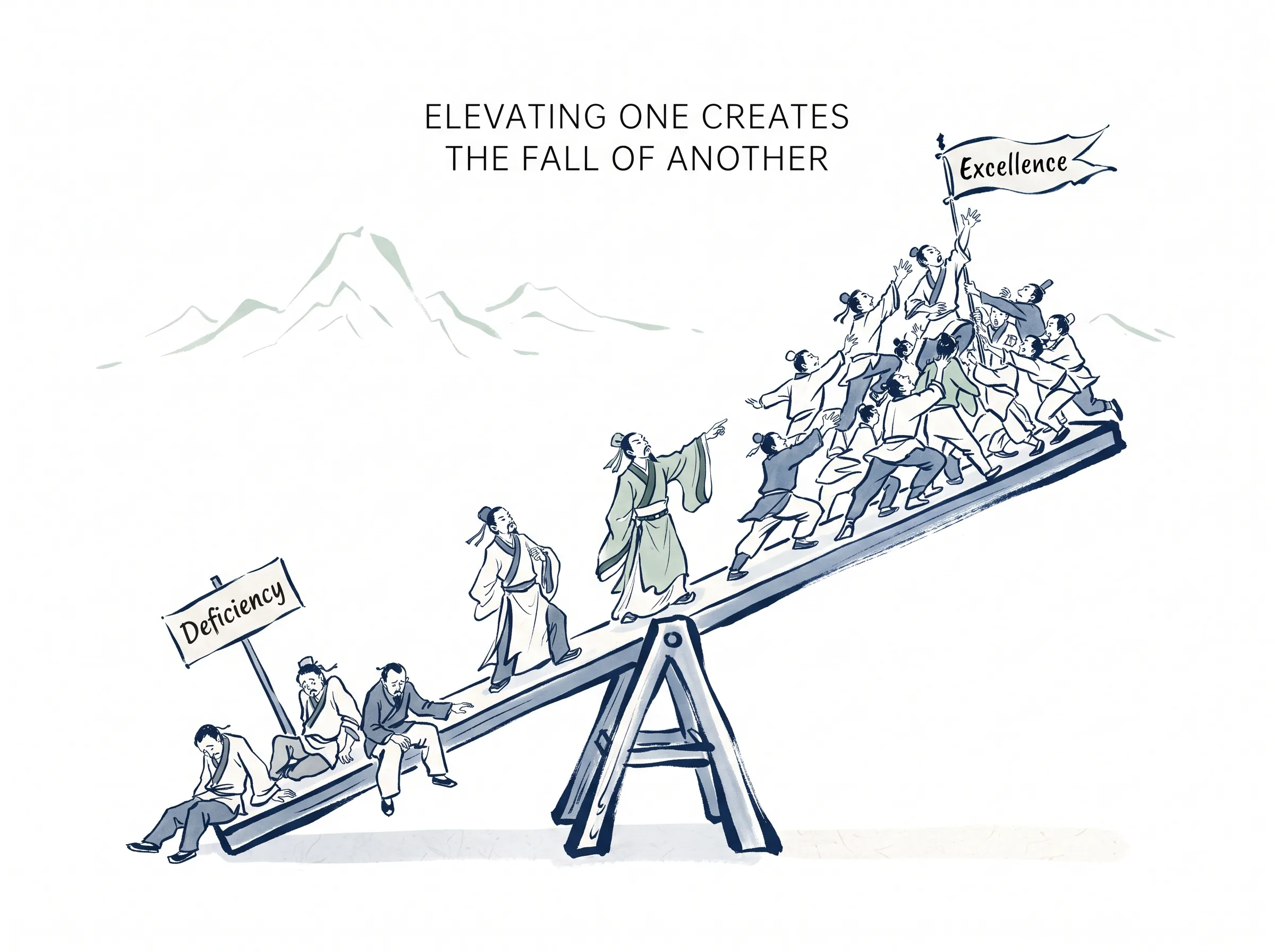
A simple test is available to anyone willing to use it. When a strong reaction arises — anger at a headline, discomfort with a stranger's opinion, a surge of pride or shame — pause for a few seconds and ask: Where did this come from? Did the situation alone produce this feeling, or did it interact with something already present inside me? This question does not eliminate emotion. It reveals its source. That distinction matters.
The Three Sounds: Why Two People Hear Different Worlds
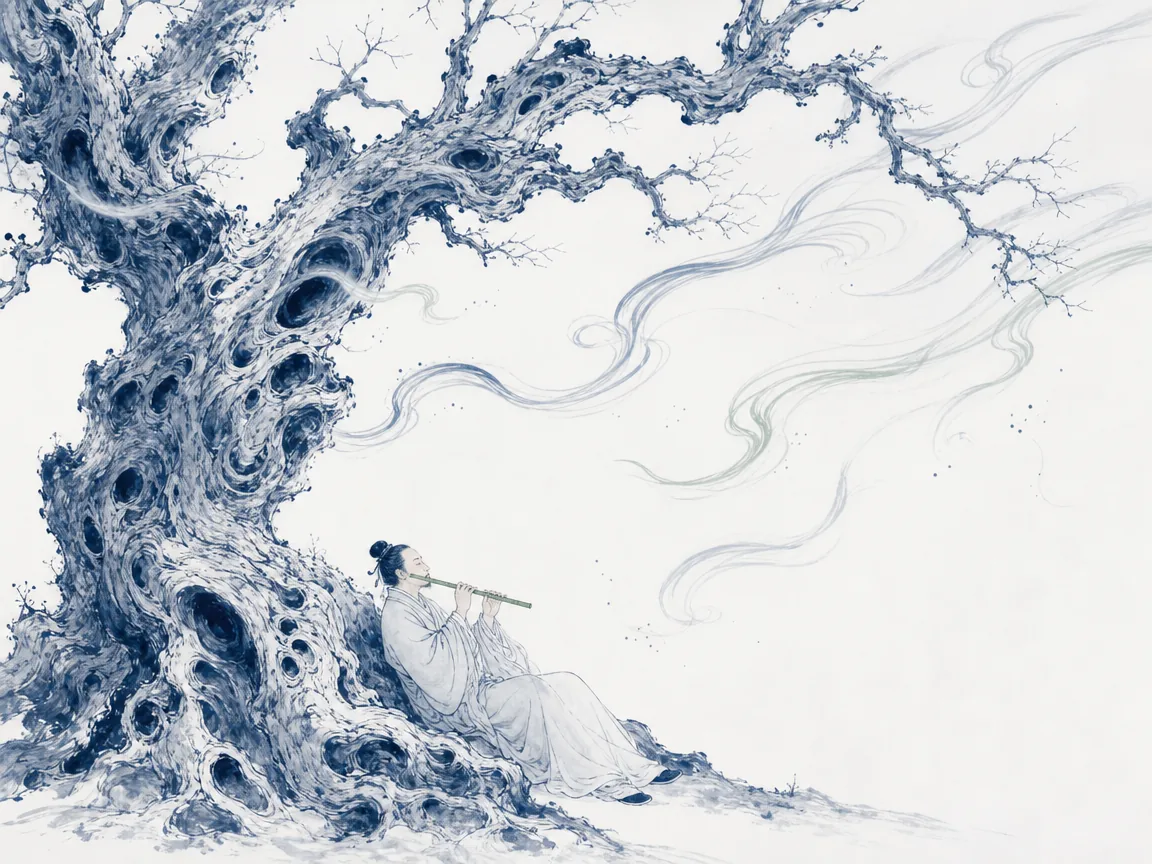
One of the most vivid metaphors in the Qi Wu Lun compares human understanding to wind passing through hollows. The wind is the same. The hollows are different. Therefore the sounds are different. Zhuangzi used this image to explain why two people can witness the same event and report completely different experiences. The event does not change. The hollows do.
This metaphor has a quiet radicalism. It does not say that reality is subjective. It says that reality is real but never arrives unfiltered. Every person is a hollow shaped by biology, culture, memory, trauma, education, language, and desire. The same "wind" — the same news story, the same conversation, the same historical moment — produces a different sound in each hollow. Two people hearing the same argument are rarely hearing the same thing.
Contemporary psychology supports a related observation. Confirmation bias, motivational reasoning, and narrative identity all demonstrate that humans interpret events through preexisting frameworks [2]. People do not process information like computers. They process information like storytellers, shaping data into coherent personal and cultural narratives. When someone says, "I saw it differently," they are not necessarily lying. They are reporting from a different hollow.
This insight changes how we approach disagreement. Most arguments are not about truth versus falsehood. They are about whose hollow is resonating. Recognizing this does not mean accepting all views as equal. It means understanding why conflicting views exist in the first place. That understanding is the beginning of clarity. To study the primary classical text and commentary, explore the original Chinese text and deep philosophical translation in Discussion on Making All Things Equal: The Flute of Heaven and the Butterfly Dream.
Right and Wrong: Where Your Standpoint Is Your Blindfold
A recurring theme in the Qi Wu Lun is the relativity of judgment. Zhuangzi observes that every position carries hidden premises. What looks like an objective stance is often a stance disguised as objectivity. People argue about right and wrong without examining where their sense of right and wrong originates.
The text introduces the image of the "pivot of the Way" — a Chinese term rendered as dào shū — to describe a different kind of mental position. Rather than standing on one side of an opposition and fighting the other, the pivot stands at the center, where opposites interdepend and transform into one another. The pivot does not deny differences. It refuses to be trapped by them.
Imagine a door. If you stand on one side, you only see the door from that angle. Move to the other side, and the view changes entirely. Both views are real. Neither is complete. The pivot is the hinge itself — small, unmoving, yet enabling the door to open in both directions. Applied to thought, this means true clarity often comes not from choosing the correct side but from understanding how sides form.
This is not relativism. Relativism says all views are equally valid. Zhuangzi's point is subtler: all views are partial, and partiality is the starting condition of wisdom, not its failure. The goal is not to abandon judgment but to make judgments aware of their own conditions.
The Morning and Evening Nuts: How Language Shapes Feeling
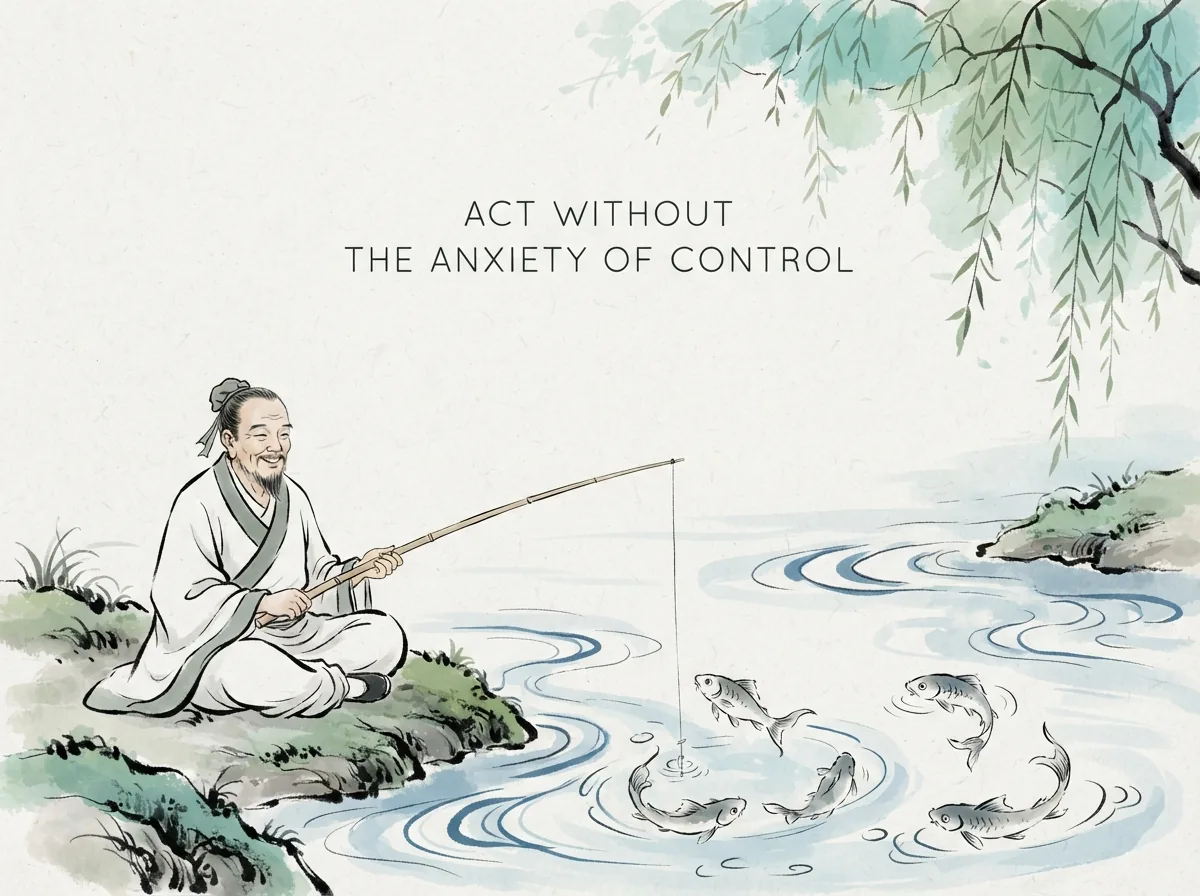
One of the most widely known parables in the Zhuangzi appears in the Qi Wu Lun. A keeper of monkeys tells them there will be three acorns in the morning and four in the evening. The monkeys grow angry. The keeper revises the statement: four in the morning, three in the evening. The monkeys are pleased. The total is unchanged. Only the order shifts. And yet the emotional response flips completely.
This story illustrates a principle that applies far beyond monkey-keeping. Humans are often governed less by facts than by the stories we tell about facts. The same event framed as loss produces despair. The same event framed as transition produces agency. The difference is not in the event. It is in the narrative container.
Modern media studies, framing theory, and behavioral economics all document this effect. How an option is presented — as a gain or a loss, as a threat or an opportunity — can alter decisions without changing the underlying reality [2]. Political slogans, advertising, social media narratives, and personal self-talk all operate as psychological "acorn schedules," rearranging the same content into different emotional sequences.
Language is not merely descriptive. It is constitutive. It shapes experience as much as it reports it. Zhuangzi's warning, expressed through a simple fable, remains one of the clearest observations about the power of naming.
Zhuangzi Dreaming of a Butterfly: Who Is the "I"?
The Qi Wu Lun concludes with perhaps the most famous passage in all of Chinese philosophy. Zhuangzi dreams he is a butterfly, flying freely and unaware of any self. He wakes and finds himself again as Zhuangzi. He then asks: Was he Zhuangzi dreaming he was a butterfly, or is he now a butterfly dreaming he is Zhuangzi?
This is not a poetic fancy about life being an illusion. It is a precise epistemological challenge. The dream self feels real while dreaming. Upon waking, the waking self feels equally real. There is no internal criterion that guarantees one state is more authentic than the other. If identity shifts across states of consciousness, on what basis do we claim a single, fixed self?
Zhuangzi's answer, conveyed through the phrase wù huà — "the transformation of things" — is that the self is not a fixed entity but a process. We are not static objects. We are ongoing events, shaped by body, memory, language, relationships, and environment. The sense of a permanent "I" is useful for daily functioning. It is not metaphysically secure.
This insight has implications that reach far beyond classical philosophy. Modern psychology recognizes that identity is fluid, context-dependent, and constructed [2]. Neuroscience shows that the brain continuously updates its model of the self. The ancient observation and the contemporary research converge on a similar conclusion: the self is something that happens, not something that simply is.
For readers navigating periods of role loss, career change, grief, or existential uncertainty, this perspective can be deeply liberating. If the self is not a fixed object, then change is not a threat to identity but an expression of it.
What the Qi Wu Lun Offers the Modern Reader
The common misunderstanding of Zhuangzi's Qi Wu Lun is that it teaches nihilism or passive relativism. It does not. The chapter argues that all views are partial, not that all views are equivalent. Partiality is not a failure of thinking. It is a condition of thinking. Recognizing it is the beginning of wisdom.
The practical shift Zhuangzi invites is subtle. Instead of asking, "Am I right?" the more useful question becomes, "Where does my sense of being right come from?" This reframes the entire project. The goal is not to defeat opponents but to understand the machinery of perception. When you see the filter, you are no longer entirely inside it.
A few concrete practices emerge naturally from this framework:
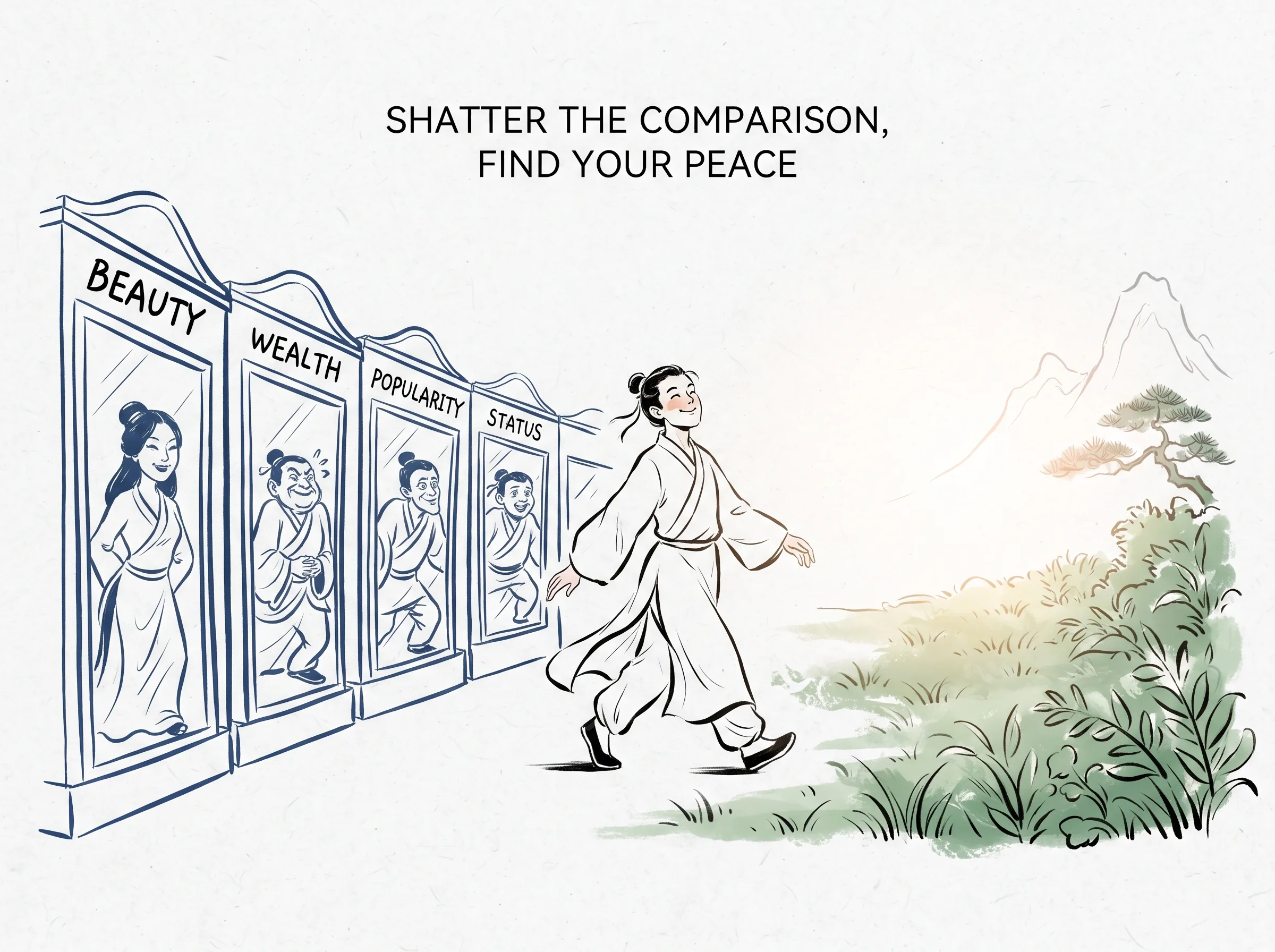
- Pause before reacting. When a strong opinion arises, spend a moment identifying its components. Is this response shaped by recent news, personal history, social pressure, biological state, or genuine evidence?
- Map the hollow. When someone holds an opposing view, ask what hollow they are standing in. What experiences, fears, and loyalties shape their perception? This builds empathy without requiring agreement.
- Question the framing. When a narrative feels emotionally charged, examine the structure of the story. What is included? What is omitted? Who benefits from this particular arrangement of facts?
- Test the fixed mind. Regularly ask whether a belief you hold is based on direct experience or on inherited assumptions. Old convictions are often mistaken for personal discoveries.
None of these practices require belief in Daoism, spirituality, or any particular philosophy. They are cognitive tools. Zhuangzi's contribution is the reminder that the most important filter to examine is the one you cannot see — because it is you, reflecting the enduring wisdom of Zhuangzi Butterfly Dream.
To explore these themes from another angle, read our related reflection on Why Do We Get More Confident the Less We Know?.
For a deeper comparative examination of these ideas, explore our related study on When Order Becomes Theft: Zhuangzi’s Warning for Modern Life.
Sources & Further Reading
[1] "Zhuangzi" — Stanford Encyclopedia of Philosophy,
[2] "Predictive Feedback and Conscious Visual Experience" — PMC,
[3] "Predictive processing of scenes and objects" — Nature Reviews Psychology,
Further Reading
- Watson, Burton. Chuang Tzu: Basic Writings. Columbia University Press.
- Chan, Wing-tsit. A Source Book in Chinese Philosophy. Princeton University Press.
- Mair, Victor H. Zhuangzi: The Classic of Inner Sections. University of Hawaii Press.
Zhuangzi's Qi Wu Lun does not offer easy answers. It offers something rarer: a mirror. The chapter asks readers to look not at the world but at the looking itself. If perception is shaped by bias, language, habit, and identity, then clarity begins with awareness of those forces — not with the illusion of escaping them entirely.
The next step is simple but not easy. Choose one area of your life where disagreement feels personal. Pause. Ask where your reaction originates. Notice the hollow. You do not need to resolve the disagreement to benefit from the question. Awareness itself is the practice.
Prefer the complete edition?
Read the full text in a beautifully designed bilingual digital edition.






