
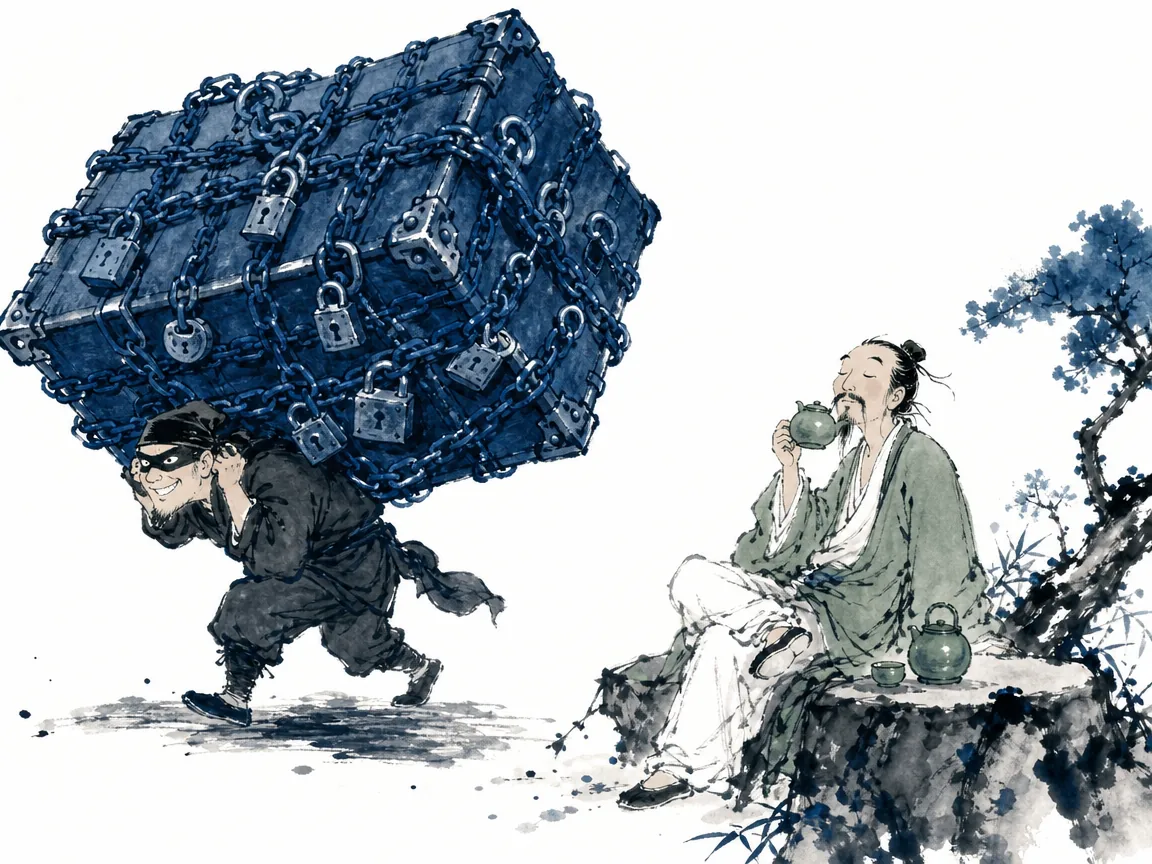
We spend our lives building locks. Career ladders, productivity systems, self-improvement routines, social metrics — each one designed to keep something valuable safe. We reinforce the knots, tighten the latches, file away the certificates that prove we're doing it right. The instinct is not wrong. Protection is reasonable. But what if the very systems we erect to safeguard our lives end up becoming the mechanisms through which our ability to think for ourselves is quietly collected and carried away?
The Chinese philosopher Zhuangzi explored this paradox more than two millennia ago in a chapter called Qū Qiè ("Burglarproof"), which opens with a scene most of us would recognize: someone securing their boxes and chests against thieves, tying ropes tightly and reinforcing locks, doing everything society calls sensible. Then Zhuangzi turns the image inside out. A small thief fears the lock. But the great thief simply lifts the entire chest and walks away — grateful, even, that you packed everything so neatly—a foundational perspective explored in Zhuangzi Chapter 10 Meaning.
The passage is unsettling because it refuses to let us rest comfortably on either side of a simple equation. Order is not automatically good. Protection is not automatically wise. Zhuangzi's point is sharper than that: systems designed to defend life can become the tools that allow the most efficient form of theft to occur — one that takes not just our possessions, but our judgment, our desires, and our sense of what a good life looks like. This is the question his writing still forces us to face today.
Zhuangzi Chapter 10 Meaning: The Locked Box and the Great Thief
The opening of the Qū Qiè chapter presents a specific image that has held up under careful reading across centuries of interpretation. The text describes someone preparing against "thieves who pry open chests, rummage through bags, and break into strongboxes" by "fastening the knots and straps and strengthening the locks and bolts"[1]. This is called "the wisdom of the common people"[1]. Nothing about this setup seems unreasonable.
Then comes the reversal. When "the great thief arrives," he does not pick the lock. He carries away the strongbox, the chest, and the bag — "worrying only that the knots and straps and locks and bolts are not secure enough"[1].
The logic is brutal in its clarity. Security measures that seem to protect a person can simultaneously make it easier for someone far more powerful to take everything at once. The tighter the person binds their own possessions, the more intact and valuable the whole package becomes to the thief who does not need to open it individually — only to carry it away.
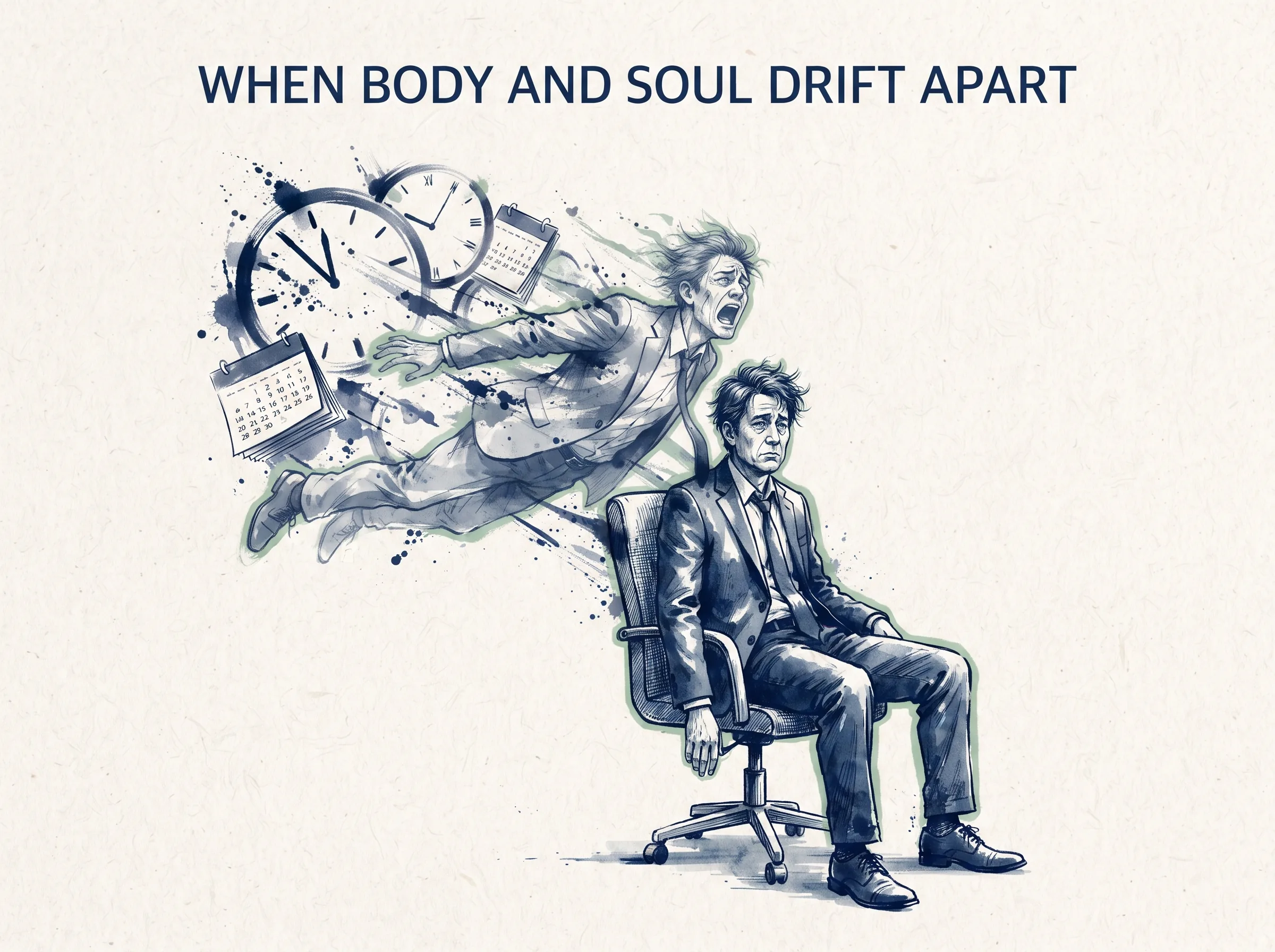
Zhuangzi's metaphor extends beyond the literal image of stolen goods. The chapter goes on to ask what happens when a society decides that standards, rituals, measurements, and moral codes are what hold everything together. These tools were invented to create order. But if someone gains control of the standard itself — not just the objects being measured — then control becomes total. The systems designed to keep chaos at bay become the channels through which a different kind of disorder is delivered: the systematic replacement of personal judgment with externally imposed criteria.
This is not a call to abandon all order. It is a warning about the difference between order that serves life and order that serves power. The distinction matters because it is often invisible to those living inside it.
When the Thief Writes the Instruction Manual
A petty thief breaks in. A great thief rewrites the rules. Zhuangzi's chapter makes a distinction that runs deeper than any simple opposition between freedom and control. The problem is not that rules exist. The problem is that rules become absolute, and those who hold the authority to define them gain the ability to direct entire populations without ever raising a hand.
The text offers a chain of examples that illustrate this mechanism. Standards of measurement are created to bring fairness — "measuring vessels and scales" — but whoever controls the vessels and scales controls what counts as fair. Tokens and seals are established to guarantee trust — but whoever holds the tokens and seals holds legitimacy[1]. Moral codes like "benevolence and righteousness" are introduced to cultivate goodness — but whoever monopolizes them decides who is virtuous and who is not.
The most frequently quoted line from the chapter captures the consequence: "He who steals a hook is executed; he who steals a state becomes a lord"[1]. The line is often read as a cynical observation about injustice. But the chapter does not stop there. It immediately asks: when the thief of a state arrives at the gate, do righteous men not appear at his door?[1] In other words — does he not also steal the benevolence and the wisdom that justify his rule?
What Zhuangzi is describing is a system in which the vocabulary of protection becomes the vocabulary of control. Standards that should serve life are absorbed into structures that serve authority. Virtue is no longer tested by how it affects actual human experience but by whether it conforms to an officially recognized template. The result is not chaos. It is a very particular kind of order — one that demands conformity while calling it wisdom, that rewards compliance while calling it morality, and that consolidates power while calling it civilization.
The insight is not anti-civilization. It is anti-naiveté.
Who Defines Success? Who Owns Your Desire?
Every society tells its members what a successful life looks like. The template is rarely presented as optional. It is embedded in education, reinforced by media, normalized through language, and rewarded through access to resources. When the template is unexamined, it functions less like advice and more like an invisible architecture — a structure people walk inside without realizing it has walls. To study the primary classical text and commentary, explore the original Chinese text and deep philosophical translation in Cutting Open Satchels: Why Clever Protections Only Arm the Great Thief.
Zhuangzi's Qū Qiè challenges the assumption that a shared standard is inherently neutral. Standards are invented by people. They are enforced by institutions. And they concentrate power in whoever gets to decide what counts as valuable. When a single definition of worth replaces a diversity of ways of living, those who control the definition control the population — not through force, but through consent.
Consider how this pattern appears in modern life. A career path is presented as the default route to security. Social metrics quantify worth through visibility and approval. Productivity tools promise optimization but deliver continuous monitoring. Self-improvement culture encourages constant refinement of the self — often according to criteria designed by marketers, platforms, and institutions that profit from the refining. None of these systems typically use chains. They use aspiration. They use the belief that improvement is always necessary and that the direction of improvement has already been decided.
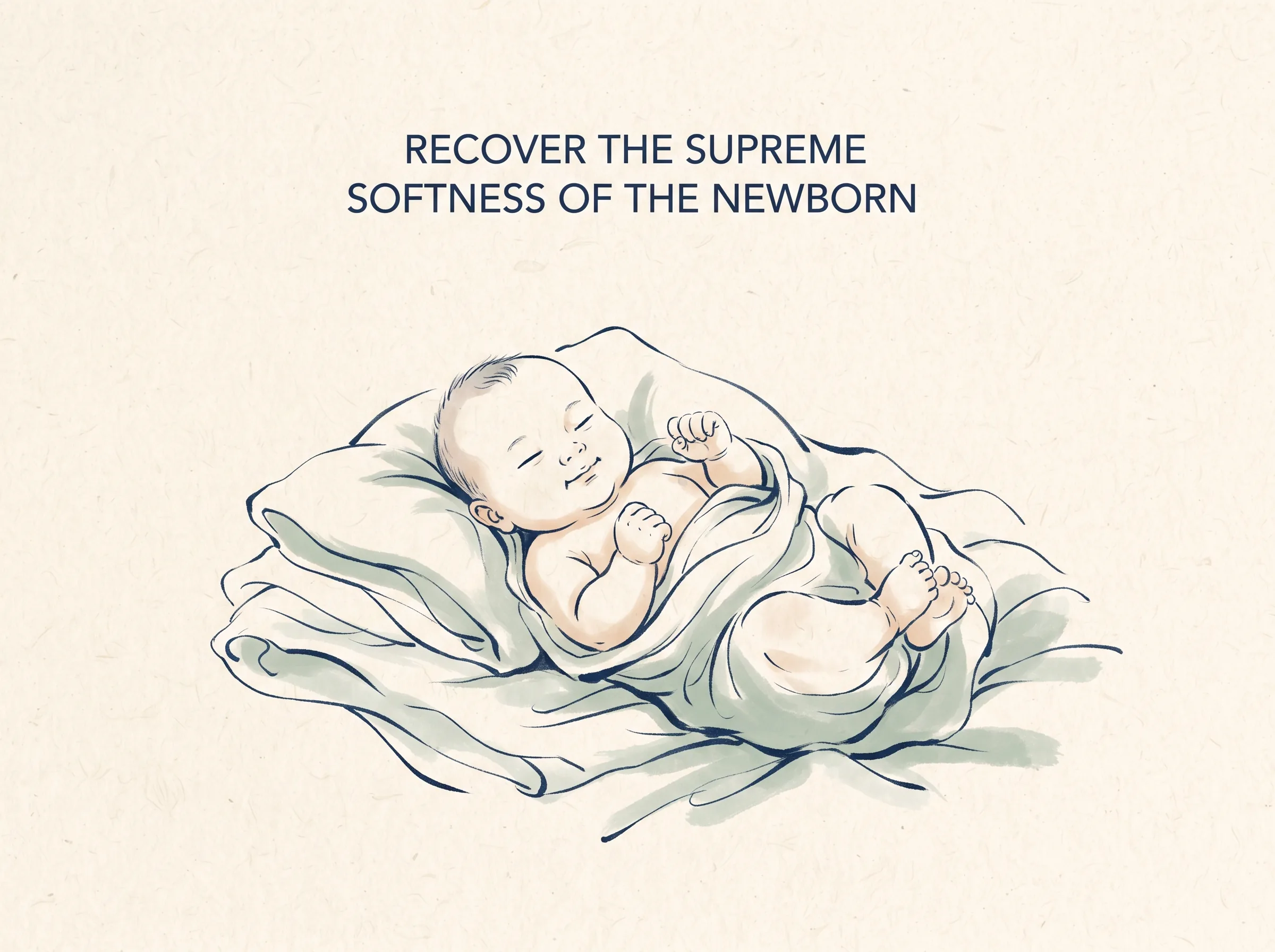
The question Zhuangzi pushes us toward is not "Should you reject all standards?" It is "Who benefits from your compliance?" and "Does this standard serve your life as it actually unfolds — or does it serve a system that requires your life to bend to it?"
These are not questions with single answers. They are questions worth carrying. A standard that helps coordinate shared needs — a speed limit, a safety procedure, a community agreement — can serve life honestly. A standard that exists primarily to make a population predictable, manageable, and interchangeable serves power. The difference is not always obvious. That is precisely why the discernment matters.
Zhuangzi Is Not Anti-Civilization — He Is Pro-Life
A common reading of the Qū Qiè chapter treats it as a radical rejection of all rules, all knowledge, and all social order. The text does contain striking prescriptions: "cut off sagehood and discard wisdom, and great thieves will stop"[1]; "burn the tally tablets and smash the jade seals"[1]; "break the measuring vessels and snap the balances"[1]; "cast aside benevolence and righteousness"[1]. Taken in isolation, these lines sound like a blueprint for chaos.
But the chapter's target is not civilization itself. It is the substitution of abstract systems for living experience. Zhuangzi's concern is what happens when tools meant to serve people become masters that demand people serve them. When the map replaces the territory, when the measure replaces the measured, when the rule replaces the relationship — order ceases to be protective and becomes extractive.
This interpretation does not erase the text's radical edge. Zhuangzi is not offering a moderate (wēnhé, 温和) reform program. He is asking a foundational question: what is the purpose of any system, any code, any standard? If the answer is "to make life easier to manage" rather than "to help life flourish as it is actually lived," then the system has reversed its proper relationship to human beings. It is no longer a tool. It is a cage dressed as protection.
Modern scholarship on the Zhuangzi notes that the text we have today was compiled and edited centuries after the period associated with the historical figure Zhuangzi, drawing from multiple authors and intellectual currents[2]. The Qū Qiè chapter sits within the "Outer Chapters," which generally reflect a broader range of voices and concerns than the "Inner Chapters"[2]. This context reminds (tíxǐng, 提醒) us that the chapter's force comes not from being a literal autobiography of Zhuangzi but from being part of a living philosophical tradition that continually tests its own assumptions about order, nature, and human flourishing.
The practical takeaway is not "destroy all systems." It is "test every system by asking whether it serves life or whether life is being made to serve it." That test is repeatable, portable, and applicable far beyond ancient texts.
Practical Discernment: Three Questions to Carry
The Qū Qiè chapter does not give a checklist. It gives a mode of attention. Below are three questions drawn from that mode of attention — not as doctrines, but as practices for examining the orders you already live inside.
1. Who defined this standard, and who benefits if I follow it without question?
Standards arrive disguised as universal. "This is what success looks like." "This is the right way to work." "This is how a good person behaves." None of these claims are automatically false. But they are not automatically neutral, either. Before adopting a standard as your own, trace it back. Who created it? What system does it reinforce? Whose interests does it serve when you comply? This is not cynicism. It is basic accountability.
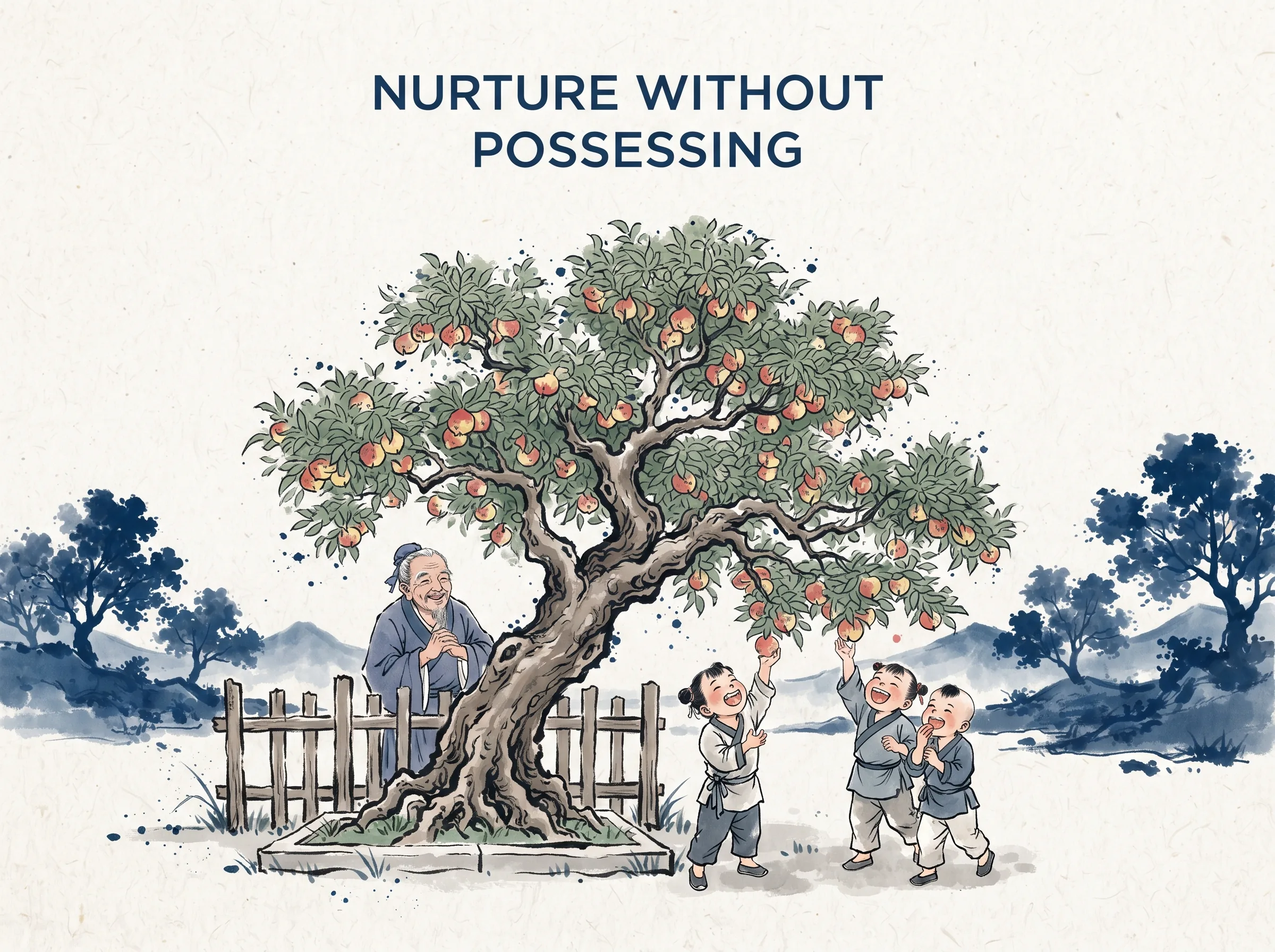
2. Does this rule increase my capacity to live well, or does it increase my capacity to be managed?
A helpful rule makes a person more free within a shared context. A manipulative rule makes a person more predictable for whoever holds the framework. The difference can be subtle. Both may call themselves "protective." One expands your options; the other narrows them while making you feel safe. Pay attention to whether a rule or standard is making you more alive or more manageable.
3. If this system were handed to someone with different values, would it still protect me — or would it protect them?
Systems are not value-free. They embed assumptions about what matters. A productivity metric that rewards endless output assumes output is the highest good. A social platform that rewards engagement assumes attention is the commodity. A corporate culture that rewards loyalty assumes loyalty is the primary virtue. When you step outside the system's assumptions, you may see that its protections are conditional — designed to protect the system itself more than the people inside it.
These questions are not meant to produce paralysis. They are meant to produce clarity. Discernment is not the same as rejection. You can use a system and still see it. You can follow a standard and still question it. The goal is not to live without order but to live with order that has been examined rather than inherited.
FAQ
Is Zhuangzi saying we should abolish all rules and live in chaos? No. The Qū Qiè chapter criticizes order that overrides lived experience and concentrates power, not order that coordinates human needs. The radical prescriptions in the text are best read as a stress test for systems, not as a manual for anarchy.
Can standards and systems be genuinely helpful? Yes. Standards become harmful when they are treated as absolute, when they replace direct perception, and when they serve control rather than life. The same standards can be tools of coordination when they remain open to revision and accountable to human flourishing.
Does this chapter apply only to politics, or to personal life as well? Both. Zhuangzi's analysis moves from political power to the personal internalization of external standards. When you adopt a definition of success that was designed by someone else and treat it as your own, the mechanism is the same as the one described at the level of state power.
Is this perspective hopeless or defeatist? No. The chapter's purpose is not to induce despair but to awaken discernment. Zhuangzi insists that people retain the capacity to see through systems that claim neutrality. The warning is serious, but so is the possibility of clear awakening (qīngxǐng, 清醒) that comes from refusing to accept every standard at face value.
What Comes Next
Zhuangzi's Qū Qiè does not offer a final answer. It offers a lens. The lens asks one question above all others: does this order protect your life, or does it quietly take your ability to decide what a good life is? The answer is rarely black and white. Most systems contain both elements — genuine protection and subtle extraction, sometimes in the same package.
The practical path forward is not to tear everything down. It is to learn to look more carefully. Examine one area of your life where you assumed a standard was neutral — a career track, a beauty ideal, a productivity method, a definition of happiness — and ask who benefits from your compliance. Notice whether the standard makes you more free or more manageable. Keep your judgment active even when the system rewards you for switching it off.
Order is not the enemy. Unquestioned order is. Zhuangzi's warning, spoken more than two thousand years ago, remains useful because it names a pattern that repeats in every era: the most effective form of theft does not break in. It arrives wearing the uniform of protection, carrying the keys you handed over without realizing you had given them away, reflecting the enduring wisdom of Zhuangzi Chapter 10 Meaning.
To explore these themes from another angle, read our related reflection on Why You Feel Empty Despite Success: Zhuangzi on Taming vs. Growth.
Deepen your understanding of these principles in our reflection on Why Knowing More Doesn’t Make Us Wiser — Zhuangzi’s Warning for Our Information Age.
Sources & Further Reading
[1] Zhuangzi / Opening Trunks (莊子/胠篋) – Wikisource — Primary text of the Qū Qiè chapter in Classical Chinese.
[2] Zhuangzi (Stanford Encyclopedia of Philosophy/Spring 2026 Edition) — Scholarly overview of the Zhuangzi text, authorship questions, and compositional history.
[3] Zhuangzi (Stanford Encyclopedia of Philosophy/Summer 2003 Edition) — Earlier version of the SEP entry, providing additional context on chapter groupings and interpretive debates. ### Recommended translations for deeper study
[4] Burton Watson, Chuang Tzu: Basic Writings — widely used English translation with accessible notes.
[5] Victor Mair, Zhuangzi: The Complete Writings — comprehensive translation with scholarly commentary.
[6] Angus Graham, Chuang-tzu: The Inner Chapters — detailed analysis of the Inner Chapters and their relationship to the Outer and Miscellaneous chapters.
Further Reading (延伸阅读)
- Bilibili lecture series on Zhuangzi's Outer Chapters (BV1CqL46dE4u) — modern commentary; useful for contextual reflection but not a primary source for classical passages.
- A. C. Graham's grouping of Zhuangzi texts into "primitivist" and other stylistic clusters — discussed in Stanford Encyclopedia of Philosophy (S2).






