
Zhuangzi Chapter 9 Meaning: The Paradox of Modern Success
There is a quiet crisis happening in plain sight. People achieve the milestones they were told to chase — the degree, the promotion, the salary, the house — and yet something inside them feels hollow. They are not broken. They are not ungrateful. They are simply running a race whose finish line was drawn by someone else.
This paradox has fascinated thinkers for millennia, but it finds an unusually sharp expression in an ancient Chinese text called the Zhuangzi [2]. Specifically, in one of its Outer Chapters known as "Hoof and Beam" (马鞁 or 马蹄), the philosopher uses the image of a horse to ask a question that still cuts through modern life: when a creature is carefully shaped to serve human purposes, is that care or harm? And when a person is carefully trained to serve social expectations, are they truly flourishing — or simply becoming more useful to everyone except themselves?
Modern psychology offers a parallel observation. Research has found that people who pursue intrinsic goals — personal growth, meaningful relationships, community contribution — tend to experience better psychological health, while those who prioritize extrinsic goals such as wealth, fame, and image do not gain the same well-being benefits and may even experience worse outcomes [3]. The data does not claim that success causes emptiness. But it does suggest that not all goal attainment is equally nourishing, and that the content of what we strive for matters deeply [3].
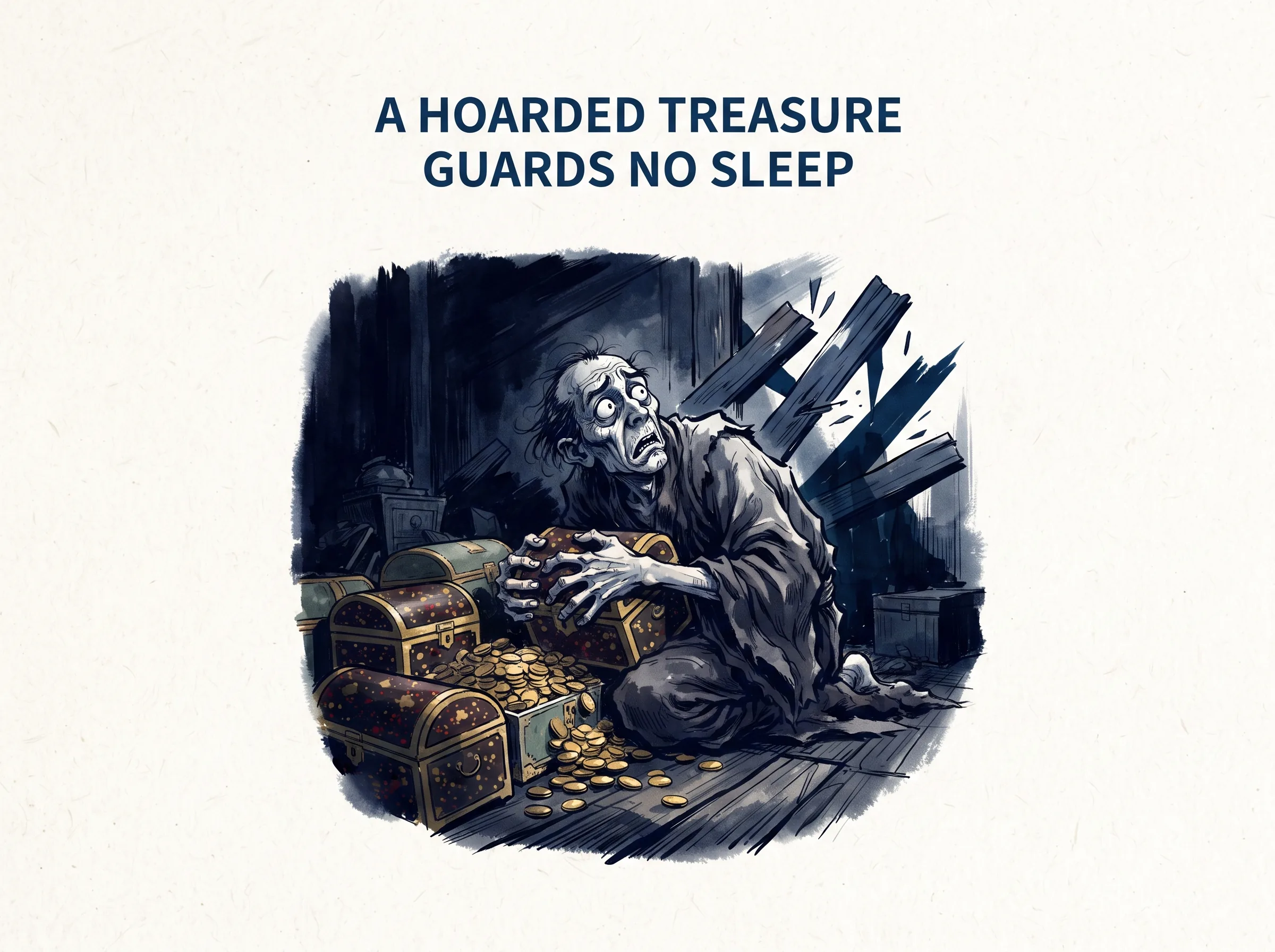
Zhuangzi was not conducting a statistical study. But his insight shares a structural similarity with what contemporary researchers call self-determination theory: the idea that human well-being depends on autonomy, competence, and relatedness — and that when these basic psychological needs are thwarted, ill-being becomes more likely [3]. Whether or not one accepts the full framework of that theory, the pattern is recognizable across cultures and centuries. A life driven entirely by external validation often feels exhausting, even when it looks successful from the outside.
Zhuangzi's Parable: What the Horse Knew Before the Master
The "Hoof and Beam" chapter belongs to the Outer Chapters of the received Zhuangzi, a collection of texts traditionally and scholarly associated with followers and elaborators of Zhuangzi's thought rather than being unreservedly attributed to Zhuangzi himself [1]****[2]. Scholars have long noted that the Outer Chapters (chapters 8–22 in the arrangement made by Guo Xiang) represent a broader and more diverse literary and philosophical corpus than the Inner Chapters [2]. This matters because it means the ideas in "Hoof and Beam" should be understood as part of a living tradition — powerful, provocative, and worth engaging with, but not necessarily reducible to a single author's definitive statement.
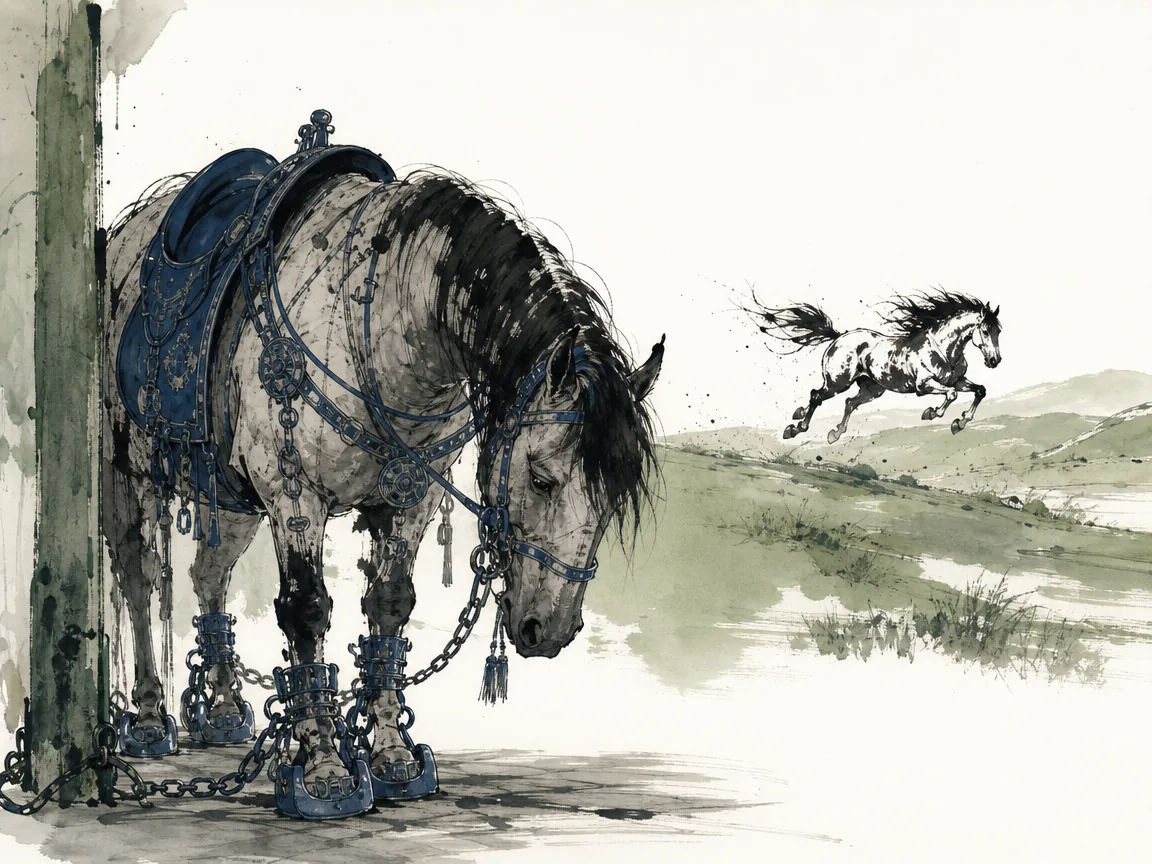
What makes the chapter so striking is not its argumentative complexity but its narrative simplicity. It opens with an image most readers can feel immediately: a horse standing in the wild, its hooves capable of treading frost and snow, its fur sufficient to ward off wind and cold. It eats grass, drinks water, raises its hooves and leaps, and gallops across the open terrain. This is not a hypothetical ideal. It is presented as the horse's ordinary, complete way of being. The horse does not need to be improved. It already knows how to live.
Then a figure enters the story — a man named Bo Le, traditionally celebrated as the greatest judge of horses, who declares that he knows how to "treat" horses. What follows is not cruelty in the crude sense. It is something more subtle and, for the text, more devastating. The horse is branded. Its mane is trimmed. Its hooves are cut. It is fitted with a bridle and placed in a stable. It is forced into rows, made to obey commands, and driven to run at speed. The text describes this as a process of "making them orderly" — which is precisely why it is so hard to resist. The intervention does not look like violence. It looks like management. It looks like care. It looks like progress.
And yet, according to the chapter, the result is catastrophic. Horses begin to die — not from neglect, but from what the text presents as excessive regulation. The passage then extends this logic beyond horses to everything shaped by human hands: wood is carved and loses its natural form, jade is shattered and ceases to be jade, and human beings are reshaped by the demands of ritual, morality, and social convention until they no longer recognize themselves. The chapter does not argue that civilization is evil. It asks whether the price of order is the life it claims to protect.
This is where the chapter connects thematically to another text in the same Outer Chapters collection, "Webbed Toes" (骈拇). That chapter opens by describing extra toes and webbed fingers as growths that depart from natural form, and it goes on to criticize how the imposition of external moral standards — such as the Confucian virtues of ren (benevolence) and yi (righteousness) — can distort what the text calls the "feeling of life and nature" (性命之情) [1]. The two chapters share a structural concern: something that appears added, refined, or improved may in fact be a departure from what is genuine. One chapter warns about growths that are not part of the body. The other warns about disciplines that are not part of the nature.
The Invisible Discipline: How Modern Life Trains Us
The horse in Zhuangzi's parable is not wearing a bridle. But the modern person often wears something equally invisible: the internalized voice of parents, teachers, employers, algorithms, and cultural expectations. What makes this discipline so effective — and so difficult to question — is that it rarely arrives dressed as oppression. It arrives dressed as opportunity.
A child is praised for being obedient, and curiosity is quietly deprioritized. A student learns that scores matter more than interests, and the habit of asking "what do I actually want to know?" atrophies alongside anything else neglected. An employee discovers that productivity is measured not by the quality of their engagement but by the volume of their output, and soon they are running not toward a goal they chose but away from the fear of falling behind. The track itself was designed by someone else. The runner simply learns to trust it.
This is the mechanism Zhuangzi's parable exposes. The horse is not abandoned. It is over-managed. The modern person is not starved. They are over-scheduled, over-evaluated, and over-optimised. The pressure does not come from a single tyrant. It comes from a hundred small voices, each saying the same thing in a different tone: You are doing well. Keep going. This is what success looks like. You should be grateful.
Psychology research supports a related observation. When people pursue goals primarily for external reasons — money, fame, image — the attainment of those goals does not reliably produce psychological well-being [3]. The reasons are complex. Some researchers argue that extrinsic goals may satisfy basic psychological needs less effectively than intrinsic ones, or that the pursuit itself may crowd out the very experiences — autonomy, genuine connection, unstructured play — that sustain mental health [3]. Others note that the social comparisons extrinsic goals often require are psychologically costly. Whatever the precise mechanism, the pattern is consistent enough to be disturbing: the harder a person runs toward externally defined success, the less likely they are to feel fulfilled by reaching it.
What Zhuangzi adds to this pattern is not data but a lens. He asks us to consider whether the problem is that we are failing, or that we are succeeding at the wrong scale. A horse that runs faster, obeys more precisely, and carries heavier loads is being "improved" in every measurable way. But improvement toward what end? And who decides that end? To study the primary classical text and commentary, explore the original Chinese text and deep philosophical translation in Horses’ Hoofs: The Native Wildness and the Tyranny of Training.
These questions are uncomfortable because they cut against a deeply held assumption: that discipline is always virtuous, that training is always beneficial, and that conformity to external standards is always a sign of maturity. Zhuangzi does not deny that order has value. He denies that all order is natural order, and he warns that the most dangerous orders are the ones we mistake for our own.
Between Natural Order and Forced Conformity
It is important to say clearly what Zhuangzi is not arguing. He is not saying that all discipline is violence. He is not saying that civilization should be abandoned. He is not saying that a horse should never be ridden or a person should never learn. What he is saying is sharper and more specific: when external discipline replaces internal structure, life is reshaped into something it does not recognize as its own.
This distinction between natural order and forced conformity runs through a great deal of classical Chinese thought, and it is worth understanding in its own right before applying it to modern life. Natural order, as the concept appears in texts like the Zhuangzi and related traditions, refers to patterns that emerge from within a living system — the way a tree grows toward light, the way a river finds its course, the way a child naturally explores when left undisturbed. It is not chaotic. It is self-organizing. It honours differences because different forms have different capacities.
Forced conformity, by contrast, is imposed from outside. It demands uniformity. It reshapes life to fit a pre-existing template. A forest cleared for a parking lot is not "smarter" than the forest. A student trained to suppress curiosity in favour of test scores is not "better" than the curious student. A worker optimised for maximum output without regard for their rhythms, sensibilities, or boundaries is not more whole than the worker who is allowed to develop according to their nature. The harm is not always dramatic. Often it is gradual, cumulative, and invisible to those experiencing it — which is precisely why Zhuangzi's parable is so effective. The horse does not know it has lost its nature. It only knows that it no longer feels like itself.
The chapter "Webbed Toes" makes this point with particular clarity. It describes extra toes and webbed fingers not as blessings but as deviations from natural form, and it extends the metaphor to argue that the imposition of rigid moral standards — what the text calls "multiplying the ways of benevolence and righteousness" — damages the same kind of natural integrity [1]. The argument is not anti-moral. It is anti-disguised. It warns against standards that present themselves as moral enhancement while actually functioning as external imposition.
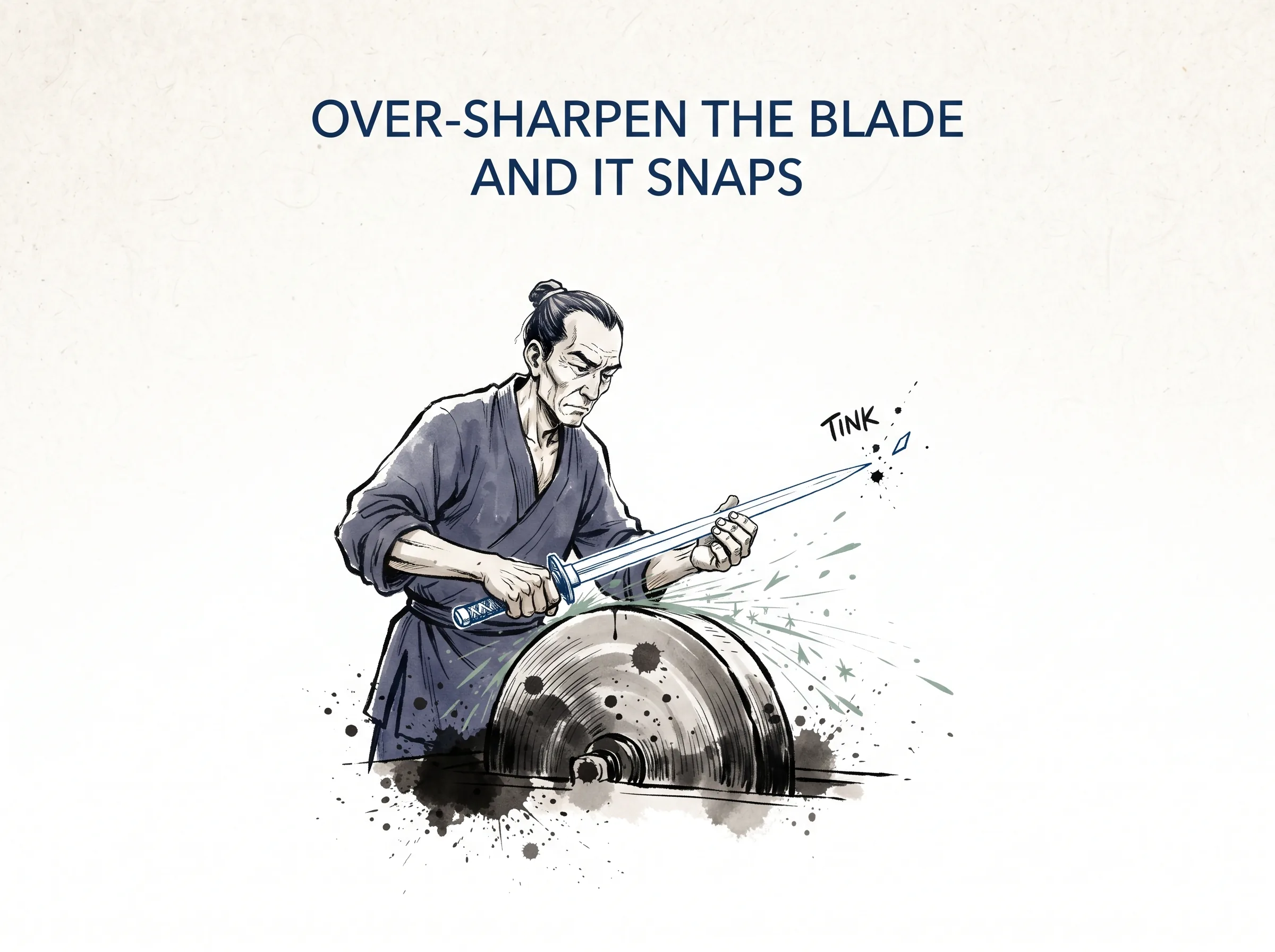
Applied to modern life, this insight helps explain why so many high-achieving people feel empty. They have not failed by external standards. They have succeeded. But the success was achieved by reshaping themselves into a shape that was never theirs. The exhaustion they feel is not the exhaustion of overwork. It is the exhaustion of living a life that does not match their nature.
Questions for Reflection: Where Is the Rein Holding You?
Zhuangzi's text does not offer a step-by-step program. It offers a mirror. The most useful thing a reader can do with that mirror is not to agree or disagree but to look. Below are a set of reflective questions drawn from the concerns of the "Hoof and Beam" chapter and the broader tradition it represents. They are not diagnostic tools. They are not meant to produce a verdict. They are meant to create space between a habit and a choice.
Is my lifestyle growing from my nature, or trained by the outside world?
Consider the rhythm of your days. When you wake, what is the first impulse? When you choose how to spend your time, whose voice do you hear? Is it your own, or is it the accumulated voice of expectations — parental, institutional, cultural, algorithmic? This is not a question about rebellion. It is a question about authorship.
Is my effort natural growth, or fear-driven running?
Effort that comes from intrinsic motivation feels different from effort that comes from external pressure. The former tends to be sustained, adaptable, and nourishing even when it is hard. The latter tends to be brittle, reactive, and depleting even when it is productive. Ask yourself: if no one would ever know about this achievement, would I still pursue it? If the answer is no, the pursuit may be serving someone else's design.
Is my maturity inner wisdom, or long-term suppression?
Maturity is often confused with compliance. But compliance is the ability to follow rules. Wisdom is the ability to discern which rules serve life and which serve control. A mature person can say no. A compliant person says yes and hopes no one notices the cost. Reflect on your recent decisions. How many were guided by genuine understanding, and how many were guided by the fear of disappointment, judgment, or instability?
Am I living my life, or is the rein living for me?
This is the most uncomfortable question in the parable. The horse that has been trained for years may no longer remember what it is like to run without a rider. The person who has been conditioned for decades may no longer remember what it is like to want something without first checking whether it is approved. Reclaiming direction does not require abandoning responsibility. It requires noticing where responsibility ends and conformity begins.
These questions are not meant to produce anxiety. They are meant to produce awareness. Awareness is the first step toward any real choice. And choice — even small, private, incremental choice — is what distinguishes a life from a performance.
Practical Steps: Reclaiming Direction Without Rejection
Zhuangzi is often misunderstood as advocating withdrawal. The "Hoof and Beam" chapter does not say that horses should be released into the wilderness and left there. It says that horses should not be reshaped against their nature. The same principle applies to human life. The goal is not to escape society but to enter it with eyes open.
Here are a few practical steps that align with this orientation:
1. Identify the sources of your standards
Write down the five most important goals you are currently pursuing. Next to each, write the name of the person or system that originally suggested it. You may find that many of your goals belong to someone else's design. This is not an accusation. It is a map. And a map is the first tool of navigation.
2. Distinguish between responsibility and internalised expectation
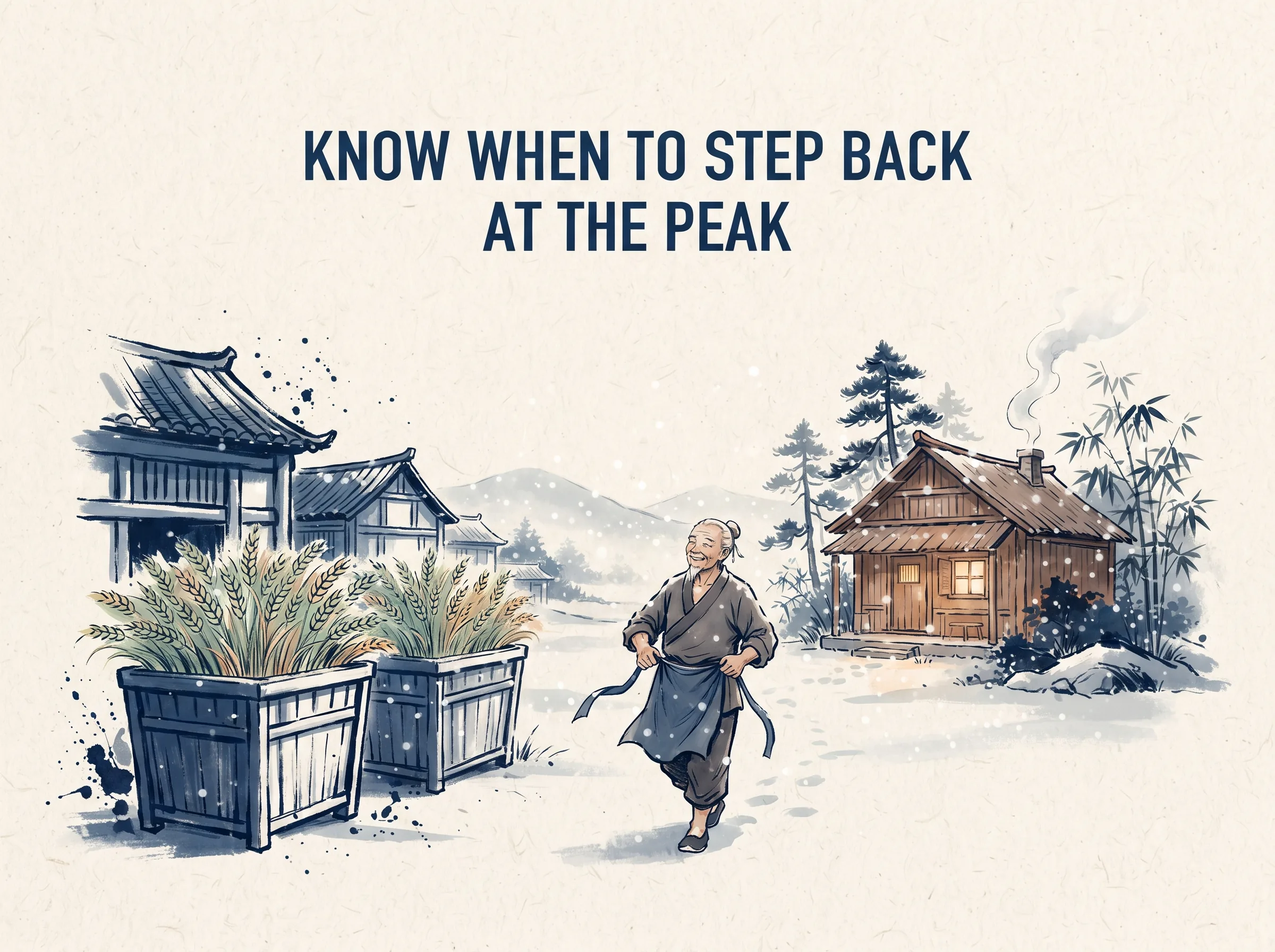
Responsibility is something you choose because it aligns with your values. Internalised expectation is something you carry because you believe you should. The difference can be subtle. A helpful test: if you removed the external reward or punishment, would you still choose this? If the answer is no, the drive is likely external. If the answer is yes, the drive is likely yours.
3. Reintroduce unproductive time
Not all time must be optimised. Not all activity must be meaningful. Some of the most important human experiences — daydreaming, idle conversation, wandering without a destination — are structurally opposed to the logic of production. Schedule at least one hour per week of unstructured time. Do not fill it with podcasts, exercise, or self-improvement. Let it be empty. What emerges from that emptiness may surprise you.
4. Track energy, not just output
Most people measure their days by what they accomplished. Try measuring them by how you felt. Did the work leave you energised or depleted? Did the interaction deepen or diminish your sense of self? Output is visible. Energy is invisible. But energy is the better indicator of whether a life is aligned with nature or being forced into a shape.
5. Create a personal boundary audit
Write down three areas of your life where you feel most constrained. For each, ask: who designed this constraint? Is it serving me, or am I serving it? Can I negotiate a modification? Can I decline entirely? Most constraints are negotiable to some degree. The hardest part is recognising that they are constraints at all.
These steps are not a programme. They are invitations. Some will resonate. Some will not. The point is not to follow all of them but to begin noticing — to develop the capacity to tell the difference between a life that is growing and a life that is being grown.
Conclusion: Running Toward Yourself
The emptiness that accompanies success is not a moral failure. It is a signal. It is the life within you saying, in the only language it has left, that something is misaligned. Zhuangzi understood this signal two thousand years ago. He did not solve the problem by telling people to quit their jobs and move to the mountains. He solved it by asking them to see the bridle before they could remove it.
The "Hoof and Beam" chapter remains relevant not because it offers an escape from modern life but because it offers a way through it. You can work without becoming only a worker. You can succeed without becoming only a success. You can participate in society without surrendering your nature to it. The requirement is not rebellion. It is awareness.
The next step is not dramatic. It is small, private, and repeated. Ask yourself, again and again, whether the life you are living is yours or someone else's. Notice the difference. honour it. And then, gradually, let your actions catch up to your nature.
FAQ
Is "Hoof and Beam" written by Zhuangzi himself?
Scholars generally agree that "Hoof and Beam" (马蹄) is part of the Outer Chapters of the received Zhuangzi text, and that these chapters should not be unreservedly attributed to Zhuangzi himself [1]****[2]. The traditional view, upheld by later editors and many modern scholars, holds that the Inner Chapters (chapters 1–7) are closer to Zhuangzi's own voice, while the Outer and Miscellaneous Chapters represent later elaborations by his followers and related thinkers [2]. This does not diminish the philosophical value of the chapter. It simply means that its ideas should be read as part of a broader tradition rather than as a single author's definitive statement.
What is the relationship between "Hoof and Beam" and "Webbed Toes"?
Both chapters appear in the Outer Chapters of the Zhuangzi and share a common concern: the harm caused by imposing external standards on natural life. "Webbed Toes" opens with the image of extra toes and webbed fingers as deformities that depart from natural form, and it extends this metaphor to criticise the imposition of rigid moral conventions such as benevolence and righteousness [1]. "Hoof and Beam" uses the image of a horse being reshaped by human discipline to make a similar point about the distortion of natural order. The two chapters are often read together because they address the same structural problem from different angles — one focusing on what is added, the other on what is subtracted or remade.
Does Zhuangzi oppose all education and discipline?
No. The "Hoof and Beam" chapter criticises discipline that replaces natural structure with external design, not discipline that supports the development of a life's inherent capacities. Zhuangzi distinguishes between natural order — which grows from within and honours differences — and forced conformity — which is imposed from outside and demands uniformity [1]****[2]. Education that helps a person discover and develop their own nature is consistent with this view. Education that reshapes a person to fit an external template is what the chapter calls into question.
How does this ancient text relate to modern psychological research?
Contemporary research in self-determination theory and related fields has found that intrinsic goals — such as personal growth, meaningful relationships, and community contribution — are associated with better psychological health, while extrinsic goals such as wealth, fame, and image are not [3]. Some researchers also note that extrinsic goal pursuit may interfere with the satisfaction of basic psychological needs for autonomy, competence, and relatedness [3]. These findings do not prove Zhuangzi's ancient claims. But they do converge with a similar intuition: that a life driven primarily by external validation tends to produce less well-being than a life grounded in internal direction, reflecting the enduring wisdom of Zhuangzi Chapter 9 Meaning.
To explore these themes from another angle, read our related reflection on When Order Becomes Theft: Zhuangzi’s Warning for Modern Life.
Deepen your understanding of these principles in our reflection on Why Do We Sabotage Ourselves When It Matters Most? Ancient Chinese Wisdom for Modern Performance Anxiety.
Sources & Further Reading
[1] Zhuangzi / Pianmu – Wikisource — The Chinese Wikimedia repository hosting the received text of the Zhuangzi, including the "Webbed Toes" chapter with its critique of external moral imposition and its discussion of natural form versus artificial addition.
[2] Zhuangzi — Stanford Encyclopedia of Philosophy — Scholarly overview of the Zhuangzi text, its composition, and the conventional distinction between the Inner Chapters and the Outer and Miscellaneous Chapters, noting that the Outer Chapters are not unreservedly attributed to Zhuangzi himself.
[3] The Path Taken: Consequences of Attaining Intrinsic and Extrinsic Aspirations in Post-College Life — PMC — Peer-reviewed research reporting that the attainment of intrinsic aspirations relates positively to psychological health, while the attainment of extrinsic aspirations relates positively to indicators of ill-being, and discussing the role of basic psychological needs in self-determination theory.
Further Reading
- Norman J. Godwin, transl. Chuang Tzu: The Inner Chapters — Accessible translation and commentary focused on the Inner Chapters, providing context for understanding the relationship between the Inner and Outer chapters.
- Brian Unger, Complete Works of Chuang Tzu — English translation of the full received text, including the Outer and Miscellaneous Chapters, with introductory notes on authorship debates.
- Edward Slingerland, Effortless Action: Wu-wei as Conceptual Metaphor and Spiritual Ideal in Early China — Explores the concept of natural ease and spontaneous action in early Chinese philosophy, offering a framework for understanding Zhuangzi's critique of forced discipline.






