
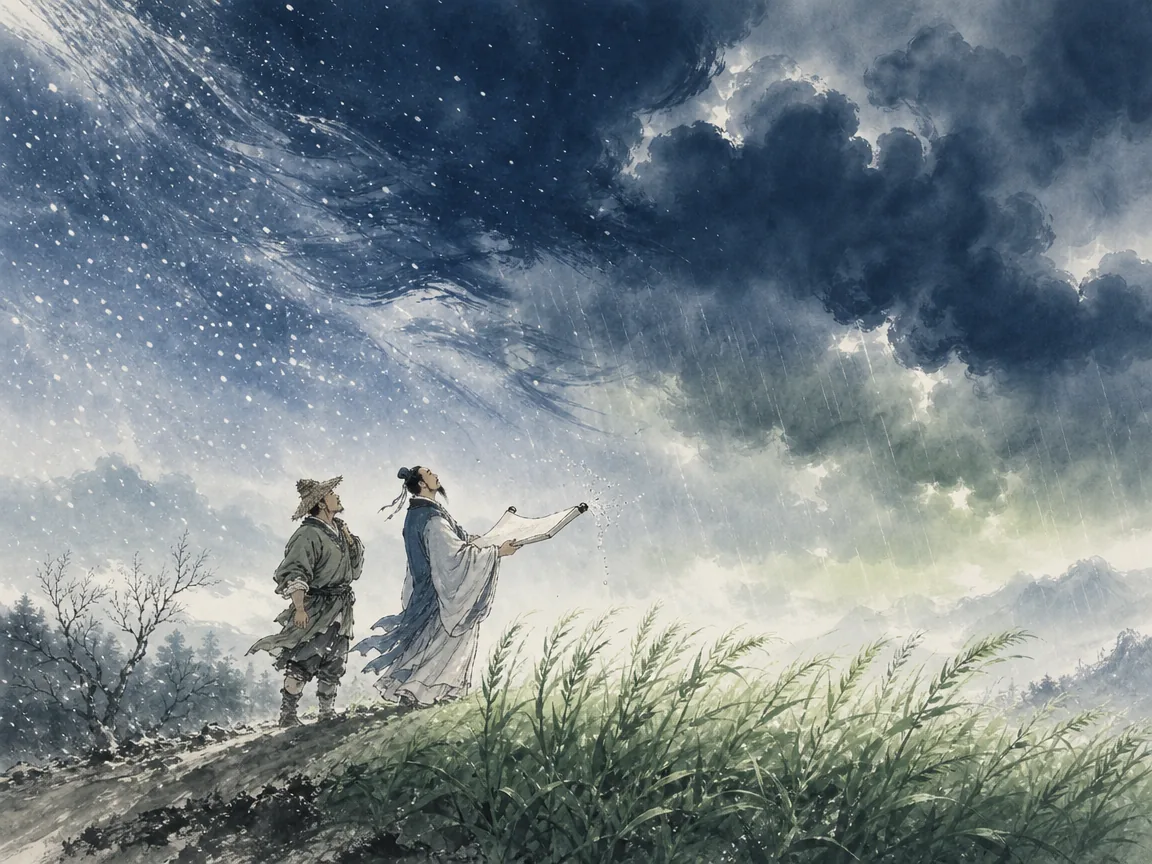
History and literature are products of geography. Every Chinese dynasty carried its own weather inside it—not as mere poetic decoration, but as a force that determined what could grow, who could survive, and what kind of words a civilization felt brave enough to speak.
A climate historian once observed that certain periods in Chinese literary history seem to carry their own atmospheric signature: the thunderstorms of the Pre-Qin era, the autumn winds of the Wei-Jin period, the blazing sun of the High Tang, the drizzle of the Northern Song, the heavy snows of the Qing. This is not simply metaphor. Paleoclimatology has shown us that temperature shifts of just one or two degrees can alter growing seasons, shift agricultural boundaries, and reshape the fate of empires [1]. When the land cannot feed its people, history records the result in famine, migration, and conflict [2]. But when the land is generous, the same history records something different: openness, confidence, and literary voices that reach toward the sky—a foundational perspective explored in How Chinas Climate Shaped Literature.
Understanding this connection does not require us to believe that climate determines culture in a mechanical way. It only asks us to pay attention to a pattern that repeats across millennia—that the weather a civilization lives inside shapes the mood it produces, and that reading those literary moods can teach us something about how to live through our own uncertain times.
How Chinas Climate Shaped Literature: The Hidden Climate of Every Dynasty
The relationship between climate and civilization in China has been studied systematically since the 1970s, when the paleoclimatologist Zhu Kezhen published his landmark research on five thousand years of climate change [1]. His work, and subsequent studies, reveal a clear pattern: warmer periods tend to coincide with agricultural surplus, territorial expansion, and cosmopolitan cultural confidence; colder periods tend to coincide with food shortage, internal strife, and a turn toward introspection or withdrawal.
A 2008 study analyzing historical records from AD 10 to 1900 found that temperature cooling in China shows a direct association with the frequency of external warfare and an indirect association with internal conflict through drought and locust plagues [2]. Food production was simply more unstable during cooler periods, which increased social tension [2]. The study also noted, however, that temperature did not have a statistically significant direct effect on the frequency of internal wars—a reminder that climate is a pressure multiplier, not a simple cause [2].
What this means for literature is subtle but real. A civilization that grows up in abundance writes differently than one that grows up in scarcity. The question is not whether climate writes history, but how consciously a culture reads its own weather—and what kind of wisdom it extracts from the seasons it endures.
Pre-Qin Thunders — When Civilization First Opened Its Eyes
The earliest surviving collections of Chinese poetry carry the texture of a young civilization experiencing the world with undiscovered intensity. The Shijing (Classic of Poetry) speaks of wind and rain in tones that feel elemental rather than controlled. The Chu Ci (Songs of Chu) describes thunder rolling across dark skies with a wildness that has not yet been refined by orthodoxy.
This was a period when Chinese agriculture was still establishing itself along the Yellow River, in a climate that was relatively warm and wet compared to what followed. The material security of those early centuries allowed something rare to happen: a proliferation of ideas. The Hundred Schools of Thought—Confucianism, Daoism, Legalism, Mohism—debated, diverged, and coexisted in a intellectual climate that mirrored the physical one. No single doctrine claimed final authority, because the world still felt unmapped.
The literary spirit of this era carries that same quality of untamed possibility. The storms in the Shijing and the thunder in the Chu Ci are not decorative imagery. They are the voice of a civilization that has not yet learned to fear its own power—and that is precisely what makes them so alive.
For modern readers, the Pre-Qin lesson is straightforward: periods of upheaval and new beginnings are not chaos to dread but fertile ground for thinking. When old categories break down, new ones become possible. The anxiety of transition is real, but so is the opportunity.
Wei-Jin Autumn Winds — Finding Calm in Collapse
The Eastern Han dynasty began to cool in the second century CE, and the warming trend that had supported imperial expansion gave way to drought, famine, and fracture. The empire broke apart. What followed was centuries of division, migration, and political instability—a period historians often associate with one of the coldest intervals in the previous millennium [1].
Yet the literature of the Wei-Jin era is remarkable not for its despair but for its strange serenity. Ji Kang, one of the Seven Sages of the Bamboo Grove, was executed by the ruling regime in 262 CE. According to the Shishuo Xinyu (New Account of the Tales of the World), he requested his lute before his death, played the piece known as Guangling San, and when it ended, remarked that the tune would now die with him [3]. There is no record of panic in this account. There is only a man facing an inevitable end with composure. To explore these themes from another angle, read our related reflection on The Smartest Strike Carries No Force: What Sun Tzu’s Fire Attack Teaches Modern Decision-Making.
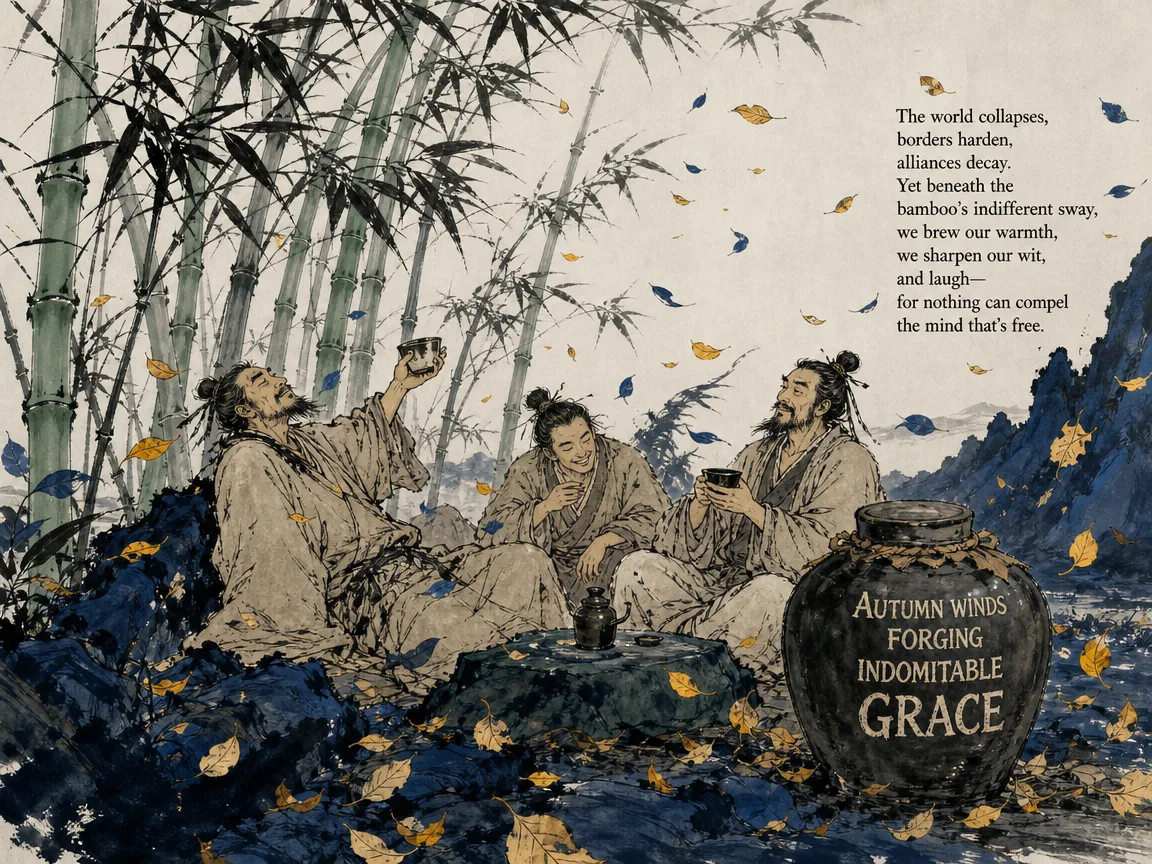
This is the spirit of autumn—not mourning, but acceptance. The Daoist tradition, particularly as expressed in the Zhuangzi, teaches exactly this posture: do not fight the wind; learn to move with it. The Wei-Jin literati did not deny suffering. They refused to let suffering dictate their inner weather.
The practical insight here is not that we should remain calm in the face of injustice or loss. It is that when the external world contracts and security fades, there are two responses available: panic, or a deeper, clearer seeing. The Wei-Jin writers chose the latter—not because they were indifferent, but because they understood that inner disorder adds suffering to suffering, while inner clarity preserves what cannot be preserved in any other way.
High Tang Blazing Sun — Confidence Born of Abundance
Zhu Kezhen's research documented that during the Tang dynasty, citrus trees were grown and bore fruit within the palaces of Chang'an, and plum trees thrived in the imperial gardens and the southern suburb of Qujiang Pool—practices that would be impossible in the same locations today [1]. The Tang period was one of the warmer intervals in the previous two millennia, and that warmth translated into longer growing seasons, expanded farmland, and grain surpluses [1].
The literature of the High Tang reflects this material confidence. Li Bai's poems reach toward the moon with a boldness that assumes the sky is reachable. His famous line—recorded in classical sources as "I wish to climb the blue heavens and embrace the bright moon" (yù shàng qīngtiān lǎn míngyuè, 欲上青天览明月)—captures a civilization that believed human aspiration could meet the cosmos [4]. The expansive energy of Tang poetry is not mere artistic fancy; it is the cultural expression of an era that had solved, for a time, the ancient problem of feeding its people.
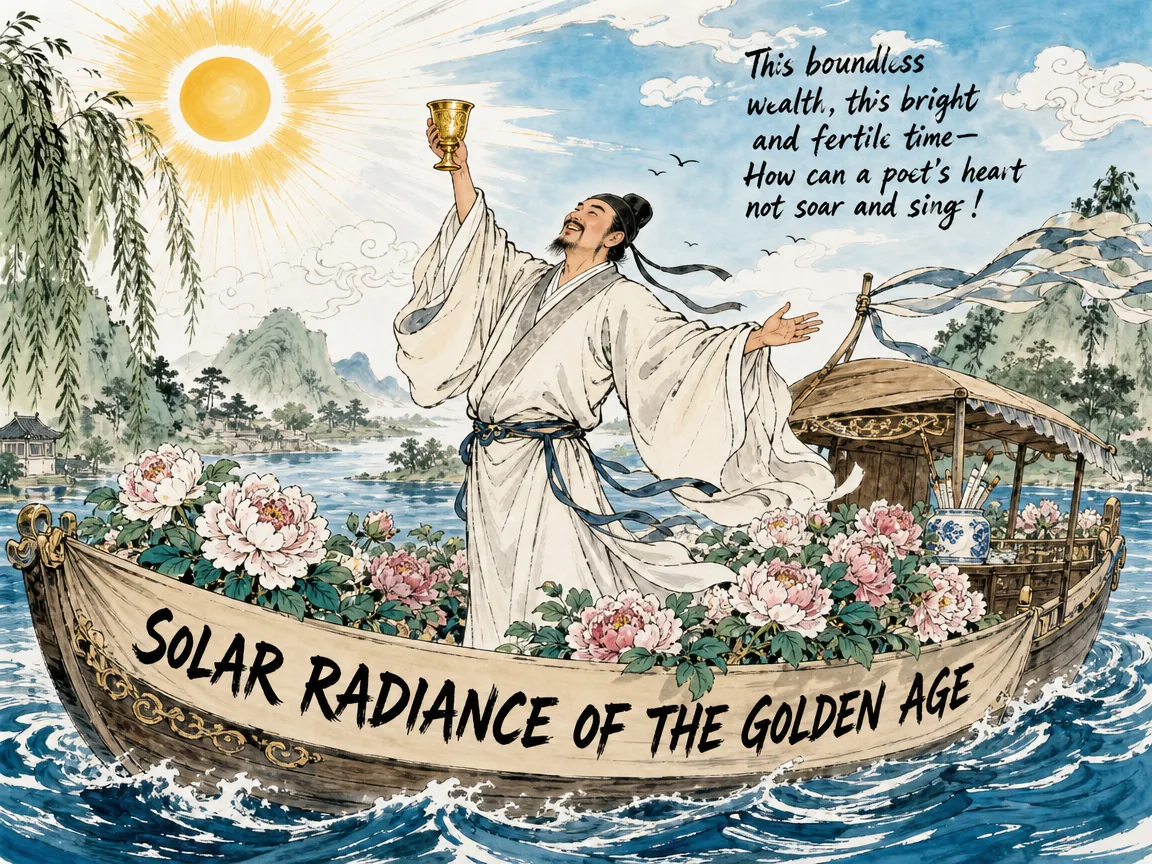
A 2008 climatological study confirmed that warmer periods in Chinese history correlate with greater external warfare capacity and more stable food production, while cooler periods introduce instability [2]. The Tang was the warm period par excellence—and its literature is the literature of abundance.
The takeaway for readers today is uncomfortable in its simplicity: prosperity shapes character as much as hardship does. An era of relative security produces art that reaches outward; an era of scarcity produces art that turns inward. Both are valid. Both are true. The question for our own time is not which is better, but what kind of cultural weather we are living in—and whether we are reading it honestly.
Northern Song Drizzle — Restraint as a Way of Being
The Northern Song dynasty (960–1127 CE) occupied a complex climatic space. Research indicates that the eleventh and early twelfth centuries saw a period of fluctuation—warmth interspersed with cooler intervals—before the severe cooling of the late Song and the Yuan [1]. Politically, the dynasty experienced a parallel pattern: initial stability and cultural flourishing followed by gradual contraction, military weakness, and the imposition of tribute payments to northern regimes.
The literary response was not dramatic. It was refined, melancholic, and restrained. The ci poetry of the Song—lyric verse set to music—turned inward. Poets wrote of rain on bluestone pavement, of boats drifting on green water, of feelings too delicate to name directly. The grand outward reach of the Tang gave way to a quiet attention to the small and transient.
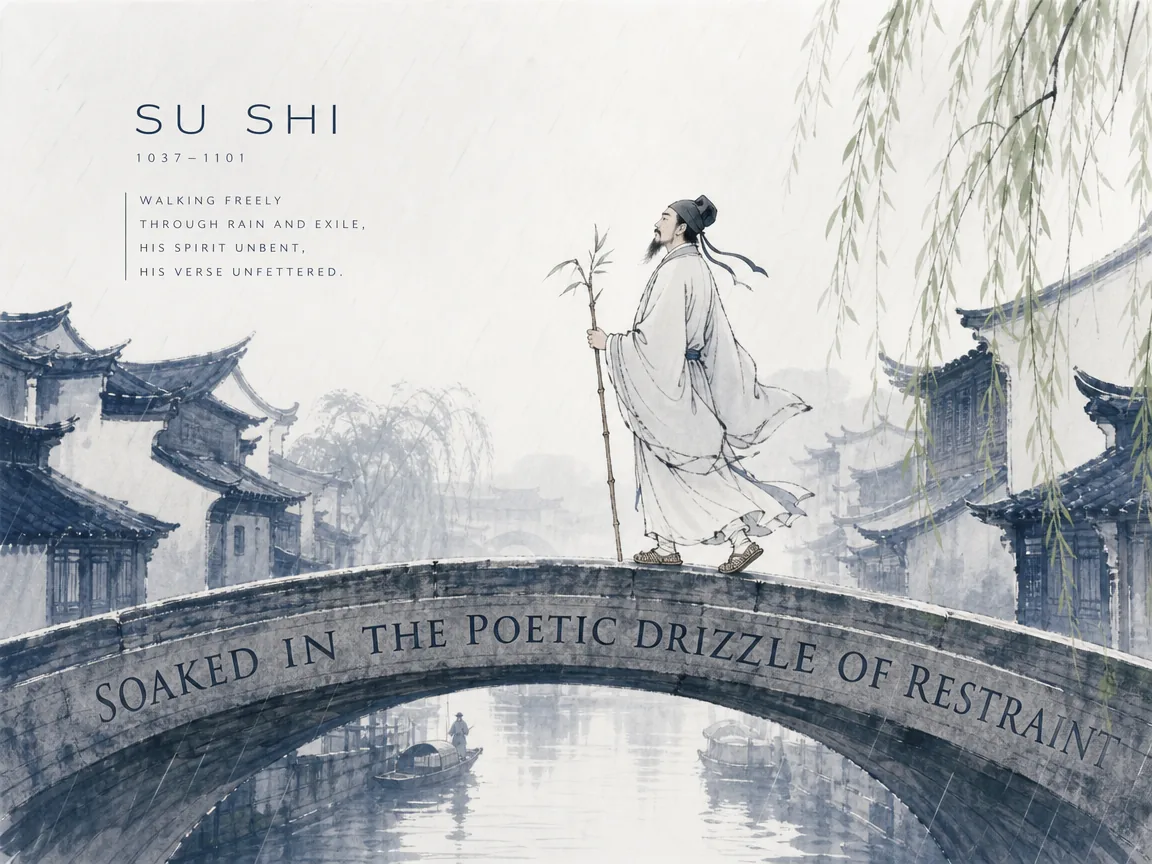
This shift mirrors a philosophical concept familiar to Chinese thought: the Doctrine of the Mean, or zhong yong. When neither full engagement nor full withdrawal feels entirely right, wisdom lies in finding the measured path. The Song scholar-official lived this tension daily—committed to public service, aware of its limits, expressing both through a literary form that valued implication over declaration.
For modern readers navigating eras of slow decline or chronic uncertainty, the Song example offers a model: not every period allows for bold action, and restraint is not weakness. Sometimes the wisest response to a contracting world is to sharpen your attention rather than widen your ambitions.
Qing Dynasty Heavy Snow — Silence Beneath the Ice
The seventeenth century, particularly the period from 1650 to 1700, marks the coldest interval of the preceding five hundred years according to Zhu Kezhen's analysis [1]. This was the height of the Little Ice Age in China, bringing severe cold, food crises, and intense frontier pressure. The Ming dynasty fell in 1644, and the Qing consolidated power in a landscape of famine and displacement.
The literary response to this extreme cold was not protest but extraordinary refinement. The greatest novel of the Qing era, Cao Xueqin's Dream of the Red Chamber, encloses vast emotional and social complexity within immaculately crafted prose. The novel's famous ending—a vision of "a vast white wilderness, truly clean"—has been read as the ultimate expression of Daoist wu wei: when the surface is frozen, the mind learns to move beneath it [5]. The brilliance is not absent; it is concentrated, preserved, waiting.
This is the literature of survival under constraint. It teaches that when the outer world becomes too harsh to shape directly, the inner world becomes the primary site of freedom. The artistry of the Qing novelists did not come from ease—it came from the discipline of maintaining depth beneath a polished surface.
What Ancient Climate Teaches Modern Readers
Chinese literature did not merely describe its weather. It absorbed it. Each dynasty's literary voice was, in a real sense, its climate made into words. The Pre-Qin storms, the Wei-Jin winds, the Tang sun, the Song drizzle, the Qing snow—these are not imposed metaphors. They are records of civilizations responding honestly to the conditions they inhabited.
The universal insight is this: your era's weather—economic, environmental, social—shapes how you think, feel, and create. The question is not whether this influence exists, but how consciously you respond to it.
There are three practical steps any reader can take. First, name your climate honestly. Are you living in a warming period or a cooling one? Not in temperature alone, but in opportunity, stability, and abundance. Second, read your era's literature without judgment. The art of scarcity is not inferior to the art of plenty; it is different, and often deeper. Third, practice what the Chinese tradition calls shun shi—going with the season. This does not mean passive resignation. It means refusing to fight the weather, and instead learning to build shelter, store grain, and cultivate inner richness according to what the times allow.
FAQ
Is it accurate to say that climate directly caused the rise and fall of Chinese dynasties?
Climate was a significant factor, but not the sole cause. Research shows that cooling periods correlated with less stable food production and increased conflict frequency [2]. However, the same studies found no statistically significant direct effect of temperature on internal war frequency, suggesting that climate acts as a pressure multiplier rather than a simple determinant [2]. Dynastic change involved politics, ideology, and human agency alongside environmental conditions.
How reliable is Zhu Kezhen's claim about Tang-era temperatures?
Zhu Kezhen's 1972 study identified the Tang period as one of the warmer intervals in China's climate history, with evidence such as citrus and plum cultivation in Chang'an's imperial gardens [1]. However, the study uses winter temperature as its primary indicator and describes temperature swings of approximately 1–2°C across multiple cold-warm cycles—not a definitive statement that the Tang was uniformly 1–2°C warmer than the present day [1]. Later research has corroborated broad patterns of warmth during the Tang, while also noting regional and decadal variability.
Does Chinese philosophy offer practical guidance for living through uncertain times?
Yes. Concepts such as wu wei (non-action or effortless action) from the Daoist tradition and zhong yong (the Doctrine of the Mean) from the Confucian tradition both address how to navigate periods of constraint without despair or recklessness. These are philosophical frameworks for understanding one's relationship to circumstances, not prescriptions for specific outcomes. Different readers may find resonance in different traditions depending on their own values and situations.
Can the climate-literature connection help us understand our own era?
It can provide a lens, but not a blueprint. The pattern—warmth correlating with outward confidence and cold correlating with introspection—has repeated across centuries [1] [2]. Recognizing this pattern may help modern readers understand why their cultural moment feels the way it does, and why different kinds of art and thought emerge in different conditions. The goal is not to predict the future but to read the present more clearly.
Conclusion
The weather of a dynasty is never just weather. It is the temperature of possibility, the precipitation of anxiety, the sunlight of confidence, the snow of restraint. Chinese literature, across five thousand years, has been a long conversation between a civilization and its climate—sometimes fighting the cold, sometimes learning to move beneath the ice, sometimes simply naming what the sky is doing.
For modern readers facing our own era of environmental uncertainty and social flux, the ancient Chinese tradition offers something rare: a language for understanding that the mood of our times is not random, and that how we respond to our climate—both literal and cultural—is itself a form of wisdom. The seasons will continue to change. The question is what kind of words we will write inside them, reflecting the enduring wisdom of How Chinas Climate Shaped Literature.
Connect these enduring values to the broader cultural heritage explored in Why China Keeps Existing When Other Empires Fade.
For a deeper comparative examination of these ideas, explore our related study on What Can Du Fu’s Lifelong Failures Teach Us About Finding Meaning in Disappointment?.
Sources & Further Reading
[2] Periodic climate cooling enhanced natural disasters and wars in China during AD 10–1900. PMC.
[3] Shishuo Xinyu (世说新语), Chapter 6 — Ya Liang (雅量). Chinese Classics.org.
[4] Li Bai. Xuanzhou Xie Tiao Tower Farewell to Uncle Shuyun (宣州谢朓楼饯别校书叔云). Wikisource.
[5] Dream of the Red Chamber (红楼梦), Cheng Jiaben edition, Chapter 120. Wikisource.
Further Reading
- Cao Xueqin. Dream of the Red Chamber (《红楼梦》). Various classical editions.
- Zhuangzi (《庄子》). Classical Daoist text.
- Analects (《论语》). Classical Confucian text.
- Shijing (《诗经》) and Chu Ci (《楚辞》). Early Chinese poetic anthologies.
- Xu Zhuoyun (许倬云). Works on Chinese historical sociology and the relationship between environment and dynastic cycles.






