
We live in a culture that praises effort above almost everything else. Work harder. Push longer. Grind until you break through. The message is repeated endlessly in career advice, fitness culture, and even in how we talk about relationships and personal growth. Yet anyone who has ever tried to force a difficult situation to change knows that effort alone rarely guarantees results. Sometimes the harder you push, the more the system pushes back.
There is a different kind of intelligence at work in situations where the smallest action produces outsized results. A single well-timed word defuses a months-long argument. A brief conversation at the right moment opens a career door that years of networking never did. In each case, the outcome was not proportional to the effort invested. The leverage was in the timing and the placement, not the intensity—a foundational perspective explored in Sun Tzu on Decision Making.
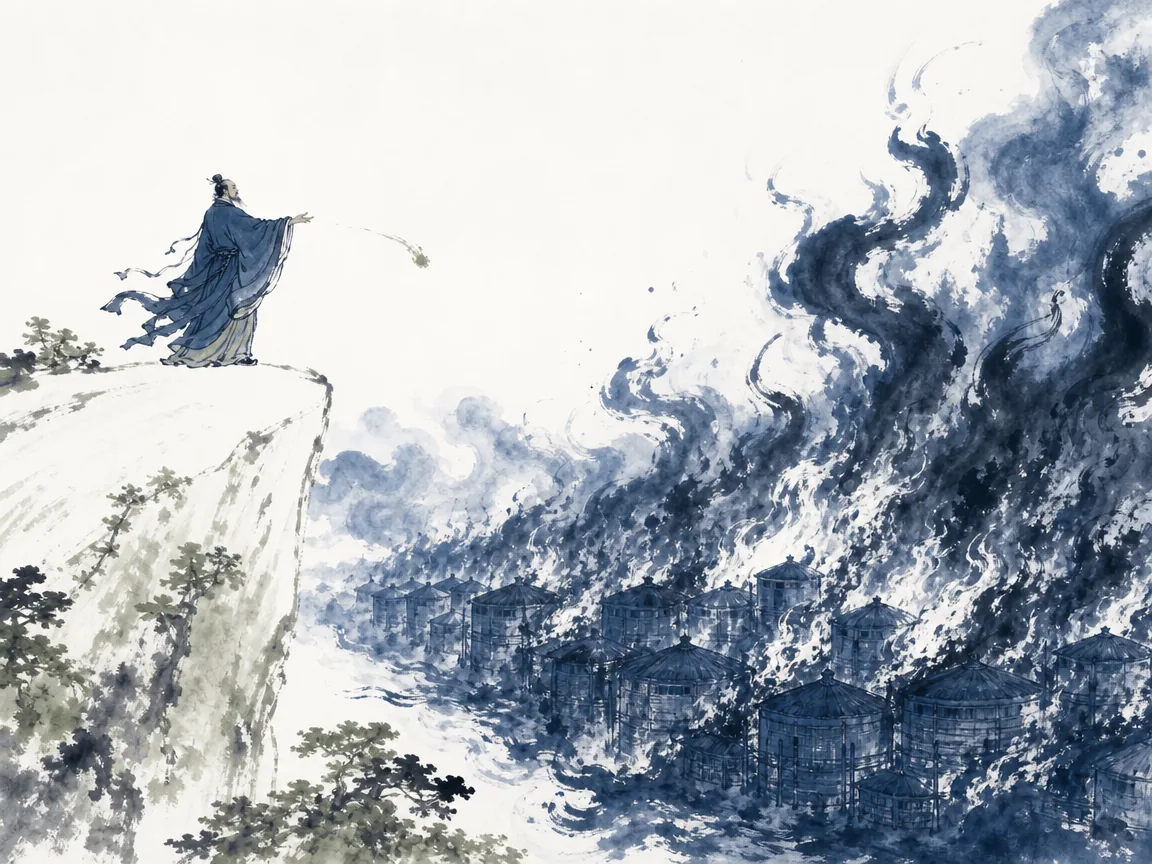
This is not a new insight. Ancient strategic thought, particularly the Art of War attributed to Sun Tzu, offers one of the earliest and clearest formulations of this principle. Chapter 12, commonly known as the Fire Attack chapter, moves beyond literal warfare to describe a way of understanding systems — identifying where they are already unstable, finding their most sensitive points, and acting only when conditions align. The lesson extends far beyond military history. It applies to how we approach change in organizations, relationships, and our own lives.
Sun Tzu on Decision Making: The Illusion of Force
The default assumption in modern problem-solving is linear: more input produces more output. If a project is behind schedule, work more hours. If a relationship is strained, address the issue more directly. If personal habits are not changing, rely more heavily on willpower. This approach treats the world as a machine that responds predictably to applied effort.
But most real-world systems are not machines. They are complex, adaptive networks where small inputs at the wrong point produce little or no change, and the same inputs at the right point trigger cascading effects. Markets do not move in straight lines. Organizations respond to incentives, hidden power structures, and cultural norms that no amount of individual effort can override. Relationships operate on layers of unspoken assumptions and emotional history that surface-level arguments rarely reach.
The problem is not that we lack effort. The problem is that we often apply force at the wrong level of the system. Donella Meadows, who studied leverage in complex systems, identified that the most effective intervention points are not the visible parameters — budgets, schedules, daily routines — but the deeper structures: the rules, goals, and underlying paradigms that shape those parameters [1]. When we push only at the surface, we are expending energy against a system that was never truly engaged.
This is what makes brute effort so exhausting and so often ineffective. You are not fighting the actual problem; you are fighting the symptoms while the system's deeper structure remains untouched.
Continue with the deeper interpretation and practical application.
ChiDestiny members get access to the full analysis, modern applications, and the growing Chinese Wisdom Library.
FAQ
Is "going with the flow" the same as doing nothing? No. The principle of aligning with existing conditions requires active observation, analysis, and timing. It is the opposite of passivity — it is a more demanding form of action that requires patience and discernment rather than force.
Does this mean effort is useless? Effort is not useless, but its effectiveness depends on where and when it is applied. Brute effort at the wrong level of a system produces exhaustion without change. Strategic effort at the right leverage point can achieve disproportionate results. The question is not whether to act but where to place your action.
Can this approach be applied to personal problems, not just organizational or strategic ones? Yes. Personal habits, emotional patterns, and life transitions are all systems with their own leverage points. Recognizing where a pattern is sustained — often at the level of underlying beliefs or environmental design rather than conscious will — can make change significantly more achievable.
What if I cannot tell whether a system is fragile or resilient? Uncertainty is inherent in this approach. The safest strategy in conditions of uncertainty is typically to gather more information before acting, to avoid premature intervention, and to start with small, reversible actions that reveal the system's response without committing to a full-scale effort.
Summary
The gap between raw effort and effective action is not a gap in intensity but in understanding. Sun Tzu's Fire Attack chapter, Donella Meadows' research on system leverage, and the Daoist tradition of aligned action all point toward the same insight: the most powerful changes come not from applying force but from finding the points where force is already building and directing it.
The practical next step is not to work harder at the problems you face. It is to slow down, observe the system, and ask three questions: Where is the system already fragile? Where is the highest leverage point? And what will happen when I act? The answer to those questions will often reveal that less effort, placed more intelligently, produces more results than any amount of force applied at the wrong level, reflecting the enduring wisdom of Sun Tzu on Decision Making.
To explore these themes from another angle, read our related reflection on Where the Road Ends: What Ancient Chinese Strategy Teaches Us About Knowing What We Can Actually Do.
For a deeper comparative examination of these ideas, explore our related study on Why Your Breakthrough Won’t Last—And What Sun Tzu Knew About Real Advantage.
Sources & Further Reading
[1] Leverage Points — Places to Intervene in a System — The Donella Meadows Project,
[2] Federal Reserve Board, Monetary Policy Report, February 24, 2009 — Part 2 — Recent Financial and Economic Developments,
Further Reading
- Thinking in Systems: A Primer by Donella H. Meadows — accessible introduction to system dynamics and leverage points
- Sun Tzu, The Art of War — Chapter 12 (Fire Attack) for the original strategic text
- Tao Te Ching — foundational Daoist text for the concept of wuwei and aligned action






