
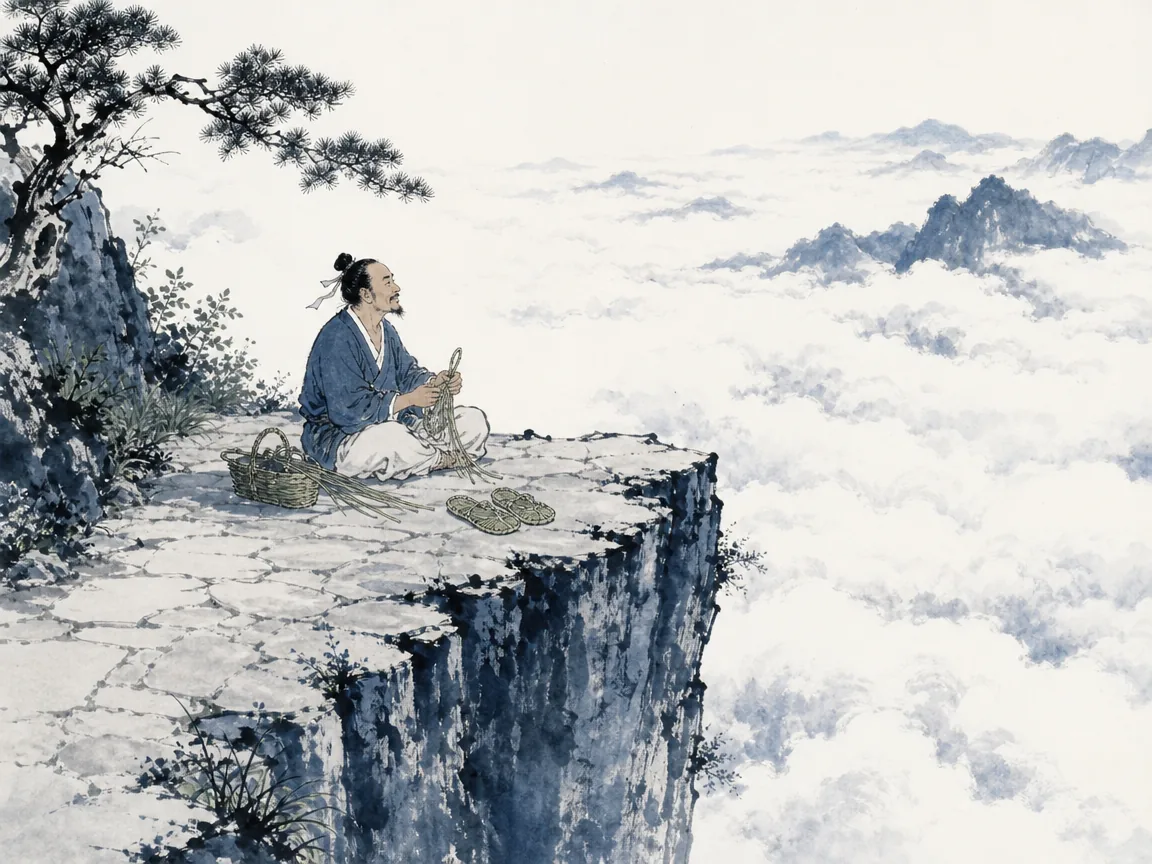
You can draw the most elegant blueprint in the world — perfect angles, sound structural logic, everything exactly where it should be on paper. But if your foundation is sand, none of that matters. The building simply cannot exist there. This is not a lesson about ambition or vision. It is a lesson about something far more fundamental, and far more overlooked: the difference between what should work and what you are actually in a position to make work.
Most conversations about strategy, career design, and personal growth orbit the same question — "How do I win?" We optimize for the right direction, the cleverest plan, the best-timed move. But there is a prior question that determines whether any of that even matters: "What am I actually allowed to do, given where I stand, what I carry, and the shape of the terrain around me?" When this question goes unanswered, the result is not a bad strategy. It is a strategy that no strategy can rescue—a foundational perspective explored in Sun Tzu Chapter 13 Strategy.
A military thinker writing over two thousand years ago understood this better than most modern frameworks. Sun Tzu's later chapters on environment — particularly Jiubian (Nine Variations; Chinese: 九变), Dixing (Terrain; Chinese: 地形), and Jiudi (Nine Situations; Chinese: 九地) — are not about how to fight better. They are about the stricter question of what is structurally possible to fight at all. Taken together, they form a constraint system that maps the boundary between theoretical direction and practical execution. That boundary is where most plans die, long before anyone notices they are missing.
Sun Tzu Chapter 13 Strategy: Why Perfect Plans Collapse
There is a persistent delusion in how we approach decisions, professional or personal. We build our plans around direction and assume that correctness implies feasibility. A career pivot makes logical sense. A relationship follows a rational script. A business idea solves a real problem. And yet — nothing happens. Or worse, things collapse under their own weight.
The root error is simple but invisible. We confuse thermodynamic possibility with kinetic activation. In chemistry, a reaction may be perfectly sound from an energy standpoint — it should happen — but without sufficient activation energy to cross the barrier, it never does. Hydrogen and oxygen can sit side by side for centuries. A single spark is what changes everything. The direction was always correct. The enabling conditions were always missing.
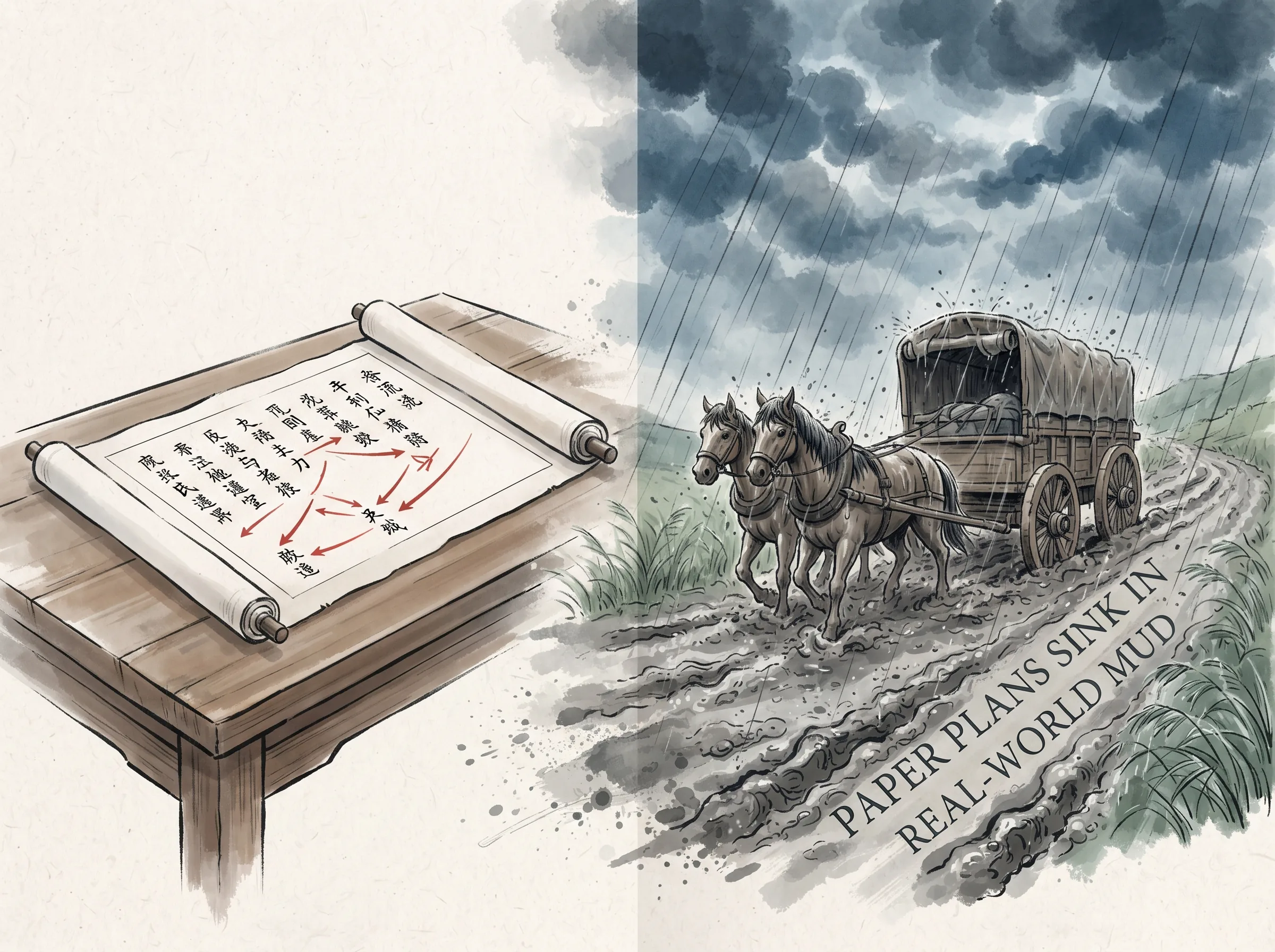
This is the pattern behind so many strategic failures that look like bad luck in hindsight. The plan was not wrong. The constraints were simply invisible to the person making it.
Continue with the deeper interpretation and practical application.
ChiDestiny members get access to the full analysis, modern applications, and the growing Chinese Wisdom Library.
FAQ
Is Sun Tzu's framework about warfare only, or can it apply to everyday decisions?
Sun Tzu wrote for military contexts, but the underlying insight — that feasible action depends on constraints, not just direction — is domain-general. Career moves, personal relationships, and business decisions all operate within the same basic structure: some paths look correct but are structurally unreachable, and recognising this is the first step toward effective action.
What is the difference between knowing the right direction and being able to act on it?
Knowing the right direction is a logical judgment — it means the strategy makes sense. Being able to act is a kinetic question — it means you have the activation conditions required: resources, capability, timing, and structural support. The gap between the two is where most plans fail.
How do I know whether I am misreading my own constraints?
The most reliable signal is a pattern: decisions that look correct in theory but consistently stall in practice, despite strong motivation. When this pattern appears, the likely explanation is not weak will but misread constraints. Make the invisible visible by listing every limiting factor explicitly and testing whether each one is rigid or negotiable.
Can constraints ever be changed, or are they fixed?
Some constraints are rigid — geography, past commitments, structural market conditions. Others are flexible — skills that can be developed, networks that can be built, narratives that can be reshaped. The practical question is not whether constraints exist but which ones can be altered and what it would take to alter them.
Summary
Most strategic failures are not failures of direction. They are failures of constraint recognition. Sun Tzu's environmental chapters offer a systematic way to see past the allure of a correct plan and ask the harder question: Given where I actually stand, what am I permitted to do? The answer to that question determines everything. Without it, even the clearest direction leads nowhere. With it, the path becomes visible — and the work begins in the right place.
The next step is simple but often skipped. Before committing to any significant decision, run the three-tier check. Ask whether the direction holds, whether the activation conditions exist, and whether you are optimising a fixed domain or working to expand it. The gap between knowing and doing closes not through more planning but through clearer constraint recognition.
To explore these themes from another angle, read our related reflection on Shaping the Battlefield: How Ancient Chinese Strategy Teaches You to Design Your Competitor’s Choices.
Deepen your understanding of these principles in our reflection on Why Your Best Strategy Is Failing (and Sun Tzu Knew Why).
Sources & Further Reading
[1] Sun Tzu (literally “Master Sun”; Chinese: 孙子) — Wikisource — Original text of Jiubian (Chapter 8), Dixing (Chapter 10), and Jiudi (Chapter 11), including the six terrain classifications and nine situations.
[2] Extended Continuation of the Comprehensive Mirror for Aid in Government, Vol. 20 (Chinese: 《续资治通鉴长编》卷二十) — Wikisource — Records of the 979 CE campaign, troop exhaustion, stretched supply lines, and the Battle of Gaoliang River.
Further Reading
- Daniel Kahneman, Thinking, Fast and Slow — discussion of the "focusing illusion" and its implications for decision-making.
- Classical commentaries on Sun Tzu's environmental chapters, including interpretations of Jiubian, Dixing, and Jiudi in both traditional and modern strategic studies.






