

Every civilization tells hero stories. England gave us the detective, France the three musketeers, America the superhero, Japan the ronin. But only China produced the xia — the knight-errant, a common person who carries justice on his own shoulders when the system cannot. This figure is not a government official with a warrant, nor a nobleman acting on royal decree. He is someone who decides, on his own, that when institutions fall short, moral action still demands a response.
The xia tradition is unusual precisely because it locates justice not in courts, temples, or thrones, but in the individual heart. In most cultures, justice flows downward — from institution to citizen. In the Chinese xia tradition, justice can flow inward — from a person's own understanding of right and wrong, outward into the world. For readers navigating today's landscape of institutional distrust, bureaucratic indifference, and moral ambiguity, this offers a striking framework: moral responsibility does not require authority. It requires choice—a foundational perspective explored in Chinese Xia Philosophy of Justice.
Chinese Xia Philosophy of Justice: Why China Has the Xia, But Not the Detective
It is worth pausing on a simple observation: the detective story and the wuxia story emerge from different civilizational answers to the same problem. What do we do when justice fails?
In Western detective fiction, the central promise is that truth, properly pursued, restores order. The detective investigates, uncovers facts, and the system — ideally — corrects itself. The narrative arc moves from disruption back to equilibrium. As cultural theorist Fredric Jameson observed, all narratives are symbolic acts of the nation — stories a culture tells itself to make sense of its deepest anxieties. The detective story reflects a civilization that, despite its frustrations, ultimately trusts that institutions can heal themselves if given the right information.
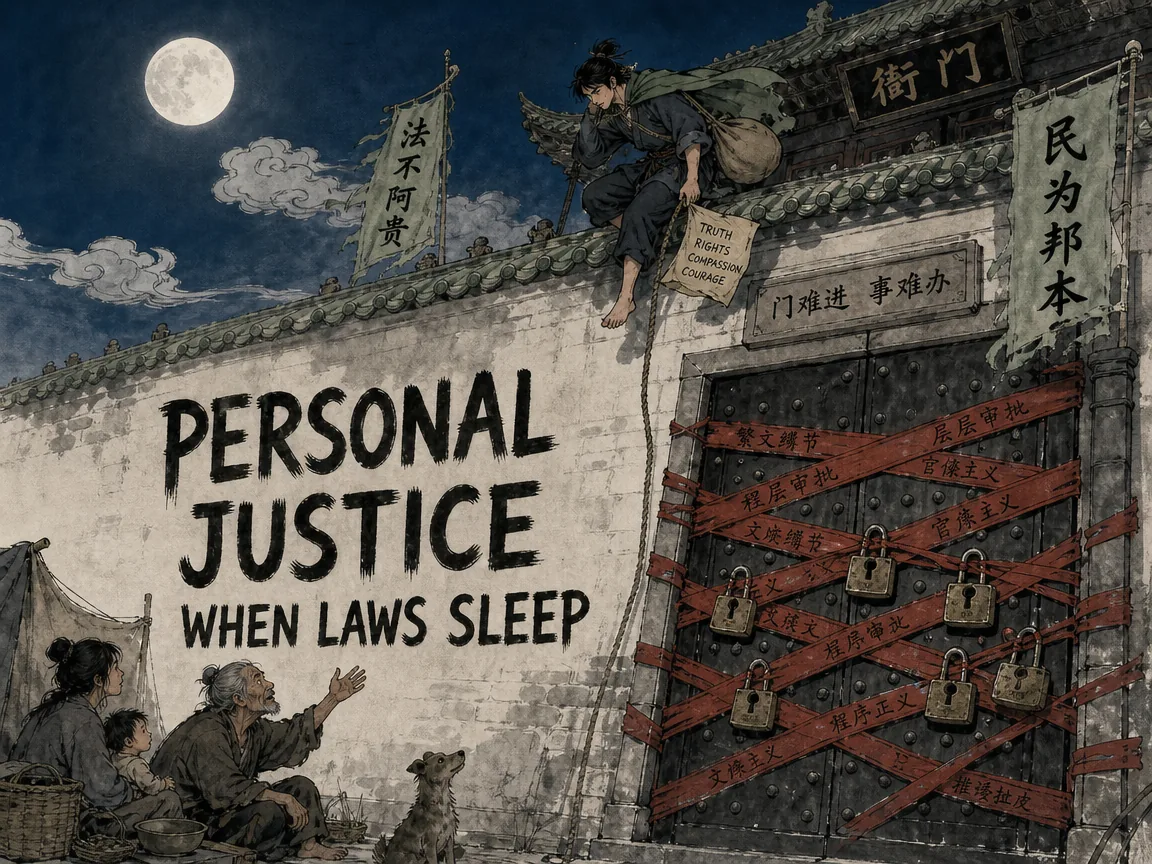
The Chinese tradition tells a different story. Consider the evolution across three great narrative forms. In gongan (公案) fiction — the "legal case" genre — justice operates within the system. A magistrate like Bao Zheng investigates and punishes the guilty. The state still functions. Then comes Water Margin (水浒传), where systemic corruption makes the state itself the problem. Rebels rise, not because they love chaos, but because the courts have become irredeemable. Finally, in wuxia fiction, justice retreats further — away from even the rebellious collective, into the lone individual who acts on personal conviction.
This trajectory reveals something important: the deeper a civilization's anxiety about institutional failure, the further moral agency migrates from the center of power toward the individual. The xia is not a vigilante in the Western sense. He does not seek to tear down the system. He acts because, in a particular moment, the system simply cannot be counted on — and someone must respond.
A Brief History: From Wu Zixu to the Wuxia Tradition
The figure of the xia did not appear fully formed. Its literary and cultural lineage stretches back thousands of years.
One of the earliest figures associated with this tradition is Wu Zixu (伍子胥), whose story is recorded in Sima Qian's Records of the Grand Historian (《史记》). When Wu Zixu's father and elder brother were killed by the state of Chu, he fled to the state of Wu and eventually helped orchestrate a military campaign that captured the Chu capital. When he could not find the ruling king, he exhumed the corpse of King Ping and struck it three hundred times with a whip [Sima Qian, Records of the Grand Historian, "Biography of Wu Zixu"]. The ancient text presents this as a devastating act of personal vengeance — Sima Qian himself remarked on how far-reaching resentment can drive even a man to violate the deepest taboos.
Modern interpretations sometimes read Wu Zixu as an early prototype of the xia, a kind of extralegal enforcer responding to institutional failure. But this is an interpretive frame imposed by later readers; the Shiji itself does not classify him as a knight-errant. What the text does clearly show is a person whose moral outrage could not wait for a court that had already proven itself corrupt. That tension — between personal righteousness and institutional justice — is precisely where the xia tradition begins.
By the Han dynasty, the concept of youxia (游侠, roaming knights) was already a recognized social phenomenon. Huan Kuan's Yan Tie Lun (《盐铁论》) documents how martial individuals operated alongside and sometimes outside official channels of justice, reflecting a society in which the gap between law and moral expectation was becoming increasingly visible [Huan Kuan, Yan Tie Lun].
Later, Sima Qian gave the tradition its most influential literary expression in the "Biography of Rangers" (《游侠列传》). He wrote that although the conduct of these individuals may not always align with formal definitions of justice, they were remarkable for keeping their word, fulfilling promises, risking their lives to help those in distress, and never boasting about what they had done [Sima Qian, Records of the Grand Historian, "Biography of Rangers"]. This is a remarkably humane assessment — one that acknowledges complexity rather than simplifying the xia into a neat moral category.
The tradition continued to evolve through Chinese literature, reaching its modern popular form through the wuxia fiction of Jin Yong, whose characters — Guo Jing defending the city of Xiangyang, Xiao Feng grappling with loyalty and identity at Yanmen Pass — embody the enduring appeal of personal moral responsibility in the face of impossible choices.
What Does It Mean to "Stop Violence"?
A key to understanding the xia tradition lies in how Chinese culture itself conceptualizes the relationship between force and justice — and the answer is surprisingly counterintuitive.
The Chinese character for martial arts, wǔ (武), is traditionally analyzed as a compound of two elements: zhǐ (止, to stop) and gē (戈, dagger-axe/spear). At its root, the character does not mean "to wield force" — it means "to stop force." This etymological insight comes from the Zuo Zhuan (Commentary of Zuo, 左传), which records a conversation between Duke Zhuang of Chu and his ministers after a military victory. When some advisors suggested piling the enemy's corpses into a trophy mound to celebrate the triumph, the duke refused. He argued that true martial virtue does not lie in displaying violence but in ending conflict. The classical text explicitly lists seven virtues of true martial accomplishment — restraining aggression, preserving greatness, establishing merit, securing the people, harmonizing communities, and enriching the common good [Zuo Zhuan Commentary, "Duke Xuan, Year 12"]. Connect these enduring values to the broader cultural heritage explored in Why Do We Only Truly Find ‘Home’ After Leaving It? What Chinese Philosophy Can Teach Us About Rootedness in a Mobile World.
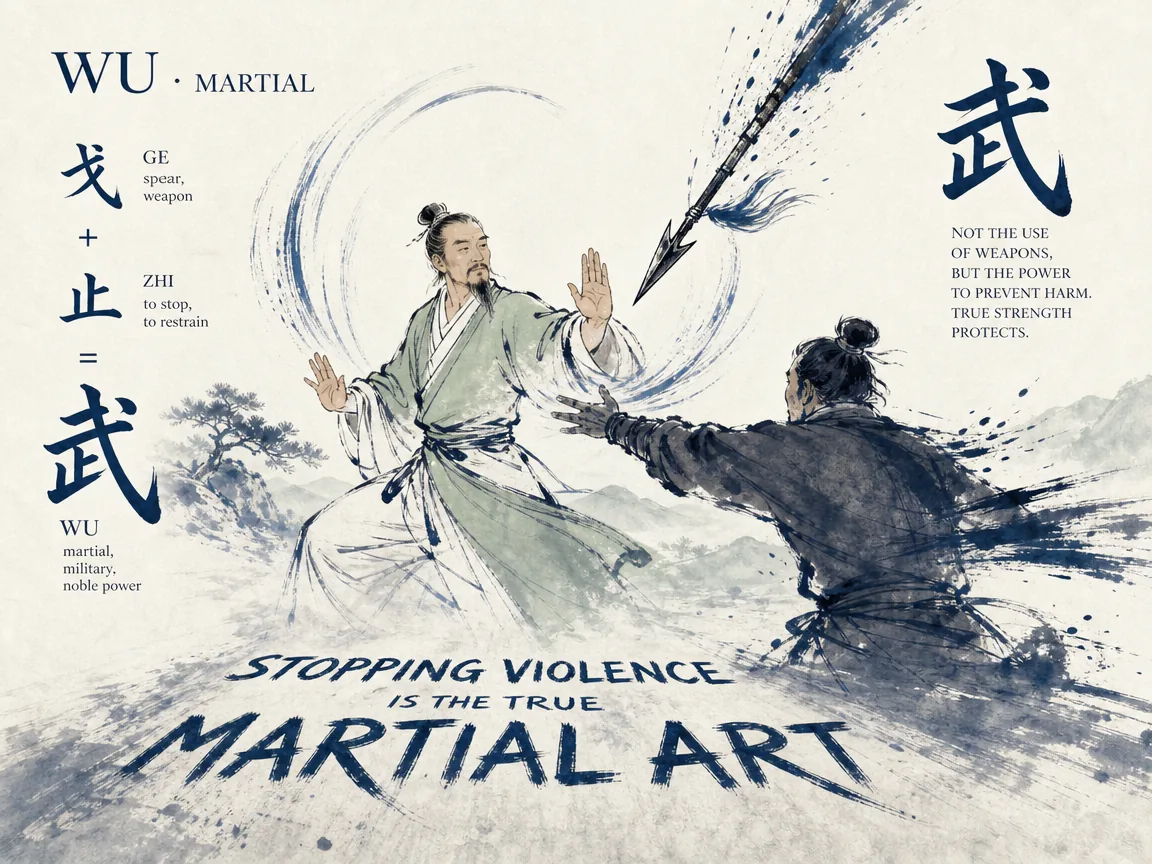
This redefinition of strength is central to the xia ideal. A true knight-errant does not seek violence. He acts to prevent it — or to end it. The violence he employs is instrumental, never celebratory. When Guo Jing in Jin Yong's fiction says that a hero's purpose is "to serve the country and protect the people," he is articulating exactly this principle: force is justified only when it protects the vulnerable and stops further harm [Jin Yong, Legend of the Condor Heroes].
In a modern context, this reframing is quietly radical. We live in a world where aggression is often normalized — in media, in politics, in everyday discourse. The xia tradition asks a different question: not "How strong are you?" but "What are you using your strength to stop?" This shifts the moral calculus from display to restraint, from dominance to protection. It suggests that the highest form of courage may not be the willingness to fight, but the discipline to fight only when fighting is the only way to stop further harm.
For readers today, this offers a practical lens: when you feel the urge to respond to injustice with force — whether physical, verbal, or structural — ask first what you are trying to stop. The answer to that question may determine whether your action is truly just, or merely another escalation.
Justice Without a Crown: The Moral Individual
In most civilizations throughout history, justice has been institutional. It flows from judges, kings, priests, constitutions — authoritative sources positioned above ordinary citizens. The legitimacy of a verdict depends not on its moral correctness in itself, but on the legitimacy of the institution that produced it.
The Chinese xia tradition disrupts this assumption. The xia does not need a royal warrant, a heavenly mandate, or a court appointment. He needs only an internal compass — what classical Chinese thought calls the moral Way (dào, 道). His authority is self-derived, grounded in his own commitment to right and wrong.
This connects to a deep thread in Confucian philosophy. The Great Learning (《大学》) places self-cultivation (xiushen, 修身) at the foundation of all moral and social order — before family harmony, before effective governance, before peace across the world. The individual is not the last link in the chain of justice; in a crucial sense, he is the first [Classical Chinese texts on self-cultivation]. Moral agency begins with the person, not the state. When institutions fail, the obligation does not disappear — it simply reverts to the individual.
Daoist thought reinforces this from a different angle. The Daoist tradition consistently questions whether human-made systems — laws, codes, hierarchies — can ever fully capture the natural order of justice. When artificial systems become corrupt or rigid, returning to a more fundamental sense of right and wrong is not rebellion; it is alignment with something deeper than any statute.
Together, these traditions suggest a provocative idea: the xia is not an outlaw in the modern sense. He is someone who recognizes that moral responsibility cannot be outsourced. When the system fails, the individual does not get to opt out. The question is no longer "Who is responsible?" but "Who will act?"
This is both empowering and demanding. It empowers the individual by insisting that moral agency is always available, regardless of status or position. It demands that the individual accept that agency comes with cost — and the xia stories are full of people who pay it.
What the Xia Offers Modern Readers
Reading about the xia tradition today can feel oddly immediate. We live in an age of institutional skepticism — where courts are distrusted, governments are questioned, and media is polarized. When systems feel broken or indifferent, the instinct can range from cynicism to despair. The xia tradition offers a third option: personal moral responsibility without institutional authority.
What the xia teaches is that moral agency does not require a title, a badge, or a platform. It requires a choice. And choices are always available, even in constrained circumstances.
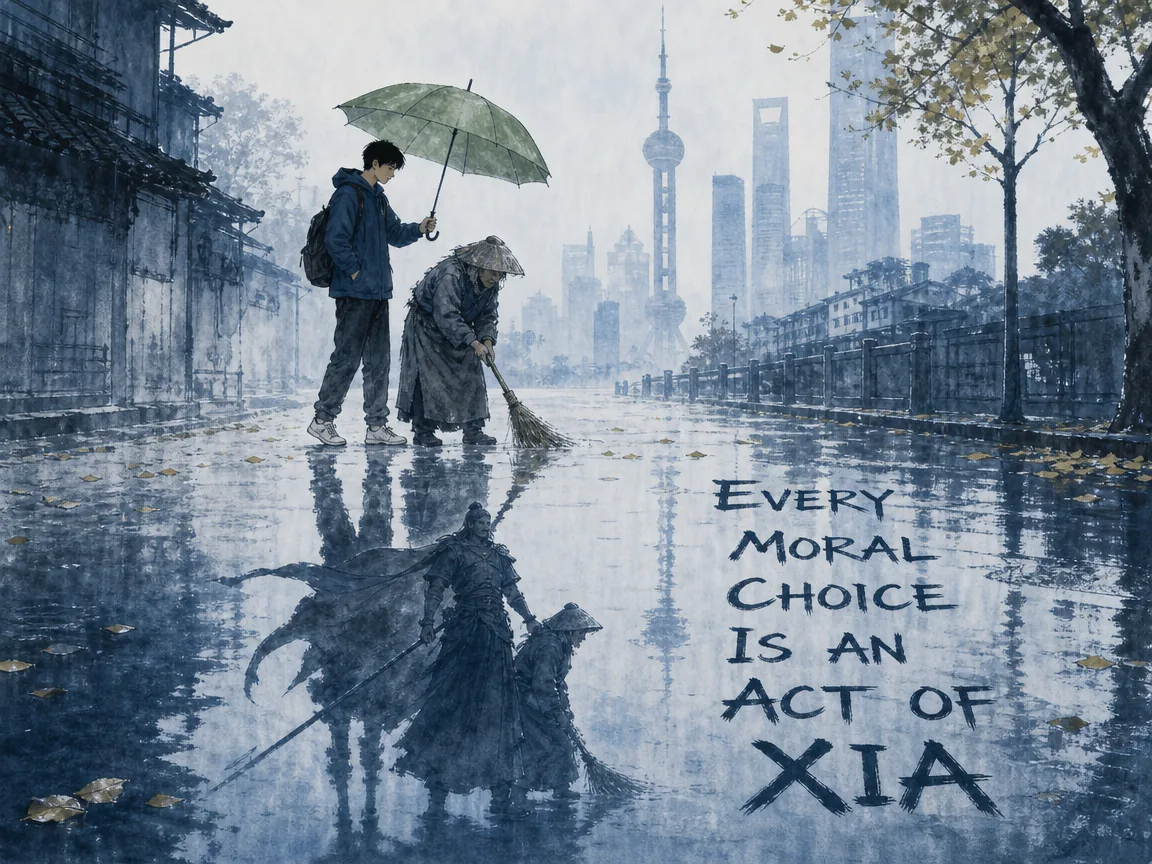
This does not mean the xia tradition romanticizes vigilantism. The great xia stories are notable precisely because their heroes bear heavy personal costs. Guo Jing dies defending a city that ultimately falls. Xiao Feng's moral clarity leads him to an impossible choice with tragic consequences. The tradition does not promise that righteous action is easy — it promises that it is sometimes necessary, regardless of difficulty.
On a practical level, the xia tradition offers several guiding principles for modern life:
Act from principle, not from power. Moral responsibility does not depend on your position in a hierarchy. If you witness something unjust, your capacity to respond is not determined by your authority — it is determined by your choice.
Understand that force is a last resort, not a first option. The etymology of martial virtue (wǔ, 武) — stopping violence, not wielding it — should shape how we think about any form of forceful intervention, whether in personal conflicts, professional disagreements, or public discourse.
Accept the cost of integrity. The xia figures in Chinese literature are memorable not because they won, but because they chose the right path even when it destroyed them. Acting justly often requires sacrifice. Recognizing this upfront — rather than discovering it unexpectedly — is a form of wisdom.
Balance personal righteousness with communal responsibility. The tradition also carries a warning: individual justice, unchecked by institutional oversight or collective deliberation, can become subjective and arbitrary. The tension between personal moral courage and the need for communal harmony is not a problem to be solved but a balance to be maintained.
For readers seeking to apply this framework, the starting point is small. Moral courage in daily life rarely looks like dramatic confrontation. More often, it looks like refusing to stay silent when something is wrong, helping someone who has been failed by a system, or simply maintaining your own integrity in situations where compromise would be easier.
FAQ
What exactly is the Chinese concept of xia, and how is it different from a vigilante? The xia (侠) is a figure from Chinese tradition who acts to uphold justice when institutions fail, motivated by personal moral conviction rather than legal authority. Unlike a vigilante — who typically operates outside the law for personal or ideological purposes — the xia is characterized by self-restraint, a willingness to bear personal cost for others, and an understanding that force is justified only as a means of stopping further harm. Classical sources describe the xia as someone who keeps promises, risks himself for those in distress, and does not seek recognition for his deeds.
Is the xia tradition connected to any specific religious or philosophical school? The xia tradition draws from multiple strands of Chinese thought rather than a single tradition. Confucian ideas about self-cultivation and moral responsibility inform the emphasis on personal integrity. Daoist skepticism toward rigid institutional systems supports the idea that justice can exist beyond formal law. Buddhist concepts of compassion and bearing suffering for others also appear in later xia narratives. The tradition is best understood as a cultural synthesis rather than a doctrine belonging to one school.
Can the xia ideal be applied in modern democratic societies with functioning legal systems? The xia tradition was born precisely in moments when institutions failed — and it is most directly relevant in those contexts. However, its core insight — that moral responsibility does not dissolve when systems are imperfect — applies more broadly. Even in societies with functioning legal institutions, individuals regularly face situations where formal mechanisms are too slow, too distant, or too limited to address a particular injustice. The xia tradition encourages people to consider their own role in upholding justice, rather than assuming that responsibility belongs exclusively to institutions.
Does the xia tradition encourage rebellion against government or law? Not necessarily. The xia acts when justice is unavailable, not simply when authority is disagreeable. Classical accounts emphasize that the xia helps the vulnerable and responds to specific injustices — not that he opposes all government or seeks to dismantle legal order. The tradition does carry an implicit critique of institutions that fail to deliver justice, but its primary impulse is restorative rather than revolutionary. The goal is not chaos but moral accountability.
Conclusion
The xia tradition offers something rare in a world of institutional doubt: a vision of moral agency that is both deeply personal and profoundly responsible. It does not ask us to surrender to cynicism when systems fail, nor does it encourage reckless rebellion against every authority. Instead, it asks a simpler, harder question: in this moment, when justice is unavailable from above, what will you do?
The answer does not require superhuman courage. It requires the willingness to see injustice clearly, to act according to your convictions, and to accept the consequences. In a time when many feel powerless before large, impersonal systems, the xia tradition reminds us that moral responsibility has always belonged, at least in part, to the individual.
If this perspective resonates with you, the next step is not to seek out grand gestures but to examine the moments in your own life where institutions have fallen short and you faced a choice: look away, or act. Those moments — however small they may seem — are where the tradition lives, reflecting the enduring wisdom of Chinese Xia Philosophy of Justice.
To explore these themes from another angle, read our related reflection on Why Trying Harder to Control Everything Backfires — And What Ancient Wisdom Says Instead.
Deepen your understanding of these principles in our reflection on What a Soulmate of True Understanding (*Zhījǐ*, 知己) Reveals About What We Need From Each Other.
Sources & Further Reading
[1] Wikisource — Sima Qian, Records of the Grand Historian (《史记》), "Biography of Wu Zixu" (《伍子胥列传》)
[2] Wikisource — Sima Qian, Records of the Grand Historian (《史记》), "Biography of Rangers" (《游侠列传》)
[3] Wikisource — Zuo Zhuan Commentary (《左传》), Duke Xuan, Year 12 — discussion of "stopping the weapon" as the meaning of martial virtue
[4] Huan Kuan (桓宽), Yan Tie Lun (《盐铁论》) — Han dynasty records of social tensions and the figure of the roaming knight
[5] Jin Yong, Legend of the Condor Heroes (《射雕英雄传》) and other wuxia novels — modern literary embodiment of the xia tradition
[6] Jameson, Fredric, Nation and Narration (1990) — on narratives as symbolic acts of cultural formation
[7] "Why Could Wuxia Only Be Born in China?" (武侠为什么只能诞生在中国?) — Bilibili: — cultural analysis of the xia tradition
Further Reading
- Confucian classics on self-cultivation, including passages from the Great Learning (《大学》)
- Daoist texts exploring natural justice beyond artificial systems, particularly selections from the Zhuangzi (《庄子》)
- Comparative studies of hero traditions across civilizations
- Modern discussions of moral agency in contexts of institutional distrust






