
兵勢第五
Core Insight: "In battle, there are not more than two methods of attack—the direct and the indirect; yet these two in combination give rise to an endless series of maneuvers." — Sun Tzu, 兵勢第五
「凡戰者,以正合,以奇勝。戰勢不過奇正,奇正之變,不可勝窮也。」
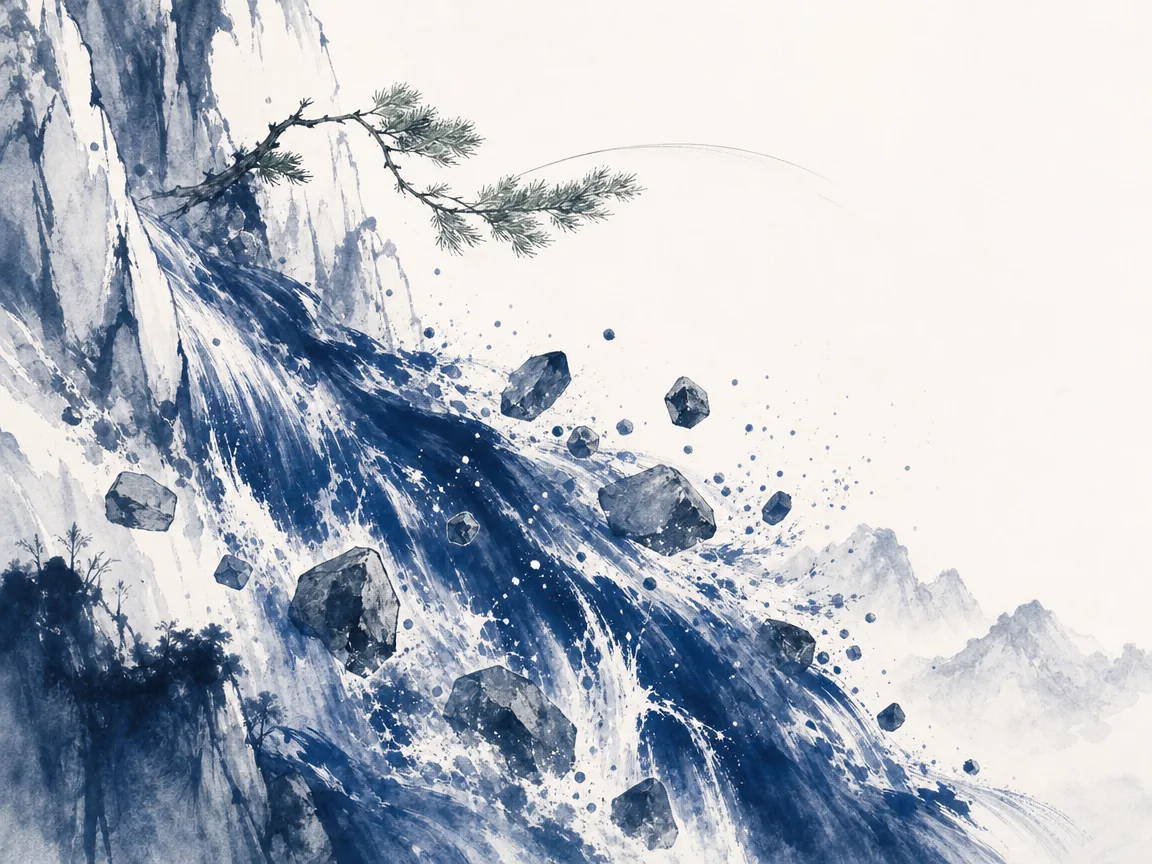
Organization turns numbers into decisive power. Like rolling round boulders down a thousand-foot mountain, strategic momentum (Shi) harnesses kinetic potential through the endless cyclic interaction of orthodox (Zheng) and unorthodox (Qi) tactics—a foundational perspective explored in Art of War Chapter 5. Discover how ancient strategy applies to modern competition in Why the Strongest Often Lose First: Sun Tzu’s Hidden Lesson on Resource Curves.
Art of War Chapter 5: Harnessing Systemic Force
Art of War Chapter 5 (兵勢第五) explores how systemic structure and organizational rhythm generate overwhelming momentum. Rather than relying on individual heroics, the strategist orchestrates forces like water released from a cataract or round boulders rolling down steep ridges, catching the adversary off guard through endless direct and indirect cycles.
Complete Chapter Translation: Modern Western Reading
Sun Tzŭ said: The control of a large force is the same principle as the control of a few men: it is merely a question of dividing up their numbers.
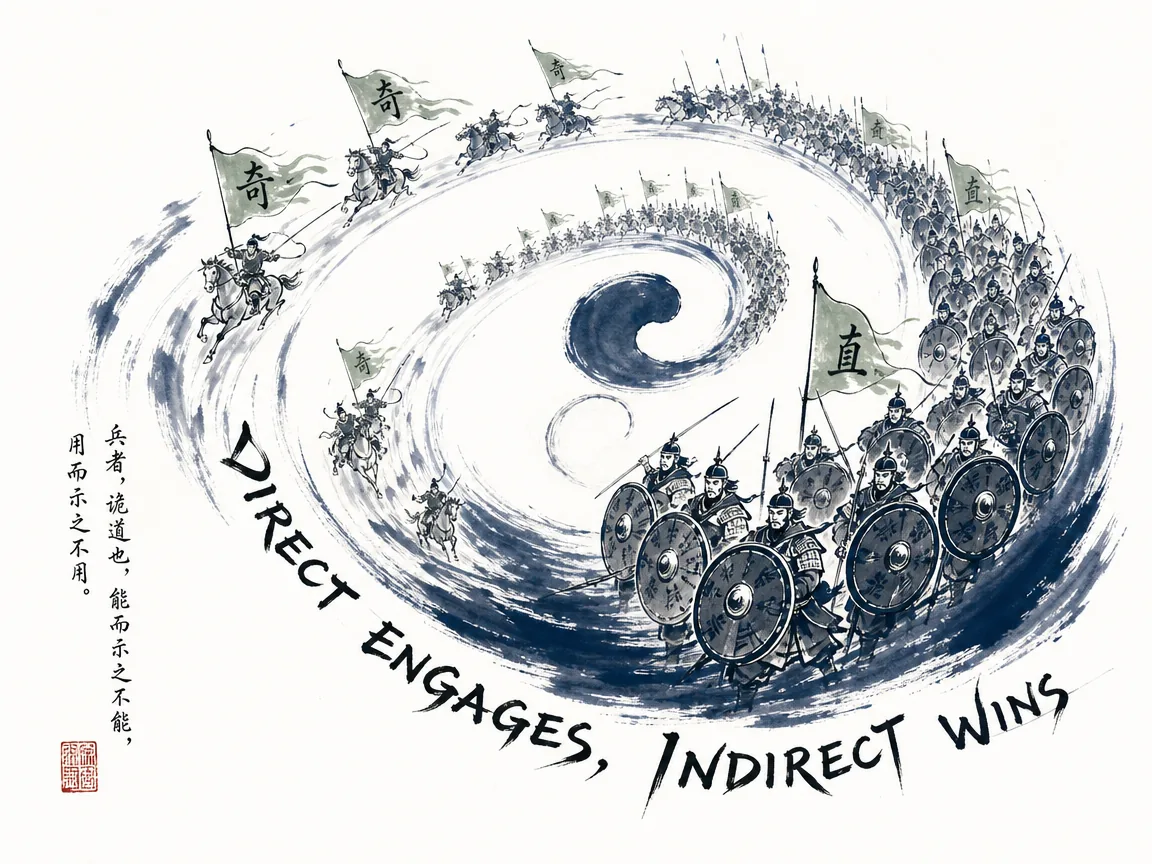
Fighting with a large army under your command is nowise different from fighting with a small one: it is merely a question of instituting signs and signals. To ensure that your whole host may withstand the brunt of the enemy’s attack and remain unshaken—this is effected by manœuvers direct and indirect. Here, we are told, the march on Lin-chin was cheng, and the surprise manœuver was ch’i." Chang Yu gives the following summary of opinions on the words: "Military writers do not agree with regard to the meaning of ch’i and cheng. Wei Liao Tzŭ says: ‘Direct warfare favours frontal attacks, indirect warfare attacks from the rear.’ Ts’ao Kung says: ‘Going straight out to join battle is a direct operation; appearing on the enemy’s rear is an indirect manœuver.’ Li Wei-kung says: ‘In war, to march straight ahead is cheng; turning movements, on the other hand, are ch’i.’ These writers simply regard cheng as cheng, and ch’i as ch’i; they do not note that the two are mutually interchangeable and run into each other like the two sides of a circle . A comment on the T’ang Emperor T’ai Tsung goes to the root of the matter: ‘A ch’i manœuver may be cheng, if we make the enemy look upon it as cheng; then our real attack will be ch’i, and vice versa. The whole secret lies in confusing the enemy, so that he cannot fathom our real intent.’" To put it perhaps a little more clearly: any attack or other operation is cheng, on which the enemy has had his attention fixed; whereas that is ch’i," which takes him by surprise or comes from an unexpected quarter. If the enemy perceives a movement which is meant to be ch’i," it immediately becomes cheng."
That the impact of your army may be like a grindstone dashed against an egg—this is effected by the science of weak points and strong. In all fighting, the direct method may be used for joining battle, but indirect methods will be needed in order to secure victory. Indirect tactics, efficiently applied, are inexhausible as Heaven and Earth, unending as the flow of rivers and streams; like the sun and moon, they end but to begin anew; like the four seasons, they pass away but to return once more.
There are not more than five musical notes, yet the combinations of these five give rise to more melodies than can ever be heard. There are not more than five primary colours (blue, yellow, red, white, and black), yet in combination they produce more hues than can ever be seen. 9 There are not more than five cardinal tastes (sour, acrid, salt, sweet, bitter), yet combinations of them yield more flavours than can ever be tasted.
In battle, there are not more than two methods of attack—the direct and the indirect; yet these two in combination give rise to an endless series of manœuvers. The direct and the indirect lead on to each other in turn. It is like moving in a circle—you never come to an end. Who can exhaust the possibilities of their combination? The onset of troops is like the rush of a torrent which will even roll stones along in its course.
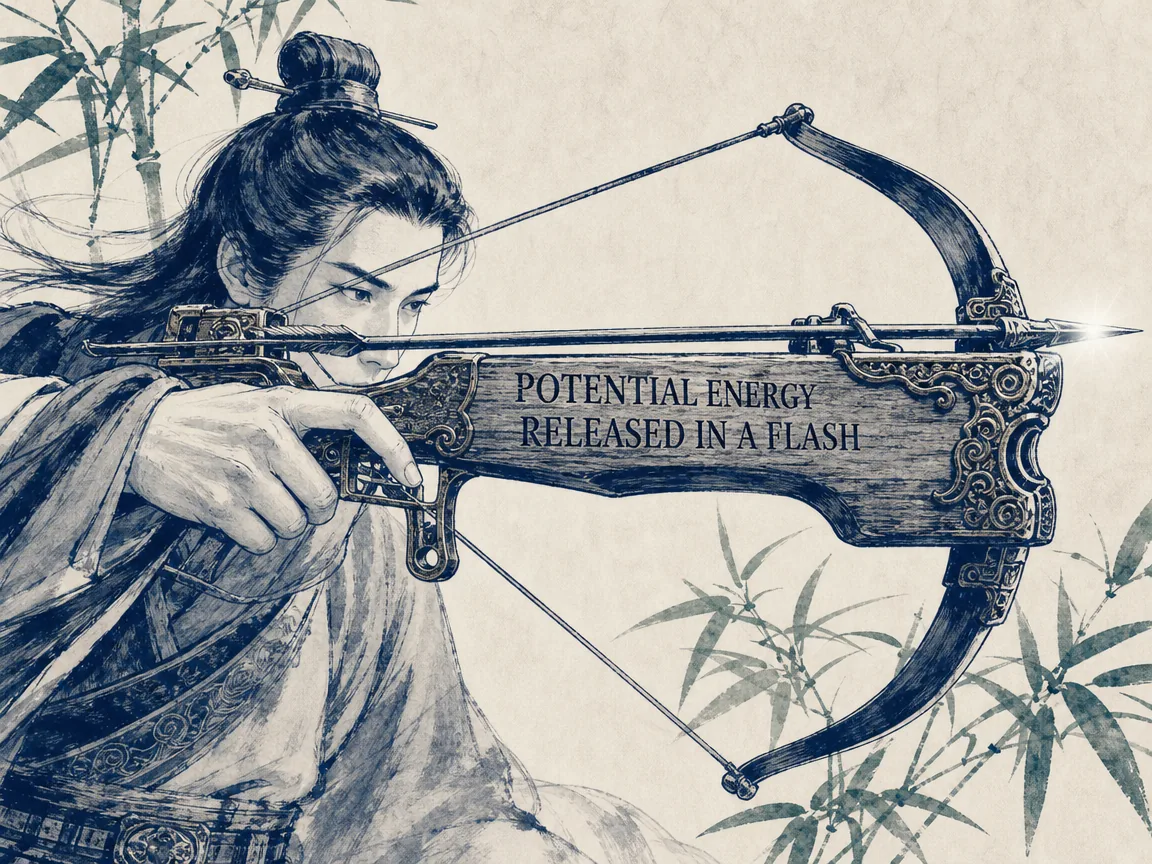
The quality of decision is like the well-timed swoop of a falcon which enables it to strike and destroy its victim. Therefore the good fighter will be terrible in his onset, and prompt in his decision. Energy may be likened to the bending of a crossbow; decision, to the releasing of the trigger. Amid the turmoil and tumult of battle, there may be seeming disorder and yet no real disorder at all; amid confusion and chaos, your array may be without head or tail, yet it will be proof against defeat.
Simulated disorder postulates perfect discipline; simulated fear postulates courage; simulated weakness postulates strength. Hiding order beneath the cloak of disorder is simply a question of subdivision; concealing courage under a show of timidity presupposes a fund of latent energy; masking strength with weakness is to be effected by tactical dispositions.
Thus one who is skilful at keeping the enemy on the move maintains deceitful appearances, according to which the enemy will act. He sacrifices something, that the enemy may snatch at it. By holding out baits, he keeps him on the march; then with a body of picked men he lies in wait for him. The clever combatant looks to the effect of combined energy, and does not require too much from individuals. Hence his ability to pick out the right men and utilise combined energy.
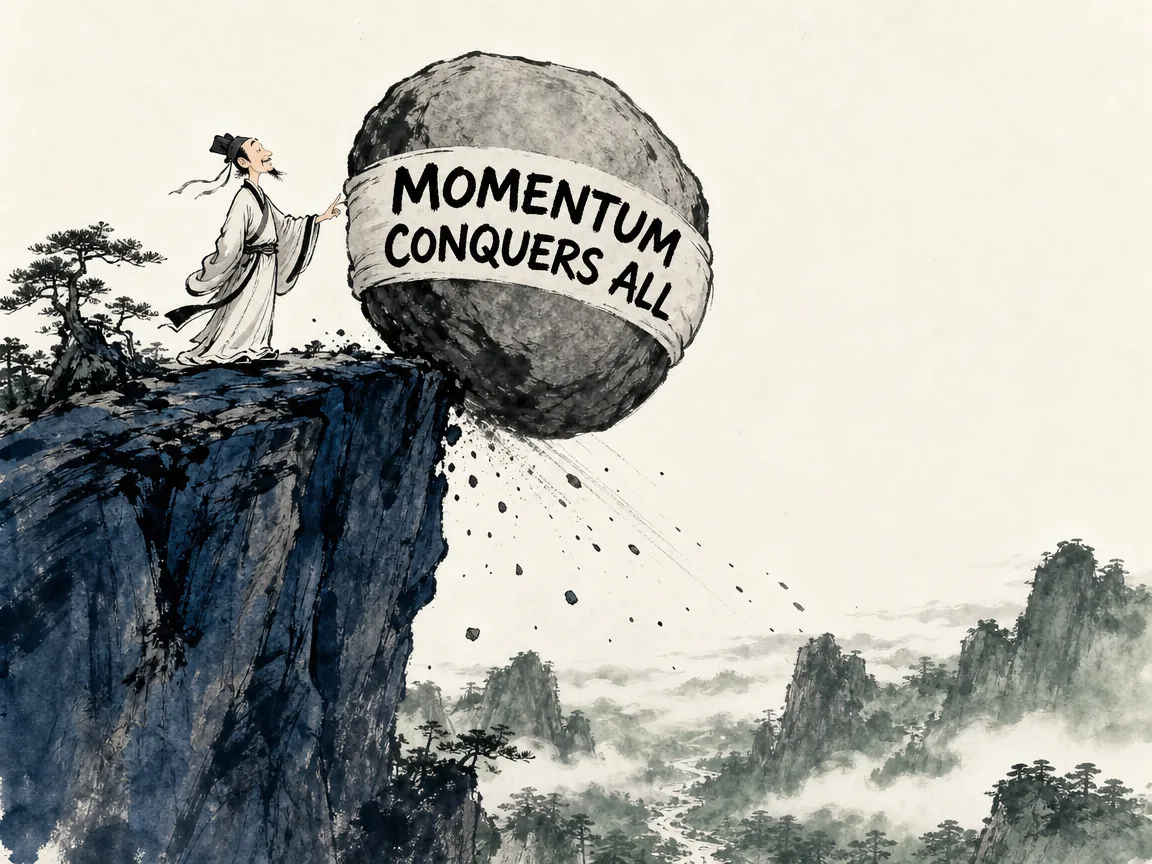
When he utilises combined energy, his fighting men become as it were like unto rolling logs or stones. For it is the nature of a log or stone to remain motionless on level ground, and to move when on a slope; if four-cornered, to come to a standstill, but if round-shaped, to go rolling down. Thus the energy developed by good fighting men is as the momentum of a round stone rolled down a mountain thousands of feet in height. So much on the subject of energy. "Forty-one Years in India," chapter 46.
孙子兵法中文原文与对照
【文言原文】
孫子曰:凡治衆如治寡,分數是也;鬥衆如鬥寡,形名是也;三軍之衆,可使必受敵而無敗者,奇正是也;兵之所加,如以碫投卵者,虛實是也。
凡戰者,以正合,以奇勝。故善出奇者,無窮如天地,不竭如江海。終而復始,日月是也。死而復生,四時是也。聲不過五,五聲之變,不可勝聽也;色不過五,五色之變,不可勝觀也;味不過五,五味之變,不可勝嘗也;戰勢不過奇正,奇正之變,不可勝窮也。奇正相生,如循環之無端,孰能窮之哉?
激水之疾,至於漂石者,勢也;鷙鳥之疾,至於毀折者,節也。故善戰者,其勢險,其節短。勢如彍弩,節如發機。
紛紛紜紜,鬥亂而不可亂也;渾渾沌沌,形圓而不可敗也。亂生於治,怯生於勇,弱生於強。治亂,數也;勇怯,勢也;強弱,形也。
故善動敵者,形之,敵必從之;予之,敵必取之。以利動之,以卒待之。
故善戰者,求之於勢,不責於人,故能擇人而任勢。任勢者,其戰人也,如轉木石。木石之性,安則靜,危則動,方則止,圓則行。故善戰人之勢,如轉圓石於千仞之山者,勢也。
Follow the progression of the military treatise in the next tactical doctrine in Weak Points and Strong: Directing the Rival and Flowing Like Water Through the Void.
For a deeper comparative examination of these ideas, explore our related study on Manoeuvring: Turning the Devious into the Direct and Orchestrating the Host.







[…] Follow the progression of the military treatise in the next tactical doctrine in Energy and Momentum: The Dynamic Interplay of Direct and Indirect Maneuver. […]
[…] Sun Tzu introduces a concept that goes beyond simple conservation of resources: forage on the enemy [1]/Waging_War). In his framing, a wise general makes a point of drawing supplies from the opponent. One cartload of the enemy's provisions is equivalent to twenty of one's own [1]/Waging_War). For the original military treatise and commentary, read the complete strategic translation and classical commentary of Energy and Momentum: The Dynamic Interplay of Direct and Indirect Maneuver. […]